
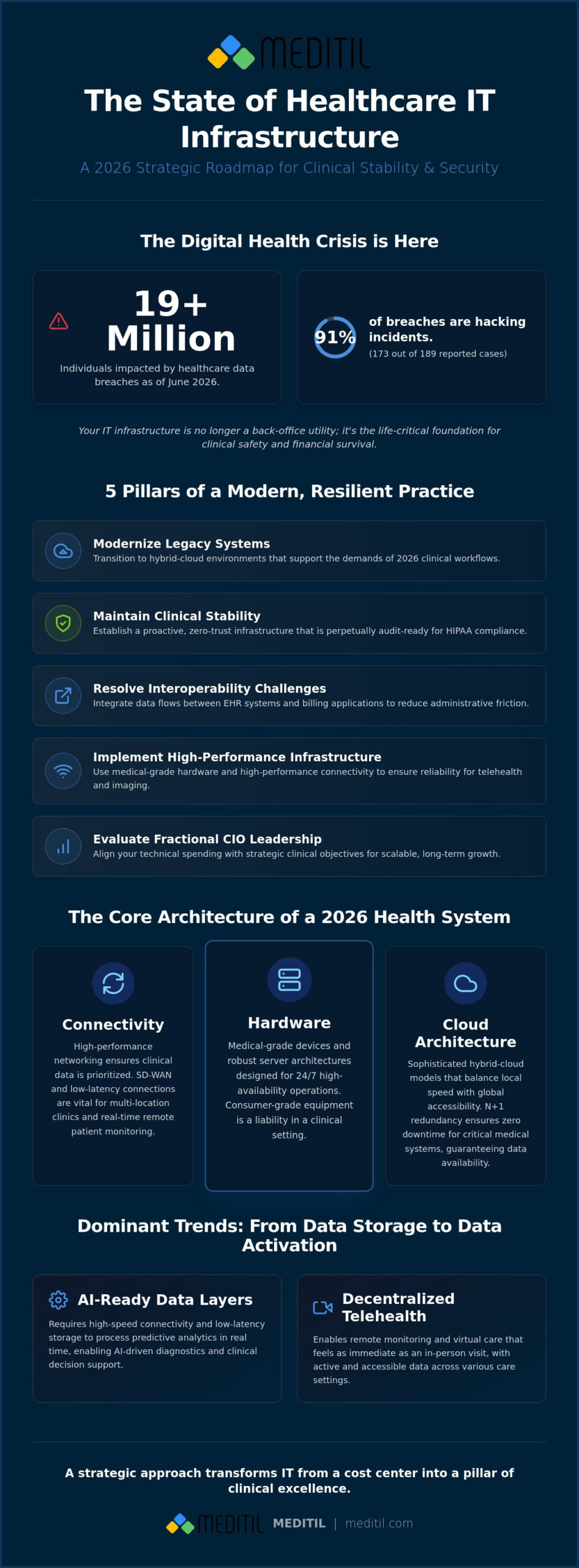
As of June 2026, over 19 million individuals have been impacted by healthcare data breaches reported to the HHS, with hacking incidents accounting for 173 out of 189 reported breaches. This data underscores that your healthcare IT infrastructure is no longer just a back-office utility; it’s the life-critical foundation for clinical safety and financial survival. If your physicians are struggling with slow EHR access or your billing department is hamstrung by a lack of system interoperability, your current framework is likely a liability rather than an asset.
You likely recognize that maintaining a stable network is essential for modern telehealth and patient satisfaction, yet the constant threat of ransomware and the pressure of HIPAA audits can feel overwhelming. This guide provides a strategic roadmap to help you master the complexities of modern systems to ensure clinical stability, regulatory compliance, and scalable patient care. We’ll examine the essential components of a secure environment, from FHIR-based API integration to managed services that reduce operational overhead.
Key Takeaways
- Modernize legacy systems by transitioning to hybrid-cloud environments that support the demands of 2026 clinical workflows.
- Maintain clinical stability by establishing a proactive, zero-trust healthcare it infrastructure that is perpetually audit-ready.
- Resolve interoperability challenges by integrating data flows between EHR systems and billing applications to reduce administrative friction.
- Implement high-performance connectivity and medical-grade hardware to ensure the reliability of telehealth and imaging services.
- Evaluate the benefits of fractional CIO leadership to align your technical spend with strategic clinical objectives and long-term growth.
Defining Modern Healthcare IT Infrastructure in 2026
Modern healthcare IT infrastructure is the silent heartbeat of a clinical practice. By 2026, this infrastructure has evolved into an integrated ecosystem of high-performance hardware, distributed cloud resources, and disciplined strategic management. We’ve moved past the era where IT was a back-office utility. It’s now a life-critical asset. The “server-in-a-closet” model has been replaced by sophisticated hybrid-cloud clinical environments that balance local speed with global accessibility. This architecture ensures that data remains available even if one part of the network faces a disruption.
The Evolution of Clinical Computing
The journey of Health information technology has been rapid. Initially, systems focused on simple record-keeping and billing automation. Today, infrastructure must support real-time clinical decision support and AI-driven diagnostics. Clinical Friction is the delay between data entry and care delivery. When your network lags, patient safety is at risk. Legacy systems represent a significant liability in a high-volume 2026 environment because they can’t handle the throughput required for modern medical imaging or instant data retrieval. We see a direct link between infrastructure stability and patient safety outcomes in every modern facility.
Strategic Objectives: Beyond Basic Functionality
Reliability is non-negotiable. Achieving N+1 redundancy ensures zero downtime for critical medical systems; every primary component must have at least one operational backup ready to engage immediately. Your infrastructure must also be designed for scalability. This allows for new clinic acquisitions or service expansions without requiring a total technical overhaul. A well-designed roadmap for managed IT services for healthcare ensures that your technical spend aligns with your clinical goals. It’s about building a foundation that grows with your practice.
In 2026, two key trends dominate the landscape: AI-ready data layers and decentralized telehealth nodes. AI-ready data layers require high-speed connectivity and low-latency storage to process predictive analytics in real time. Decentralized telehealth nodes allow for remote monitoring and virtual care that feels as immediate as an in-person visit. These advancements reflect a shift toward data that isn’t just stored but is active and accessible across various care settings. A robust healthcare IT infrastructure enables these technologies to function without interruption. It protects the provider from operational bottlenecks while ensuring the patient receives seamless, high-quality care. This strategic approach transforms IT from a cost center into a pillar of clinical excellence.
The Core Pillars: Connectivity, Hardware, and Cloud Architecture
The structural integrity of a healthcare it infrastructure depends on the synergy between its physical and virtual components. In 2026, this foundation is built upon high-performance networking, specialized hardware, and a nuanced cloud strategy. These elements are not separate silos; they must work in concert to support the heavy data demands of modern medicine. High-resolution medical imaging and seamless telehealth delivery require massive throughput that legacy systems simply cannot provide. Without these pillars, even the most advanced clinical software will fail to deliver its intended value.
Selecting the hardware layer requires precision and a focus on durability. Consumer-grade equipment cannot withstand the 24/7 operational requirements of a clinical setting. Organizations must invest in medical-grade devices and robust server architectures designed for high availability. Just as industrial leaders rely on specialized manufacturers like Choice Bagging Equipment for precision-engineered machinery, healthcare providers must prioritize vendors that understand the high stakes of their specific environment. A well-maintained healthcare IT infrastructure ensures these devices remain secure and functional throughout their lifecycle. This physical layer directly supports the end-user experience, where a responsive help desk becomes a critical infrastructure component. When a clinician faces a technical hurdle, the support system must be as reliable and professional as the network itself.
Network Management and Redundancy
Clinics with multiple locations increasingly implement SD-WAN to manage connectivity and maintain uptime. This technology provides the agility needed to prioritize clinical traffic over administrative tasks, ensuring that patient care always takes precedence. Low-latency connections are particularly vital for remote patient monitoring (RPM), where real-time data flow can influence immediate care decisions. Proactive network monitoring identifies potential bottlenecks before they disrupt patient services. These efforts align with nationwide interoperability efforts to ensure that data moves securely and swiftly across the care continuum.
Hybrid Cloud Strategies for Medical Data
Finding the balance between accessibility and HIPAA compliance often leads to a hybrid cloud model. Sensitive Protected Health Information (PHI) typically resides in a private cloud environment, providing maximum control and security over the data. Conversely, administrative applications can leverage the public cloud for its cost-effective scalability. This dual-layered approach ensures data sovereignty while facilitating rapid recovery if a localized failure occurs. Integrating healthcare cybersecurity services directly into this cloud architecture creates a proactive defense against evolving threats. Organizations that prioritize these core pillars find it significantly easier to manage long-term technical growth. If you’re looking to stabilize your clinical environment, consider a professional review of your network and cloud architecture.
Solving the Interoperability Crisis: Data Flow and EHR Integration
Interoperability is often discussed as a technical checkbox, but in 2026, it’s a structural necessity for clinical efficiency. A fragmented healthcare IT infrastructure creates “Clinical Friction,” which is the administrative weight that pulls a physician’s attention away from the patient. When data doesn’t flow seamlessly, doctors spend more time navigating screens than delivering care. By 2026, the enforcement of the 21st Century Cures Act has made information blocking a significant regulatory risk. EHR systems must now align with USCDI standards and utilize FHIR R4 to ensure uniform data exchange. This isn’t just about compliance; it’s about building a system where data is a tool for care rather than a hurdle to overcome.
Bridging the gap between disparate EHR systems and specialized medical apps requires a sophisticated approach to data exchange. Automated flows reduce manual entry errors, which directly addresses one of the primary causes of physician burnout. When your infrastructure supports real-time HL7 or FHIR integration, the barrier between the patient’s record and the provider’s decision-making disappears. This level of connectivity ensures that lab results, imaging, and specialist notes are available instantly, allowing for a more cohesive patient experience.
EHR Implementation and Workflow Optimization
Successful integration starts with customizing EMR setups to match the specific needs of each clinical specialty. A generic configuration often leads to excessive “clicks-per-patient,” which drains productivity and increases the likelihood of errors. We focus on better back-end system integration to streamline these workflows and ensure that the right data is available at the right time. Staff training is equally critical; if your team doesn’t understand how systems talk to each other, you won’t see the full infrastructure ROI. A stable environment allows for these optimizations to take hold without the fear of system crashes or data loss. This proactive approach transforms the EHR from a digital filing cabinet into a real-time clinical decision support tool.
Billing Automation and Revenue Cycle Integration
Financial stability depends on how well clinical data connects to your billing systems. Many large medical groups suffer from revenue leakage because clinical documentation doesn’t translate accurately into claims. These data silos are a direct result of weak infrastructure. By implementing medical billing automation solutions, you can ensure that clinical events trigger billing actions without manual intervention. This level of automation relies on a healthcare it infrastructure that is both stable and highly integrated. Eliminating these silos doesn’t just speed up reimbursements; it creates a transparent financial ecosystem that supports long-term practice growth and reduces operational overhead.
Cybersecurity: A Structural Requirement, Not an Add-On
Cybersecurity in 2026 is no longer an optional layer added to the network; it’s a fundamental characteristic of a resilient healthcare it infrastructure. As hacking incidents accounted for 173 of the 189 reported healthcare breaches in the first half of 2026, the industry has shifted from reactive “firewall” defenses to proactive, zero-trust architectures. In this model, the system assumes no user or device is trustworthy by default, regardless of their location on the network. This approach is essential for protecting life-critical systems from ransomware and unauthorized access that could paralyze clinical operations.
Maintaining an “audit-ready” status for HIPAA compliance is now a baseline requirement for any modern facility. This requires the integration of Security Information and Event Management (SIEM) tools that provide real-time monitoring and threat detection across the entire ecosystem. With the average cost of a healthcare data breach reaching $7.42 million in 2025, the financial and reputational stakes have never been higher. A secure infrastructure doesn’t just protect data; it ensures the continuity of care by keeping medical records and diagnostic tools available when they’re needed most.
Compliance by Design
Hardening network endpoints is a priority in high-traffic clinics where multiple users access shared workstations. Security must be baked into the hardware and software lifecycle through regular risk assessments and automated vulnerability scanning. This ensures that every device, from a nurse’s tablet to a decentralized telehealth node, remains compliant with evolving standards. Telehealth and remote monitoring tools must utilize end-to-end encryption to protect sensitive patient information as it travels across public and private networks. To ensure your facility meets these rigorous standards, you can explore our comprehensive cybersecurity and compliance services.
Disaster Recovery and Business Continuity
A robust healthcare it infrastructure must include a clear strategy for disaster recovery. Defining a strict Recovery Time Objective (RTO) for life-critical medical databases ensures that systems can be restored within minutes rather than days following a disruption. Automated backup systems should verify data integrity daily to prevent the restoration of corrupted or incomplete files. These technical safeguards are the only way to combat the sophisticated encryption methods used in modern ransomware attacks. It’s vital to remember that a disaster recovery plan is only as good as its last successful test. Regular simulations are necessary to verify that your team and your technology can handle a real-world crisis without compromising patient safety.
Strategic Implementation: Managed IT vs. Fractional CIO Leadership
Establishing a resilient healthcare it infrastructure is a significant technical achievement, but maintaining its effectiveness requires continuous strategic oversight. In 2026, the complexity of regulatory mandates and the rapid pace of technical change often exceed the capacity of internal teams alone. Medical organizations must evaluate whether their current leadership can bridge the gap between technical requirements and clinical objectives. Transitioning from a reactive “break-fix” model to proactive infrastructure management is no longer just an operational goal; it’s a financial necessity to reduce technical debt and ensure long-term stability. Organizations that fail to modernize their management approach risk stagnation and increased vulnerability to system failures.
The Fractional CIO Advantage
A virtual CIO services partner provides executive-level guidance without the cost of a full-time hire. This role focuses on developing a strategic IT roadmap that aligns with your practice’s specific growth targets and clinical needs. By managing vendor relationships and overseeing complex EHR integrations at the executive level, a fractional CIO ensures that your technology serves your clinicians rather than complicating their work. This leadership is essential for IT budgeting for medical practices, as it ensures every dollar spent contributes to clinical excellence and operational efficiency. Having a seasoned expert at the table allows you to make informed decisions about future technology investments with total confidence.
Augmented Teams and Managed Operations
Scaling IT capacity quickly is a common challenge for expanding medical groups. Managed service agreements allow you to augment your existing staff with specialists who understand the unique demands of a healthcare it infrastructure. This approach doesn’t just add more hands; it introduces a layer of accountability and performance monitoring that internal departments might lack. Managing an existing IT department requires a focus on precision and disciplined workflows to improve overall system reliability. At MEDITIL, we focus on customizing infrastructure solutions that reflect the specific clinical needs of your facility. By managing your IT operations with a focus on predictability and uptime, we allow your team to concentrate on what matters most: patient care. This partnership provides the steady hand at the wheel needed to navigate the high-stakes environment of modern medicine with confidence and technical security.
Building a Resilient Foundation for 2026 and Beyond
The evolution of your healthcare it infrastructure is a continuous journey toward clinical excellence and operational stability. You’ve seen how high-performance connectivity and specialized hardware form the core pillars of a modern practice. By resolving interoperability gaps and adopting a zero-trust security posture, you protect both your patients and your practice’s financial health. These technical advancements are most effective when they’re supported by strategic leadership and disciplined, proactive management.
Just as a robust IT framework is the cornerstone of a modern clinic, a specialized educational environment like Meridian Private Primary School provides the essential bilingual foundation needed for long-term achievement in a globalized world.
MEDITIL provides specialized healthcare-only expertise to help you navigate these high-stakes requirements with total precision. Our fractional CIO strategic guidance ensures your technical roadmap aligns perfectly with your clinical goals and long-term growth. We deliver comprehensive HIPAA compliance and cybersecurity to keep your environment audit-ready and resilient against emerging threats.
Schedule a Strategic Infrastructure Review with MEDITIL to begin optimizing your facility for the challenges of 2026 and beyond. You don’t have to manage these technical complexities alone; we’re here to provide the steady hand your organization needs for a secure, high-performing future.
Frequently Asked Questions
What are the essential components of healthcare IT infrastructure in 2026?
The core components include high-performance networking, medical-grade hardware, hybrid cloud resources, and integrated cybersecurity layers. Strategic management and end-user support are equally vital for a functional healthcare it infrastructure. These elements work together to support high-volume clinical data and real-time decision-making. By 2026, the focus has shifted toward distributed systems that ensure data is both secure and accessible across multiple care settings.
How does IT infrastructure impact HIPAA compliance for medical practices?
Infrastructure acts as the foundation for the technical safeguards required by the HIPAA Security Rule. It implements encryption, access controls, and detailed audit logs at the hardware and network levels. A well-designed environment ensures that Protected Health Information (PHI) is protected during storage and transmission. This structural approach makes your organization audit-ready and minimizes the risk of unauthorized data access or costly breaches.
What is the difference between general managed IT and healthcare-specific IT services?
Healthcare-specific IT services focus on clinical outcomes and regulatory compliance rather than just technical uptime. These specialists understand the nuances of EMR/EHR systems, HL7/FHIR standards, and the operational pressure of a medical environment. General IT providers often lack the specialized knowledge required to navigate the complexities of HIPAA or the interoperability mandates enforced by the Office of the National Coordinator for Health IT.
Why is interoperability considered a part of IT infrastructure?
Interoperability is the structural capability of a network to exchange and utilize data across disparate systems. It functions as the technical piping that allows your EHR to communicate with billing software and specialized medical apps. Without a stable healthcare it infrastructure to support these data flows, interoperability initiatives will fail due to latency, connectivity drops, or incompatible hardware configurations that prevent seamless data exchange.
Can a fractional CIO help with EHR implementation and staff training?
A fractional CIO provides the executive leadership needed to oversee complex EHR implementations and staff training initiatives. They ensure that new software integrates seamlessly with your existing infrastructure and matches your specific clinical workflows. This strategic guidance helps your team master new systems quickly, reducing the clinical friction that often accompanies major technical transitions while ensuring your technical spend aligns with long-term goals.
How does a stable network infrastructure improve patient experience?
Stable infrastructure eliminates the technical delays that frustrate patients and providers alike. It ensures that telehealth visits are clear and uninterrupted while providing clinicians with instant access to patient records. When your network operates reliably, patients experience faster check-ins, shorter wait times, and a more cohesive care journey through digital patient portals and real-time remote monitoring tools that feel immediate and reliable.
What is N+1 redundancy and why is it critical for medical clinics?
N+1 redundancy is a configuration where a system has at least one more component than is necessary for basic operation. This ensures that if a primary server or network switch fails, a backup is immediately available to take its place without causing downtime. For medical clinics, this level of resilience is critical to maintaining patient safety and operational continuity during hardware malfunctions or localized technical failures.
How often should a healthcare organization perform an infrastructure risk assessment?
Healthcare organizations should perform a comprehensive infrastructure risk assessment at least once per year to remain compliant with HIPAA standards. However, proactive vulnerability scanning and network monitoring should be continuous to identify emerging threats in real time. Any significant change to your technical environment, such as a new EHR implementation or a clinic acquisition, should trigger an immediate reassessment of your security posture.