
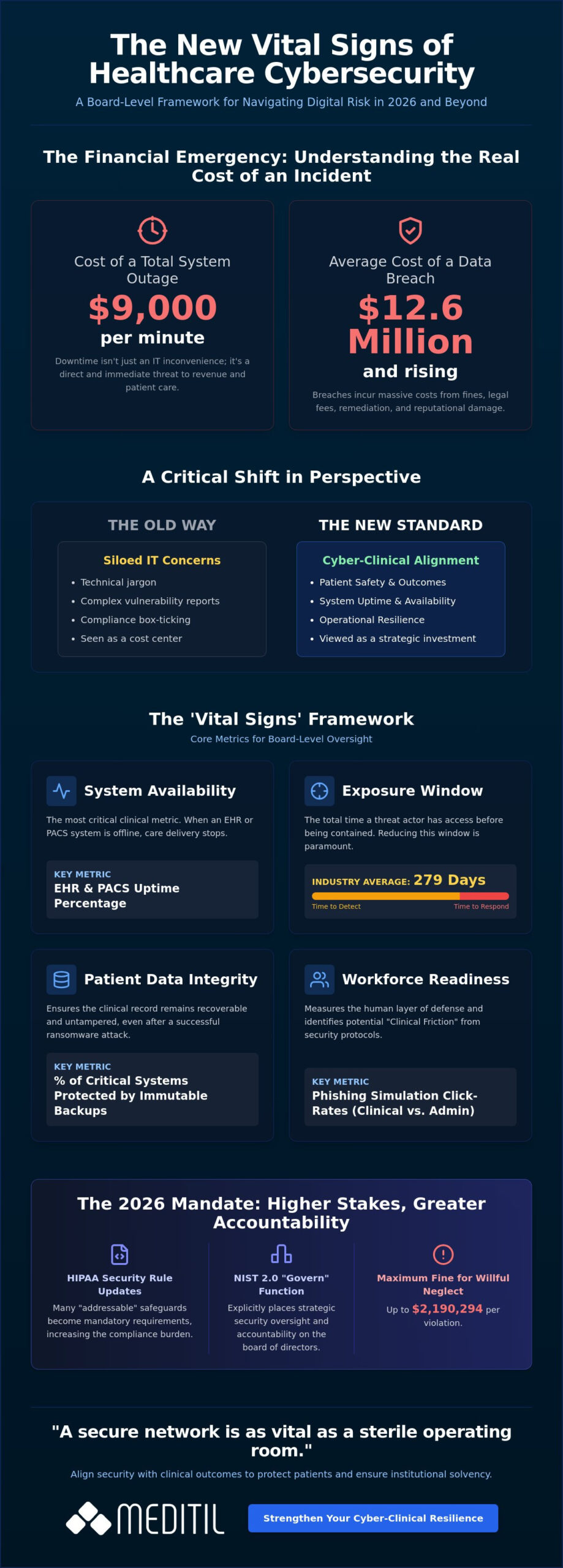
A total system outage now costs the average hospital approximately $9,000 every minute. While these financial stakes are clear to you, conveying that urgency through technical data often leads to board members losing focus during critical presentations. Establishing effective healthcare cybersecurity metrics for board reporting is no longer just an IT requirement; it’s a fundamental component of patient safety and institutional solvency. You likely feel the pressure of the 2026 HIPAA Security Rule updates and the rising average cost of healthcare data breaches, which now reaches up to $12.6 million.
We understand the difficulty of quantifying the return on investment for proactive security measures. This guide provides a strategic framework to translate complex cyber threats into the “Vital Signs” that your board actually cares about. You’ll discover how to align IT security with clinical outcomes, secure approval for essential investments, and move from mere compliance to true operational resilience. By focusing on metrics like Mean Time to Detect and patch compliance, you can provide the steady hand your organization needs to navigate an increasingly audited landscape.
Key Takeaways
- Reframe cybersecurity as a patient safety metric to ensure board members understand its direct impact on clinical operations and hospital solvency.
- Adopt a “Vital Signs” framework that prioritizes EHR uptime and system availability over abstract technical data points.
- Master the use of healthcare cybersecurity metrics for board reporting to quantify financial risk exposure and reduce technical debt.
- Streamline communication with executive-level dashboards that provide clear, color-coded visibility into your organization’s risk posture.
- Discover how strategic leadership, such as a Fractional CIO, can translate complex infrastructure requirements into actionable business outcomes.
The 2026 Healthcare Boardroom: Why Cybersecurity is a Patient Safety Metric
The 2026 boardroom requires a fundamental shift in how we discuss digital risks. We’ve moved past the era where cybersecurity was a siloed technical concern managed by the IT department. Today, the core reporting philosophy is Cyber-Clinical Alignment. This approach ensures that every security investment is evaluated through the lens of patient care and operational stability. Ransomware has evolved from simple data exfiltration to sophisticated attacks that cause life-critical system disruptions. When an Electronic Health Record (EHR) goes dark, it isn’t just a data problem; it’s a direct threat to patient safety.
Boards now face a heightened fiduciary duty regarding patient data and system availability. With the average cost of a healthcare data breach rising to between $7.42 million and $12.6 million in 2026, the financial implications are impossible to ignore. However, the connection between patient safety and data breaches is what truly defines the current regulatory environment. Transitioning your focus from technical defense to operational resilience is the only way to ensure the long-term solvency of the organization. Reframing these risks as clinical outcomes helps leadership understand that a secure network is as vital as a sterile operating room.
The Shift from Compliance to Resilience
Checking a box for HIPAA compliance is no longer sufficient for board-level assurance. The proposed 2026 updates to the HIPAA Security Rule transition many previously addressable safeguards into mandatory requirements. This change reflects a broader move toward Enterprise Risk Management (ERM). The NIST Cybersecurity Framework 2.0, with its specific “Govern” function, emphasizes that the board must oversee the strategic direction of security. Failure to adapt can result in significant liabilities, as the maximum cap for willful neglect HIPAA violations reached $2,190,294 per violation in early 2026. Effective healthcare cybersecurity metrics for board reporting must highlight these regulatory risks alongside technical progress to ensure the organization remains protected and solvent.
Cybersecurity as a Quality of Care Indicator
System uptime is now a primary indicator of care quality. Research indicates that cyberattacks are linked to increased mortality and morbidity rates due to delayed procedures and lost access to patient histories. We must also track Clinical Friction, which measures how security tools impact physician workflows. If a security measure is so cumbersome that it prevents a nurse from accessing vitals quickly, it creates a new type of risk. Clinical Resilience is the ability to maintain the continuity of care and protect patient outcomes during a digital outage. By presenting healthcare cybersecurity metrics for board reporting that focus on these clinical realities, you provide the board with a clear roadmap for strategic investment that prioritizes the patient experience.
The ‘Vital Signs’ Framework: Core Metrics for Healthcare Security
Just as a clinician relies on vital signs to assess a patient’s immediate health, a board of directors requires specific, high-level indicators to evaluate the organization’s security posture. Technical jargon often obscures the actual risk. To bridge this gap, healthcare cybersecurity metrics for board reporting should focus on operational impact. The most critical metric for clinical leadership is System Availability. When an EHR or PACS system is offline, care delivery stops. Considering that a full system outage costs a hospital approximately $9,000 per minute, downtime isn’t just an IT inconvenience; it’s a financial and clinical emergency.
Another essential “vital sign” is the Exposure Window, which encompasses Mean Time to Detect (MTTD) and Mean Time to Respond (MTTR). In 2025, the average healthcare breach took 279 days to identify and contain. Reducing this window is vital for minimizing the volume of exposed electronic Protected Health Information (ePHI). We also track Patient Data Integrity by measuring the percentage of critical systems protected by immutable backups. This ensures that even if a ransomware attack occurs, the clinical record remains recoverable and untampered.
Workforce Readiness serves as an additional leading indicator of risk. Phishing simulations should distinguish between clinical and administrative staff. High click rates among clinicians suggest that security protocols might be creating too much “Clinical Friction,” leading staff to bypass safety measures to save time. Monitoring these trends provides a clear picture of the human element in your defense strategy.
Measuring Clinical Availability
Quantifying the “Cost of a Minute” helps the board prioritize investments. While an ER outage carries immediate life-safety risks, downtime in outpatient clinics disrupts revenue cycles and patient trust. Boards should review the stability of “Critical Path” systems like Telemedicine and EHR platforms. For organizations seeking to strengthen these defenses, specialized Healthcare Cybersecurity Services provide the necessary infrastructure to maintain high uptime. Identifying these dependencies is the first step toward a resilient clinical environment.
Vulnerability Management Through a Risk Lens
Reporting thousands of unpatched vulnerabilities is counterproductive. Instead, boards need to see the “Time-to-Remediate” for critical clinical risks. This is especially true for the Internet of Medical Things (IoMT). Recent data shows that 99% of hospitals have devices with known, exploited vulnerabilities on their networks. This “Patch Gap” represents a significant entry point for attackers. By using the CISA cybersecurity toolkit, organizations can better align their remediation efforts with national standards. Utilizing business intelligence tools to visualize these risk trends allows the board to see if the organization is becoming more secure over time. If you’re looking for expert guidance, consulting with a strategic partner can help clarify how you present healthcare cybersecurity metrics for board reporting.
Quantifying the Financial Impact: ROI and Risk Exposure
While clinical availability is the primary mission, financial solvency remains the foundation of every healthcare institution. Board members require a clear understanding of how security investments translate into fiscal stability. One of the most direct applications of healthcare cybersecurity metrics for board reporting is the optimization of cyber insurance. In 2026, insurers no longer accept vague assurances of safety. They demand granular data on patch latency and incident response times to determine premium costs and coverage limits. Providing these metrics allows the board to negotiate from a position of strength, potentially reducing the total cost of risk transfer. This focus on fiscal stability is also essential during organizational transitions; for hospice and home health agencies, Healthcare Biz Advisors provides specialized representation to ensure that all operational and financial risks are professionally managed during a sale or acquisition.
We must also address the “Unfunded Liability” of legacy IT infrastructure. Technical debt in the form of outdated servers and unsupported medical devices represents a significant financial risk that often sits off the balance sheet. By calculating the cost of this debt, leadership can visualize the price of inaction. This financial exposure extends to the third-party supply chain. Business Associate Agreements (BAAs) are legally binding, yet many organizations fail to quantify the potential liability if a critical vendor suffers a breach. Aligning your reporting with NACD’s Director’s Handbook on Cyber-Risk Oversight ensures that these complex financial risks are presented in a format that supports strategic decision-making.
Proactive investment often proves more economical than reactive recovery. The predictable cost of Managed IT Services provides a stable budgetary line item that pales in comparison to the average $12.6 million cost of a single healthcare breach. Investing in a steady, managed presence allows the organization to avoid the volatile expenses associated with emergency digital forensics and system restoration.
Calculating the Potential Cost of Breach
A comprehensive financial report must factor in more than just immediate recovery costs. It should include the maximum HIPAA civil monetary penalties, which reached $2,190,294 per violation in early 2026 for some cases of willful neglect. Beyond these fines, the “Reputational Tax” following a publicized leak can lead to significant patient churn and a loss of physician trust. For life sciences organizations, maintaining this professional trust while managing external events requires secure partners with transparent pricing, such as zhmllc.com. Cyber Risk Appetite is the specific dollar amount of potential loss an organization is prepared to absorb before reaching a state of insolvency. Defining this threshold helps the board understand exactly when a risk becomes an existential threat.
The ROI of Security Automation
Security automation provides a dual benefit by protecting data while increasing operational efficiency. Implementing Medical Billing Automation Solutions reduces the human error risks associated with manual data entry in sensitive financial workflows. These systems ensure that interoperability doesn’t come at the expense of security. Furthermore, managed SIEM (Security Information and Event Management) reduces “alert fatigue” for IT teams, allowing them to focus on strategic advancement rather than chasing false positives. This efficiency gain translates directly into lower labor costs and a more resilient infrastructure.
Operationalizing the Report: Dashboards and Benchmarking
Effective communication is the bridge between technical execution and executive oversight. Once you’ve identified the “Vital Signs” and financial impacts, the focus must shift to how this data is presented. Operationalizing healthcare cybersecurity metrics for board reporting requires a disciplined approach to data visualization. The gold standard for 2026 is the “Executive Summary” rule. Your primary report should be a single page utilizing a simple Red/Amber/Green (RAG) status system. Jargon is the enemy of action; if a director needs a glossary to understand a slide, the reporting has failed its primary objective.
Reporting frequency is equally critical for maintaining momentum. While monthly “health checks” are appropriate for operational teams to track tactical progress, the board requires a quarterly deep dive. These sessions should focus on the “Forward-Looking” roadmap, connecting current performance metrics to next year’s strategic objectives. This cadence ensures that security remains a consistent priority without overwhelming the board with granular details. By aligning your presentation with a proven reporting framework, you can ensure your message remains clear and authoritative.
Visualizing the Data for Non-Technical Directors
Raw log data should never enter a board deck. Directors don’t need to see the number of blocked firewall pings; they need to see risk concentration. Heat maps are exceptionally effective for this purpose, as they allow you to show which clinical departments or facilities carry the highest risk profile. Trend lines are also indispensable. They provide visual proof that your security investments are “bending the curve” of risk over time. If a specific vulnerability has been open for six months, a trend line makes that exposure impossible to ignore, often facilitating the budget required for remediation.
Benchmarking Against Industry Standards
The board needs context to understand if the organization’s performance is adequate. Peer benchmarking allows you to show how your facility compares to similar-sized Integrated Delivery Networks (IDNs) or private clinics. Utilizing the NIST CSF 2.0 or the HHS Cybersecurity Performance Goals (CPGs) provides a standardized language for these comparisons. Instead of reporting “completion percentages” for various tasks, present “Maturity Scores.” A maturity score reflects the organization’s ability to sustain a process, which is a far more strategic indicator of resilience. This approach ensures a tight strategic alignment with your IT budgeting for medical practices, as it identifies exactly where additional funding will yield the highest maturity gains. To ensure your reporting meets these rigorous standards, consider engaging a strategic consultant to audit your current dashboarding strategy.
The Fractional CIO: Bridging the Communication Gap
The disconnect between technical output and executive understanding is often the primary hurdle to securing vital resources. A Fractional CIO serves as the vital link in this chain. This role focuses on translating complex healthcare cybersecurity metrics for board reporting into actionable business intelligence. By contextualizing data within the broader clinical and financial goals of the organization, a strategic leader ensures that board members aren’t just informed, but empowered to act. This proactive guidance is essential for navigating the high-stakes environment of 2026.
MEDITIL provides this “steady hand” during board presentations, offering the technical confidence and mission-driven focus necessary for high-stakes environments. We move beyond simply reporting on “what happened” to explaining “what it means” for your organization’s long-term stability. This professional oversight builds a bridge between the server room and the boardroom, ensuring that security is viewed as a strategic asset rather than an operational burden. It’s about providing a reliable presence that suggests every detail is being handled with precision.
Strategic Advisory vs. Technical Management
Having a strategic voice at the table fundamentally changes the board’s perception of IT. Instead of seeing a cost center, they see a partner in risk management. While MEDITIL’s augmented IT teams execute the day-to-day tactical defense validated by your metrics, the Fractional CIO focus remains on the horizon. This role ensures that your infrastructure supports your growth objectives rather than hindering them. Independent, third-party verification in your reporting provides an additional layer of trust, demonstrating that your security posture is being held to the highest industry standards. This transparency is crucial for maintaining the fiduciary trust of the board and the safety of your patients.
Next Steps: Auditing Your Current Reporting
True resilience requires a culture of security that extends from the board of directors down to the front-desk staff. When leadership prioritizes cybersecurity as a foundation for patient safety, that commitment filters through every level of the organization. Cybersecurity is ultimately the bedrock of a stable, scalable healthcare practice. If your current reporting only answers “Are we busy?” instead of “Are we safe?”, it’s time to reevaluate your framework. Many organizations find that their existing healthcare cybersecurity metrics for board reporting lack the clinical and financial context required for effective oversight.
Requesting a MEDITIL Cybersecurity Assessment is the most direct way to establish your baseline metrics and identify gaps in your current framework. This assessment provides a clear roadmap for improvement, ensuring your reporting is both accurate and impactful. Don’t leave your organization’s reputation and solvency to chance. Contact MEDITIL for a Strategic IT Consultation to refine your reporting and secure your organization’s future.
Securing the Bedrock of Clinical Resilience
Reframing digital risk as a clinical vital sign is the most effective way to ensure board-level alignment and long-term institutional stability. By utilizing specific healthcare cybersecurity metrics for board reporting, you move beyond technical defense to achieve true operational resilience. This guide has detailed how to quantify financial exposure, implement intuitive dashboards, and leverage strategic leadership to translate complex threats into actionable insights. This methodical approach protects both your patient outcomes and your organization’s financial health in an increasingly regulated landscape.
Establishing a stable, HIPAA-compliant infrastructure requires more than just technical management; it demands a proactive partner who understands the unique pressures of the medical environment. MEDITIL provides a specialized healthcare IT focus and Fractional CIO strategic leadership to help you navigate these complexities with precision and confidence. Our team is dedicated to ensuring your systems remain secure, interoperable, and fully aligned with your clinical mission. Secure your strategic roadmap with MEDITIL’s Fractional CIO and Cybersecurity services.
With a clear reporting framework and expert guidance, you’re well-positioned to lead your organization toward a more secure, scalable, and resilient future.
Frequently Asked Questions
What are the top 3 cybersecurity metrics every healthcare board should see?
Every healthcare board should monitor system availability, Mean Time to Respond (MTTR), and patch latency for critical clinical vulnerabilities. These metrics provide a high-level view of clinical uptime and the speed at which the organization closes windows of exposure. Focusing on these specific healthcare cybersecurity metrics for board reporting ensures that leadership understands the direct connection between network stability and patient safety. This clarity allows for more informed decisions regarding strategic infrastructure investments.
How do we quantify the ROI of cybersecurity in a non-profit medical environment?
Quantifying ROI in a non-profit medical environment involves measuring the avoidance of unbudgeted expenses and the preservation of institutional reputation. A single data breach can cost upwards of $12.6 million, which directly impacts the funds available for community care and equipment upgrades. By maintaining a secure infrastructure, non-profits protect their operational budget and ensure that donor contributions are directed toward clinical outcomes rather than disaster recovery or regulatory fines.
How often should cybersecurity be on the board agenda in 2026?
Cybersecurity should be a standing item on the board agenda at least once per quarter for a comprehensive review. Additionally, monthly high-level dashboard updates allow for ongoing monitoring of the organization’s risk posture. This methodical cadence ensures that strategic security investments remain aligned with clinical objectives and regulatory shifts, such as the 2026 HIPAA Security Rule updates. Consistent visibility prevents security from becoming a reactive priority after a critical incident occurs.
What is the difference between a technical KPI and a board-level KRI?
A Key Performance Indicator (KPI) measures how effectively a technical task is being performed, such as the percentage of staff who completed security training. Conversely, a board-level Key Risk Indicator (KRI) measures the likelihood or potential impact of a future adverse event, like an increase in unauthorized access attempts. Boards prioritize KRIs because they provide a forward-looking view of enterprise risk, whereas KPIs are more tactical and operational in nature.
Can cyber insurance replace the need for extensive board reporting?
Cyber insurance is a risk transfer mechanism and cannot replace the fiduciary oversight provided by extensive board reporting. While insurance provides a financial safety net, it doesn’t prevent clinical disruptions or protect patient safety during an active ransomware attack. Robust reporting demonstrates that the board is fulfilling its duty of care, which is increasingly scrutinized by regulators. Insurance premiums are also directly influenced by the quality and transparency of your reported security metrics.
How do we report on medical device (IoMT) security without overwhelming the board?
Report on Internet of Medical Things (IoMT) security by focusing on “Clinical Exposure” rather than individual device counts. Boards should see the percentage of life-critical devices with known vulnerabilities and the timeline for their remediation. This approach highlights the risk to patient care without overwhelming directors with technical nomenclature. Visualizing this data through heat maps helps leadership understand where legacy medical devices create the most significant operational debt and potential for care disruption.
Should we include third-party vendor risks in our primary board report?
Third-party vendor risks must be included in the primary board report because these partners represent a significant portion of the organization’s attack surface. A breach at a business associate often leads to the same financial penalties and operational downtime as an internal failure. Reporting on the security maturity of critical vendors ensures the board understands the full scope of the supply chain risk and the strength of existing Business Associate Agreements (BAAs).
How does a Fractional CIO improve the quality of board reporting?
A Fractional CIO improves the quality of board reporting by acting as a strategic translator between technical teams and executive leadership. This role ensures that healthcare cybersecurity metrics for board reporting are framed within the context of clinical stability and financial risk. By providing independent verification of security progress, a Fractional CIO offers a steady hand at the wheel. This expert oversight builds trust and facilitates more disciplined decision-making regarding long-term infrastructure and protection strategies.