
What if the primary obstacle to patient care isn’t a lack of medical technology, but the very IT infrastructure designed to support it? Many organizations find that technical debt and fragmented systems create a constant drag on clinical efficiency. Implementing strategic healthcare it services isn’t about adding more software layers; it’s about engineering a foundation that eliminates clinical friction. When your technology functions as a seamless extension of the care team, you move beyond the limitations of a reactive, break-fix model.
You likely recognize that data silos and the persistent threat of ransomware are more than just technical hurdles. They’re fundamental risks to patient safety and organizational stability. This article provides a clear framework to transform your IT department from a costly necessity into a strategic asset that improves clinical outcomes and reinforces data security. We’ll explore how to align your infrastructure with clinical workflows, integrate disparate systems for better interoperability, and prepare your organization for the regulatory demands of 2026.
Key Takeaways
- Understand the fundamental shift from reactive “break-fix” maintenance to a proactive model that aligns technology with long-term clinical and business objectives.
- Identify the four essential pillars required to build a framework for strategic healthcare it services that ensures practice stability and data security.
- Discover how a Fractional CIO provides executive-level guidance to bridge the gap between technical infrastructure and the daily needs of clinicians.
- Learn to identify and eliminate “clinical friction” by re-engineering IT systems to support seamless provider workflows rather than creating technical barriers.
- Explore the structured roadmap for transitioning from fragmented, high-cost IT operations to a managed strategic state that prioritizes interoperability.
What Are Strategic Healthcare IT Services?
Strategic healthcare it services represent the intentional integration of technological infrastructure with specific clinical and business objectives. Rather than treating technology as a separate utility, this framework positions it as a clinical enabler. It’s a move away from the traditional view where IT is merely a cost center. Instead, it becomes a foundational asset that directly influences patient care quality and operational stability.
The efficacy of Health information technology (HIT) depends on how well it serves its primary stakeholders. Clinicians require systems that reduce administrative burden; patients need secure, accessible data; and administrators seek predictable costs and regulatory compliance. A strategic approach ensures these diverse needs are met through a single, cohesive roadmap rather than fragmented technical fixes.
The Shift from Reactive to Proactive Management
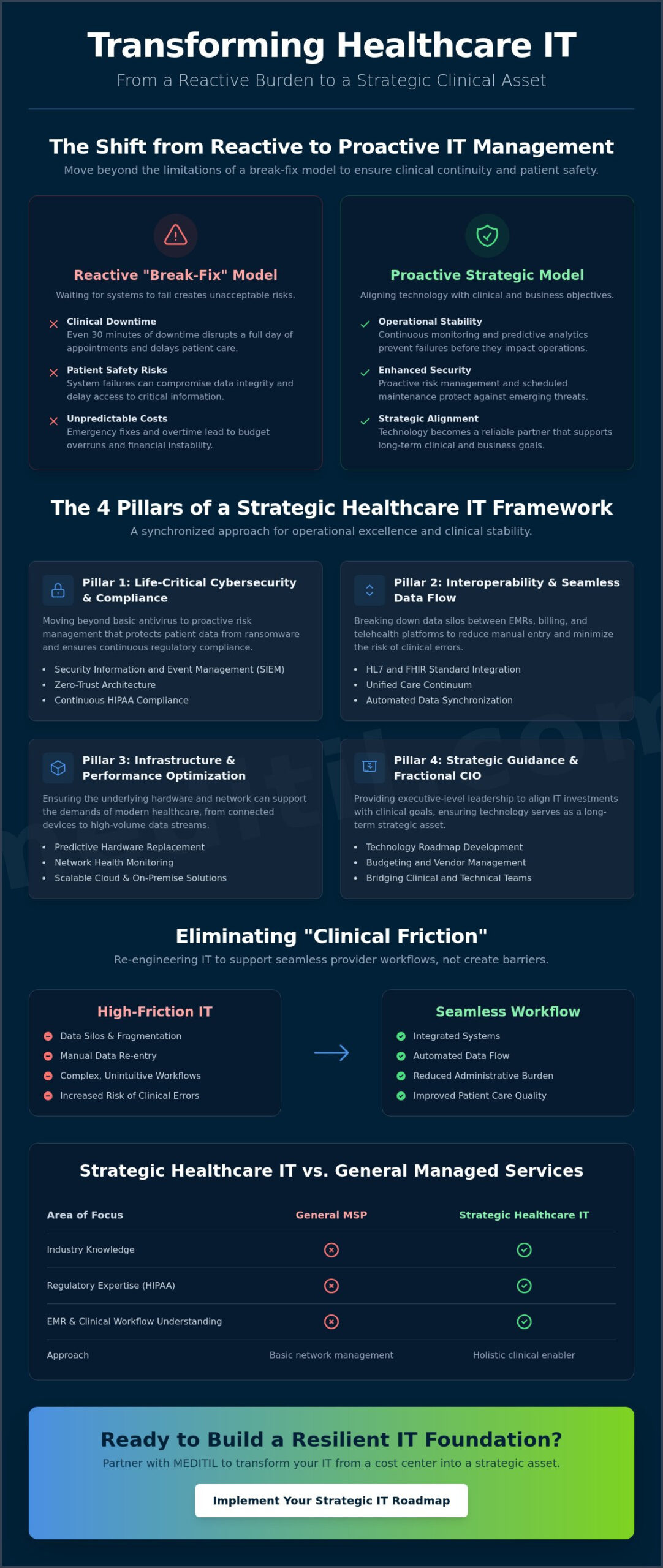
The traditional ‘break-fix’ model is increasingly dangerous for healthcare organizations. Waiting for a system to fail before addressing it creates unacceptable risks to patient safety and data integrity. In high-volume clinics, even thirty minutes of downtime can disrupt an entire day of appointments and delay critical treatments. By 2026, the complexity of connected medical devices and data streams makes a reactive stance professionally irresponsible.
Proactive management utilizes continuous monitoring to identify potential points of failure before they impact clinical operations. Predictive analytics play a vital role here, allowing IT teams to assess infrastructure health and replace aging components during scheduled maintenance windows. This methodical approach ensures that technology remains a silent, reliable partner in the exam room, preventing the sudden outages that frustrate staff and patients alike.
Strategic IT vs. General Managed Services
Many healthcare providers make the mistake of hiring general Managed Service Providers (MSPs) who lack industry-specific expertise. While these firms may understand basic networking, they often lack the depth required to handle HIPAA audits or complex systems integration. Healthcare environments demand a higher standard of precision and a deep understanding of EMR workflows that a standard office environment simply doesn’t require. Understanding why general managed services for healthcare fall short is the first step toward selecting a partner with the clinical knowledge your organization demands.
Strategic healthcare it services bridge this gap by combining technical proficiency with a thorough knowledge of the regulatory environment. Without this specialized focus, organizations often face recurring ‘clinical friction’, where technology becomes a hurdle rather than a help. You can learn more about these distinctions in our guide on Why General Managed IT Fails the Healthcare Sector. A partner who understands the high-stakes nature of medicine is essential for maintaining a stable, high-performing practice.
The 4 Pillars of a Strategic Healthcare IT Framework
A robust framework for strategic healthcare it services requires more than just functional hardware. It demands a synchronized approach where four core pillars work together to provide a “steady hand at the wheel” for all digital operations. When these pillars are managed in unison, they transition a practice from a state of constant technical friction to one of operational excellence. MEDITIL integrates these components into a single service model, ensuring that every technical decision supports clinical stability and patient outcomes.
Pillar 1: Life-Critical Cybersecurity & Compliance
Modern healthcare security must move beyond basic antivirus software. A strategic framework utilizes proactive risk management and Security Information and Event Management (SIEM) to identify threats before they penetrate the network. In a clinical setting, zero-trust architecture means that every user and device must be verified continuously, regardless of their location on the network. This approach ensures that regulatory compliance isn’t an annual checklist but a permanent feature of the infrastructure, protecting sensitive patient data from the rising threat of ransomware.
Pillar 2: Interoperability & Seamless Data Flow
Data silos between EMRs, billing systems, and telehealth platforms often force clinicians into manual data entry, which increases the risk of error. Strategic IT planning prioritizes current 2026 standards, such as HL7 and FHIR, to ensure seamless connectivity across the entire care continuum. By focusing on Healthcare Tech And Data Analytics Strategies, organizations can reduce the administrative burden on physicians. This allows providers to focus on patients rather than navigating fragmented software interfaces.
Pillar 3: Resilient Infrastructure & Network Management
High-volume healthcare hubs require N+1 redundancy to prevent single points of failure from halting clinical operations. This involves maintaining backup systems for critical hardware and internet connectivity to ensure that remote monitoring and telehealth services remain uninterrupted. Whether utilizing a cloud-first or hybrid storage strategy, the network must be engineered for high availability. A resilient foundation is the only way to support the bandwidth-intensive applications that modern medicine requires.
Pillar 4: Strategic Oversight and Clinical Alignment
The final pillar involves continuous oversight to ensure technology evolves alongside the practice. This isn’t about buying new gadgets; it’s about aligning every technical investment with specific business goals. Through high-level strategic healthcare it services, organizations can bridge the gap between technical potential and clinical reality. This oversight provides the discipline needed to maintain a high-performing environment while controlling long-term costs. If your current infrastructure feels like a barrier rather than a tool, it’s likely that one of these pillars is missing the necessary strategic focus.
The Fractional CIO: Driving Strategy Without the Executive Salary
Mid-sized healthcare organizations frequently operate in a difficult middle ground. They face the same regulatory pressures and technical complexities as large hospital systems but often lack the capital for a full-time Chief Information Officer. This is where the Fractional CIO becomes a vital component of strategic healthcare it services. Similar to how a fractional CMO Lithuania provides specialized marketing leadership for growth-focused firms, a Fractional CIO offers executive-level guidance on a part-time basis, ensuring that technology decisions are driven by clinical needs rather than technical convenience.
This role serves as the essential translator between the boardroom and the server room. While clinicians focus on patient throughput and care quality, technical staff often prioritize system uptime and patch management. A Fractional CIO bridges this divide. They ensure that every infrastructure upgrade or application integration directly supports the organization’s mission. They also provide the necessary discipline to manage internal or augmented IT teams, holding them accountable to a long-term strategic vision that prioritizes stability over temporary fixes.
Budget Alignment and ROI Analysis
A strategic partner brings financial discipline to the IT department. Instead of reacting to sudden equipment failures with unplanned capital expenditures (CapEx), a Fractional CIO helps transition the organization to a predictable operational expenditure (OpEx) model. This shift allows for better cash flow management and ensures that every dollar spent on strategic healthcare it services yields a measurable return. By identifying and systematically eliminating technical debt, these leaders prevent the budget from being drained by obsolete systems that no longer serve a clinical purpose. It’s about spending smarter, not just spending more.
Strategic Roadmap Development
Effective IT management requires a forward-looking perspective. A Fractional CIO develops a comprehensive 3-5 year technology roadmap that anticipates healthcare trends and regulatory shifts. This plan ensures that the organization can scale seamlessly as it adds new locations or services without needing to rebuild its foundation. Periodic business reviews, or QBRs, serve as a verification step. These meetings confirm that the technology stack remains aligned with the evolving clinical landscape. This structured oversight provides the stability needed to navigate a complex and highly regulated industry with confidence.
Eliminating Clinical Friction Through Better IT Design
The most common complaint among medical professionals is that technology often feels like a barrier to patient care. This perception is rooted in “clinical friction,” a term describing the technical latencies and workflow interruptions that force providers to focus on screens rather than patients. When a system requires excessive clicks or suffers from slow login times, it doesn’t just waste minutes; it erodes the quality of the patient-provider relationship. Strategic healthcare it services aim to eliminate these obstacles by prioritizing the user experience (UX) of doctors and nurses, ensuring that technology serves as a bridge to better care.
Reducing clinical friction is a direct intervention against physician burnout. By engineering an environment where systems are intuitive and responsive, organizations can return valuable time to their clinical staff. This approach requires a deep understanding of how medical teams move through their day. It isn’t about adding more features, but about refining the ones that exist to ensure they support, rather than disrupt, the clinical mission. A well-designed medical IT infrastructure allows clinicians to operate at the top of their license, focused on diagnosis and treatment rather than troubleshooting software.
Optimizing EHR & Billing Workflows
Software implementation is only fifty percent of the struggle; the remainder is integration and optimization. Many practices struggle because their systems operate in isolation, requiring staff to bridge the gaps with manual data entry. Strategic IT focuses on connecting EHR platforms with billing systems to automate the revenue cycle. This connectivity ensures that clinical documentation triggers billing events accurately and immediately, reducing the administrative burden on providers. Furthermore, comprehensive staff training is treated as a core strategic component, ensuring that every team member can navigate the digital environment with confidence and speed.
Telehealth and Remote Patient Monitoring (RPM)
Telehealth and remote patient monitoring (RPM) are no longer optional additions but essential components of modern care delivery. However, these services fail if the underlying infrastructure cannot support high-quality video or real-time data transmission. A strategic approach ensures that RPM data flows directly into the patient’s electronic record without manual intervention. This level of automation provides clinicians with a holistic view of patient health between visits. To achieve this, the network must be engineered for high availability and seamless data flow. If you’re looking to modernize your practice, learn how strategic healthcare it services can eliminate technical friction and improve your clinical outcomes.
Implementing Your Strategic IT Roadmap with MEDITIL
Transitioning from a reactive, high-stress IT environment to a managed strategic state requires a partner who understands both the technical and clinical stakes. MEDITIL serves as this comprehensive partner, providing the specialized expertise needed to execute a 2026-ready framework. Whether your organization needs a Fractional CIO to lead an internal team or a fully augmented IT team to handle daily operations, the goal remains the same: total clinical alignment. By integrating strategic healthcare it services into your core business model, you move away from the unpredictability of “break-fix” cycles and toward a state of verified operational stability.
Execution of a strategic roadmap isn’t a one-time event but a disciplined, ongoing process. It involves constant verification of security protocols and the continuous optimization of network performance. MEDITIL’s approach ensures that your infrastructure doesn’t just work, but actually improves the way your clinicians deliver care. We take the burden of technical management off your leadership team, allowing you to focus on patient outcomes and organizational growth while we maintain a steady hand at the wheel of your digital infrastructure.
The MEDITIL Onboarding & Assessment Process
The journey toward a strategic state begins with a rigorous, deep-dive audit of your existing infrastructure. We identify hidden technical debt, security vulnerabilities, and data silos that currently impede your clinical flow. This assessment provides a clear baseline for your organization’s technical health. From there, we prioritize “quick wins” that immediately reduce clinical friction for your staff. These early improvements build trust and provide immediate relief to providers who’ve struggled with slow systems or fragmented workflows. Finally, we establish long-term strategic goals that align your technology spend with your clinical mission, ensuring every future investment is purposeful and data-driven.
A Steady Hand at the Wheel: Long-Term Partnership
Once the initial roadmap is established, MEDITIL provides the ongoing management necessary to keep your practice stable and secure. This includes proactive oversight of your network, cloud services, and cybersecurity posture. In a high-stakes medical environment, having a partner who understands the nuance of HIPAA compliance and EMR interoperability is invaluable. We don’t just respond to issues; we prevent them through methodical maintenance and strategic advising. This long-term partnership ensures that as medical IT and healthcare technology evolves, your organization remains at the forefront of efficiency and security.
Securing your organization’s future requires a move beyond basic support to a comprehensive strategic model. If you’re ready to eliminate technical friction and transform your IT into a clinical asset, the next step is a structured conversation about your specific needs. Schedule a consultation with MEDITIL to discuss your strategic roadmap and discover how a disciplined approach to IT can stabilize your operations for years to come.
Securing Your Clinical Foundation for 2026
The transition from a reactive IT model to a proactive framework is a fundamental requirement for modern healthcare organizations. By focusing on clinical alignment, practices can eliminate technical friction and ensure that their infrastructure supports rather than hinders patient care. We’ve examined how executive-level guidance and a focus on interoperability create a stable environment for long-term growth. Implementing strategic healthcare it services ensures that your digital assets are protected by life-critical cybersecurity and optimized for seamless data flow across the entire care continuum.
MEDITIL serves as a dedicated partner, providing the seasoned expertise necessary to navigate these high-stakes complexities. Our focus on fractional CIO leadership, HIPAA compliance, and billing automation helps you bridge the gap between technical requirements and clinical success. Our proven track record in EHR integration ensures your team can focus on patient outcomes without the burden of technical debt. Take the first step toward a more resilient and efficient organization today. Secure your clinical operations with MEDITIL’s strategic IT services and experience the stability of a truly aligned infrastructure.
Frequently Asked Questions
What is the difference between an MSP and a strategic healthcare IT partner?
A standard Managed Service Provider (MSP) typically focuses on reactive technical support and maintaining system uptime. In contrast, a strategic partner aligns your technology stack with specific clinical and business outcomes. This approach includes high-level consulting and fractional CIO services to ensure that every infrastructure investment supports the long-term stability and growth of the practice.
How can strategic IT services help with HIPAA compliance audits?
Strategic services ensure that compliance is a continuous operational state rather than a reactive response to an audit. By implementing automated monitoring and zero-trust architecture, a partner provides the necessary verification and documentation required for regulatory standards. This proactive stance reduces the risk of significant penalties and ensures that patient data remains protected through verified security protocols.
What does a fractional CIO actually do for a medical practice?
A Fractional CIO provides executive-level technology leadership on a part-time or project basis. They develop long-term roadmaps, manage IT budgets, and bridge the gap between clinical needs and technical implementation. This role ensures that your internal or augmented IT team remains focused on strategic objectives that directly improve patient care and operational efficiency.
Can strategic IT solutions help reduce physician burnout?
Yes, these solutions reduce burnout by intentionally eliminating clinical friction and technical latencies. When EHR systems are optimized and interoperability is seamless, clinicians spend less time on administrative tasks and more time on patient care. Focusing on the user experience of doctors and nurses ensures that technology remains a supportive tool rather than a daily obstacle.
Is it better to have an in-house IT team or an augmented managed service?
The choice depends on your organization’s size, but an augmented model often provides a superior depth of expertise. An augmented IT team allows a practice to retain internal institutional knowledge while gaining access to specialists in cybersecurity and systems integration. This hybrid approach ensures that complex healthcare requirements are handled with professional precision and technical confidence.
How do strategic healthcare it services impact the cost of healthcare operations?
These services transition organizations from unpredictable capital expenditures to a stable and predictable operational expenditure model. By eliminating technical debt and preventing costly downtime, strategic healthcare it services lower the total cost of ownership for technology. This structured financial approach allows for better budget forecasting and ensures that every dollar spent supports a clinical outcome.
What should be included in a 2026 healthcare IT roadmap?
A 2026 roadmap must include cloud-first infrastructure, advanced cybersecurity protocols, and a clear plan for seamless systems integration. It should also account for the increasing bandwidth demands of telehealth and remote patient monitoring. This framework ensures that your organization can scale efficiently as regulatory requirements and clinical technologies continue to evolve.
How does interoperability affect patient safety and data accuracy?
Interoperability ensures that patient data flows accurately between disparate systems such as EHRs, billing platforms, and telehealth tools. This connectivity reduces the risk of manual entry errors and ensures that clinicians have immediate access to the most current medical information. Accurate and seamless data flow is essential for maintaining patient safety and improving the precision of clinical documentation. Organizations that rely on managed services for healthcare that lack clinical specialization often find that interoperability gaps persist, undermining both data accuracy and patient safety.
3 Responses