
What if the biggest risk in a hospital IT project isn’t the technology, but a decision that overlooks how care is delivered? Hospital IT project management brings clinical, operational, and technical priorities into the same governance model while keeping security and continuity in view. Scope changes, vendor dependencies, downtime concerns, and staff adoption all need attention from the start.
Those pressures are familiar to hospital leaders. A project can meet its technical milestones and still create friction if workflows, data protection, or operational readiness haven’t been addressed. A clear plan helps teams make informed decisions, respond to risks, and prepare for change without losing sight of patient care.
This guide explains how to scope and govern hospital IT projects, compare delivery approaches, manage dependencies, and plan a controlled transition into ongoing operations. It follows a healthcare-specific lifecycle, from defining outcomes and assigning decision-making roles through implementation, testing, training, and operational handoff. MEDITIL supports healthcare IT planning and delivery through HIPAA-ready project consulting, infrastructure, cybersecurity, integration, and application support. Its approach is Smart. Secure. Scalable. Healthcare IT, Simplified.
Key Takeaways
- Use a healthcare-specific lifecycle to clarify the decision, accountable owner, and deliverable at each project phase.
- Compare internal-led, augmented-team, and consulting approaches against your clinical context, internal capacity, and need for specialist support.
- Make hospital IT project management more accountable with named risk owners, escalation paths, and documented scope decisions.
- Plan controls for clinical continuity, cybersecurity, data handling, dependencies, and staff adoption before implementation begins.
- Set acceptance criteria and operational handoff requirements early so documentation, ownership, and support readiness are part of delivery.
Why hospital IT project management needs a clinical-first plan
A hospital technology change can alter how clinicians document care, how departments share information, and how staff complete routine tasks. Hospital IT project management is therefore more than coordinating technical work. Clinical, operational, and technical teams need to agree on intended outcomes, responsibilities, risks, and readiness measures before implementation.
Hospital IT project management is the governed delivery of technology change across clinical, operational, and technical teams, with workflow continuity, patient-data protection, and adoption built into scope and success criteria. A system isn’t ready simply because it’s installed. It must also support real workflows, be appropriately protected, and have an operational owner prepared to support it.
A technology installation changes infrastructure or configures a system. A clinical change can also affect staff responsibilities, handoffs, documentation, and patient-facing processes. For example, a new integration may change where information appears and which team acts on it. Include workflow review, security planning, training, and validation in the project scope, not just technical completion.
Which hospital IT initiatives need formal project management?
Formal project management is useful when work has a defined outcome, delivery period, accountable owners, and coordinated dependencies. Examples include an EHR implementation, cloud migration, network redesign, or integration connecting clinical and administrative applications.
Coordination needs rise when several departments must change how they work, when vendors or internal teams depend on one another, or when implementation affects clinical schedules. A bounded project has a planned start and completion, such as migrating a defined group of systems. Recurring operational support continues after delivery, addressing ongoing application, infrastructure, or user needs. Define this boundary early so the project team knows what to deliver and operations knows what it will own.
Map the hospital’s system landscape to identify connections and affected functions. A Hospital Information System (HIS) can encompass administrative, operational, and clinical components, so a change in one area may have dependencies elsewhere. Record those dependencies in the project plan and identify who can resolve them.
What makes hospital projects different from general IT projects?
Hospital implementation planning must account for patient-facing workflows and the schedules of the people who use them. A rollout that interrupts documentation, access to information, or departmental coordination can affect care delivery. Identify sensitive workflows, choose implementation windows with clinical and operational leaders, and define how staff will continue essential work if a step is delayed or needs to be reversed.
Responsibility also crosses organizational boundaries. Clinical representatives explain how care processes work; administrative leaders identify operational impacts; security stakeholders assess data protection; and technical teams manage configuration, infrastructure, integration, and testing. Assign decision owners across these groups so questions are resolved before they become go-live blockers.
HIPAA considerations belong in planning from discovery onward. Identify how the project handles protected health information, incorporate appropriate safeguards into design and testing, and document relevant decisions. This supports disciplined project governance, but it isn’t a substitute for legal advice or an organization’s compliance review.
How to manage a hospital IT project from discovery through go-live
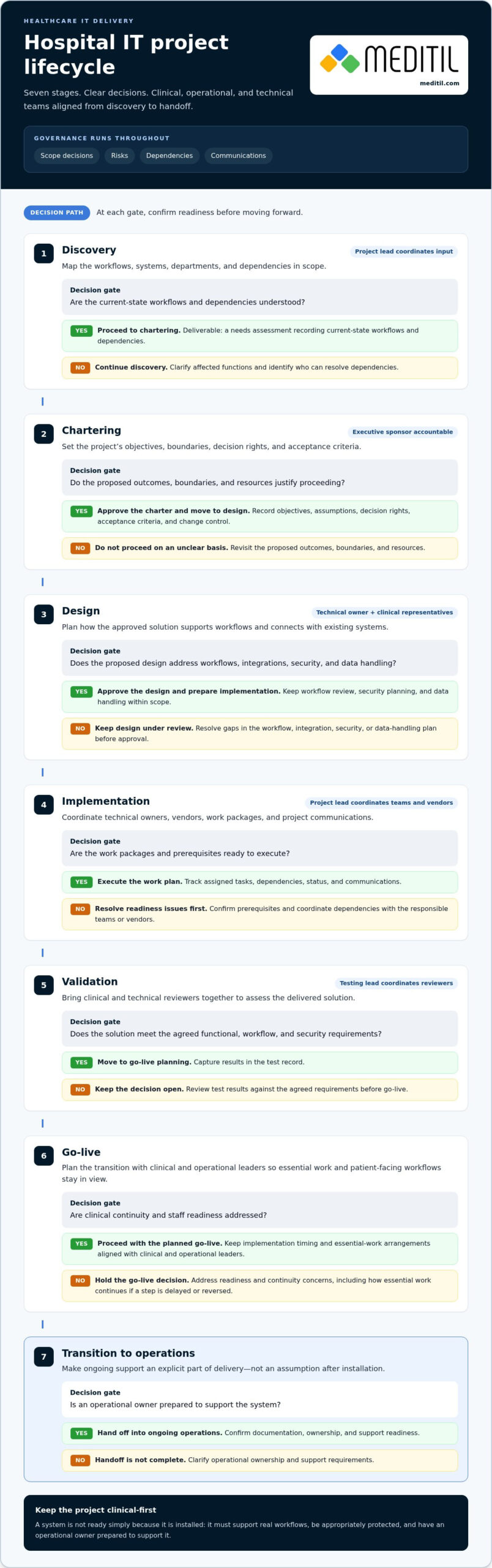
A disciplined lifecycle gives clinical, operational, and technical teams clear decisions and deliverables at each stage. In hospital IT project management, the sequence is discovery, chartering, design, implementation, validation, go-live, and transition. Governance runs throughout, tracking scope, risks, dependencies, and communications.
- Discovery: Decide which workflows, systems, and departments are in scope. The project lead coordinates input from clinical and technical representatives. The deliverable is a needs assessment that records current-state workflows and dependencies.
- Chartering: Decide whether the proposed outcomes, boundaries, and resources justify proceeding. The executive sponsor is accountable. The project charter records objectives, assumptions, decision rights, acceptance criteria, and the change-control process.
- Design: Decide how the approved solution will support workflows and connect with existing systems. The technical owner leads with clinical representatives. The deliverable is an approved design covering workflows, integrations, security, and data handling.
- Implementation: Decide whether work packages and prerequisites are ready to execute. The project lead coordinates technical owners and vendors. The deliverable is a work plan with assigned tasks, dependencies, status, and communications.
- Validation: Decide whether the solution meets agreed functional, workflow, and security requirements. The testing lead coordinates clinical and technical reviewers. The deliverable is a test record with results, issues, and resolutions.
- Go-live: Decide whether readiness criteria are met and deployment can proceed. The sponsor makes the go-live decision using input from the project lead and clinical and technical owners. The deliverable is documented readiness approval and a deployment plan.
- Transition: Decide whether operational teams can accept ownership. The operations owner leads the handoff with the project lead. The deliverable is an acceptance record with documentation, support ownership, and open issues.
Set scope, outcomes, governance, and ownership
Translate the service need into observable outcomes, such as a defined workflow functioning as approved or an integration passing agreed validation. State what is included and what is excluded. Name an executive sponsor, project lead, clinical representatives, and technical owners. Specify who recommends, approves, and escalates decisions so unresolved questions don’t drift between teams.
Coordinate implementation, validation, and go-live readiness
Build the work plan around approved workflows, technical dependencies, staff preparation, and operational readiness. Schedule validation with the people who perform affected tasks, and define issue severity and escalation routes before testing begins. Include rollback planning and explicit go-live criteria, such as resolved critical issues and named operational owners. Communications should tell staff what is changing, when it is changing, and where to direct questions.
Healthcare-focused project consulting can help coordinate planning, implementation, and operational handoff. MEDITIL’s healthcare IT project consulting connects project delivery with HIPAA-ready technical and operational considerations.
Compare hospital IT project delivery models and trade-offs
The right delivery model depends on project scope, the hospital’s available capacity, and how decisions are governed. Internal teams bring organizational context, while external support can add specialist capacity. Neither model replaces clear clinical ownership. A project plan can track tasks, but it can’t resolve competing priorities or unclear decision rights by itself.
| Model | Decision authority | Clinical context | Internal capacity | Continuity | Specialist coverage |
|---|---|---|---|---|---|
| Internal-led | Hospital sponsor and project lead | Strong if clinical owners are engaged | Requires available staff | Knowledge stays in-house | May need coordination across teams |
| Augmented team | Hospital retains decisions | Built through staff collaboration | Adds delivery capacity | Supports internal knowledge transfer | Can add targeted expertise |
| Project-based consulting | Hospital retains sponsorship and approvals | Established through discovery and clinical input | Provides defined project support | Requires planned handoff | Can address scoped technical needs |
Use the table as a starting point, not a ranking. For each model, establish who approves scope changes, who resolves clinical workflow questions, and who accepts delivery. The hospital remains accountable for its priorities and decisions, even when specialist work is supported externally. Without named owners and stakeholder alignment, a schedule or status report may only make unresolved issues more visible.
When an internal hospital team may lead delivery
An internal-led model can work well when the hospital has established governance, an available project lead, and clinical owners who can participate in decisions and validation. Internal leadership preserves institutional knowledge and keeps responsibility close to affected departments. The project lead still needs to coordinate specialist work across infrastructure, applications, integration, and security. Protect clinical stakeholders’ time to review workflow impacts and make decisions.
When augmented or project-based support can help
Augmented support can add capacity to an existing hospital team, while project-based consulting can focus on a defined implementation, integration, or infrastructure initiative. MEDITIL provides both healthcare-focused capabilities through HIPAA-ready services that support planning and delivery. Its positioning is Smart. Secure. Scalable. Healthcare IT, Simplified. For broader executive planning context, see this virtual CIO strategic IT leadership guide.
Choose the model by matching project demands to available ownership and skills. A contained initiative with experienced internal leadership may remain internal-led. A project that stretches staff capacity or requires focused technical expertise may benefit from added support. In either case, define decision authority, clinical participation, knowledge transfer, and operational handoff before work begins. These governance choices help hospital IT project management stay aligned with care needs and delivery responsibilities.
Build controls for hospital IT project risks, change, and continuity
Risk controls work when they inform routine project decisions, not when they appear only on a checklist before go-live. In hospital IT project management, teams need a shared view of clinical continuity, cybersecurity, data handling, scope, dependencies, and adoption. For each risk, record an owner, mitigation action, escalation route, and review cadence. Keep decisions and changes traceable so teams can see who approved them and why.
A practical control set can cover:
- Clinical continuity: Map affected workflows and departments, identify sensitive operating periods, and document contingencies for disruption.
- Cybersecurity: Coordinate project-specific access, configuration, testing, and issue escalation with the organization’s security stakeholders.
- Data handling: Identify which project activities involve patient information and assign responsibility for appropriate safeguards and validation.
- Scope: Record requested changes, assess their effect on workflows and delivery, and route decisions through the agreed approval process.
- Dependencies: Track prerequisites across departments, applications, infrastructure, and vendors, with owners and escalation paths for blocked work.
- Adoption: Monitor training, communications, user feedback, and readiness for affected roles and workflows.
Project-level security coordination is not the same as designing the hospital’s broader cybersecurity program. Apply the organization’s established security expectations to the specific implementation and raise gaps to the appropriate security owner. Enterprise-wide policy, risk strategy, and ongoing security operations remain broader program responsibilities. MEDITIL provides HIPAA-ready cybersecurity and compliance services for healthcare IT needs; its healthcare cybersecurity services strategic guide offers further context.
Keep clinical operations and project risks visible
Map workflows and departments before choosing implementation windows or sequencing work. For example, a change affecting how staff access patient information may involve multiple units, so clinical and operational representatives should identify dependencies and contingency needs. The risk register should state the potential impact, owner, mitigation, escalation route, and next review point. Review it regularly, and coordinate testing or contingency decisions with the people responsible for affected operations.
Pair the register with a decision log. Record the issue, options considered, decision owner, outcome, and any resulting scope or schedule change. This makes accountability actionable and gives teams a clear basis for escalation when a risk grows or a dependency slips.
Manage adoption and change without losing accountability
Identify affected user groups and define role-specific training, communications, and readiness measures. Gather feedback through workflow-based testing and track reported barriers by role or department, so recurring issues reach the right owner before go-live. Establish who can accept residual issues and who authorizes movement between project stages. Give unresolved concerns a documented disposition rather than assuming they are resolved.
For support with healthcare project controls, cybersecurity, and implementation planning, connect with MEDITIL’s healthcare IT team.
Transition hospital IT projects into dependable ongoing operations
Implementation isn’t complete just because a system is live. A dependable handoff confirms that operational teams understand what changed, have the documentation and access needed to support it, and know which issues remain open. Define acceptance and support readiness before closing delivery so project completion reflects operational ownership, not only technical installation. This is essential to hospital IT project management because ongoing teams inherit the system and its effects on clinical work.
Create a clear handoff and post-go-live stabilization plan
Before transition, identify the operational owner for each component, including infrastructure, applications, integrations, and user support. Provide current configuration records, system and workflow documentation, support pathways, vendor responsibilities, and instructions for escalating issues. Record outstanding decisions and known limitations instead of leaving them in project meeting notes.
Agree on how post-launch issues will be prioritized and reviewed. For each item, document its impact, owner, next action, escalation route, and relationship to the project’s acceptance criteria. The sponsor and operational owner should determine which remaining issues can be accepted, who accepts them, and what follow-up is required. Close delivery only when support ownership and responsibility for open items are clear.
Use a stabilization review to capture lessons from implementation, testing, and staff feedback. Transfer knowledge directly to the teams responsible for ongoing operations, and update documentation when project decisions change system configuration or workflow. This makes handoff a managed stage of delivery rather than an administrative sign-off.
Connect implementation to ongoing healthcare IT operations
After handoff, infrastructure and network services support the environment’s technical foundation, while cloud services support ongoing platform operations where applicable. Healthcare application support addresses application needs, and systems integration and interoperability support connections among systems. Managed IT services provide an ongoing operational model, distinct from the project’s temporary delivery structure. MEDITIL’s managed IT services for healthcare strategic guide offers further context on operational support.
Project needs can also include EMR/EHR implementation and training alongside integration work and application support. MEDITIL provides healthcare-focused project consulting and these related capabilities as HIPAA-ready or HIPAA-compliant services. Its documented experience includes a 400GB patient data migration with zero compliance issues. This is a migration proof point, not a claim about a hospital client or an outcome every project will achieve.
With 100% focus on healthcare IT environments, MEDITIL’s positioning is Smart. Secure. Scalable. Healthcare IT, Simplified. To discuss planning, implementation, integration, or operational transition for a healthcare IT project, discuss a healthcare IT project with MEDITIL.
Set your next project up for operational success
Start by identifying the decision that needs attention first. Is the project’s clinical owner clear? Can affected teams explain what success looks like in practice? Resolving these questions early gives leaders a stronger basis for setting priorities and aligning clinical, operational, and technical teams before delivery pressure builds.
Use hospital IT project management to connect technology decisions with the care environment they will affect. Keep operational ownership in view as plans take shape, and treat the transition into ongoing support as part of the project’s intended outcome. MEDITIL brings a healthcare-focused approach to project consulting, supported by HIPAA-ready services across relevant IT capabilities. Its positioning is Smart. Secure. Scalable. Healthcare IT, Simplified.
If you’re planning an implementation, integration, or infrastructure initiative, Discuss your hospital IT project with MEDITIL. A focused conversation can help clarify priorities and establish a practical path forward. Aligning the right expertise and ownership gives your team a clearer basis for moving ahead.
Frequently Asked Questions
How long does a hospital IT project usually take?
A hospital IT project’s duration depends on its scope, integrations, decision turnaround, testing needs, and operational readiness. A fixed estimate before these factors are understood can conceal dependencies. For planning, break work into deliverables, identify decisions and external prerequisites, then refine the schedule as teams confirm design and validation requirements. Include time for workflow review, issue resolution, and staff preparation rather than treating go-live as the only endpoint.
What should a hospital IT project charter include?
A hospital IT project charter should define the purpose, scope, intended outcomes, sponsor, project ownership, constraints, and approval authority. It should also clarify what is outside the project boundary, identify major assumptions and dependencies, and describe how proposed changes will be assessed. Include how success will be evaluated and who can authorize the project to proceed. A precise charter gives teams a shared reference when priorities or requirements shift.
How should a hospital measure whether an IT project succeeded?
Measure success against objectives agreed before implementation, not a universal benchmark. Select indicators that reflect the project’s purpose, such as whether a workflow performs as designed, technical functions pass validation, staff can complete role-specific tasks, and operational issues are addressed. Assign an owner and data source to each measure. For example, a team might compare workflow completion findings from user testing with post-launch feedback to identify gaps that need follow-up.
What is a go-live stabilization period in a hospital IT project?
A go-live stabilization period is the planned time after launch when teams monitor the new system or change closely and resolve emerging issues. It gives staff a defined path to report problems and helps operational owners distinguish urgent workflow impacts from lower-priority adjustments. Set issue categories, review frequency, escalation responsibility, and exit criteria in advance. The period ends when the designated owner confirms that agreed operational conditions are met.
Can a hospital run multiple IT projects at the same time?
Yes, a hospital can run multiple IT projects concurrently if its portfolio governance accounts for capacity and competing demands. Review shared clinical subject-matter experts, technical resources, vendor commitments, testing environments, and implementation windows. Projects may depend on the same infrastructure or integration work, so map those links before confirming schedules. Prioritize initiatives using organizational objectives, workflow impact, risk, and dependency order, then revisit the portfolio as constraints change.
Who should approve a hospital IT project go-live?
Name the go-live approver in the project’s governance plan before implementation reaches its final stage. The executive sponsor or designated decision authority typically makes the formal decision, informed by relevant clinical and operational owners and technical leads. Define required sign-offs and readiness evidence, such as completed validation, known issue dispositions, and operational coverage. If a required owner identifies an unresolved risk, clarify the escalation path before requesting approval.
How can a hospital manage vendor dependencies in an IT project?
Manage vendor dependencies by assigning a hospital-side owner to each external deliverable and documenting how it connects to internal systems, teams, and decisions. Track interface requirements, prerequisites, milestones, review points, and accountable contacts in a shared dependency record. Set a route for resolving delays or conflicting assumptions, and record decisions that affect other work. Regular coordination should focus on upcoming handoffs and blocked items, not only status updates.