
What if hospital IT support were sized around clinical workflows rather than the scale of the vendor providing it? Leaders searching for alternatives to hospital IT outsourcing to large vendors often want dependable expertise with clearer oversight and a better fit for organizational priorities. A standardized service model can leave important questions about workflow, accountability, and decision-making unanswered.
That concern is understandable. Hospitals need reliable technology operations, security, and application support, but outsourcing everything isn’t the only way to access specialized expertise. Internal teams, targeted consulting, augmented IT capacity, and healthcare-focused managed services each offer a different balance of control and external support.
This guide compares practical alternatives and explains where each model may fit. Assess them by coverage, governance, expertise, and integration needs, then consider how to combine internal ownership with outside support. From managed operations to fractional CIO leadership and project-based consulting, the goal is to choose an operating model that supports clinical and operational priorities while preserving strategic oversight.
Key Takeaways
- Compare internal IT, co-managed support, fractional leadership or augmented teams, and project-based consulting to see which model aligns with your organization’s priorities.
- Alternatives to hospital IT outsourcing to large vendors can be combined, allowing you to retain internal ownership while adding targeted expertise where gaps exist.
- Evaluate each support model by control, coverage, internal workload, specialist access, and continuity rather than assuming one approach fits every hospital.
- Use a structured transition plan to document systems, responsibilities, access, dependencies, escalation routes, and knowledge-transfer needs.
- Consider how managed operations, team augmentation, and defined project support can address distinct IT needs within a tailored healthcare-focused partnership.
Why hospitals consider alternatives to large-vendor IT outsourcing
Hospital IT outsourcing means transferring some or all technology responsibilities to an external organization. The scope can range from a defined project to ongoing operational management. The broader practice of outsourcing in healthcare also includes management functions, as outlined in Medical outsourcing.
The decision isn’t simply whether a vendor is large or small. It’s about selecting an operating model with clear accountability, appropriate expertise, and a fit for clinical priorities. Leaders may reassess an arrangement when support responses don’t match operational needs, specialist knowledge is difficult to access, ownership of recurring issues is unclear, or clinical workflows and technology requirements change.
Fully outsourced support places agreed IT operations under an external organization’s management; co-managed support divides responsibilities between that organization and internal staff; project-based support is limited to a defined outcome, such as an implementation or integration. These models offer different levels of control and continuity, and organizations can combine them.
What hospital IT outsourcing can include
An agreement may cover infrastructure, networking, cloud operations, cybersecurity, help desk, or healthcare application support. It may assign responsibility for one function or span several parts of the IT environment. Ongoing operational management differs from a time-limited implementation or systems integration project, even when both involve the same systems.
Contracts also establish who handles each task, how issues are escalated, and which decisions remain with hospital leadership. Those details shape day-to-day accountability as much as the service list does. Before comparing models, identify the tasks that must be covered and the decisions leadership needs to retain.
Why a large-vendor model may not fit every organization
A standardized process can support consistency, but it may not reflect every hospital’s workflows or priorities. Complex escalation paths can make ownership harder to follow, while a support team with limited context may need time to understand how technology dependencies affect clinical operations. These are possible fit considerations, not universal weaknesses of large vendors.
Assess the model against clinical priorities, internal capacity, and governance needs. For example, a hospital with a capable internal team may want outside expertise for cybersecurity or cloud operations while retaining strategic decisions in-house. Alternatives to hospital IT outsourcing to large vendors are useful when they align responsibilities and support with actual organizational needs, rather than prompting a change based only on vendor size.
Four alternatives to hospital IT outsourcing by large vendors
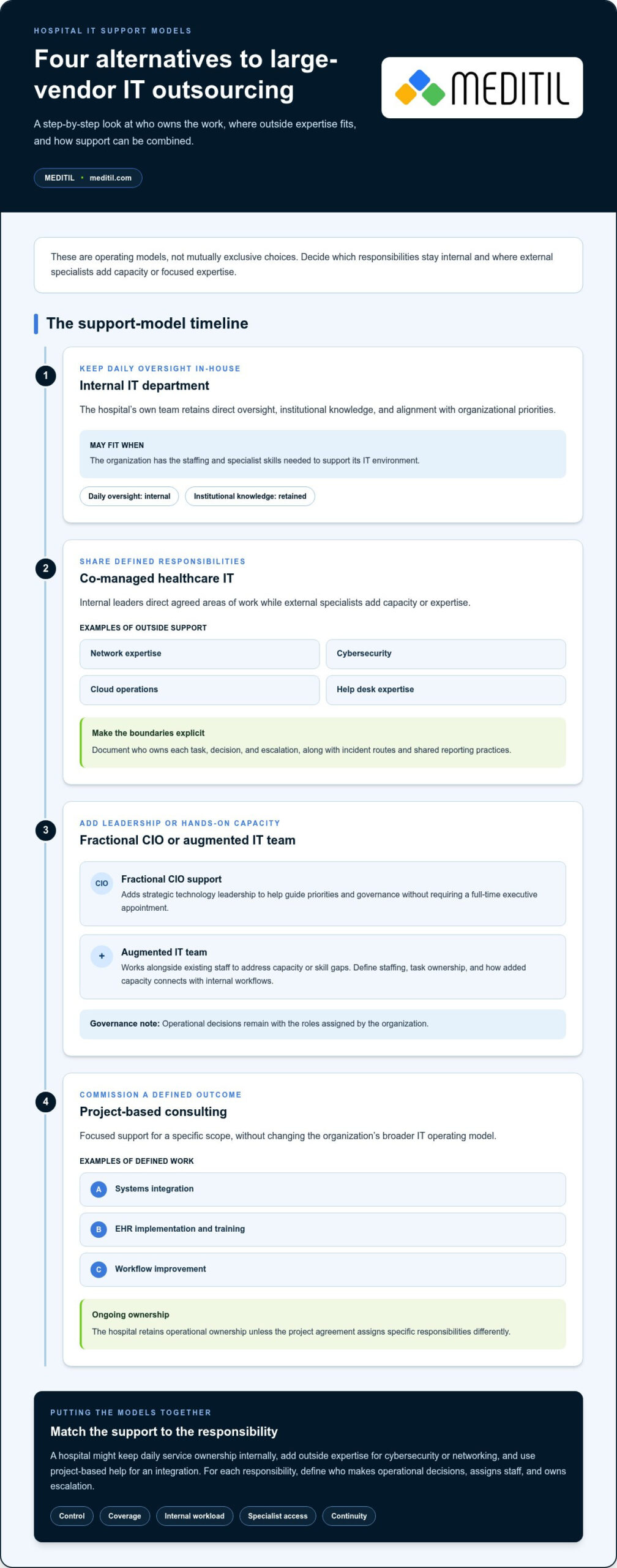
Alternatives to hospital IT outsourcing to large vendors include keeping IT in-house, sharing responsibilities with external specialists, adding strategic or technical capacity, and commissioning support for defined projects. These are operating models, not mutually exclusive choices. A hospital might retain daily service ownership internally, use outside expertise for cybersecurity or networking, and bring in project-based help for an integration.
The right division depends on the organization’s capacity and the work involved. Health IT spans systems and services that support care delivery and operations, as described by the U.S. Department of Health and Human Services in its overview of Health information technology (health IT). For each responsibility, define who makes operational decisions, assigns staff, and owns escalation.
Internal and co-managed healthcare IT
An internal IT department can retain daily oversight, institutional knowledge, and direct alignment with hospital priorities. This model may suit organizations with the staffing and specialist skills needed to support their environment. A co-managed arrangement adds external capacity, such as network, cybersecurity, cloud, or help desk expertise, while internal leaders continue to direct agreed areas of work.
A co-managed model divides responsibilities by defined service boundaries, so internal staff and external specialists know who owns each task, decision, and escalation. Document those boundaries, incident routes, and shared reporting practices to reduce ambiguity when work crosses teams.
Fractional CIO, augmented teams, and project-based support
Fractional CIO support adds strategic technology leadership without requiring a full-time executive appointment. A fractional leader can help guide priorities and governance, while operational decisions remain with the roles assigned by the organization. An augmented IT team works alongside existing staff to address capacity or skill gaps. Define staffing, task ownership, and how the added capacity connects with internal workflows.
Project-based consulting focuses on defined work, such as systems integration, EHR implementation and training, or workflow improvement. The hospital retains ongoing operational ownership unless the project agreement assigns specific responsibilities differently. This approach provides focused expertise for a defined scope without changing the organization’s broader support structure.
- Internal IT: Hospital leaders direct operations; internal staff handle assigned work and escalation.
- Co-managed support: Responsibilities are shared by service boundary, with escalation routes documented.
- Fractional leadership or augmented teams: Strategic guidance or additional technical capacity complements existing staff.
- Project-based consulting: Work is scoped to a defined outcome, with ongoing operations handled separately.
For organizations considering a tailored mix, healthcare-focused IT support can bring managed operations, team augmentation, leadership, and project work into a coordinated relationship.
Compare healthcare IT support models by control, coverage, and risk
No support model is inherently safest or most effective. Start by identifying the work that needs coverage, the decisions leaders need to retain, and the internal capacity available to oversee delivery. The matrix below outlines common tendencies; actual responsibilities depend on the organization’s staffing and the agreements that define the work.
| Model | Control and coverage | Internal workload and specialist access | Continuity considerations |
|---|---|---|---|
| Internal IT | Direct organizational oversight; coverage depends on internal roles and skills. | Higher staffing responsibility; expertise is limited to available personnel. | Knowledge stays in-house, but continuity depends on documentation and team capacity. |
| Co-managed support | Shared control, divided across documented service boundaries. | Internal leaders coordinate shared work; external specialists can fill defined skill or capacity gaps. | Requires clear escalation, shared records, and coordination across teams. |
| Fractional leadership or augmented team | Leadership or technical capacity is added while organizational decision rights can remain internal. | Can address specific expertise or capacity gaps; internal staff still need to coordinate assigned work. | Document decision authority, responsibilities, and knowledge transfer. |
| Project-based consulting | Control is focused on a defined scope, such as integration or implementation. | Temporary specialist input; internal staff prepare to own ongoing operations. | Transition plans and system documentation support continuity after project work ends. |
| Fully outsourced operations | Broader operational execution is assigned externally; governance and decision rights depend on the agreement. | Less direct execution by internal staff, but oversight and vendor coordination remain necessary. | Review escalation paths, documentation, dependencies, and transition arrangements. |
How much control and internal capacity does the organization need?
Separate strategic ownership from routine execution. Executive leaders may retain investment priorities, clinical leaders may define workflow requirements, compliance leaders may oversee governance, and IT leaders may direct technical operations. Map those decision rights before selecting among alternatives to hospital IT outsourcing to large vendors. Also account for the staff time needed to manage external relationships, review shared reporting, and resolve work that crosses service boundaries.
How should security, compliance, and continuity affect the choice?
Assess access controls, risk management, incident response, system documentation, and integration with existing applications. HIPAA responsibilities don’t disappear when work is contracted. Covered entities remain responsible for their applicable obligations, and a business associate may have obligations under HIPAA as well. Define roles and escalation routes rather than treating a contract as a transfer of accountability.
Continuity planning should clarify who manages backups, recovery planning, and clinical escalation when a technology issue affects operations. The U.S. Government Accountability Office examined visibility concerns in federal health data outsourcing in its report on the risks of outsourcing federal health data. Use this as a reminder to understand responsibilities across the service relationship, including documentation and downstream dependencies.
How to Choose and Transition to New Support Models
A support model change works best when it starts with a clear picture of current responsibilities, not just a new contract. Use this assessment to determine what to retain, where to add capacity, and how to transfer work without losing operational visibility. For additional context on healthcare IT service considerations, see this strategic guide to managed IT services for healthcare.
Build the current-state and target-state service map
Map the systems and services that support clinical and administrative operations. Record internal owners, vendors, dependencies, support hours, access arrangements, and escalation routes. Then compare the current arrangement with the coverage and decision rights the organization needs. This makes gaps visible before responsibilities shift.
- Inventory services: List infrastructure, networks, cloud environments, cybersecurity functions, help desk, and application support.
- Map responsibilities: Document who performs each task, approves changes, manages access, and owns incidents across internal teams and vendors.
- Identify gaps: Assess coverage, specialist skills, cybersecurity and network management, end-user support, strategic leadership, and system integration.
- Define the target model: Decide which responsibilities remain internal, which are shared, and which are assigned externally. Specify measurable responsibilities and reporting expectations.
- Plan the transition: Sequence knowledge transfer, access changes, documentation, contract milestones, and escalation ownership.
Make the transition controlled and accountable
Before a handoff, gather current system documentation, access records, contracts, dependencies, open issues, and escalation procedures. Assign an owner to each transition task. Coordinate milestones with clinical, compliance, operational, and IT stakeholders so changes reflect workflow dependencies and established governance.
Where appropriate, use phased handoffs and parallel validation. For example, teams can verify that documentation and escalation routes work for a defined service before transferring the next responsibility. Agree on review checkpoints to assess service quality, open risks, access changes, and unresolved dependencies. This gives teams a practical way to adjust the plan before small gaps become operational obstacles.
Organizations evaluating alternatives to hospital IT outsourcing to large vendors can use this process to preserve strategic oversight while changing how work gets done. Information about tailored healthcare IT support covers managed operations, augmented team capacity, and defined project support.
A tailored healthcare IT partnership beyond large-vendor outsourcing
A support model doesn’t have to shift from fully outsourced to fully internal in one move. MEDITIL manages IT operations, augments existing teams, and supports defined projects, helping hospitals align external expertise with specific responsibilities while retaining strategic oversight. The right mix depends on where internal capacity is strong and where infrastructure, security, or application needs call for added support.
Combine operational support with strategic IT leadership
Managed services can address ongoing responsibilities such as infrastructure, networking, cloud services, cybersecurity, help desk, and healthcare application support. A hospital might assign routine network and end-user support externally while its IT leaders retain oversight of priorities, governance, and clinical requirements. Clear service boundaries help staff understand how operational work connects with internal decision-making.
Fractional CIO guidance can link technology priorities to operational strategy. It can help leaders shape roadmaps, set priorities, and strengthen technology governance without requiring a full-time executive appointment. For more detail on this leadership model, read the strategic guide to virtual CIO services.
Match project support to healthcare systems and workflows
Some needs are best handled as defined projects rather than ongoing operational transfers. Project support can help with EHR implementation and training, system integration, and workflow improvement. Integration and interoperability work can address how systems exchange information, while billing automation support can focus on administrative processes and their technology dependencies. Scope projects around the systems, workflows, owners, and handoff requirements involved.
Hospitals assessing information exchange needs can explore this guide to healthcare interoperability solutions. A project can also complement managed operations or an augmented team, provided responsibilities for ongoing support and escalation are assigned clearly.
For organizations comparing alternatives to hospital IT outsourcing to large vendors, the practical question is which responsibilities need ongoing management, added expertise, strategic direction, or time-limited project support. MEDITIL brings healthcare-focused managed IT, fractional CIO guidance, augmented teams, and project consulting together in a tailored partnership. Explore healthcare IT support options to consider a model aligned with your organization’s clinical and operational needs.
Build an IT Support Model Around Your Hospital’s Needs
The strongest alternative to a large-vendor arrangement isn’t necessarily a fully internal team. It’s a model that fits your clinical priorities, internal capacity, and governance requirements. Compare options by who owns decisions and escalation, then document responsibilities and plan transitions carefully to support continuity.
Alternatives to hospital IT outsourcing to large vendors can include managed operations, co-managed support, fractional CIO leadership, augmented IT teams, or project-based consulting. These approaches can be combined to retain strategic oversight while adding expertise where it’s needed. MEDITIL provides healthcare-focused managed IT, infrastructure, and network services, with support spanning cybersecurity, cloud services, EHR implementation, and interoperability.
Choose a support structure that gives your teams clear ownership and a practical path to evolving needs. Discuss a healthcare IT model tailored to your organization and take the next step toward a more aligned approach to technology support.
Frequently Asked Questions
What are the alternatives to hospital IT outsourcing to a large vendor?
Common alternatives include an internal IT department, co-managed support, fractional CIO leadership, augmented IT teams, and project-based consulting. These models can be combined to match specific needs. For example, a hospital could retain strategic oversight and daily ownership while using external specialists for cybersecurity, networking, cloud services, or a defined implementation. The appropriate mix depends on clinical priorities, internal capacity, governance, and continuity requirements.
Is co-managed IT a practical alternative to fully outsourcing hospital IT?
Yes, co-managed IT can suit hospitals with internal staff who need additional expertise or operational capacity. Internal leaders and external specialists share defined responsibilities, such as network management, cybersecurity, or help desk support. Set boundaries for who performs work, makes decisions, and owns escalation. Documenting access controls, reporting, and incident routes helps both teams coordinate and gives hospital leaders clearer visibility into service delivery.
Can a hospital keep IT in-house and still use outside specialists?
Yes. A hospital can retain its internal IT department and engage outside specialists for particular skills, projects, or coverage needs. Examples include cybersecurity support, cloud services, systems integration, and strategic advice. Define the specialist’s scope and coordinate system access, documentation, and escalation with internal staff. This approach can preserve institutional knowledge and internal oversight while providing expertise that the in-house team doesn’t have available.
How do fractional CIO services differ from large-vendor IT outsourcing?
Fractional CIO services provide strategic technology leadership on a part-time or defined basis; they don’t necessarily transfer daily IT operations. A fractional CIO can help assess technology needs, set priorities, and guide planning and governance. Operational support may stay with internal staff or be assigned through a separate managed or co-managed arrangement. Establish decision rights and clarify how strategic guidance connects to execution.
What should a hospital evaluate before changing its IT outsourcing model?
Start by documenting current services, systems, contracts, access, clinical dependencies, and responsibility owners. Identify gaps in coverage, expertise, governance, and continuity, then define the target model and assign transition responsibilities. Include clinical, operational, compliance, and IT stakeholders in planning. Before changing access or support routes, sequence the handoff and set review checkpoints to track service performance, unresolved dependencies, and open risks.
Does changing IT vendors remove a hospital’s HIPAA responsibilities?
No. Contracting with an external IT provider doesn’t remove a healthcare organization’s applicable responsibilities for protecting health information. The hospital should understand its obligations, document vendor roles, and maintain appropriate oversight of agreements, safeguards, and operating practices. A vendor relationship isn’t an automatic compliance guarantee. Because requirements depend on the organization’s circumstances and arrangements, involve qualified compliance and legal advisors when assessing specific obligations.