
What if the right IT support isn’t a larger team, but the specific expertise your clinical operations need right now? Healthcare IT staff augmentation can add capacity for a demanding implementation, integration, or security initiative while internal teams continue supporting daily operations. To make that added expertise useful, define the work, access, accountability, and measures of success before the assignment begins.
Those concerns matter in healthcare, where IT work often involves sensitive patient information, interconnected systems, and workflows staff rely on every day. An added specialist should strengthen delivery, not create uncertainty about who directs the work, which systems they can access, or how decisions are made.
This guide explains when augmentation is appropriate, how to define responsibilities and scope, and how to distinguish embedded staffing from managed services. It also covers planning access, continuity, and outcomes. MEDITIL provides on-demand healthcare IT staffing alongside managed services and project-based consulting. Its approach is “Smart. Secure. Scalable.” and “Healthcare IT, Simplified.”
Key Takeaways
- Use delayed initiatives, recurring support backlogs, and missing specialist skills to identify when extra capacity may be needed.
- Healthcare IT staff augmentation works best when scope, responsibilities, communication, and escalation paths are clear from the outset.
- Compare augmentation, managed services, and fractional CIO support by the ownership and coordination your organization needs.
- Plan access and oversight deliberately, then review progress against defined outcomes to support security and continuity.
- MEDITIL’s on-demand staffing can complement managed IT operations and project-based support for healthcare teams.
When healthcare IT staff augmentation solves a real capacity gap
Healthcare technology teams must keep clinical systems dependable while delivering initiatives with deadlines. An EHR optimization effort, infrastructure change, or cloud migration can pull internal specialists away from routine support. If projects slip, support requests keep returning to the backlog, or a required skill is missing, the problem may be capacity rather than commitment.
Healthcare IT staff augmentation adds a specialist or extra capacity to an organization’s team for defined work, while the organization retains operational direction. It differs from handing an entire function to an outside team. See What is Staff Augmentation? for a general overview. The practical question is whether a specific resource can address a bounded gap within your team’s existing workflows.
Look for patterns, not one unusually busy week. A useful capacity review asks:
- Which initiatives are delayed because the people assigned to them are also covering routine support?
- Are support backlogs recurring, and what work is competing for the same staff time?
- Does a project require expertise your team lacks, such as experience with a healthcare application, cloud environment, or integration?
- Can you define the work, internal owner, and expected result clearly enough for an added specialist to contribute?
If those answers point to a time-bound workload or skill gap, augmentation may fit. If demand is constant, determine whether the underlying need is ongoing service ownership or technology leadership instead.
Which healthcare IT capacity gaps may justify augmentation?
Project surges can displace everyday responsibilities. During EHR optimization, for example, internal application staff may need to support configuration or workflow changes while continuing to handle user issues. Cloud migration and infrastructure projects can also compete with network maintenance and application support. An added specialist can focus on a defined workstream, provided the organization identifies how that work connects to clinical operations and who coordinates decisions. The right expertise depends on the agreed scope, systems, and workflows, not a generic job title.
Before assigning a role, translate the project into responsibilities. Identify the relevant systems, tasks, dependencies, handoffs, and limits of authority. “Support the migration” is too broad to guide delivery. A clearer scope identifies the migration workstream, internal decision-maker, coordination with application owners, and how routine support will remain covered. That specificity helps the added resource contribute without leaving clinical teams uncertain about priorities.
When is added capacity not enough on its own?
A temporary skills gap has a defined purpose and endpoint. By contrast, a persistent need to coordinate service delivery, manage vendors, set priorities, or guide technology strategy may call for ongoing operational ownership or leadership. Adding an individual won’t resolve unclear accountability or inconsistent processes. Before expanding the team, confirm who sets priorities, approves changes, handles escalations, and remains responsible for continuity after the assignment ends.
When the need extends beyond a scoped resource, consider a service model built around ongoing operational responsibility. A healthcare managed IT services guide can help clarify how comprehensive operations support differs from adding capacity to an internally directed project. Separating these needs early helps leaders choose support that matches the work, rather than expecting a temporary assignment to solve a persistent ownership problem.
How healthcare IT staff augmentation works in a clinical environment
In a clinical setting, an augmented IT professional contributes to work defined by the organization and follows its agreed team processes. They may bring additional technical capacity, but the arrangement doesn’t automatically transfer operational accountability or decision-making. The organization identifies the need, sets boundaries for the work, and establishes how the specialist collaborates with internal teams.
Scope and oversight determine how added IT expertise supports clinical operations: define the work, assign decision owners, and agree on coordination before the engagement begins. Staff augmentation provides people and expertise for an agreed scope. It isn’t software procurement or the purchase of an EHR platform. Nor does adding a resource, by itself, make that person accountable for every IT outcome.
What work can augmented healthcare IT capacity support?
Useful assignments connect a technical skill to a defined operational need. Infrastructure and network support might focus on a specific upgrade or a backlog of documented maintenance tasks. Healthcare application support can add capacity for a defined implementation, optimization effort, or user-support workload. Systems integration work can address a scoped interface or data-exchange task, with internal owners coordinating dependencies and decisions.
EMR/EHR hosting and optimization are also possible areas of work. For example, a specialist may contribute to a defined hosting or optimization initiative involving the organization’s existing environment. The platform remains the organization’s or vendor’s system, not a product supplied through staff augmentation. In each case, specify what the added resource will do, which teams and workflows are affected, and where the assignment ends.
How does added capacity collaborate with internal teams?
Integration works best when the resource joins a clear operating rhythm. Before work starts, document responsibilities, communication channels, decision rights, and escalation routes. Agree how priorities are set and how changes that may affect clinical workflows are reviewed. These details help prevent parallel instructions and uncertainty about who approves a technical decision.
Practical coordination can include:
- A named internal owner who sets priorities and resolves questions about scope.
- Shared documentation for decisions, system changes, dependencies, and outstanding tasks.
- A regular communication cadence suited to the work, with a clear route for urgent issues.
- Planned knowledge transfer so internal staff retain relevant context, documentation, and handoff details as the assignment changes or concludes.
Knowledge transfer is part of the work, not an afterthought. For a configuration or integration effort, record decisions and dependencies as they arise, then review the handoff with the people who will support the environment. Healthcare IT staff augmentation is most effective when expertise strengthens the team’s ability to carry work forward, rather than creating an isolated workstream.
Organizations that need scoped healthcare IT capacity can explore MEDITIL’s on-demand IT staffing as part of a broader support approach.
Staff augmentation vs. managed services and fractional CIO support
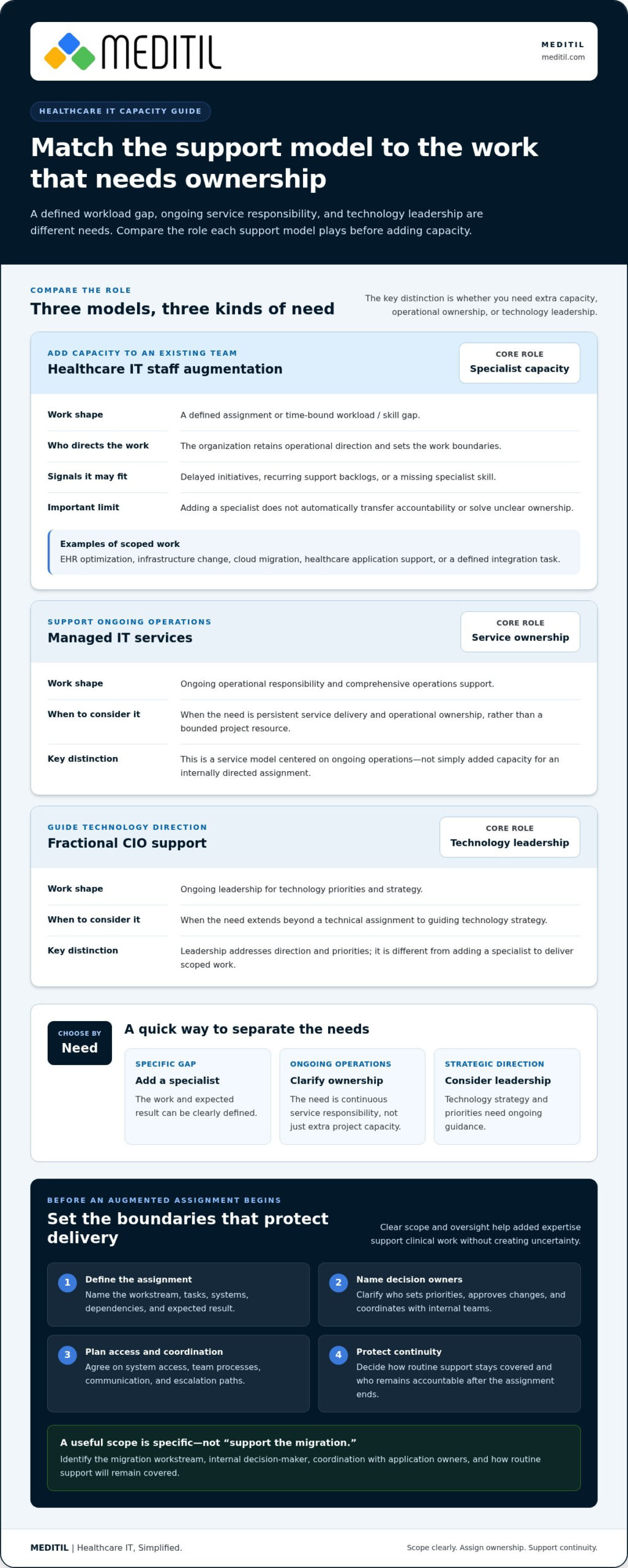
These support models address different needs. The key distinction is whether your organization needs added capacity for defined work, ongoing operational management, or strategic direction. Choosing based on the problem to solve helps prevent a mismatch, such as expecting a specialist assigned to a project to own the entire IT environment.
With healthcare IT staff augmentation, your organization retains operational direction while an added professional contributes scoped capacity. Managed services shift responsibility for ongoing operational work to a provider. MEDITIL’s Managed Services (Ongoing) include a fully managed IT department, proactive network monitoring, patch management, SLA-based support, and vendor management. Fractional CIO support, in contrast, provides strategic guidance. It can help clarify priorities, but it isn’t a substitute for hands-on technical capacity to execute a project.
When does staff augmentation fit better than managed services?
Choose augmentation when a specific project, workload surge, or skill gap needs additional capacity and your organization can direct the work. Ongoing managed support is a better fit when the need includes continuing operational management, such as network monitoring, patch management, and service support. The managed IT services for healthcare guide provides more detail on the operational model.
When should healthcare leaders consider fractional CIO support?
Consider strategic leadership when the challenge is deciding what to prioritize, how initiatives fit together, or where technology planning should focus. A fractional CIO can help establish direction before an organization commits resources to staffing or implementation. That guidance doesn’t itself deliver hands-on project execution. Leaders weighing this need can explore virtual CIO services for healthcare to understand the strategic leadership role.
How to scope healthcare IT augmentation with security and continuity in mind
Additional personnel can expand capacity, but they also require deliberate security and coordination. Access, accountability, and handoffs shouldn’t be left to assumption. A clear scope gives the specialist useful direction while helping the organization protect sensitive systems and maintain continuity. Staffing alone doesn’t establish HIPAA compliance; the organization remains responsible for its oversight and compliance processes.
Use this sequence to prepare the engagement:
- Define the need. State the operational problem or project outcome the added resource will address. Separate essential work from tasks that can wait.
- Document the scope. Record assigned tasks, boundaries, priorities, dependencies, deliverables, and the systems involved. Clarify what requires internal review or approval.
- Assign oversight. Name an accountable internal contact who coordinates work, resolves priority conflicts, and connects the specialist with affected teams.
- Plan access and continuity. Align permissions with assigned responsibilities and existing security processes. Decide how routine work, escalations, and documentation will be handled during the engagement.
- Review results and handoff. Assess progress against agreed measures, capture unresolved items, and plan knowledge transfer before the work concludes or changes.
What should the scope and success measures specify?
A useful scope is specific enough to guide work without expanding into general ownership of the IT environment. Describe the task, systems and workflows affected, exclusions, accountable contacts, and expected deliverables. For an integration assignment, clarify which workstream is in scope and who approves decisions that affect connected systems. Measures should match the assignment, such as completion of agreed milestones or continuity of a support workflow. Set them with the internal owner rather than relying on generic benchmarks or promised outcomes.
Also define how scope changes will be handled. If a new dependency emerges or priorities shift, the team needs a clear route to review the impact and agree on next steps. That keeps requests visible and helps prevent informal work from expanding beyond the original assignment.
How should access and operational oversight be planned?
Before work begins, map the systems and information required for each responsibility. Apply the organization’s access approval, authentication, monitoring, and review processes. Avoid broad permissions that aren’t needed for the defined work. Establish who supervises activity, how relevant work is documented, and how concerns or incidents are escalated to the appropriate internal contact. Coordinate communication with clinical and IT stakeholders whose workflows may be affected.
Plan the exit as carefully as the start. Decide how access will be reviewed or removed when responsibilities change, what records and decisions must be handed over, and who will own remaining tasks. These steps support continuity without assuming that an external resource replaces internal governance. For wider program planning, MEDITIL’s healthcare cybersecurity services guide offers related security context.
For scoped, healthcare-focused capacity, explore MEDITIL’s on-demand IT staffing alongside a defined access and oversight plan.
How MEDITIL supports healthcare IT teams with on-demand staffing
Healthcare IT capacity needs vary by project and operational pressure. MEDITIL provides on-demand IT staffing as part of a broader healthcare IT support portfolio, so organizations can align added expertise with defined work and related support needs. MEDITIL has a 100% focus on healthcare IT environments and brings healthcare-specific context to staffing and technology services. Its services are HIPAA-compliant and HIPAA-ready, with security and responsibilities shaped around the engagement.
That combination matters when an initiative touches more than one part of the environment. A project may involve infrastructure dependencies, application support, and coordination with internal teams. The goal is to match the resource and support model to the work, rather than treat added headcount as a complete solution on its own.
How can MEDITIL align added capacity with healthcare operations?
MEDITIL’s resource fulfillment can complement infrastructure and network services, healthcare application support, and systems integration. For example, added capacity can support a defined infrastructure workload while the organization coordinates clinical priorities, or contribute to an application or integration initiative alongside internal stakeholders. The appropriate support depends on the healthcare IT need and how it fits the organization’s operations.
MEDITIL also supports cloud environments and EMR/EHR hosting and optimization. These are service capabilities, not software or EMR/EHR product sales. Support can be tailored to the organization’s healthcare IT needs, with scope and responsibilities established around the work. This allows staffing to sit alongside project-based implementation or ongoing operational support, rather than being treated as a one-size-fits-all engagement.
For ongoing operations, MEDITIL’s Managed Services (Ongoing) include:
- A fully managed IT department.
- Proactive network monitoring and patch management.
- SLA-based support and vendor management.
This is a distinct option when the need extends beyond a scoped resource to continuing IT operations support. Organizations can align added staffing with these broader services based on the work they need covered.
What evidence can support a considered next step?
MEDITIL reports a 95% reduction in downtime for urgent care clients. This is a specific client result, not a guaranteed outcome, and it isn’t attributed to staffing alone. It offers context for MEDITIL’s experience supporting healthcare IT environments while underscoring why project scope, operational ownership, and service fit should be considered together.
MEDITIL’s approach is captured in “Smart. Secure. Scalable.” and “Healthcare IT, Simplified.” If your team is assessing a defined capacity gap or broader support needs, discuss healthcare IT staffing and support with MEDITIL.
Move forward with a clear support plan
Connect the capacity gap to the operational outcome your team needs. Identify the work that should move forward, the internal owner who will guide it, and the support your clinical environment must maintain. That gives you a practical starting point for deciding whether healthcare IT staff augmentation, ongoing managed support, or strategic guidance best fits.
MEDITIL has a 100% focus on healthcare IT environments and provides HIPAA-compliant and HIPAA-ready services. Its experience includes a 95% reduction in downtime for urgent care clients, a specific client result rather than a promised outcome of staffing. These points offer context as you consider support that fits your organization’s needs.
Share your priorities and discuss a support approach with MEDITIL. Discuss your healthcare IT needs with MEDITIL and take a considered next step toward dependable technology operations.
Frequently Asked Questions
What is healthcare IT staff augmentation?
Healthcare IT staff augmentation brings external technical expertise into a healthcare organization’s team for defined work. For example, a specialist might help an internal team address a specific application-support workload while the organization retains operational direction. It isn’t the purchase of software or an EHR platform, and it doesn’t automatically make the added professional responsible for the whole IT environment. Define the assignment, decision authority, and handoff before work begins.
When should a healthcare organization use IT staff augmentation?
Consider it when a defined project or workload needs capacity or expertise your current team can’t readily provide without disrupting other priorities. A team preparing for an application update, for instance, may need extra support for related technical tasks while maintaining its usual work. If the gap reflects a continuing need for operational ownership or technology strategy, compare managed services or fractional CIO support instead of treating temporary capacity as the answer.
Is healthcare IT staff augmentation HIPAA-compliant?
Staff augmentation by itself doesn’t establish an organization’s HIPAA compliance. The organization should apply its own security and oversight processes to the engagement, including appropriate access, documented responsibilities, and clear procedures for handling concerns. MEDITIL’s services are HIPAA-compliant and HIPAA-ready. That description doesn’t replace the organization’s broader compliance program or determine how a particular engagement should be governed. Align the work with applicable requirements and internal controls.
How does healthcare IT staff augmentation differ from managed services?
Staff augmentation adds technical capacity to work your organization directs, while managed services provide ongoing operational support under defined service responsibilities. An augmented specialist may contribute to a project while your team manages priorities. Managed support may cover continuing functions such as network monitoring, patch management, SLA-based support, and vendor management. Choose based on whether the need is bounded project capacity or continuing operational management, and make ownership clear.
Can augmented IT staff support an EHR implementation or optimization project?
Yes. Added healthcare IT capacity can contribute to scoped work involving EMR/EHR implementation, hosting, optimization, application support, or systems integration. For an optimization effort, define the technical tasks separately from clinical or operational decisions, and identify who approves changes affecting workflows. MEDITIL provides EMR/EHR-related services and implementation support, not EMR/EHR software products. Clarify access, dependencies, documentation, and handoff expectations so internal teams can support the environment after project tasks are complete.
How should we measure whether healthcare IT staff augmentation is working?
Measure progress against the assignment’s agreed deliverables, not a generic benchmark. Depending on the work, useful indicators may include completion of project milestones, resolution of assigned support items, quality of handoff documentation, or whether the affected workflow continued as planned. Set a baseline where relevant, name who reviews progress, and agree when reviews occur. If priorities change, revise the measures with the scope so the assessment reflects the work actually assigned.