
What should you look for when an IT provider says it supports HIPAA compliance? Finding a HIPAA compliant IT company means looking beyond a label to understand how the provider protects sensitive information, documents its work, and supports your organization’s responsibilities.
An IT partner can help strengthen security, maintain systems, and support documentation, but hiring a provider doesn’t transfer the healthcare organization’s responsibility for HIPAA compliance. A business associate agreement matters, too, but it isn’t proof of compliance on its own.
This guide explains how to assess a prospective partner’s HIPAA-related practices, compare service models, and make a decision you can document. You’ll learn how to distinguish meaningful evidence from general assurances, clarify responsibilities shared between your organization and its IT partner, and consider whether managed services, augmented support, or fractional CIO guidance fits your needs. The goal is a practical evaluation grounded in security, continuity, and healthcare workflows.
Key Takeaways
- Finding a HIPAA compliant IT company starts with assessing accountable practices, not relying on a compliance label.
- Compare prospective partners using evidence of clear ownership, written procedures, reporting, and defined service boundaries.
- Review contract scope, BAA terms, subcontractor involvement, incident coordination, and exit provisions before making a decision.
- Match the service model to your organization’s needs, whether that means managed IT, added team capacity, or fractional CIO guidance.
- Connect security planning with healthcare infrastructure and daily workflows to support a complete, documented decision.
Finding a HIPAA-Compliant IT Company Starts With Understanding the Responsibility
Finding a HIPAA compliant IT company starts with a practical distinction: an IT partner can help implement and manage safeguards, but it can’t take over a healthcare organization’s full responsibility for protecting health information. A partner may support infrastructure, access controls, backups, or incident response. The important questions are how those responsibilities are defined, carried out, and documented over time.
There’s no simple HIPAA certification that makes an IT provider a compliant company. Broad claims such as “HIPAA compliant” don’t explain which safeguards are in place, who maintains them, or how gaps are addressed. A compliance claim is a statement; documented, ongoing practices show how responsibilities are put into action. Evaluate the evidence and division of duties, not just the label.
Technology responsibilities also depend on how systems handle protected health information (PHI). For example, a telehealth workflow may transmit patient data to a cloud environment. Wikipedia’s overview of Masimo describes SafetyNet transmitting data to a HIPAA-compliant cloud platform, illustrating how technology services can intersect with PHI. The specific safeguards and contractual responsibilities depend on the organizations and services involved.
When an IT provider may be a business associate
HHS uses the term business associate for a person or organization that performs certain functions or services for a covered entity involving PHI. If an IT provider creates, receives, maintains, or transmits PHI on the covered entity’s behalf as part of its work, a business associate relationship may apply, and a business associate agreement (BAA) may be required. The determination depends on the provider’s actual functions and access, so confirm the specifics with qualified privacy or legal counsel.
Why a BAA is necessary but not a complete evaluation
A BAA sets contractual boundaries for permitted uses and disclosures of PHI, safeguards, and each party’s responsibilities. It is an important part of the relationship, but signing one doesn’t establish that either organization has effective safeguards in practice. The covered entity still needs to address its own risk analysis, workforce controls, policies, and oversight; the provider must carry out its agreed security responsibilities.
Review the agreement alongside the provider’s operating scope. Identify which systems and data the provider can access, how responsibilities are assigned, and how incidents will be coordinated. Also consider whether the provider’s work connects security with infrastructure and day-to-day healthcare operations. MEDITIL’s healthcare cybersecurity services support that broader view of security and compliance. Next, examine how safeguards are managed in routine operations.
What a HIPAA-Focused IT Partner Should Manage Day to Day
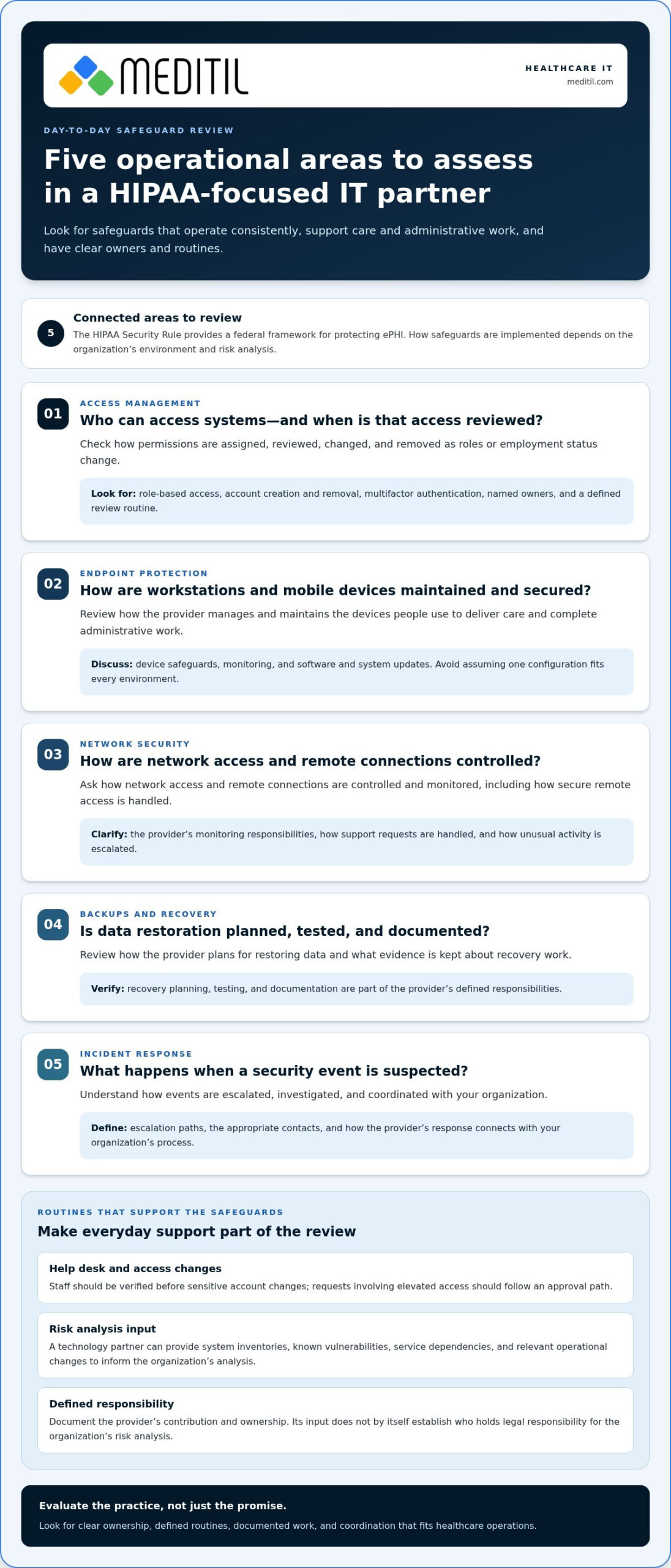
Safeguards matter when they operate consistently across the systems people use to deliver care and complete administrative work. A practical review of a healthcare IT partner should look beyond infrastructure features to the routines that maintain protection, identify issues, and support recovery. The HIPAA Security Rule provides the federal framework for protecting electronic protected health information (ePHI); an organization’s implementation depends on its environment and risk analysis.
Organize your review around five connected areas:
- Access management: How permissions are assigned, reviewed, changed, and removed as roles or employment status change.
- Endpoint protection: How workstations and mobile devices are managed, maintained, and secured.
- Network security: How network access and remote connections are controlled and monitored.
- Backups and recovery: How data restoration is planned, tested, and documented.
- Incident response: How suspected security events are escalated, investigated, and coordinated with the organization.
Security operations, access, and workforce support
Ask how the partner supports role-based access, account creation and removal, and multifactor authentication. If a staff member changes roles, for example, their system permissions may need to change. When an employee leaves, access may need to be removed promptly under the organization’s process. These controls should have named owners and a defined review routine, rather than depending on informal requests.
Endpoint and network safeguards also require ongoing attention. Discuss how the provider handles monitoring, software and system updates, secure remote access, and support requests. Avoid assuming one configuration suits every environment. Help desk procedures are part of this picture: staff should be verified before sensitive account changes, requests involving elevated access should follow an approval path, and unusual activity should be escalated to the appropriate contact. Clear processes help protect information without unnecessarily obstructing clinical work.
Risk analysis, incident response, and continuity
A technology partner can provide useful information for the organization’s security risk analysis, such as system inventories, known vulnerabilities, service dependencies, and relevant operational changes. That input can help the organization understand where ePHI may be exposed and what needs attention. Define the partner’s contribution clearly; it doesn’t by itself establish who holds legal responsibility for the organization’s analysis.
Incident readiness depends on written coordination. Review how staff report suspected events, who receives escalations, how the partner shares relevant facts, and how notification decisions are coordinated with the organization. Set out responsibilities before an event occurs.
Continuity planning deserves the same operational focus. Backups are useful only if restoration is feasible and tested. Look for a documented approach to backup testing, recovery planning, and restoration exercises, including records of what was tested and any follow-up actions. Restoring access to clinical systems and administrative records can affect appointment workflows, documentation, and billing. Documented risk management is meaningful when it connects to recurring operational controls, review, and follow-through.
For organizations aligning infrastructure, security, and daily healthcare workflows, healthcare-focused IT support can provide a coordinated basis for that work.
How to Compare Healthcare IT Companies Using Evidence
A consistent comparison makes it easier to separate operational capability from persuasive language. For each prospective partner, record the evidence provided, who owns the work, whether procedures are written, how often reporting occurs, and where the service boundary sits. Apply the same criteria to each candidate. The NIST HIPAA Security Rule guidance can help frame questions about technical safeguards without treating any single credential or document as proof of overall compliance.
Use a comparison matrix to organize what you learn. Score each dimension on a simple scale, such as 0 for no evidence, 1 for a general description, and 2 for specific, reviewable evidence. Use the scale as a decision aid, not as a compliance rating.
| Dimension | Evidence to compare |
|---|---|
| Governance | Named owners, written responsibilities, review processes, and service boundaries. |
| Security operations | Documented access controls, monitoring, update procedures, event handling, and remediation follow-through. |
| Support | Help desk workflows, identity verification, escalation paths, and communication with your staff. |
| Continuity | Backup and recovery procedures, restoration testing, and records of follow-up actions. |
| Healthcare experience | Relevant experience supporting healthcare applications, EHR workflows, integrations, and clinical or administrative users. |
Evidence that makes a provider’s claims assessable
Look for examples that show how work is performed and recorded. Depending on the service scope, this might include redacted procedures, risk-related documentation, escalation guidance, or sample service reports. Check whether access reviews have an owner and record, security events are tracked, and remediation items have documented follow-through. A polished policy alone is less informative than a process showing who acts, when, and how completion is recorded.
Also map the service relationship beyond the primary provider. Determine whether subcontractors may handle systems or information, how their responsibilities are addressed, and how applicable BAAs fit into the arrangement. A clear scope helps prevent important tasks from falling between organizations.
Fit for your practice, systems, and service model
Technical evidence matters most when it fits actual workflows. Compare support for healthcare applications, EHR coordination, system integrations, and user needs against the way your teams work. For example, when connecting clinical SaaS platforms like TeleDIETS, an integration change may affect both clinical information flow and billing processes, so clarify how coordination and support responsibilities are assigned.
Then distinguish the proposed model: fully managed services, co-managed support alongside internal staff, project-based work, or strategic advisory. Each creates a different division of responsibility. Identify who approves changes, communicates incidents, maintains documentation, and handles routine support. The managed IT services for healthcare guide provides additional context for comparing service models. When finding a HIPAA compliant IT company, prioritize a partner whose documented scope fits your systems, people, and operational needs.
Due Diligence Before Choosing a HIPAA-Supporting IT Company
A disciplined diligence process turns a promising proposal into a clear operating plan. Before selecting a partner, document your current environment: systems that store or transmit protected health information, data flows, business-critical applications, key integrations, and internal owners. This baseline helps reveal where responsibilities may overlap or where an important task could be left unassigned.
Work through the decision in sequence:
- Define the scope. List the systems, locations, users, and workflows the provider is expected to support. Identify what remains with internal staff or other vendors.
- Compare the proposed work with your needs. Match service descriptions to the documented environment, including support, security operations, and project responsibilities.
- Review contract and BAA terms. Check that the agreement reflects actual services, PHI access, subcontractor involvement, incident coordination, and each party’s responsibilities.
- Resolve operational details. Document support hours, escalation routes, reporting expectations, change approvals, and who communicates with clinical and administrative teams.
- Plan for transition and exit. Assign owners and sequence onboarding tasks. Record how access is removed, data is returned or destroyed as applicable, and transition assistance is handled when the relationship ends.
Have qualified legal counsel review contractual language and interpret legal obligations. Regulatory requirements and guidance can change, so verify current authoritative guidance during diligence rather than relying on a vendor’s summary or an outdated checklist.
Questions to resolve in scope and contract review
Make the service boundary specific. Clarify which systems are managed, how support requests are handled, who approves changes, and how issues are escalated and reported. Compare the BAA with the contract’s scope: do the documents address the provider’s access, relevant subcontractors, and incident coordination consistently? Write down end-of-contract steps for data handling, account removal, and knowledge transfer to reduce ambiguity later.
Plan a controlled transition without disrupting care
Build an inventory that includes accounts, endpoints, networks, cloud services, EHR dependencies, and critical integrations. Then assign transition owners, sequence activities around operational dependencies, define access controls and communication channels, and agree on rollback considerations before changes begin. A healthcare cybersecurity services guide can help connect transition planning with security considerations, such as protecting access and maintaining visibility as systems change.
During onboarding, track decisions, open risks, dependencies, and completed handoffs in a shared record. For example, a system integration may rely on credentials or vendor coordination that isn’t apparent from an application list alone. Recording those dependencies helps teams plan sequencing and identify who must participate before a change is made. A controlled transition is not just a technical handoff; it should preserve the knowledge and communication needed to support clinical and administrative work.
For healthcare organizations planning a partner evaluation or transition, discuss healthcare IT planning with MEDITIL.
How MEDITIL Supports Healthcare IT, Security, and Compliance
Healthcare IT decisions connect security with the systems and workflows people rely on every day. MEDITIL supports healthcare organizations across infrastructure, cybersecurity and compliance, end-user support, healthcare applications, and strategic planning. This scope helps organizations consider technical safeguards alongside system availability, user needs, and operational priorities.
MEDITIL’s services are not a certification or a guarantee of HIPAA compliance. The organization remains responsible for its own compliance program, including decisions about its policies, risk management, and oversight. MEDITIL provides IT services and compliance-related support within an agreed scope, with responsibilities documented between the organization and its partner.
Connect infrastructure and security to healthcare operations
Network and cloud services provide the foundation for connected systems, while cybersecurity and end-user support address protection and the practical needs of staff. Healthcare application support and systems integration add another layer: an application or interface may affect how clinical information moves, how administrative teams work, and how connected services operate. Whether managing specialized platforms like Datascan Pharmacy Software or broader EHR tools, considering these elements together keeps technology decisions grounded in healthcare workflows.
For organizations seeking strategic technology leadership alongside operational support, MEDITIL’s virtual CIO services for healthcare provide context for aligning IT planning with organizational priorities. Strategic guidance can help define initiatives and clarify how technology work fits broader needs.
Choose a practical engagement model and next step
The right engagement depends on existing staff, systems, and the work that needs attention. MEDITIL can manage IT operations through ongoing managed services, augment an internal team with additional IT capacity, or provide fractional CIO guidance for technology planning. Project-based consulting can support a defined initiative, such as infrastructure work, systems integration, or EHR implementation and training.
These options represent different scopes, not interchangeable labels. An organization seeking ongoing operational ownership may consider managed IT. A team with internal leadership but limited capacity may benefit from augmented support. Fractional CIO guidance can help with strategic direction, while project-based consulting focuses on a defined body of work. The engagement can be tailored to the organization’s existing capabilities and priorities, with responsibilities and service boundaries established clearly.
As you continue finding a HIPAA compliant IT company, use the same evidence-based approach to assess whether a partner’s capabilities fit your operational needs. Connect the desired work to defined ownership, communication, and documentation. MEDITIL’s healthcare-focused services span infrastructure, security, application support, integration, and planning, supporting a coordinated discussion about priorities while recognizing that no provider can ensure compliance on the organization’s behalf.
Discuss your healthcare IT priorities with MEDITIL to explore an engagement aligned with your organization’s systems, team, and operational needs.
Turn Your IT Review Into a Clear Next Step
Use your evaluation to create a practical roadmap: identify the most important gaps, assign internal owners, and decide which work should happen first. That plan can guide discussions with leadership and help ensure a future IT engagement supports both security priorities and the daily needs of your organization.
Finding a HIPAA compliant IT company is not about transferring responsibility through a contract. It’s about building a working relationship with clear roles, relevant evidence, and services that fit your healthcare environment. MEDITIL brings together healthcare-focused managed IT, infrastructure, network, and cybersecurity support, with options for ongoing management, team augmentation, fractional CIO guidance, and project-based consulting. Its healthcare IT services include EHR implementation, systems integration, and application support.
Start with the priorities your organization has identified and the outcomes you need from an IT partner. Discuss your healthcare IT priorities with MEDITIL and take the next step toward a well-planned, clearly documented approach.
Frequently Asked Questions
Is there an official HIPAA certification for IT companies?
No. HIPAA doesn’t provide a simple government certification that makes an IT company compliant. A provider may point to audits, security controls, or other credentials, but each has a defined scope and should be assessed in context. For example, an audit of one hosting environment doesn’t necessarily describe the provider’s help desk or incident processes. Healthcare organizations retain responsibilities, too. Check current HHS guidance and consult qualified legal counsel about your specific situation.
Does a HIPAA-compliant IT company need to sign a BAA?
Generally, a Business Associate Agreement is required when an IT provider’s functions make it a business associate under HIPAA. The relationship depends on what services the provider performs and whether it creates, receives, maintains, or transmits protected health information on the organization’s behalf. A provider supporting a system with PHI may present different considerations from one with no access to that information. Have qualified counsel review the arrangement and agreement terms.
Does signing a BAA make a healthcare organization HIPAA compliant?
No. A BAA records obligations between the parties, but it can’t substitute for the organization’s own compliance and security work. For example, the agreement doesn’t establish that staff follow appropriate procedures or that the organization has addressed risks across its systems. The provider and healthcare organization each have responsibilities based on their roles. Treat the BAA as one part of a broader program, and evaluate whether actual practices support the written commitments.
What should I look for when finding a HIPAA-compliant IT company?
Look for a clear match between the provider’s scope and your healthcare environment. When finding a HIPAA compliant IT company, consider how its experience applies to your applications and workflows, how security responsibilities are documented, and how it reports work or escalates concerns. For example, if a support team can change user access, understand how requests are authorized and recorded. Also review subcontractor involvement and applicable agreements, then compare the same evidence across candidates.
Can a managed IT provider guarantee HIPAA compliance?
A managed IT provider can support security and compliance-related work, but a blanket guarantee can’t account for every organization’s workforce, policies, systems, and operating decisions. A provider might manage defined technical tasks while the organization retains responsibility for other controls and oversight. Instead of relying on an assurance alone, establish responsibilities in writing, examine evidence that fits the service scope, and seek qualified legal or compliance advice for organization-specific interpretations.
What is the difference between HIPAA hosting and managed healthcare IT?
HIPAA-oriented hosting generally concerns the infrastructure used to host systems or data and the controls associated with that environment. Managed healthcare IT can extend to networks, cloud services, user support, cybersecurity, application support, integrations, and strategic planning. The exact scope varies. A useful comparison is whether the service covers only the hosted environment or also the people and connected systems that support care delivery and administration. Map those boundaries before assigning responsibilities.