
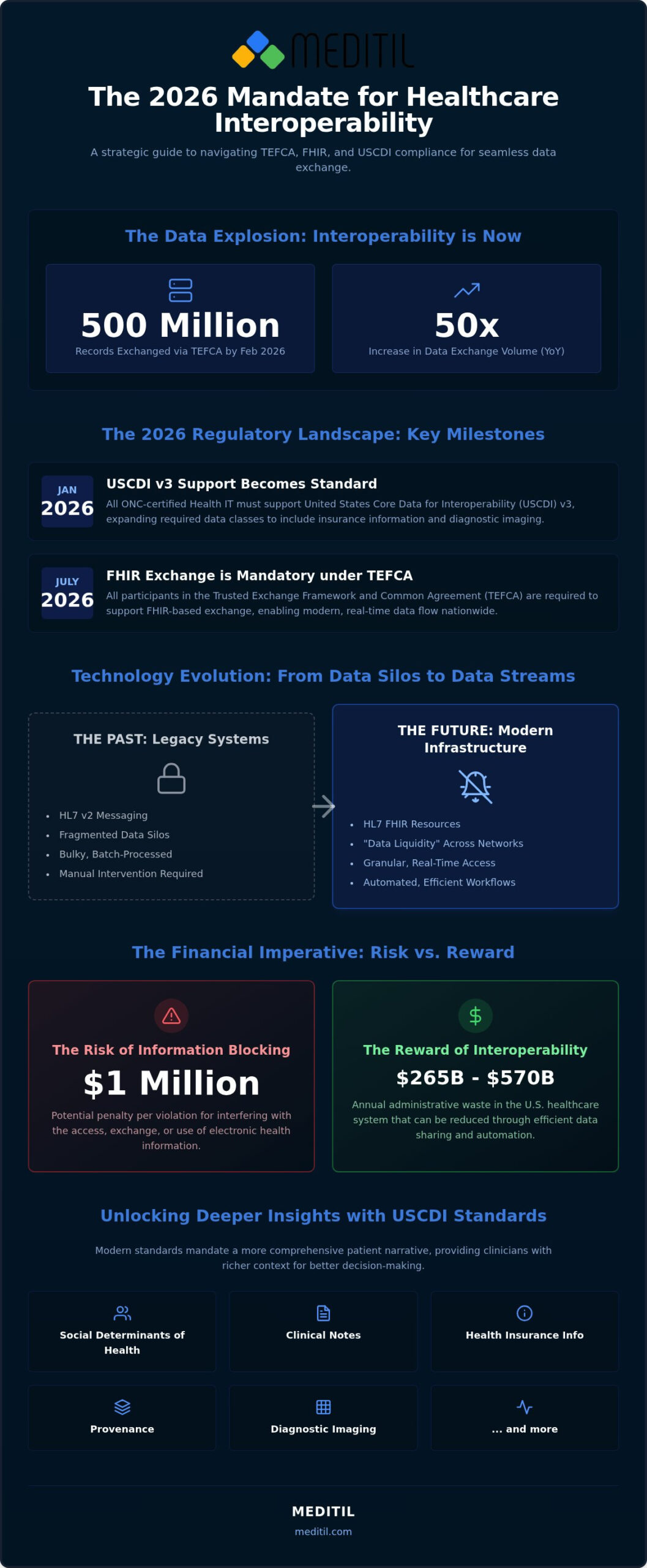
By February 2026, data exchange volume through the Trusted Exchange Framework and Common Agreement (TEFCA) reached 500 million records, representing a 50x increase from the previous year. This rapid shift proves that nationwide interoperability is no longer a future objective but a present operational requirement. You likely understand that fragmented data silos and the technical debt of legacy systems are direct threats to both patient safety and your bottom line. Implementing expert hie integration services is now a strategic necessity to bridge these gaps and avoid the $1 million penalties associated with information blocking.
It’s clear that the pressure to meet the July 2026 TEFCA FHIR requirements and the latest USCDI v3 standards feels overwhelming. This article provides a definitive roadmap to help you master these complexities. We’ll ensure your organization achieves full regulatory compliance and seamless clinical data flow. We’ll also examine how to transition toward FHIR-native architectures and automate data retrieval to reduce clinician burnout. Finally, we’ll look at building a scalable infrastructure that supports your long term goals for telehealth expansion and remote monitoring.
Key Takeaways
- Understand how the shift toward mandatory interoperability under TEFCA transforms hie integration services into a critical strategic pillar for 2026 compliance.
- Learn why transitioning to HL7 FHIR and the latest USCDI standards is essential for maintaining a secure and modern data exchange infrastructure.
- Differentiate between directed and query-based exchange models to optimize your clinical workflows and facilitate more efficient patient referrals.
- Follow a structured five-step roadmap to assess existing technical debt and establish the governance required for a seamless flow of information.
- Discover how strategic advisory and fractional CIO services can align your organization’s technical capabilities with long-term operational stability.
Understanding HIE Integration Services in the 2026 Regulatory Landscape
The secure exchange of electronic health information across disparate systems is the foundation of modern care delivery. This process, facilitated by specialized hie integration services, ensures that a patient’s medical history follows them regardless of where they seek treatment. In 2026, the industry has moved past elective participation. Interoperability is now a mandated standard driven by federal oversight and the maturation of national networks. Effective Health Information Exchange (HIE) practices turn clinical data into a liquid asset, allowing for real-time decision support and improved patient safety.
2026 stands as a watershed year for healthcare leaders. As of January, all health IT certified under the ONC program must support USCDI v3, which introduces critical data classes like health insurance information and diagnostic imaging. For organizations still relying on siloed data, the risk isn’t just clinical; it’s regulatory. The maturation of Qualified Health Information Networks (QHINs) has created a standardized environment where data must flow freely to remain compliant with federal patient access rights.
The Role of TEFCA in Nationwide Data Exchange
The Trusted Exchange Framework and Common Agreement (TEFCA) provides the legal and technical baseline for sharing data at scale. It establishes a single “on-ramp” to nationwide connectivity, reducing the need for hundreds of individual bilateral agreements. For mid-sized healthcare organizations, connecting to a QHIN through professional hie integration services simplifies the technical burden. It allows smaller entities to access the same robust data streams as large academic centers without the prohibitive cost of custom builds. By July 2026, TEFCA requires all participants to support FHIR-based exchange. This shift ensures that your infrastructure is ready for the high-volume, real-time demands of modern medicine.
Combatting Information Blocking Mandates
Compliance is no longer a suggestion; it’s a financial imperative. The Office of the Inspector General (OIG) now investigates complaints with the authority to levy penalties up to $1 million per violation. Information blocking occurs when a provider or developer interferes with the access, exchange, or use of electronic health information. While some leaders view these mandates as a burden, proactive organizations treat them as a strategic advantage. Interoperability reduces administrative waste, which costs the U.S. healthcare system between $265 billion and $570 billion annually. Moving toward an open data model protects your reputation and prepares your organization for future telehealth expansion. It’s about shifting the internal culture from data gatekeeping to data stewardship.
- Regulatory Alignment: Ensure your systems meet the July 2026 TEFCA FHIR requirements.
- Risk Mitigation: Avoid the heavy financial penalties of information blocking through automated data sharing.
- Operational Efficiency: Leverage USCDI v3 standards to provide clinicians with a unified patient view.
Technical Standards Powering Modern Interoperability
The transition from legacy HL7 v2 messaging to HL7 FHIR (Fast Healthcare Interoperability Resources) marks the most significant technical shift in a decade. While HL7 v2 remains a production reality for systems handling ADT feeds, FHIR R4 is the mandated standard for TEFCA participation in 2026. This shift replaces bulky, batch-processed messages with a granular, resource-based approach. This granular approach allows for “data liquidity,” where information flows where it’s needed without manual intervention. It’s the difference between sending a fax and accessing a live database. By 2026, the United States Core Data for Interoperability (USCDI) v5 has become the baseline. It mandates specific data classes to ensure that hie integration services deliver a comprehensive patient narrative:
- Social Determinants of Health: Capturing environmental and social factors affecting long-term care.
- Clinical Notes: Providing deeper context beyond simple lab results or vital signs.
- Provenance: Tracking the original source and history of every data point to ensure reliability.
True interoperability requires semantic understanding. This means the receiving system doesn’t just receive data but understands its clinical context. For a deeper look at these foundational concepts, the ONC provides an authoritative guide to HIE that outlines these technical requirements. Without this shared understanding, data becomes a liability rather than a strategic asset. Data silos must end to protect patient safety.
FHIR APIs: The Engine of Data Liquidity
Modern healthcare relies on a “plug-and-play” ecosystem driven by RESTful APIs. These interfaces allow EMRs to communicate with third-party applications as easily as a smartphone connects to a cloud service. Standardized API implementation reduces the technical debt often associated with legacy systems. Instead of building expensive, custom point-to-point interfaces, organizations can leverage a single FHIR-based gateway. This architecture supports real-time data access. It’s critical for reducing clinician burnout and improving point-of-care decisions. By adopting these standards, healthcare leaders future-proof their infrastructure against upcoming changes in telehealth and remote monitoring.
Data Mapping and Standardization Challenges
The primary hurdle in 2026 remains the gap between legacy databases and modern FHIR resources. Data is often trapped in non-standard formats that require intensive mapping before it can be exchanged. Clean data management is the only way to ensure that clinical analytics and AI tools produce reliable results. MEDITIL acts as a steady hand during these transitions, specializing in hie integration services that manage complex data transformation projects. If your team is struggling with technical debt, our systems integration and interoperability experts can help bridge the gap to modern standards. We focus on creating a scalable framework that protects your data integrity while meeting every regulatory deadline.
Strategic Models for Health Information Exchange
Choosing the right exchange model is a foundational decision that dictates your organization’s workflow efficiency and data accessibility. Most leaders rely on a combination of three functional models to meet their clinical needs. Directed Exchange allows providers to securely push encrypted patient information directly to another known healthcare professional. This is most common during coordinated care events like specialist referrals or sending discharge summaries to primary care physicians. It’s a proactive method of ensuring the next link in the care chain has the necessary context.
In contrast, Query-Based Exchange enables providers to search for and pull patient records from other organizations. This model is indispensable for emergency departments where immediate access to a patient’s history can be life-saving. Finally, Consumer-Mediated Exchange empowers patients to aggregate and manage their own health records. By providing patients with digital access to their data, organizations fulfill federal access requirements while improving engagement. Understanding Health Information Exchange (HIE) models helps leaders identify where their current infrastructure falls short and where hie integration services can bridge those gaps.
Healthcare leaders face a critical “build vs. partner” dilemma. Building custom hie integration services in-house offers maximum control, but it often results in high technical debt and prohibitive maintenance costs. Partnering with a specialist allows your team to focus on clinical outcomes while experts handle the complex infrastructure required for TEFCA compliance. This strategic partnership ensures that your data exchange remains a reliable asset rather than a technical burden.
Centralized vs. Federated HIE Architectures
Architectural choices impact both speed and security. A centralized HIE maintains all patient data in a single repository, which offers high-speed querying but creates a single point of failure. Conversely, a federated model keeps data at the source, retrieving it only when requested. This decentralized approach enhances data sovereignty and security, as there’s no massive central database to target. Many modern systems use a hybrid approach to balance these priorities, keeping some core metadata centralized while clinical details remain distributed.
Evaluating HIE Service Providers
Selecting a partner requires a deep dive into their cybersecurity posture and technical reliability. You should prioritize providers who demonstrate a steady hand during high-stakes data migrations. A partner’s ability to maintain uptime and ensure semantic accuracy is vital for clinical safety. Integrating managed IT services for healthcare ensures that your exchange environment remains stable and secure. Look for partners who act as strategic consultants, helping you navigate the evolving regulatory landscape rather than just providing a technical connection.
A 5-Step Roadmap for Successful HIE Integration
Successful interoperability isn’t a single event. It’s a disciplined sequence of strategic and technical milestones. Many organizations falter because they treat hie integration services as a simple software installation rather than a comprehensive infrastructure overhaul. A structured roadmap ensures that every stakeholder, from the IT department to the clinical floor, understands their role in the data exchange ecosystem. This methodical approach minimizes disruption and maximizes the return on your technical investment.
The first step is a rigorous assessment of your current technical debt. You must audit your EMR’s native capabilities and identify legacy protocols that might hinder FHIR-based communication. Following this, you must establish clear governance. This defines who owns the data and which entities have the authority to access it. Implementation follows, focusing on deploying FHIR-based gateways that act as the primary translator between your internal systems and the national networks. Validation ensures that every data packet maintains its integrity and remains HIPAA-compliant during transit. Finally, optimization ensures that the data is actually usable by your staff in real-time environments.
Phase 1: Infrastructure Readiness and Security
Hardening your network is the first priority. Increased data traffic from external queries can strain existing bandwidth and expose new vulnerabilities. It’s essential to align your HIE goals with robust healthcare cybersecurity services to protect against evolving threats. Identifying “low-hanging fruit,” such as automating common referral patterns, provides immediate interoperability wins that build organizational momentum. These early successes prove the value of the investment to stakeholders who may be wary of large-scale IT projects.
Phase 2: Workflow Integration and Clinician Training
A common pitfall in these projects is the “data dump” syndrome. Simply providing more data isn’t helpful if it isn’t actionable or easily accessible. Successful hie integration services present external records directly within the existing EHR workflow. This reduces physician burnout by eliminating the need to log into separate portals. Automated record retrieval ensures that the care team has a unified patient view before the first appointment begins. We measure success through specific clinical outcome metrics, such as reduced duplicate testing and faster discharge times. This ensures the technology serves the mission of care rather than becoming an administrative burden.
If you’re ready to modernize your data exchange framework, our project-based IT consulting team can provide the technical expertise and strategic guidance needed for a seamless transition.
MEDITIL: Your Strategic Partner for Interoperability
MEDITIL serves as a specialized extension of your leadership team, providing the technical confidence required to navigate 2026’s complex regulatory environment. Our hie integration services don’t just connect systems; they align your clinical data exchange with your broader financial objectives. By bridging the gap between clinical interoperability and billing automation, we ensure that your data flow supports both patient care and revenue cycle health. This holistic view prevents the common mistake of treating IT projects as isolated technical tasks. We focus on creating a unified patient view that empowers your staff while protecting your bottom line.
The Value of a Fractional CIO for HIE Projects
High-stakes integrations demand strategic oversight that goes beyond simple coding. A fractional CIO from MEDITIL manages the entire vendor landscape, acting as your primary advocate when dealing with various EHR providers. We ensure your hie integration services are built on a foundation of clean data that feeds directly into your business intelligence and analytics goals. This leadership ensures that technical debt is reduced rather than accumulated during the transition to FHIR standards. It’s about having a steady hand at the wheel to guide long-term outcomes. We help you navigate the vendor landscape to ensure that your specific needs are met without unnecessary custom development costs.
Beyond Integration: Managed Healthcare IT
Beyond the initial deployment, we focus on the continuous stability and protection of your infrastructure. Interconnected ecosystems require a proactive approach to cybersecurity to protect against data breaches during exchange. Our ongoing support ensures that your connections remain active, secure, and compliant with the latest OIG standards. We also assist with strategic IT budgeting to ensure your technology remains a predictable asset. As your organization grows, we scale your infrastructure to support future innovations like remote monitoring and advanced telehealth. Our team remains a constant partner, ensuring that every technical detail is handled with precision.
Schedule a consultation with our interoperability experts to secure your organization’s digital future.
Securing Your Organization’s Future Through Interoperability
The shift toward mandatory interoperability in 2026 requires more than just technical compliance; it demands a comprehensive strategic vision. We’ve explored how transitioning to HL7 FHIR and USCDI v3 standards protects your organization from information blocking penalties while significantly reducing clinician burnout. By following a structured roadmap, healthcare leaders can turn complex data silos into a unified clinical asset that supports long-term growth. Professional hie integration services provide the steady hand at the wheel needed to manage these high-stakes transitions without disrupting patient care.
As you navigate the complexities of TEFCA and QHIN participation, having a specialized partner is essential. MEDITIL offers managed IT experts who are deeply familiar with healthcare regulations and provide strategic vCIO leadership for your interoperability journey. Our team has a proven track record in EMR/EHR system optimization, ensuring your infrastructure is both secure and scalable. It’s time to move beyond fragmented systems and embrace a connected clinical environment.
Partner with MEDITIL for Authority-Led HIE Integration and ensure your organization remains a leader in the modern healthcare ecosystem. We’re ready to help you build a stable, compliant, and connected future.
Frequently Asked Questions
What is the primary difference between HIE and interoperability?
HIE is the process of electronically moving health information, while interoperability is the ability of different systems to communicate and use that data effectively. Think of HIE as the infrastructure and interoperability as the outcome. In 2026, hie integration services are the technical means used to achieve high-level interoperability. This ensures that a patient’s record is not just sent but is also readable and actionable by the receiving clinician.
How does TEFCA impact HIE integration in 2026?
TEFCA standardizes the legal and technical requirements for nationwide data exchange, making it easier for disparate systems to connect. By July 2026, TEFCA requires all participants to support FHIR-based exchange. This shift eliminates the need for numerous bilateral agreements between individual providers. It creates a single “on-ramp” through Qualified Health Information Networks, which simplifies the integration process for mid-sized practices and ensures consistent data privacy standards across the country.
Is HIE integration mandatory for small medical practices?
While joining a specific network is often elective, the 21st Century Cures Act makes the act of sharing data practically mandatory. Small practices must comply with anti-information blocking rules, which carry penalties of up to $1 million per violation. Even if you don’t join a state HIE, your systems must be capable of responding to external data requests. Implementing hie integration services helps small practices automate these responses and avoid regulatory scrutiny.
What are the most common security risks in HIE integration?
The most frequent risks include unauthorized access at system endpoints and data breaches during transit between legacy EMRs and modern networks. Many legacy systems lack the robust encryption required for today’s threat landscape. Additionally, improper data mapping can lead to semantic errors, which compromise patient safety. A proactive cybersecurity strategy is essential to harden the network and ensure that all API connections are verified and monitored for suspicious activity.
How long does a typical HIE integration project take?
A typical project timeline usually ranges from three to nine months, depending on the complexity of your existing infrastructure. Initial assessments and technical audits take several weeks, followed by the deployment of FHIR-based gateways. The most time-consuming phase is often the validation and testing of data integrity across the exchange. Training your clinical staff and optimizing their workflows for automated record retrieval is the final step to ensure long-term stability.
Can HIE integration help reduce medical billing errors?
Yes, integration significantly reduces billing errors by ensuring that patient demographics and insurance information are accurate across all platforms. When clinical systems and billing software share a single source of truth, the risk of duplicate records or incorrect coding decreases. This synergy between clinical data and billing automation helps medical practices maintain a healthy revenue cycle. It also reduces the administrative burden of manual data entry and reconciliation.
What is a QHIN and should my practice join one?
A QHIN is a Qualified Health Information Network that serves as a central hub for nationwide data exchange under TEFCA. Joining a QHIN is highly recommended because it provides your practice with a single connection point to thousands of other providers. This reduces the cost and technical burden of maintaining multiple individual interfaces. It ensures your organization stays compliant with federal standards while gaining access to a much larger pool of patient data.
How does FHIR improve the HIE integration process?
FHIR improves the process by using modern, RESTful APIs that allow for more granular data access than older HL7 v2 standards. This makes it easier for developers to build “plug-and-play” connections between different healthcare applications. FHIR reduces the need for expensive custom coding and allows for real-time data retrieval. This modern architecture supports the scalability needed for future telehealth expansion and ensures that your data exchange is fast, secure, and reliable.