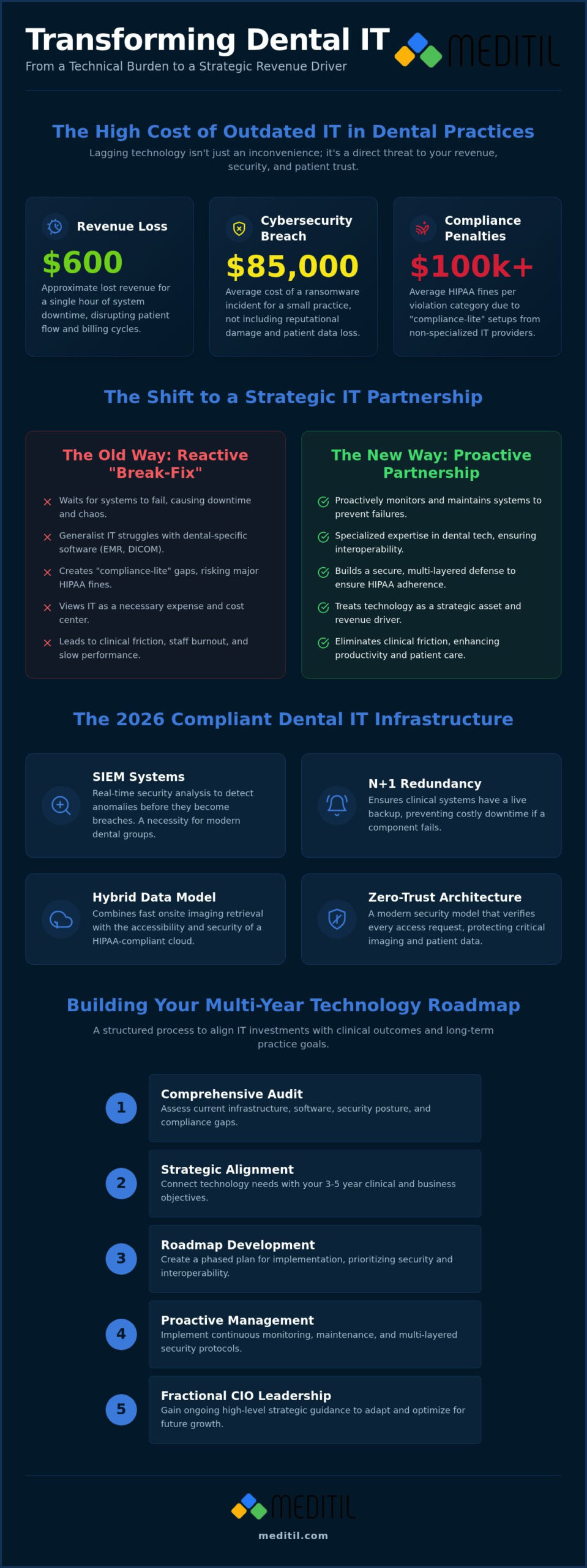
A single hour of system downtime in 2026 costs the average dental practice approximately $600 in lost revenue, yet the true damage often lies in the invisible friction of disconnected systems. You likely entered the profession to provide exceptional clinical care, not to troubleshoot lagging EMR performance or navigate the complexities of the latest HIPAA Security Rule updates. It’s frustrating when your technology feels like a barrier between you and your patients rather than a tool that supports your success.
Strategic it support for dental practices transforms this technical burden into a secure, interoperable revenue driver. By aligning your infrastructure with modern compliance standards, you can eliminate clinical friction and ensure your imaging and billing systems communicate without error. This guide provides a comprehensive roadmap for the next three to five years. We’ll explore how to achieve zero downtime during patient hours and build a resilient framework that protects your practice from the $85,000 average cost of a ransomware incident. Is your current infrastructure robust enough to handle the 2027 regulatory shifts? Let’s examine the path toward a more stable and integrated clinical environment.
Key Takeaways
- Transition from reactive “break-fix” models to a proactive infrastructure partnership that treats technology as a strategic revenue driver rather than a technical burden.
- Secure your practice with a 2026-compliant technology stack and specialized it support for dental practices to mitigate ransomware risks and ensure HIPAA adherence.
- Eliminate clinical friction by prioritizing interoperability between imaging and billing systems to automate the revenue cycle and enhance staff productivity.
- Establish a multi-year technology roadmap through a structured five-step audit and alignment process that connects IT investments to clinical outcomes.
- Utilize Fractional CIO leadership to gain high-level strategic advisory and specialized healthcare application support tailored to the complexities of a regulated environment.
Beyond Troubleshooting: The Evolution of IT Support for Dental Practices
Modern it support for dental practices has transcended the role of a simple help desk. In 2026, technology acts as the silent partner in every clinical decision. It encompasses the entire lifecycle of Health information technology (HIT), from the initial network architecture to the continuous verification of data integrity. A reactive “break-fix” model is no longer a viable strategy for a professional clinic. Waiting for a system to fail before intervening invites catastrophic risks, including data loss and regulatory scrutiny. Instead, a proactive managed approach ensures that your infrastructure remains a stable foundation for patient safety and clinical excellence. We position ourselves as the steady hand at the wheel, providing the technical precision required to keep your practice operational and secure.
Dental practices are prime targets for cyberattacks in 2026 because they hold a wealth of protected health information (PHI) within relatively small operational footprints. With the average cost of a ransomware incident reaching $85,000, the stakes have never been higher. Effective it support for dental practices must prioritize cybersecurity as a core component of the infrastructure rather than an optional add-on. This involves more than just installing antivirus software; it requires a disciplined, multi-layered defense strategy that evolves alongside emerging threats.
The High Cost of Generalist IT Support
General IT firms often lack the specialized knowledge required to manage dental-specific imaging and EMR workflows. While they may keep your internet running, they frequently struggle with the nuances of DICOM standards or the interoperability requirements of modern practice management software. This knowledge gap often leads to “compliance-lite” configurations. While these systems may appear functional, they often leave significant HIPAA gaps that result in average fines exceeding $100,000 per violation category. Over time, this accumulated technical debt creates clinical friction. Providers and staff experience burnout as they struggle with lagging systems and unreliable data access, detracting from the quality of patient care.
Managed IT as a Revenue Driver
Viewing IT solely as an expense is a perspective that limits your growth potential. When managed strategically, your technology becomes a high-performing asset. An optimized network accelerates patient throughput by ensuring that digital radiographs and clinical charts load instantly across all operatories. Uptime is the currency of your practice’s reputation. A single hour of downtime can cost a single-dentist practice roughly $600 in lost revenue. By maintaining a steady, reliable presence, you protect patient trust and ensure that your revenue cycle remains uninterrupted. Our software-agnostic approach focuses on optimizing your existing tools to drive measurable clinical efficiency.
The 2026 Dental IT Infrastructure Stack: Security and Compliance
The 2026 dental IT infrastructure requires a sophisticated blend of onsite resilience and compliant cloud architecture. Modern it support for dental practices must implement Security Information and Event Management (SIEM) systems to provide real-time analysis of security alerts generated by applications and network hardware. For dental groups, SIEM is no longer a luxury; it is a necessary tool for detecting anomalies before they escalate into breaches. Additionally, maintaining N+1 redundancy across clinical systems ensures that if one component fails, a backup is already in place to maintain operations. This level of preparation prevents the costly disruptions associated with technology downtime.
Implementing a hybrid model for data management allows practices to benefit from the accessibility of HIPAA-compliant cloud services while maintaining onsite data for high-speed imaging retrieval. This structure supports seamless connectivity across multiple locations without sacrificing the performance required for high-resolution diagnostic tools. A steady, well-engineered network architecture serves as the backbone of a high-performing clinic, allowing providers to focus on patient outcomes rather than system reliability.
Life-Critical System Protection
Protecting imaging data and patient records requires a shift toward zero-trust architecture. In a multi-operatory environment, this means every user and device must be verified before gaining access to the network, regardless of their location. Proactive monitoring acts as a continuous audit of system health, identifying unpatched vulnerabilities in medical devices. Since 44% of healthcare organizations currently use devices with known security gaps, this vigilant oversight is essential for preventing clinical interruptions. Specialized it support for dental practices ensures these protocols are applied consistently across all endpoints.
Navigating HIPAA and Regulatory Standards
Compliance in 2026 demands more than simple password protection. The HIPAA Security Rule requires advanced audit trails that log every instance of protected health information (PHI) access, alongside stricter encryption protocols for data at rest and in transit. As of July 2026, proposed updates to these rules anticipate mandatory vulnerability scanning and a strict 72-hour system restoration timeline after an incident. Managing these requirements while integrating third-party billing or diagnostic tools requires a disciplined approach to vendor management. You can find detailed strategies for these challenges in our Healthcare Cybersecurity Services guide. Implementing these standards ensures your practice remains a stable environment for care. If you require assistance with these complex configurations, we offer Managed IT Services to help you navigate the technical requirements of modern dentistry.
Reducing Clinical Friction Through Interoperability and Automation
Clinical friction is the operational resistance that occurs when technology disrupts rather than facilitates patient care. In a dental environment, this often manifests as lagging image rendering, manual data re-entry, or disconnected billing cycles. High-quality it support for dental practices focuses on identifying and eliminating these bottlenecks through robust interoperability solutions. These systems bridge the gap between clinical data, such as high-resolution digital radiographs, and administrative records, ensuring a seamless flow of information across the entire practice. When your technology functions as a unified ecosystem, your staff can focus on clinical outcomes rather than troubleshooting software conflicts.
Interoperability is not merely a technical preference; it’s a financial necessity in 2026. When systems operate in silos, the risk of insurance claim denials increases due to inconsistent coding or missing documentation. By automating the revenue cycle, practices can significantly reduce these errors and improve cash flow. We position ourselves as the expert partner in medical billing automation solutions, providing the strategic oversight needed to integrate complex financial workflows with clinical outputs. This expertise ensures that your practice operates as a disciplined, high-performing entity with a clear view of its financial health.
Optimizing EMR/EHR Implementation
A successful technology transition depends on a software-agnostic implementation strategy. Since we don’t sell EMR or EHR software, our focus remains entirely on optimizing the tools you’ve already selected for your clinic. We ensure that your chosen platform integrates perfectly with your existing network infrastructure and imaging hardware. This process includes comprehensive staff training designed to maximize system utilization without causing clinical disruption. By bridging the data gaps between disparate dental software platforms, we eliminate the need for redundant manual entry and provide a single, verified source of truth for patient records. This methodical approach reduces the learning curve and prevents the productivity dips often associated with new software deployments.
The ROI of Automated Workflows
The return on investment for automated workflows is most visible in the immediate reduction of “days in AR” (Accounts Receivable). Automation allows for real-time insurance verification and the direct integration of digital patient intake forms into the electronic record. This connectivity reduces manual entry errors, which are a primary cause of billing delays and patient frustration. In 2026, the trend toward administrative automation is a direct response to rising labor costs and chronic staffing shortages. By streamlining these processes, your team can dedicate more time to patient interaction rather than administrative troubleshooting. To further support your staff, you can discover TurnUp World and its capacity optimization platform for dental front desks. This strategic advancement reinforces your practice’s stability and ensures a predictable revenue stream.
A technology roadmap provides the discipline required to transition from reactive maintenance to strategic advancement. Without a structured plan, it support for dental practices often becomes a series of emergency expenditures that address symptoms rather than root causes. A professional roadmap ensures that every technical investment serves a specific clinical or operational objective. This methodical approach allows practice leaders to predict costs and minimize the clinical friction discussed in previous sections. By establishing a clear path forward, you transform your IT from an unpredictable expense into a reliable business driver.
- Step 1: Conduct a comprehensive infrastructure and security audit. We begin by verifying every endpoint, network switch, and security protocol to establish a baseline of your current capabilities and identify hidden vulnerabilities.
- Step 2: Align IT investments with clinical and financial goals. Technology shouldn’t exist in a vacuum. We ensure your infrastructure supports your specific patient volume, diagnostic requirements, and revenue targets.
- Step 3: Develop a multi-year IT budget for medical practices. This financial roadmap eliminates the “emergency spend” trap by forecasting hardware refreshes and software updates three to five years in advance.
- Step 4: Implement scalable cloud and network infrastructure. We build a foundation that supports high-resolution imaging and seamless data transfer across all operatories, ensuring your network can handle future growth.
- Step 5: Establish ongoing vCIO oversight and performance reporting. Continuous monitoring and strategic reviews ensure your technology remains aligned with evolving regulatory standards and practice needs.
Aligning Budget with Patient Outcomes
Prioritizing IT spending requires an authoritative understanding of clinical risk and revenue impact. Technical debt, often the result of aging hardware or unpatched software, acts as a hidden tax on your practice’s growth. By addressing these vulnerabilities proactively, you avoid the high costs of system failure during peak patient hours. A disciplined budget focuses on high-impact areas, such as redundant data backups and secure interoperability, which directly influence patient safety and trust. If you’re ready to stabilize your technology costs, our Managed IT Services provide the long-term oversight needed to protect your bottom line.
Scalability for DSOs and Group Practices
For Dental Support Organizations (DSOs) and expanding group practices, standardization is the key to efficient management. Centralizing your it support for dental practices allows for uniform security protocols and streamlined software updates across multiple locations. Leveraging business intelligence and analytics provides practice leaders with the data required to identify growth opportunities and optimize chairside productivity. We ensure your network management supports high-volume clinical hubs, providing the steady hand necessary to navigate the complexities of a multi-site healthcare environment. This scalability ensures that as your practice grows, your technology infrastructure remains a reliable and high-performing asset.
The Fractional CIO: The Missing Link in Dental IT Strategy
Most dental practices confuse technical support with strategic leadership. Standard help desk services are essential for day-to-day operations; however, they don’t address the long-term alignment of technology with business growth. A Fractional CIO provides this executive-level oversight, serving as a strategic partner who understands the complexities of a regulated healthcare environment. This role is especially critical in 2026 as regulatory requirements and cybersecurity threats become more sophisticated. By utilizing virtual CIO services, practices gain access to high-level expertise and disciplined guidance without the financial burden of a full-time executive salary.
Strategic it support for dental practices must transition from a reactive cost center to a proactive leadership function. A Fractional CIO ensures that your technology infrastructure isn’t just functional but is also optimized to meet your specific financial and clinical objectives. They provide the “steady hand” required to navigate the fast-paced changes in healthcare technology, ensuring that your practice remains stable and competitive. This leadership bridges the gap between technical execution and business vision, providing a clear path for long-term success.
Strategic Advisory vs. Technical Support
IT decisions shouldn’t be made in isolation. Your practice requires a seat at the executive table for technology discussions that directly impact clinical workflows and patient safety. While technical support focuses on resolving immediate hardware or software issues—where specialized services like Pleasanton Computer Repair can assist with device-level maintenance—strategic advisory manages the entire lifecycle of clinical applications and infrastructure. This includes evaluating when hardware requires a refresh and ensuring that software integrations are performing at peak efficiency. A Fractional CIO also handles vendor management, acting as your professional representative when dealing with software providers. This ensures that your it support for dental practices remains focused on your practice’s unique needs rather than a vendor’s sales agenda.
MEDITIL acts as a strategic partner for healthcare organizations across the nation, managing entire IT teams and complex technical operations. Our approach centers on customization and verification, ensuring that every security protocol and interoperability link is functioning exactly as intended. We provide the stability and precision required to manage a modern dental group. To begin transforming your technology from a burden into an asset, we recommend starting with a comprehensive healthcare IT audit. This process identifies current gaps and provides a disciplined foundation for your future technology roadmap. Our national coverage ensures that your practice receives consistent, high-level expertise regardless of your location.
Securing Your Practice’s Digital Future
The transition from a reactive “break-fix” mindset to a proactive, strategic partnership is essential for any clinic aiming for long-term stability in 2026. By building a resilient infrastructure that prioritizes interoperability and HIPAA compliance, you eliminate the clinical friction that drains staff productivity and compromises patient safety. High-performing it support for dental practices isn’t just about technical maintenance; it’s about creating a foundation where imaging, billing, and clinical records function as a single, verified ecosystem.
As your strategic partner, we provide Specialized Healthcare IT Experts and Fractional CIO Leadership to guide your technology roadmap with precision. Our National Infrastructure Management ensures that your operations remain secure and scalable regardless of your practice’s size or location. We’re ready to help you transform your technology from a technical burden into a reliable revenue driver.
Take the first step toward a more stable and efficient clinical environment. Schedule a Strategic IT Consultation with MEDITIL today and gain the steady hand at the wheel your practice deserves.
Frequently Asked Questions
What is the difference between general IT support and dental-specific IT?
General IT firms often focus on basic connectivity; however, specialized it support for dental practices understands the nuances of digital imaging and EMR workflows. We manage the technical requirements of DICOM standards and ensure that your high-resolution radiographs load instantly across all operatories. This focused expertise prevents the clinical friction that occurs when generalists misconfigure specialized healthcare applications. Our approach prioritizes the specific uptime needs of a busy dental environment.
How does managed IT support improve HIPAA compliance for my practice?
Managed it support for dental practices shifts HIPAA compliance from a periodic checklist to a continuous, automated process. We implement advanced audit trails, stricter encryption protocols, and real-time vulnerability scanning that align with 2026 regulatory standards. This proactive monitoring ensures that your practice meets the administrative and technical safeguards required by the HIPAA Security Rule. By automating these protections, we reduce the risk of human error and provide a verified record of compliance.
Can you support our practice if we use specific EMR/EHR software like Dentrix or Eaglesoft?
We provide comprehensive implementation, training, and integration services for major platforms such as Dentrix and Eaglesoft. Because we are software-agnostic, we don’t sell the EMR software itself; instead, we focus on optimizing its performance within your specific network. We ensure these systems communicate seamlessly with your imaging hardware and billing platforms. This integration eliminates data silos and allows your staff to utilize the full capabilities of your chosen software.
What is a Fractional CIO and does a small dental practice really need one?
A Fractional CIO acts as a strategic partner who provides executive technology leadership without the cost of a full-time hire. Small practices use these services to develop multi-year IT roadmaps and align technical spending with clinical outcomes. This “steady hand” ensures that your infrastructure remains stable as you grow. By providing high-level advisory on cybersecurity and interoperability, a Fractional CIO helps you avoid the “emergency spend” trap and maintain long-term financial discipline.
How do you handle emergency IT issues during clinical hours?
We address emergency issues through a combination of proactive monitoring and rapid response protocols. Our network designs emphasize N+1 redundancy, meaning your clinical systems have built-in backups to prevent immediate failure. If a disruption occurs, our specialized help desk provides immediate remote assistance to restore functionality. We focus on achieving zero downtime during patient hours, ensuring that your providers can maintain their schedules without technical interference.
Will upgrading our IT infrastructure require significant downtime?
Infrastructure upgrades are carefully staged to ensure minimal clinical disruption. We typically perform complex migrations outside of patient hours or through phased deployments that maintain system availability. Our goal is to provide a seamless transition that preserves data integrity while enhancing network performance. By using a disciplined project management approach, we verify every component before it goes live, ensuring your staff can return to a stable environment without operational delays.
How does MEDITIL help with medical billing automation?
We specialize in billing automation and integration by bridging the gap between clinical documentation and administrative financial systems. By creating interoperability between your EMR and billing software, we reduce the manual entry errors that lead to insurance claim denials. This streamlined workflow accelerates the revenue cycle and improves your practice’s cash flow. We provide the technical framework necessary to automate repetitive tasks, allowing your administrative team to focus on patient relations.
Does your IT support cover multiple practice locations nationally?
MEDITIL provides national infrastructure management for healthcare organizations across the entire United States. We specialize in standardizing IT protocols across multiple practice locations, which is essential for DSOs and growing dental groups. This national scope allows us to provide consistent security standards and centralized performance reporting for every office in your network. Whether you operate a single clinic or a multi-state organization, we deliver the same high-level expertise and strategic oversight.