
A fragmented revenue cycle in 2026 isn’t just an administrative hurdle; it’s a structural risk that compromises the long-term stability of your healthcare organization. You’ve likely experienced the mounting frustration when your medical billing system integration fails to bridge the gap between clinical documentation and financial reimbursement. It’s exhausting to watch your staff manage the burnout of double data entry while legacy systems refuse to communicate, leading to preventable denials and deep technical debt. You deserve an infrastructure that works as hard as your providers do.
This guide provides the strategic framework necessary to master these complexities and eliminate revenue leakage through precise alignment. By connecting your clinical and financial data, you can significantly reduce administrative overhead and improve operational precision. We’ll explore how to replace manual workarounds with a seamless data flow from the initial patient encounter to the final payment. This approach ensures your IT environment remains a stable, future-proof asset that supports long-term growth and stays ahead of evolving regulatory standards.
Key Takeaways
- Understand why it’s essential for bidirectional data flow between EHR and RCM platforms to eliminate the “Integration Gap” that causes claim denials.
- Learn why FHIR has emerged as the 2026 gold standard for healthcare data exchange over traditional HL7 protocols.
- Discover how to execute a medical billing system integration without risking data corruption or increasing clinical friction for your providers.
- Follow a structured roadmap that begins with a comprehensive infrastructure audit to ensure your IT environment supports seamless connectivity.
- Identify the role of strategic leadership, such as virtual CIO services, in transforming integration into a sustainable revenue driver.
The Strategic Importance of Medical Billing System Integration
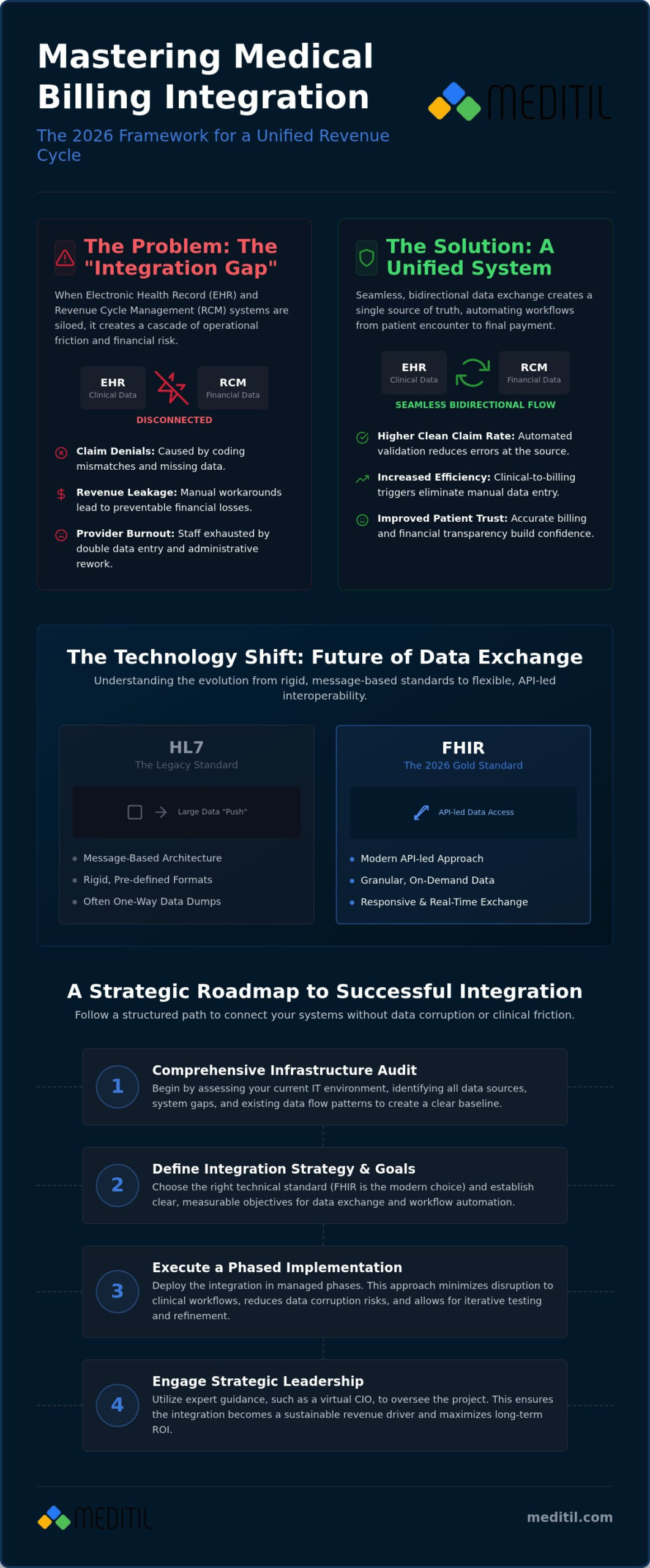
Successful medical billing system integration is defined by the seamless, bidirectional exchange of data between an Electronic Health Record (EHR) and Revenue Cycle Management (RCM) platforms. This connectivity ensures that every clinical action is automatically translated into a financial record. By establishing this link, organizations ensure that clinical documentation flows directly into the medical billing process without the need for manual intervention or redundant data entry. It creates a single source of truth that spans the entire patient journey.
The “Integration Gap” represents the structural failure that occurs when these systems remain siloed. When clinical and financial data don’t communicate, the result is a cascade of operational friction. This gap is a primary driver of claim denials, often caused by simple coding mismatches or missing demographic data that an integrated system would have flagged instantly. For providers, this lack of connectivity is a significant contributor to burnout. Physicians find themselves trapped in a cycle of administrative rework, correcting errors that should have been prevented by automated validation rules at the point of care.
Beyond internal efficiency, integration is a critical component of the patient experience. Modern patients expect financial transparency and billing accuracy. When clinical data is integrated with billing systems, providers can offer precise cost estimates and clear, consolidated statements. This reduces the likelihood of surprise bills and billing disputes, which are common points of friction in the provider-patient relationship. Accuracy in the back office directly translates to trust in the exam room.
As we move through 2026, deep integration has shifted from a competitive advantage to a baseline requirement for survival. Regulatory shifts and tightening reimbursement models leave no room for the inefficiencies of legacy, disconnected workflows. Organizations that fail to prioritize a unified infrastructure risk not only financial instability but also non-compliance with evolving data exchange mandates. A future-proof IT environment must be built on the principle of total connectivity.
From Siloed Workflows to Unified Revenue Cycles
Transitioning from manual data entry to automated clinical-to-billing triggers is essential for maintaining a healthy bottom line. In a siloed environment, staff must manually pull data from the EHR to create claims, a process prone to human error. Integration automates this transition, significantly improving the Clean Claim Rate (CCR). High-performing practices use these automated workflows to execute real-time eligibility checks during the patient intake process. This ensures that coverage is verified before the provider even enters the room, preventing front-end denials and reducing the administrative burden on front-desk staff.
The Role of Interoperability in Modern Healthcare
Robust healthcare interoperability serves as the foundational layer for an organization’s financial health. While legacy interfaces often relied on rigid, one-way data dumps, modern integration utilizes advanced protocols to ensure data is both accessible and actionable across different platforms. This evolution supports higher standards of patient safety by ensuring that financial decisions, such as prior authorizations, are based on the most current clinical data. It creates a transparent environment where financial outcomes are a direct, predictable result of clinical excellence.
Technical Standards: HL7, FHIR, and the Future of Data Exchange
For decades, Health Level Seven (HL7) served as the standard language for healthcare data exchange. It relies on a message-based architecture where data is “pushed” from one system to another in a specific, often rigid, format. While foundational, traditional HL7 often struggles with the real-time demands of modern medical billing system integration. As we enter 2026, the industry has pivoted toward Fast Healthcare Interoperability Resources (FHIR). FHIR leverages modern web technologies and Application Programming Interfaces (APIs) to allow for more granular data access and improved system responsiveness.
FHIR is the API-led evolution of healthcare data exchange for 2026.
FHIR vs. HL7: Choosing the Right Integration Path
The primary difference between these standards lies in how data is retrieved and processed. HL7 typically follows a “push” model, sending entire packets of information regardless of what specific data is needed. Conversely, FHIR uses a “pull” model, allowing billing systems to request specific data points, such as a single diagnosis code or insurance ID. Modern medical billing automation solutions require FHIR-based connectivity to achieve the speed and accuracy necessary for real-time processing. To support these standards, your practice network must maintain high-speed throughput and low latency to handle frequent API calls without disrupting clinical operations. All data exchanges must strictly adhere to the HIPAA Privacy Rule to ensure patient confidentiality is maintained during every transaction.
The Role of Middleware and Integration Engines
Many healthcare organizations still operate with legacy Electronic Health Records (EHRs) that cannot communicate directly with modern billing modules. This is where integration engines or middleware act as essential translators. These engines ingest disparate data formats and map them into a standardized structure, ensuring that CPT and ICD-10 codes transfer accurately from the clinical record to the claim form. This mapping process is vital for preventing data corruption that leads to denials. Strategic leaders understand that software is only half the battle. Real-time API performance depends heavily on the underlying infrastructure. If your cloud connectivity or local network is unstable, even the most advanced FHIR implementation will fail. Maintaining a robust network environment is a prerequisite for seamless interoperability. For organizations looking to audit their current readiness, consulting with a technical partner can help identify potential bottlenecks before they impact your revenue cycle.
Addressing the Challenges of Billing Integration Projects
Implementing a medical billing system integration is a high-stakes endeavor that requires more than technical alignment; it demands a strategic approach to risk management. While the operational benefits are significant, leaders often face internal resistance rooted in valid concerns about data safety and workflow disruption. Acknowledging these hurdles early is the first step toward a successful transition. By identifying potential points of failure, organizations can build a more resilient infrastructure that supports long-term growth.
The most frequent objection among healthcare executives is the perceived risk of data loss or corruption during migration. Moving sensitive financial and clinical data across platforms creates opportunities for record misalignment or total data drop-offs. This fear is often compounded by the “clinical friction” that arises when integration changes how providers document care. When clinical notes are tied directly to billing triggers, doctors may feel their charting becomes more rigid. Without a clear focus on user experience, these changes can lead to staff burnout and reduced clinical efficiency.
Organizations must also contend with the hidden cost of technical debt. Many legacy billing systems are built on outdated architectures that don’t support modern API connectivity. Maintaining these systems is expensive and limits your ability to scale. Finally, cybersecurity must be baked into the integration roadmap. A unified system is only as strong as its weakest link. If security isn’t prioritized during the planning phase, the very connectivity that drives efficiency could also expose the practice to significant regulatory and financial risk.
Data Migration and Integrity Strategies
Successful migration begins with rigorous data cleansing. Before any data moves, it’s essential to identify and correct duplicates or incomplete records in the source system. Moving “dirty” data only amplifies existing errors. Organizations must also maintain access to historical billing records to meet regulatory retention requirements while transitioning to a new integrated platform. A robust validation framework ensures that every record in the destination system matches the source with 100% accuracy, providing a verifiable audit trail for the transition.
Security and Compliance in an Integrated Environment
In an integrated environment, the “attack surface” of a medical practice expands. Each new connection point between an EHR and a billing platform is a potential target for unauthorized access. Security cannot be an afterthought. It’s vital to ensure end-to-end encryption for all financial and clinical data in transit. Utilizing specialized healthcare cybersecurity services is a non-negotiable component of any integration project. These services provide the protection and verification needed to maintain compliance and safeguard patient trust during and after the integration process.
A Strategic Roadmap for Successful System Integration
The transition to a unified revenue cycle is a strategic deployment rather than a simple software installation. To ensure a medical billing system integration delivers on its promise of efficiency, leaders must follow a rigorous roadmap that accounts for both technical readiness and human workflows. This methodical process transforms fragmented data into actionable business intelligence, providing a clear view of the organization’s financial health. When executed correctly, this roadmap mitigates the risks of data loss while maximizing the return on investment.
The journey toward a future-proof infrastructure begins with a defined five-step progression:
- Step 1: Conduct a comprehensive IT infrastructure and network audit to identify existing hardware limitations.
- Step 2: Define business requirements and ROI benchmarks to measure the success of the connectivity.
- Step 3: Select an integration partner with deep expertise in both clinical documentation and financial workflows.
- Step 4: Execute a phased rollout using rigorous User Acceptance Testing (UAT) to catch errors in a controlled environment.
- Step 5: Implement post-go-live optimization and continuous staff training to ensure long-term adoption.
The Importance of an IT Infrastructure Audit
A successful integration is only as stable as the network supporting it. Before deployment, an evaluation of server capacity and network bandwidth is mandatory to handle the increased data traffic generated by real-time API exchanges. Organizations must ensure N+1 redundancy for mission-critical billing operations to prevent downtime that could stall the revenue cycle. Identifying hardware bottlenecks, such as outdated switches or insufficient memory, prevents the latency issues that often plague poorly planned integration projects. This foundational step ensures the system can scale as the practice grows.
Staff Training and Workflow Optimization
Technical connectivity is meaningless if the staff cannot use the system effectively. Training must bridge the communication gap between the front office, clinicians, and the billing department. By implementing automated charge capture, organizations can significantly reduce the cognitive load on providers, allowing them to focus on patient care rather than administrative tasks. Establishing a real-time feedback loop allows teams to address integration glitches immediately, preventing small technical errors from becoming systemic financial problems. For leaders seeking a steady hand to manage this complex transition, partnering with a strategic IT consultant ensures every technical and operational detail is handled with precision.
Maximizing ROI Through Professional Integration Management
A successful medical billing system integration is not a one-time project with a static end date; it’s a dynamic operational state that requires ongoing oversight. While the initial setup establishes the connection, the long-term value lies in how that connection is managed, secured, and optimized over time. Leaders who view integration as a “set and forget” task often find that technical drift eventually leads to sync errors and revenue leakage. Professional management ensures that your clinical and financial systems remain in lockstep as your practice evolves.
Beyond maintaining stability, professional management transforms integrated data into a catalyst for advanced business intelligence. When your EHR and billing platforms communicate perfectly, you gain a granular view of your operational performance. This visibility allows for sophisticated analytics, such as identifying the specific clinical workflows that lead to the highest denial rates or predicting cash flow based on real-time encounter data. Integration becomes the foundation for a data-driven culture that prioritizes both fiscal health and provider satisfaction.
The Fractional CIO: Strategic Oversight for Integration
Strategic leadership is essential for navigating the complexities of modern interoperability. Utilizing virtual CIO services provides your organization with an expert who can oversee the entire revenue cycle roadmap. A vCIO ensures that IT budgeting for medical practices remains aligned with your integration goals, preventing the technical debt that occurs when infrastructure falls behind software requirements. This role is critical for managing vendor relationships; they ensure that EHR and billing providers maintain the necessary API connectivity to keep data flowing without interruption. With this high-level guidance, practices can leverage their integrated data for predictive financial modeling, turning historical billing trends into a roadmap for future growth.
Managed IT: The Foundation of Integration Stability
The reliability of an integrated system depends on the health of the underlying network. Managed IT services provide the proactive monitoring needed to prevent data sync failures before they impact your bottom line. If an API connection drops or a server experiences latency, a managed team can intervene immediately, ensuring 100% uptime for mission-critical billing operations. This support extends to the help desk, where technicians understand the specific nuances of integrated clinical-financial workflows. Continuous managed security updates ensure that your interconnected systems remain in full compliance with HIPAA standards, protecting patient data across every touchpoint. This steady hand at the wheel allows clinical leaders to focus on patient outcomes while knowing the technical infrastructure is handled with precision.
Securing Your Financial Future Through Unified Infrastructure
Establishing a unified revenue cycle is a strategic necessity for healthcare leaders as we move further into 2026. By adopting FHIR standards and following a methodical roadmap, your organization can effectively bridge the gap between clinical encounters and financial stability. A successful medical billing system integration isn’t just a technical upgrade; it’s the creation of a resilient infrastructure that eliminates administrative friction and protects your bottom line from preventable denials.
As a strategic partner for national healthcare organizations, MEDITIL brings deep expertise to complex billing and EHR interoperability projects. Our fractional CIO leadership ensures that your technical investments are aligned with long-term ROI and operational precision. We act as the steady hand at the wheel, managing the complexities of your IT environment so you can focus on patient care. Ready to eliminate revenue leakage and future-proof your practice? Schedule a Strategic IT Consultation with MEDITIL today to begin building a seamless, integrated financial ecosystem. Your organization’s long-term stability is within reach.
Frequently Asked Questions
What is the difference between an interface and full system integration?
An interface typically facilitates a one-way data transmission from one system to another, often requiring manual reconciliation. In contrast, full medical billing system integration establishes a bidirectional flow where clinical and financial platforms communicate in real time. This ensures that any update in the patient record is instantly reflected in the billing ledger. This level of connectivity eliminates the lag and errors inherent in traditional one-way data dumps.
How long does a typical medical billing system integration project take?
Most projects require three to six months for completion, depending on the complexity of your existing infrastructure. This timeline accounts for the essential phases of auditing, data cleansing, and rigorous testing. A methodical approach prevents the accumulation of technical debt and ensures a stable transition. Rushing the deployment phase often leads to data misalignment that can disrupt your revenue cycle for months after the go-live date.
Will integrating my EHR and billing system require an upgrade to my network?
Network upgrades are frequently necessary to manage the increased data traffic generated by real-time API exchanges. While your current bandwidth might support basic documentation, bidirectional integration demands low latency and high-speed throughput to function without lag. Ensuring N+1 redundancy and evaluating your server capacity are critical steps. These foundational improvements prevent the hardware bottlenecks that could otherwise cause clinical friction and system instability during peak hours.
How does integration impact HIPAA compliance and data security?
Integration expands your practice’s digital footprint, which requires more robust security protocols to maintain HIPAA compliance. Every connection point between your EHR and billing platform must utilize end-to-end encryption for data in transit and at rest. A unified system actually improves your security posture by centralizing audit logs and access controls. This makes it easier for your technical team to monitor for unauthorized access across all platforms simultaneously.
Can I integrate an older legacy EHR with a modern cloud-based billing system?
You can connect legacy systems to modern cloud platforms by utilizing middleware or specialized integration engines. These tools act as translators that ingest older data formats and map them to current standards like FHIR. This strategy allows your organization to modernize its financial workflows without the disruption and cost of a total EHR replacement. It provides a bridge to modern interoperability while preserving your existing clinical documentation workflows.
What is the ROI of medical billing system integration for a mid-sized practice?
The return on investment is primarily realized through a significant reduction in administrative overhead and a higher clean claim rate. By automating the clinical-to-billing trigger, your staff spends less time on manual data entry and denial management. This efficiency allows mid-sized practices to capture revenue more accurately and accelerate the reimbursement cycle. Integration transforms your billing department from a cost center into a streamlined, data-driven asset for the organization.
What role does a vCIO play in the integration process?
A vCIO provides the strategic leadership necessary to align your technical roadmap with your financial objectives. They manage complex vendor relationships and ensure that your medical billing system integration remains interoperable as software updates occur. This role is vital for overseeing the long-term lifecycle of your infrastructure. By providing expert guidance, a vCIO helps your practice avoid expensive technical missteps and ensures your systems support sustainable growth.
How do we prevent data corruption during the migration phase?
Preventing corruption requires a rigorous validation framework and extensive data cleansing before the transfer begins. Your technical team must map every clinical and financial field with precision to ensure that CPT and ICD-10 codes transfer without error. Executing a phased rollout with parallel testing allows you to verify data accuracy in a controlled environment. This methodical verification process ensures that your records remain 100% accurate throughout the entire migration journey.