
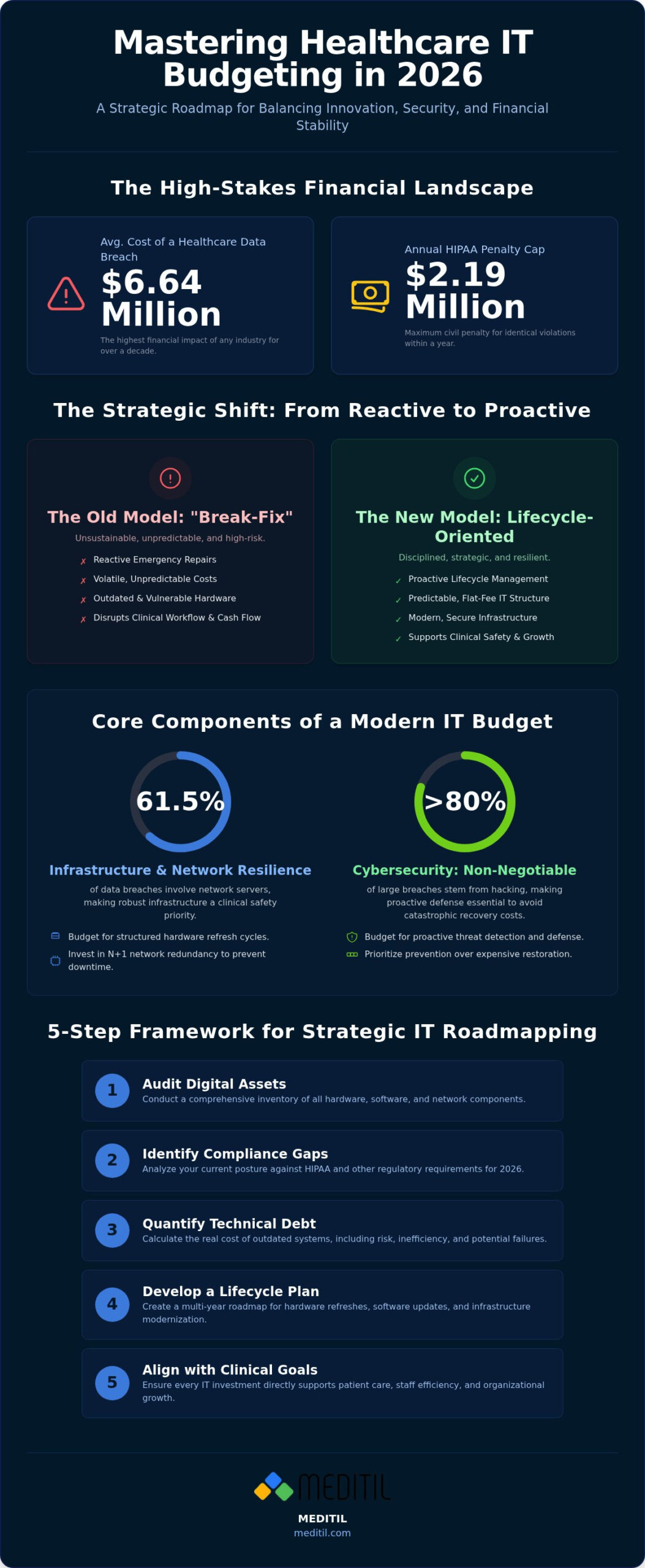
In 2026, the average cost of a healthcare data breach has reached a staggering $6.64 million, marking the highest financial impact of any industry for over a decade. For many administrators, this figure represents more than just a statistic; it is a constant source of anxiety when managing healthcare it budgeting. You likely feel the pressure of balancing these rising security risks against the urgent need for clinical efficiency and modern infrastructure. It is often difficult to justify increasing spend to a board that may still view technology as a back-office expense rather than a vital clinical safety net.
This article provides a strategic roadmap to help you master the complexities of financial planning by balancing innovation with rigorous protection. You will learn how to transition from unpredictable, reactive spending to a structured, flat-fee model that satisfies both insurance requirements and clinical staff. We will examine the cost of technical debt, the role of fractional leadership, and the specific steps required to build a predictable IT framework for the coming year. By the end of this guide, you will have the tools to transform your IT department into a disciplined, high-performing asset.
Key Takeaways
- Transition from a reactive “break-fix” mindset to a proactive, lifecycle-based financial model that treats technology as a vital clinical asset.
- Align your healthcare it budgeting with the core pillars of infrastructure reliability and cybersecurity to mitigate the financial risks of data breaches.
- Quantify the impact of technical debt to move away from volatile emergency repairs toward a predictable, flat-fee IT cost structure.
- Utilize a rigorous five-step framework to audit your digital assets and identify critical gaps in your 2026 compliance posture.
- Leverage fractional CIO services to gain executive-level oversight, helping your organization eliminate redundant vendor subscriptions and justify spend to the board.
The Evolution of Healthcare IT Budgeting in 2026
Healthcare IT budgeting is the methodical allocation of financial resources to manage digital infrastructure, cybersecurity frameworks, and clinical workflows. In previous years, many organizations viewed IT as a peripheral administrative cost. However, the environment in 2026 has shifted significantly. High-performance Health Information Technology (HIT) systems are now the primary drivers of clinical safety and operational continuity. This evolution requires a transition from reactive, emergency-based spending to a proactive, lifecycle-oriented financial model that treats technology as a core strategic asset.
Recent HIPAA updates and increased regulatory scrutiny have elevated healthcare it budgeting from a departmental task to a board-level priority. As of January 28, 2026, the civil penalties for HIPAA violations have reached an annual cap of $2,190,294 for identical violations. When systems fail or data is compromised, the impact isn’t just a technical delay; it’s a direct financial and clinical threat. A well-structured budget ensures that every dollar spent strengthens the practice while reducing these high-stakes risks.
Why Traditional Budgeting Fails Modern Practices
The “break-fix” financial mentality is increasingly unsustainable in a regulated environment. Relying on emergency repairs creates volatile expense cycles that disrupt cash flow and leave organizations vulnerable to outdated hardware. Many annual budgets also fail to account for the rising cost of software subscriptions and the impact of inflation on medical technology. Practices that don’t plan for hardware refresh cycles often find themselves facing massive, unbudgeted capital expenditures when systems inevitably fail.
Perhaps most critically, traditional budgeting often overlooks the financial reality of emergency cybersecurity incidents. With over 80% of large healthcare breaches in 2025 stemming from hacking or IT incidents, failing to budget for proactive defense leads to catastrophic, unbudgeted recovery costs. A static budget can’t survive a dynamic threat landscape. Organizations must shift toward a model that prioritizes prevention over restoration.
The Strategic Shift: IT as a Clinical Utility
Modern practices must view IT infrastructure as a clinical utility, similar to electricity or water. It’s essential for every patient interaction. When the network is slow or systems aren’t interoperable, the result is clinical friction and increased physician burnout. By ensuring that systems are optimized and reliable, organizations can improve the daily experience of their medical staff and the quality of patient care.
Aligning financial objectives with a comprehensive roadmap for managed it services for healthcare allows for a more predictable cost structure. This shift ensures that technology serves the clinical mission rather than hindering it. It replaces uncertainty with a steady, reliable presence that supports long-term growth. When IT is managed as a utility, the focus moves from maintaining hardware to enhancing the delivery of care.
Core Components of a Modern Healthcare IT Budget
A comprehensive approach to healthcare it budgeting involves more than simply accounting for EHR subscription fees. It requires a detailed breakdown of the infrastructure, security protocols, and human capital necessary to maintain a resilient clinical environment. By following good budgeting practices for health, organizations can move from a state of constant financial surprise to one of disciplined, strategic investment. This structured approach ensures that every technological component directly supports patient care and organizational stability.
Infrastructure and Network Resilience
In 2025, 61.5% of healthcare data breaches involved data stored on network servers. This statistic highlights why budgeting for robust infrastructure is critical for clinical safety. Hardware lifecycles for servers, workstations, and medical-grade tablets must be strictly managed to prevent performance degradation and security vulnerabilities. We recommend a structured refresh cycle to maintain modern performance standards. Additionally, investing in N+1 network redundancy is essential to prevent clinical downtime during hardware failures. While cloud services offer scalability, on-premise storage requires careful financial evaluation regarding long-term maintenance and data control.
Cybersecurity: A Non-Negotiable Line Item
With the average cost of a healthcare data breach reaching $6.64 million in 2026, cybersecurity is a vital line item that requires consistent funding. Resources must be allocated for proactive monitoring, Security Information and Event Management (SIEM), and endpoint protection. These tools provide the visibility needed to detect threats before they escalate into full-scale incidents. Regular HIPAA compliance audits and risk assessments offer a high return on investment by identifying vulnerabilities that could result in penalties of up to $2,190,294. Investing in staff training remains one of the most cost-effective methods for preventing the hacking incidents that caused over 80% of large breaches last year.
Interoperability and Billing Automation
Seamless data exchange between disparate systems reduces manual entry errors and improves the provider experience. Budgeting for medical billing automation solutions is a strategic move to optimize revenue cycle management and reduce administrative overhead. Organizations must also account for the recurring costs of API connections between EHRs, laboratories, and external pharmacies. These integrations are vital for maintaining a unified patient record and ensuring interoperability across the care continuum. If you’re looking to refine these technical layers, engaging with a specialist in Managed IT Services can provide the necessary precision for your financial roadmap.
Analyzing the Cost of Technical Debt vs. Modernization
Technical debt is the accumulated cost of maintaining obsolete hardware and unpatched software. In the context of healthcare it budgeting, ignoring this debt is equivalent to ignoring a foundation crack in a surgical suite. While delaying an upgrade might seem like a short-term saving, the long-term interest on this debt is paid through system failures, security gaps, and clinical friction. Modernization isn’t an elective expense; it’s a debt repayment strategy that prevents catastrophic operational failure.
The contrast between managed services and reactive models is most visible in the predictability of the balance sheet. A proactive organization utilizes a flat-fee managed service model to ensure consistent performance and security. Conversely, a reactive practice relies on a “break-fix” mentality, which leads to volatile financial spikes. For example, a practice might avoid a monthly maintenance fee only to face a massive, unbudgeted invoice for emergency data recovery when a legacy server finally fails. This volatility makes it impossible to provide accurate financial forecasting to board members.
Legacy systems also carry a heavy liability burden. In 2026, cyber insurance providers have become significantly more stringent, often requiring proof of consistent patch management and hardware lifecycles before issuing or renewing policies. Organizations that cling to technical debt face higher premiums or outright denial of coverage. This creates a dangerous scenario where the practice is both more likely to suffer a breach and less likely to have the financial protection to survive it.
The Hidden Costs of Legacy Systems
The “Legacy Tax” is the premium you pay to support software that no longer receives vendor updates. This often requires specialized labor or complex workarounds that drain internal resources. Beyond these direct costs, there is a significant impact on physician productivity. If a provider loses just five minutes per patient due to lagging workstations or slow EHR loading times, the cumulative loss in patient throughput and revenue far exceeds the cost of a hardware refresh. Outdated systems also create security vulnerabilities that practically invite the HIPAA fines discussed earlier.
Reframing IT Modernization as Risk Mitigation
Modernization should be reframed as insurance against downtime. A resilient, updated infrastructure allows healthcare cybersecurity services to operate with maximum efficiency, providing the visibility needed to stop threats in real time. Investing in modern systems also provides a competitive advantage by delivering a seamless, technologically advanced patient experience. When your systems are fast and reliable, patients feel more confident in the care they receive, and clinical staff can focus entirely on patient outcomes rather than technical troubleshooting.
A 5-Step Framework for Strategic IT Roadmapping
The transition from a reactive “break-fix” model to a proactive financial strategy requires a disciplined, step-by-step approach. An effective framework for healthcare it budgeting doesn’t just list expenses; it maps technology to clinical outcomes and risk management. This process ensures that every dollar spent in 2026 contributes to a more secure and efficient practice. By following a structured roadmap, you can replace financial uncertainty with a steady, predictable investment cycle.
Step 1 & 2: The Assessment Phase
A comprehensive technical and security audit is the foundation of any strategic roadmap. This involves documenting every asset, from network servers to end-user tablets, and verifying the status of all software licenses and security protocols. Once the inventory is clear, a gap analysis identifies where your current technology fails to meet the 2026 HIPAA compliance standards. Benchmarking your current spend against industry standards for your practice size is also vital. This comparison helps determine if you’re under-investing in critical areas or over-spending on redundant tools.
During this phase, it’s essential to identify “single points of failure” within your network. These are technical bottlenecks where a single hardware malfunction could halt all clinical operations. By uncovering these vulnerabilities early, you can prioritize investments that offer the highest protection against downtime and patient data exposure. This assessment provides the data needed to justify spend to board members and stakeholders.
Step 3 & 4: Planning for Sustainable Growth
Planning for the future involves more than just looking at the next twelve months. Successful organizations develop a 3-year it budgeting for medical practices roadmap that aligns technology goals with overall business objectives. This long-term view allows for phased implementation, distributing the costs of major upgrades over several years to maintain steady cash flow. It ensures that you aren’t forced into “nice-to-have” upgrades when “mission-critical” systems require attention.
One of the most effective tools for financial stability is the creation of a Capital Replacement Fund. By setting aside smaller, regular amounts for hardware refreshes, you avoid the massive, unbudgeted capital expenditures that often occur when aging systems fail simultaneously. This approach ensures that modernization is a continuous, manageable process rather than a periodic financial crisis.
The final step is continuous review. A strategic budget isn’t a static document; it must be adjusted quarterly to account for emerging cyber threats or new regulatory requirements. This agility is the hallmark of sophisticated healthcare it budgeting, allowing your practice to remain resilient even as the technological environment shifts. If you’re ready to build a more predictable financial future, contact the experts at MEDITIL to start your comprehensive IT audit today.
Leveraging Fractional CIO Services for Financial Precision
Effective healthcare it budgeting requires more than just accounting skills; it demands a deep understanding of how technical decisions impact clinical workflows. For many mid-sized practices, the cost of a full-time executive leader is prohibitive. As of August 2026, the average annual salary for a Healthcare CIO in the United States is $159,468, with some metropolitan roles exceeding $513,000. A fractional or virtual CIO (vCIO) provides the same high-level strategic oversight at a fraction of the cost, acting as a bridge between administrative goals and technical execution.
A vCIO acts as a steady hand at the wheel, ensuring that long-term financial stability isn’t compromised by short-term technical fixes. They translate complex clinical needs into precise technical requirements, ensuring that every infrastructure upgrade serves a specific operational purpose. This expert oversight prevents the “vendor bloat” that often occurs when practices accumulate multiple software subscriptions with overlapping features. By auditing these contracts, a fractional leader ensures the organization only pays for the tools it actually uses.
Strategic Guidance Without the Executive Salary
Choosing a fractional engagement allows a practice to access executive-level expertise without the burden of a full-time executive salary and benefits package. This is particularly valuable given that 76% of employers currently report talent shortages in specialized fields like cybersecurity and data analytics. A vCIO manages vendor relationships with a disciplined eye, negotiating service level agreements that protect the practice’s interests. They serve as an advocate who understands the nuances of medical administration, ensuring that technology serves the providers rather than creating new hurdles.
Aligning Budget with Clinical Outcomes
The ultimate goal of any IT investment is to improve the provider and patient experience. Professional virtual cio services utilize data analytics to prove the ROI of technical spend, showing exactly how faster networks or automated billing systems reduce administrative lag. This evidence-based approach makes it much easier to justify IT spend to board members who may be skeptical of rising costs. When financial decisions are tied directly to clinical outcomes, the budget becomes a tool for growth rather than a source of friction.
Securing your financial future in an increasingly complex digital environment requires a partner who understands the high stakes of healthcare. By integrating strategic leadership into your healthcare it budgeting process, you can ensure that your practice remains secure, compliant, and efficient. Contact MEDITIL today to learn how our fractional CIO services can help you build a resilient and predictable IT roadmap for 2026 and beyond.
Securing the Future of Your Clinical Infrastructure
Mastering healthcare it budgeting is no longer just a financial necessity; it’s a fundamental component of patient safety and risk management. By shifting from a reactive “break-fix” mentality to a proactive, lifecycle-based strategy, your organization can eliminate the volatility of emergency repairs and the looming threat of technical debt. A disciplined approach ensures that every dollar spent strengthens your cybersecurity posture and enhances provider efficiency, turning IT from a back-office expense into a strategic clinical asset.
Expert oversight is the key to maintaining this stability in a shifting regulatory environment. MEDITIL has provided fractional CIO leadership for over 50 healthcare organizations, maintaining a 100% HIPAA compliance success rate for our managed clients. We specialize in multi-site healthcare infrastructure management, ensuring that your systems remain seamless and secure across every location. Secure your clinical roadmap with MEDITIL’s Virtual CIO services today.
Building a predictable financial future for your practice is a complex journey, but you don’t have to navigate it alone. With the right framework and a steady hand at the wheel, you can achieve a secure, high-performing environment that serves your patients and your staff with precision.
Frequently Asked Questions
How much of a healthcare organization’s revenue should be spent on IT?
Industry benchmarks suggest between 3% and 6% of gross revenue, though this varies by specialty and digital maturity. Organizations focusing on aggressive modernization or telehealth expansion often lean toward the higher end of this range. It’s vital to ensure this spend aligns with clinical objectives rather than just maintaining legacy hardware. A disciplined budget prevents overspending on redundant software while ensuring essential security layers remain fully funded.
What is the difference between capital and operating expenses in healthcare IT?
Capital expenses involve major one-time purchases like servers or network switches that provide value over several years. Operating expenses are the ongoing monthly costs, such as managed IT service fees or cloud subscriptions. Many modern practices are shifting toward an operating model to create a more predictable, flat-fee cost structure. This transition helps avoid the large, unbudgeted capital outlays that often disrupt a practice’s cash flow during hardware failures.
How often should a medical practice refresh its IT hardware?
A standard refresh cycle for workstations and medical-grade tablets is typically three to four years, while servers should be evaluated every five years. Maintaining hardware beyond these windows significantly increases technical debt and security vulnerabilities. As systems age, they become less efficient and more prone to the performance lags that cause clinical friction. A structured replacement fund ensures these upgrades are manageable and don’t require emergency financial intervention.
Is cybersecurity a separate budget or part of the general IT budget?
While cybersecurity is technically a component of healthcare it budgeting, it should be treated as a distinct, non-negotiable line item for tracking purposes. Separating these costs allows administrators to verify the ROI of proactive monitoring and risk assessments. Given that hacking caused over 80% of large breaches in 2025, dedicated funding for endpoint protection and staff training is essential. This visibility ensures that security isn’t compromised during general IT cost-cutting measures.
How can a Fractional CIO help reduce our overall IT spending?
A Fractional CIO identifies financial inefficiencies by auditing vendor contracts and eliminating redundant software subscriptions. They prevent “vendor bloat” by ensuring that every technical investment directly supports a clinical or administrative requirement. By providing executive-level oversight without the full-time salary burden, they help practices move from reactive spending to a proactive roadmap. This strategic guidance ensures that IT investments are disciplined, results-oriented, and aligned with long-term growth objectives.
What are the most common IT budgeting mistakes medical practices make?
The most frequent mistake is relying on a “break-fix” mentality that ignores the hidden costs of downtime and technical debt. Practices often fail to account for hardware lifecycles or the recurring costs of system integrations between disparate platforms. Another common error is underestimating the financial impact of HIPAA non-compliance, which can lead to penalties exceeding $2 million. Without a structured roadmap, organizations often find themselves facing volatile, unbudgeted expenses that disrupt clinical operations.
How do we budget for unexpected HIPAA compliance changes in 2026?
Maintaining a contingency reserve of approximately 10% within your healthcare it budgeting framework allows for agility when regulatory standards shift. This fund provides the resources needed for immediate risk assessments or technical adjustments mandated by federal oversight. Proactive organizations also utilize vCIO services to stay ahead of legislative trends. This foresight ensures that compliance remains a continuous process rather than a rushed, expensive response to new federal or state-level requirements.
Should we prioritize cloud migration in our 2026 budget?
Prioritizing cloud migration is often a strategic move to replace aging on-premise servers with a scalable operating expense model. Cloud environments offer better resilience and easier interoperability for telehealth and remote monitoring services. However, the decision should be based on a thorough cost-benefit analysis that considers data control and long-term subscription fees. For many practices, a hybrid approach provides the best balance between modern accessibility and the security of local data storage.