
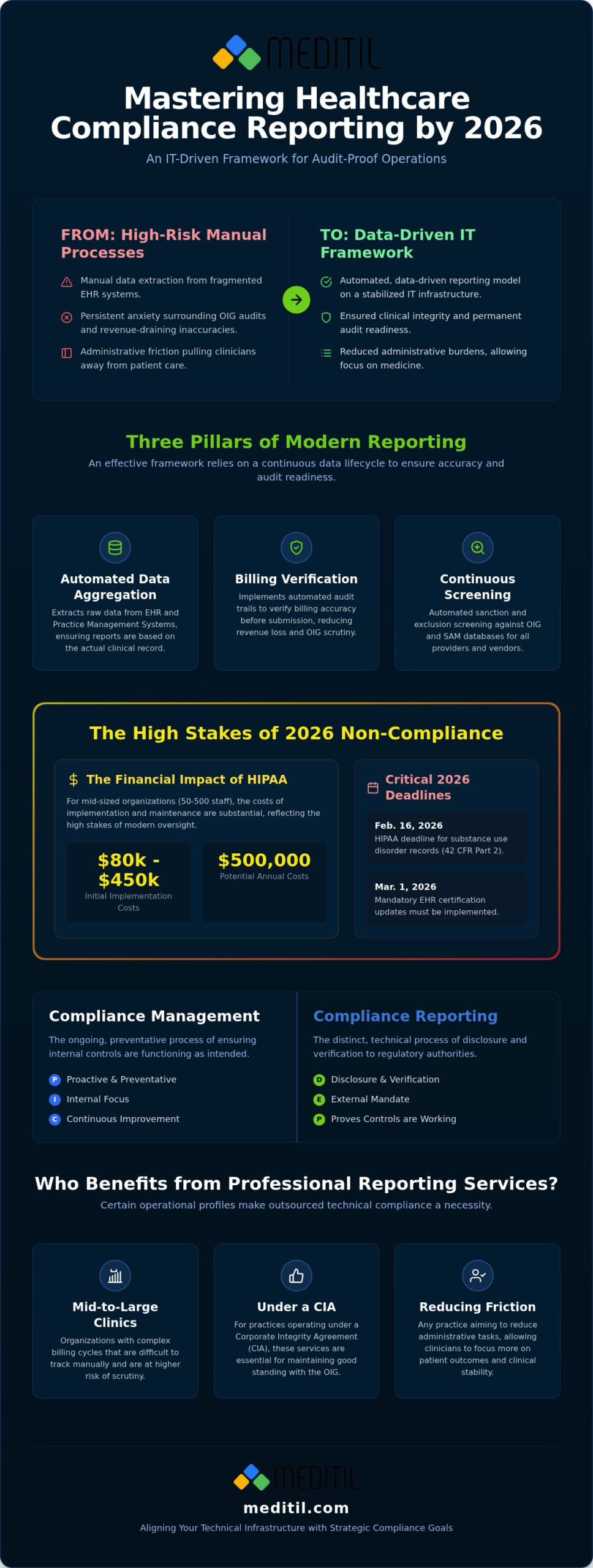
By 2026, healthcare compliance reporting is no longer a manual administrative task; it’s a high-stakes technical output of a well-managed IT infrastructure. You likely feel the weight of manual data extraction from fragmented EHR systems and the persistent anxiety surrounding OIG audits or revenue-draining inaccuracies. It’s exhausting when administrative friction pulls your clinicians away from patient care just to satisfy regulatory checkboxes.
This strategic guide provides the roadmap to master these complexities by utilizing expert healthcare compliance reporting services. We’ll show you how a data-driven IT framework ensures clinical integrity and makes your organization audit-proof. You’ll learn how to navigate critical 2026 milestones, including the February 16 HIPAA deadline for substance use disorder records and the March 1 EHR certification updates. We’ll also examine how strategic systems integration creates a seamless bridge between your IT department and compliance objectives, allowing your team to focus on medicine rather than manual data entry.
Key Takeaways
- Learn the critical distinction between preventative compliance management and the rigorous documentation required for formal regulatory disclosure and verification.
- Discover why utilizing professional healthcare compliance reporting services is the only sustainable way to meet the 2026 OIG and HHS transparency requirements.
- Transition from manual, high-risk data extraction to an automated, data-driven reporting model built on a stabilized IT infrastructure.
- Identify the specific steps to centralize fragmented EHR data through strategic network management to ensure clinical integrity and permanent audit readiness.
- Understand how fractional CIO leadership can align your technical infrastructure with strategic compliance goals to reduce administrative friction for clinicians.
What are Healthcare Compliance Reporting Services?
Healthcare compliance reporting services represent the technical intersection of regulatory mandate and operational data. These services manage the identification, documentation, and formal submission of critical data to federal and state authorities. While many organizations focus on compliance management, which is preventative in nature, reporting is the distinct process of disclosure and verification. It’s the mechanism that proves your internal controls are functioning as intended. Utilizing expert healthcare compliance reporting services ensures that your clinical data is translated into a language regulators understand, reducing the risk of misinterpretation.
The scope of these services is broad, covering everything from billing integrity to disclosures required by the Health Insurance Portability and Accountability Act (HIPAA). They also handle complex filings related to Stark Law and the Anti-Kickback Statute (AKS). By 2026, the margin for error has narrowed significantly. Regulatory bodies now expect high-velocity, data-driven reporting that manual spreadsheets simply can’t provide without significant risk of human error. A steady, technical hand is required to bridge the gap between clinical activity and regulatory disclosure.
The Core Components of Modern Reporting
Effective reporting isn’t a standalone event; it’s the result of a continuous data lifecycle. Modern frameworks rely on three primary pillars to ensure accuracy and audit readiness:
- Automated Data Aggregation: Extracting raw data from Electronic Health Records (EHR) and Practice Management Systems ensures that reports are based on the actual clinical record rather than manual interpretations.
- Billing Verification: Implementing automated audit trails allows for the verification of billing accuracy before submission, reducing the risk of revenue loss and OIG scrutiny.
- Continuous Screening: Professional services include automated sanction and exclusion screening against OIG and SAM databases to ensure every provider and vendor remains in good standing.
Who Needs Professional Reporting Services?
Not every practice requires a full-scale reporting service, but certain operational profiles make them a necessity. Mid-to-large specialty clinics often face complex billing cycles that are difficult to track manually. For organizations currently operating under a Corporate Integrity Agreement (CIA), healthcare compliance reporting services are essential for maintaining standing with the OIG. Finally, any practice looking to reduce administrative friction for clinicians should consider outsourcing these technical tasks. When clinicians spend less time on documentation for the sake of reporting, they spend more time on patient outcomes and clinical stability.
The Regulatory Landscape: Why Reporting Services Are Mandatory in 2026
The regulatory environment in 2026 has moved beyond simple “check-the-box” activities. The Office of Inspector General (OIG) and Department of Health and Human Services (HHS) now prioritize real-time data integrity over static annual reviews. The OIG Compliance Program Guidance serves as the primary blueprint for this shift, placing the burden of proof squarely on the provider. This means your healthcare compliance reporting services must be capable of demonstrating active, continuous monitoring rather than just retrospective analysis. Organizations that fail to adapt face more than just fines; they risk total exclusion from Medicare and Medicaid programs.
Accuracy in revenue reporting is now inextricably linked to the False Claims Act. If your billing data doesn’t align perfectly with clinical documentation, it’s often viewed as evidence of intent rather than a clerical error. For mid-sized organizations with 50 to 500 staff, initial HIPAA implementation costs can range from $80,000 to $450,000, with ongoing annual costs often reaching $500,000. These figures reflect the high stakes of modern oversight. Engaging with strategic IT consulting helps mitigate these financial risks by ensuring your technical infrastructure supports every regulatory requirement without fail.
HIPAA and HITECH: Data Privacy Reporting
The 2026 landscape introduces specific challenges, such as the February 16, 2026 deadline for organizations to align substance use disorder records with 42 CFR Part 2. HIPAA breach reporting requirements in 2026 demand that any unauthorized access to protected health information must be identified, documented, and disclosed within strict federal timelines. Maintaining reportable audit logs is no longer optional; it’s a foundational requirement of cybersecurity. These logs provide the verification needed to prove that your organization has maintained the integrity of patient data during a potential security event.
Stark Law and Anti-Kickback Statute Disclosures
Stark Law and the Anti-Kickback Statute (AKS) require rigorous monitoring of physician compensation and referral arrangements. Manual tracking of “fair market value” (FMV) is notoriously prone to error and frequently leads to accidental violations that trigger OIG scrutiny. By centralizing data through interoperable systems, you can automate FMV verification and ensure that all financial arrangements remain within legal boundaries. This technical oversight prevents the administrative friction that typically plagues complex specialty clinics, providing a steady hand at the wheel for even the most complicated referral networks.
IT Infrastructure vs. Manual Audits: Choosing Your Reporting Model
Choosing between manual audits and an IT-driven framework is a decision between reactive damage control and proactive stability. While traditional methods rely on human auditors, the scale of modern data makes this approach increasingly unsustainable. Professional healthcare compliance reporting services leverage managed IT to transform raw clinical data into verified regulatory outputs. These services rely on the Healthcare Compliance Essentials established by industry leaders, which highlight the necessity of accurate, verifiable documentation as a core pillar of any program.
Managed IT services aren’t just for help desk support; they’re the engine of your reporting strategy. By creating a foundation of system interoperability, these services allow you to pull reports from disparate clinical hubs without manual intervention. This ensures that your compliance software is always working with the most current data available. Cybersecurity acts as the final guardian of this process, implementing audit trails that prevent data tampering and ensure report integrity during high-stakes reviews.
Manual Reporting: The Traditional (and Risky) Approach
Manual reporting carries significant administrative costs and contributes heavily to physician burnout. When clinicians are forced into manual data entry roles, clinical focus suffers and error rates climb. A human auditor might take weeks to review a small sample of records, whereas an automated system analyzes the entire dataset in seconds. This lack of scalability makes it nearly impossible to identify subtle patterns of non-compliance across large, fragmented EHR systems before they become systemic liabilities.
There’s also the persistent risk of “stale data.” During an active OIG audit, providing information that’s even a few weeks old can raise red flags regarding your organization’s internal controls. Manual processes are inherently retrospective, meaning you’re always looking at the past rather than managing the present. Without a steady technical hand to centralize this information, your reporting remains vulnerable to inaccuracies that lead to revenue loss and potential regulatory penalties.
Automated Reporting: The Data-Driven Standard
Automated reporting shifts the focus to real-time monitoring of billing and coding anomalies. Integrating your reporting framework with medical billing automation solutions creates a seamless pipeline of verified information. This connectivity reduces the friction between your billing department and your compliance officers. It ensures that every claim submitted is backed by a technical audit trail that’s ready for inspection at a moment’s notice.
When your IT infrastructure is designed for transparency, you don’t just survive an audit; you demonstrate a level of technical maturity that reassures regulators. This data-driven standard provides the security and partnership needed to navigate a regulated environment. It allows your organization to maintain a serious, composed presence during inquiries, knowing that every detail is handled with precision and backed by a reliable, high-performing IT foundation.
Building a Proactive Compliance Reporting Framework
Establishing a robust framework requires moving beyond policy manuals into the actual architecture of your network. Professional healthcare compliance reporting services succeed when they’re built on a foundation of technical accountability and data visibility. This isn’t a passive process; it’s a strategic deployment of resources designed to catch errors before they become liabilities. To achieve permanent audit readiness, your organization must follow a structured implementation roadmap that prioritizes technical precision.
- Step 1: Conduct a comprehensive IT and compliance risk assessment. This initial phase identifies where protected health information (PHI) resides and where your reporting pipeline might fail. It’s the diagnostic stage that informs every subsequent technical decision.
- Step 2: Centralize data sources through robust network management. Fragmented data is the primary cause of reporting inaccuracies. By centralizing your infrastructure, you ensure that every report is drawn from a single, verified dataset.
- Step 3: Implement automated monitoring for high-risk areas. Focus on billing cycles and EHR access logs. Automation allows for the immediate detection of anomalies, such as coding errors or unauthorized record access, which are common triggers for OIG inquiries.
- Step 4: Establish a clear chain of command for disclosure and remediation. Technical findings mean little without a structured path for action. Define who is responsible for verifying data and who manages the final submission to federal authorities.
- Step 5: Regularly test the reporting system with mock audits. Stability is built through repetition. Regular testing ensures that your infrastructure can produce the required documentation under pressure, confirming that your processes are truly audit-proof.
The Role of Interoperability in Reporting
Interoperability is the key to breaking down data silos that plague modern healthcare organizations. When your systems talk to each other, you create a “single source of truth” that eliminates the need for manual data reconciliation. This standardization makes federal submissions much easier and ensures that your reports are consistent across different regulatory bodies. Perhaps most importantly, a high level of interoperability reduces clinical friction. When data flows automatically into reporting modules, clinicians don’t have to stop their work to provide manual extracts, allowing them to focus entirely on patient care.
Cybersecurity as a Reporting Requirement
In 2026, cybersecurity is no longer adjacent to compliance; it’s a foundational reporting requirement. You must ensure that all reportable data is encrypted and remains tamper-proof throughout its lifecycle. Utilizing healthcare cybersecurity services provides the protection needed to maintain the integrity of your audit logs. Implementing Security Information and Event Management (SIEM) is particularly critical. These systems provide the continuous monitoring and logging required to prove your organization’s adherence to privacy standards during a forensic audit. If you’re ready to secure your data foundation, contact our specialists at MEDITIL to schedule your initial technical risk assessment.
Optimizing Compliance with MEDITIL’s Managed IT and vCIO Services
Technical compliance isn’t a project with a start and end date. It’s a continuous state of readiness that requires a specialized foundation. MEDITIL provides the technical confidence necessary to manage high-stakes regulatory requirements. By integrating your clinical workflows with professional healthcare compliance reporting services, you ensure that every data point is verified and every submission is precise. Our role is to act as a proactive guide, identifying infrastructure risks before they escalate into reportable security events or audit failures.
Fractional CIO: Strategic Leadership for Compliance
Effective compliance requires more than just software; it needs strategic vision. Our virtual CIO services provide the leadership necessary to develop a multi-year technology roadmap. This roadmap aligns your reporting capabilities with long-term organizational goals, ensuring you’re prepared for upcoming shifts like the March 1, 2026, EHR certification extension. A Fractional CIO helps you budget for essential compliance upgrades without sacrificing clinical innovation, providing a steady hand at the wheel for your most complex technical decisions.
Comprehensive Managed IT for Healthcare
The integrity of your reporting depends entirely on the stability of your network. MEDITIL’s managed IT services for healthcare offer continuous monitoring of the systems that generate your compliance data. We prioritize 100% uptime for both life-critical and reporting-critical systems, ensuring that your audit logs remain complete and untampered. This level of oversight provides the security and partnership needed to build trust with regulators. When your technical infrastructure is managed with precision, you can focus on patient outcomes while we handle the complexities of the regulated environment.
Navigating the 2026 regulatory landscape requires a partner who understands that compliance is a technical output. MEDITIL serves as that seasoned expert, offering a disciplined approach to infrastructure management. We don’t just provide services; we act as a consultant invested in your long-term stability and improvement. With our team managing your technical roadmap, you gain the peace of mind that comes from knowing every detail of your reporting framework is under expert control.
Securing Your Regulatory Future Through Technical Excellence
Navigating the 2026 regulatory landscape requires a shift from manual administrative efforts to a centralized, data-driven architecture. We’ve explored how a stabilized IT infrastructure serves as the foundation for clinical integrity, ensuring that your organization remains audit-ready in the face of evolving federal mandates. By breaking down data silos and implementing automated monitoring, you don’t just satisfy OIG requirements; you protect your revenue and reduce the administrative burden on your clinicians. Utilizing professional healthcare compliance reporting services is the most reliable way to maintain this balance of security and operational efficiency.
MEDITIL serves as a strategic partner, offering specialized healthcare IT focus and national compliance expertise. Our strategic vCIO leadership provides the steady hand at the wheel needed to align your technical roadmap with long-term stability. You can move forward with confidence, knowing that your reporting processes are verified, precise, and fully protected against the risks of non-compliance. Secure your practice with MEDITIL’s expert healthcare IT and compliance services. We’re ready to help you build a more stable and resilient future for your organization.
Frequently Asked Questions
What is the difference between compliance management and compliance reporting?
Compliance management refers to the ongoing, preventative policies and training used to maintain regulatory standards. In contrast, compliance reporting is the formal process of disclosing and verifying that these standards have been met through documented data. While management sets the rules, reporting provides the evidence required by federal agencies. Utilizing professional healthcare compliance reporting services ensures this distinction is clearly maintained, providing a steady hand for your organization’s formal disclosures.
How often should a healthcare organization perform compliance reporting audits?
Most healthcare organizations should perform compliance reporting audits at least annually to meet basic regulatory requirements. However, high-risk areas like billing or pharmacy benefit from quarterly reviews or continuous monitoring. This frequency is especially critical in 2026 to ensure alignment with shifting OIG guidance and new deadlines. Regular intervals allow your team to identify and remediate anomalies before they escalate into significant liabilities or trigger a formal federal investigation.
Can managed IT services help with OIG Corporate Integrity Agreements (CIAs)?
Managed IT services are instrumental for organizations under a Corporate Integrity Agreement (CIA). These agreements often mandate rigorous, independent monitoring and frequent data submissions to the OIG. A technical framework built on managed IT provides the immutable audit trails and data integrity required to prove adherence to CIA terms. This infrastructure ensures that your reporting is accurate, verifiable, and submitted on time, reducing the risk of additional penalties or exclusion from federal programs.
What are the most common reporting errors in medical billing?
The most common reporting errors include upcoding, unbundling of services, and failing to document medical necessity within the clinical record. These inaccuracies often stem from fragmented data sources where billing systems and EHRs are not fully integrated. Such discrepancies are frequently flagged during federal audits and can lead to significant revenue loss. Automated healthcare compliance reporting services help mitigate these risks by cross-referencing clinical documentation with billing codes to ensure total accuracy.
Is automated compliance reporting secure enough for HIPAA data?
Automated compliance reporting is significantly more secure than manual methods when supported by a robust cybersecurity framework. These systems utilize advanced encryption and Security Information and Event Management (SIEM) to create tamper-proof logs of all data access. Unlike manual spreadsheets, automated tools provide a clear, permanent audit trail that satisfies HIPAA’s stringent privacy and security requirements. This technical precision ensures that patient data remains protected while fulfilling your organization’s disclosure obligations.
How does a vCIO improve healthcare compliance reporting?
A vCIO improves reporting by aligning your technical infrastructure with long-term regulatory objectives. They move beyond basic support to provide strategic leadership, helping you budget for essential updates like the 2026 EHR certification requirements. By overseeing the integration of disparate clinical hubs, a vCIO ensures that your data foundation is stable and scalable. This strategic oversight reduces administrative friction for clinicians and provides a disciplined roadmap for maintaining permanent audit readiness.
What happens if we discover a compliance violation during internal reporting?
Discovering a violation during internal reporting is a critical opportunity for remediation before an external audit occurs. Organizations should have a clear self-disclosure protocol in place to address such findings immediately. This process involves documenting the error, determining its scope, and implementing corrective actions to prevent recurrence. Proactive internal discovery demonstrates a commitment to integrity and can often result in more favorable outcomes when dealing with regulatory bodies like the OIG.
Are compliance reporting services scalable for smaller medical practices?
Compliance reporting services are highly scalable and are often more critical for smaller medical practices with limited administrative staff. Managed services allow these organizations to access enterprise-level automation and expert oversight without the cost of a full-time compliance department. This scalability ensures that even a small specialty clinic can maintain the same level of audit readiness as a large health system. It provides the technical stability needed to navigate complex regulations efficiently.