
Does your clinical team spend more time documenting at the kitchen table than they do treating patients in the exam room? Many healthcare leaders invest heavily in sophisticated platforms only to find that “pajama time” persists and revenue continues to leak through manual billing errors. The reality is that successful clinical workflow automation isn’t merely a software purchase. It’s a strategic infrastructure initiative. When your underlying network and data systems aren’t aligned, even the most advanced tools become another layer of administrative friction.
You recognize that your providers are exhausted by fragmented data silos and the constant burden of manual entry. It’s a common challenge, but it isn’t an inevitable part of modern medicine. This 2026 guide provides a roadmap to eliminate these bottlenecks and improve patient outcomes through a disciplined, infrastructure-first methodology. We’ll examine how to secure your environment, achieve true interoperability, and leverage billing automation to recover lost revenue. By the end of this article, you’ll understand how to transition from managing technical debt to leading a streamlined, high-performing clinical operation—a goal shared by innovative providers like MedShape Weight Loss that prioritize patient-centric efficiency.
Key Takeaways
- Understand the transition from manual data entry to “invisible” technology layers that reduce provider burnout and documentation fatigue.
- Learn why the EHR must serve as the central source of truth to ensure data integrity across all automated systems.
- Identify high-ROI opportunities within clinical workflow automation, specifically focusing on revenue cycle management and billing accuracy.
- Address HIPAA concerns by adopting a “Security by Design” approach when integrating new automation APIs into your existing network.
- Discover why a managed implementation strategy is necessary to prevent the failure of “set it and forget it” automation projects.
What is Clinical Workflow Automation in the 2026 Healthcare Landscape?
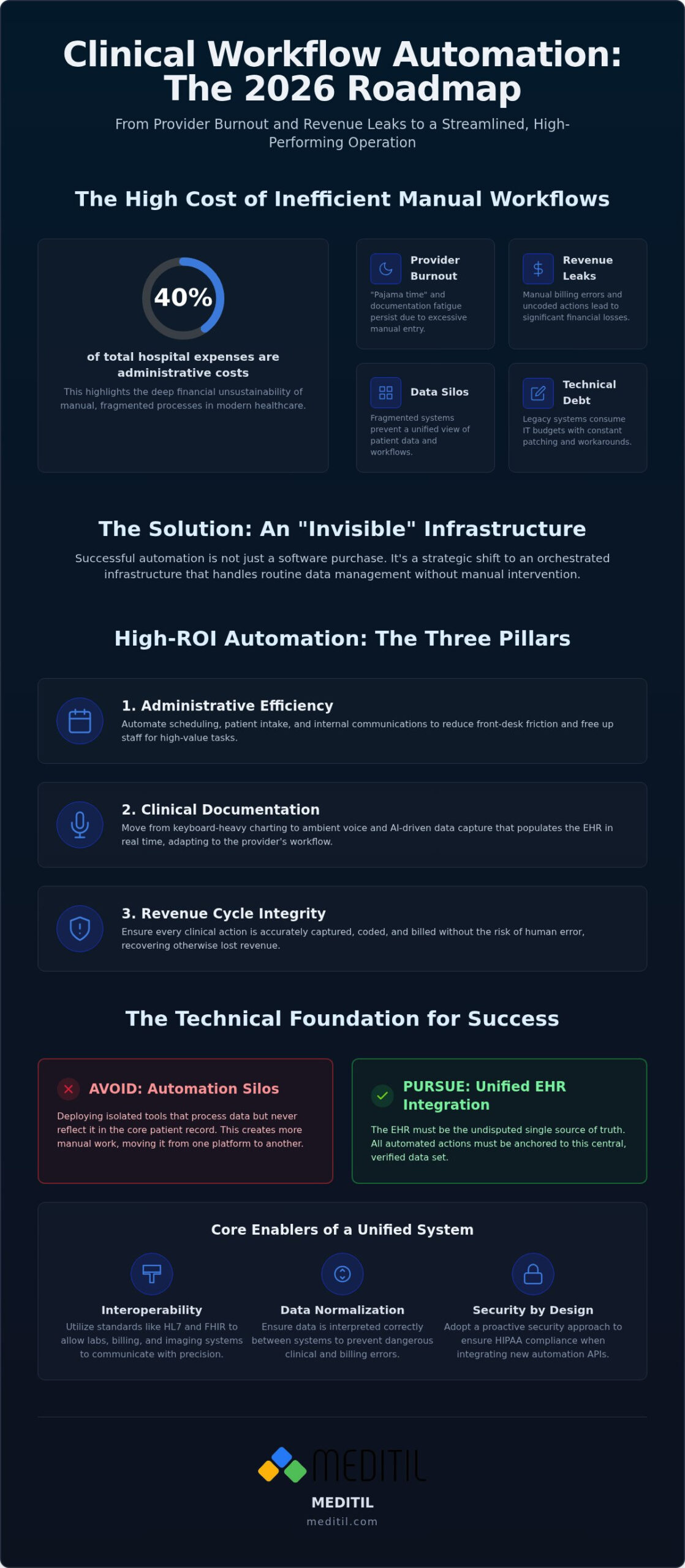
In 2026, clinical workflow automation represents the sophisticated orchestration of technology to streamline both patient care and the administrative tasks that surround it. It’s no longer just a collection of disconnected software tools. Instead, it has evolved into an “invisible” layer of infrastructure that handles routine data management without manual intervention. This year marks a critical tipping point for the industry. Persistent labor shortages and tightening reimbursement models have made manual processes financially unsustainable for most organizations.
To achieve a stable operational environment, leaders must focus on three primary pillars:
- Administrative Efficiency: Automating scheduling, patient intake, and internal communications to reduce front-desk friction.
- Clinical Documentation: Moving away from keyboard-heavy charting toward ambient voice and data capture that populates the EHR in real time.
- Revenue Cycle Integrity: Ensuring every clinical action is accurately captured, coded, and billed without the risk of human error.
The Drivers of Automation: Burnout and Reimbursement
Administrative costs currently account for roughly 40% of total hospital expenses, a figure that highlights the deep inefficiency of manual workflows. For clinicians, clinical workflow automation serves as a digital safety net, catching potential errors and reducing the cognitive load that leads to documentation fatigue. Technical debt in a clinical setting is the accumulated cost of maintaining fragmented, legacy systems that prevent modernization and consume significant portions of annual IT budgets through constant patching and manual workarounds. By addressing these infrastructure gaps, organizations can pivot from reactive troubleshooting to proactive patient care.
From Rule-Based to AI-Driven Workflows
The transition from simple, rule-based triggers to intelligent orchestration defines the modern landscape. While early automation relied on basic “if-then” logic for reminders, today’s systems use Natural Language Processing (NLP) to extract structured data from unstructured clinical notes. This shift allows for a more fluid documentation process where the technology adapts to the provider, rather than the provider adapting to the software.
However, these advanced capabilities are only possible when the underlying infrastructure is sound. Systems integration and interoperability are the absolute prerequisites for any advanced automation strategy. Without a seamless flow of data between the EHR and secondary applications, automation remains siloed and ineffective. Success requires a steady hand to manage these complex connections, ensuring every automated step is verified, secure, and compliant with regulatory standards.
The Technical Foundation: Interoperability and EHR Integration
For clinical workflow automation to deliver on its promise, the Electronic Health Record (EHR) must remain the undisputed single source of truth. Many organizations make the mistake of deploying automation tools that operate in isolation. This creates “automation silos” where data is processed but never reflected in the core patient record. When your systems don’t communicate, you don’t actually save time; you just move the manual labor from one platform to another. A unified approach ensures that every automated action is anchored to a centralized, verified data set.
Successful integration relies on established industry standards like HL7 and FHIR (Fast Healthcare Interoperability Resources). These protocols act as the universal language for data exchange, allowing different software environments to communicate with precision. Without these standards, automated triggers, such as a lab result automatically alerting a physician, would be unreliable or delayed. By prioritizing seamless data exchange, you minimize clinical friction and ensure that information moves fluidly across the entire care continuum.
Bridging Data Gaps with Interoperability Solutions
Connecting disparate systems like labs, billing, and imaging into a unified workflow is a complex undertaking. It’s not enough to simply link these platforms; you must also normalize the data. Normalization ensures that a “Positive” result in one system is interpreted correctly by the automation engine in another, preventing dangerous errors. Implementing robust healthcare interoperability solutions ensures your automated triggers are both accurate and actionable. If you need assistance auditing your current data flow, our team provides project-based IT consulting to identify and bridge these critical infrastructure gaps.
Optimizing EHR Implementation for Automation
Standard software rarely supports optimized workflows “out of the box.” Most EHRs require significant customization to handle automated billing triggers or specialized clinical templates that save time. A successful strategy focuses on EMR/EHR implementation and training that aligns the software with your specific operational goals. This involves:
- Developing customized templates that capture structured data during the patient encounter.
- Configuring automated billing triggers that reduce the need for manual coding reviews.
- Providing targeted staff training to ensure clinicians understand how to leverage new automated features.
Without this level of customization, even the most advanced automation tools will struggle to gain clinician buy-in or deliver a measurable return on investment. The goal is to create a system where the technology supports the provider, rather than adding to their workload.
Administrative vs. Clinical Automation: Prioritizing ROI
Every healthcare leader faces the challenge of where to allocate limited capital. While clinical tools often generate the most excitement among providers, administrative automation frequently delivers a faster financial return. Balancing these priorities requires a dual focus on operational efficiency and provider well-being. By distinguishing between “Front Office” patient-facing enhancements and “Back Office” revenue cycle improvements, organizations can build a phased implementation plan that funds itself through recovered revenue.
The emotional ROI of automation is just as critical as the financial metrics. Physician turnover is a significant expense, often driven by the documentation fatigue mentioned earlier. When clinical workflow automation effectively removes the burden of “pajama time,” it directly impacts staff retention. You aren’t just buying software; you’re investing in the long-term stability of your clinical team. A successful strategy ensures that operational gains don’t come at the expense of the patient experience, maintaining a seamless journey from the initial portal login to the final bill payment—a process that can be further streamlined by using Postal Methods to automate the mailing of patient invoices and statements.
Revenue Cycle and Billing Automation
Revenue Cycle Management (RCM) represents the most immediate opportunity for cost recovery. Manual insurance eligibility verification and prior authorizations are notorious for causing delays and increasing labor costs. Automating these steps ensures that coverage is confirmed before the patient even arrives, reducing the likelihood of front-end errors. Additionally, predictive AI can be used for “automated scrubbing,” identifying potential claim denials before they are submitted to payers. Implementing comprehensive medical billing automation solutions allows your staff to focus on complex exceptions rather than repetitive data entry, significantly shortening the accounts receivable cycle.
AI-Enhanced Clinical Documentation
The clinical side of the equation has been transformed by ambient listening technology. These systems act as automated scribes, “listening” to the patient-provider interaction and generating structured SOAP notes in real time. This shift fundamentally changes the provider’s role from a data entry clerk to a clinical verifier. Instead of typing during a consultation, the physician focuses entirely on the patient, later spending a few minutes reviewing and signing off on the generated note. This transition not only improves the accuracy of the medical record but also restores the human element to the exam room. For this to work, however, the documentation tool must be deeply integrated with the EHR to ensure the data remains secure and accessible for future care coordination.
Building a Secure Roadmap: Compliance in Automated Environments
The primary concern for many healthcare executives when considering clinical workflow automation is the potential for expanded HIPAA risk. It’s a valid apprehension. Every new integration point represents a potential vulnerability if not handled with technical precision. However, automation doesn’t inherently compromise security; rather, it demands a more rigorous approach to data governance. By implementing a “Security by Design” framework, you ensure that protection is built into the architecture of every automated process from the very first line of code.
A stable automation roadmap requires proactive monitoring and disciplined risk management. Since machines are now performing tasks previously handled by staff, the system must maintain comprehensive audit trails. Every data exchange, automated message, and billing trigger must be logged. This ensures that your organization remains “audit-ready” and can demonstrate accountability for every piece of Protected Health Information (PHI) that moves through your network.
HIPAA Compliance and Data Governance
Data governance in an automated environment requires strict identity management and access controls. You must ensure that automated systems only access the specific data required for their function, following the principle of least privilege. Before integrating any new tool, you must verify the vendor’s commitment to regulatory standards. Use this verification checklist for every automation partner:
- Confirm the vendor provides a comprehensive Business Associate Agreement (BAA).
- Verify third-party security certifications such as SOC 2 Type II or HITRUST.
- Evaluate encryption protocols for data both at rest and in transit.
- Audit the vendor’s vulnerability management and patch frequency.
Cybersecurity for Interconnected Systems
As you connect more platforms, you face the risk of “API sprawl.” This occurs when numerous unmonitored connections create a fragmented and vulnerable network perimeter. Protecting your clinical hub requires robust infrastructure and network services that monitor traffic in real-time. Unauthorized data access often happens at the seams between systems, making the security of your APIs just as important as the security of your core EHR.
Our team provides specialized healthcare cybersecurity services to help you manage these risks while maintaining operational speed. If you’re concerned about your current security posture, we offer Cybersecurity & Compliance audits to ensure your automation roadmap remains safe and compliant. Securing these connections isn’t just about avoiding fines; it’s about maintaining the trust of the patients you serve.
The Managed Implementation: Why a Strategic Partner is Essential
Many healthcare organizations treat clinical workflow automation as a one-time software purchase. This “set it and forget it” approach is a primary driver of project failure. Automation isn’t a static tool; it’s a dynamic system that requires ongoing management and iterative optimization to remain effective. As clinical protocols evolve and regulatory requirements change, your automated workflows must be adjusted to ensure they continue to deliver value without introducing new errors.
High-stakes transitions in healthcare technology require a steady hand at the wheel. Managed IT services provide the continuous oversight necessary to bridge the gap between initial deployment and long-term operational success. Instead of burdening your internal team with the complexities of systems integration, a strategic partner manages the technical details, allowing you to focus on the mission-critical task of patient care. It’s about moving beyond simple troubleshooting to proactive system refinement.
The Fractional CIO: Strategic Leadership Without the Overhead
Navigating the 2026 technology landscape doesn’t require the massive expense of a full-time executive hire. A vCIO provides the high-level expertise needed to create a long-term technology roadmap for automation. This role serves as a bridge between your clinical goals and technical execution, offering strategic advisory on vendor selection and complex systems interoperability. By leveraging virtual cio services, you gain access to seasoned leadership that aligns your IT budget with measurable clinical outcomes.
Managed IT as the Foundation for Growth
A stable infrastructure is the prerequisite for any growth initiative. Managed IT services ensure that your clinicians have the support they need when adopting new automated tools. This foundation allows clinical workflow automation to scale alongside your practice without compromising performance. Effective management includes:
- End-user support and help desk services to resolve issues before they disrupt the patient encounter.
- Proactive infrastructure management to prevent network downtime during peak clinical hours.
- Ongoing monitoring of automated triggers to verify accuracy and data integrity.
- Management of IT teams to ensure technical tasks align with clinical workflows.
Partnering with a specialist who understands the unique pressures of the healthcare industry ensures your technology remains an asset rather than a liability. It’s about building a resilient environment where innovation is supported by disciplined execution and reliable support systems. When your infrastructure is handled with precision, your team can return their full attention to the patients who need it most.
Leading the Future of High-Performance Clinical Operations
The path to optimized clinical operations in 2026 requires more than just adopting new tools; it demands a fundamental shift toward infrastructure-first thinking. As we’ve discussed, successful clinical workflow automation relies on the seamless integration of your EHR with a secure, interoperable network. By prioritizing high-ROI administrative improvements and addressing documentation fatigue through ambient technology, you create a more resilient environment for both staff and patients. This strategic approach ensures that technology serves as a bridge to better care rather than a barrier to productivity.
MEDITIL serves as a strategic partner in this journey, providing the technical expertise and leadership required for long-term success. We offer tailored IT solutions for the healthcare sector, comprehensive management of IT operations and compliance, and Fractional CIO leadership for strategic roadmap development. Our focus is on ensuring your systems are verified, connected, and fully optimized to meet the demands of modern medicine. We provide the steady hand needed to manage complex technical debt while building for future growth.
Request a Strategic IT Consultation with MEDITIL to evaluate your current infrastructure and build a roadmap for sustainable growth. We’re ready to help you navigate these high-stakes transitions with precision and technical confidence. Your organization can achieve operational excellence by aligning your clinical goals with a disciplined, expert-led technology strategy.
Frequently Asked Questions
What are the most common clinic workflows to automate first?
Prioritize high-volume, repetitive tasks such as insurance eligibility verification, appointment reminders, and digital patient intake forms. These administrative workflows offer immediate relief to front-office staff and reduce manual data entry errors. Automating these areas first provides a stable foundation before moving into more complex clinical documentation or diagnostic support tools. This phased approach allows your team to adapt to new systems while realizing a faster return on investment.
How does clinical workflow automation impact HIPAA compliance?
Clinical workflow automation enhances HIPAA compliance by creating immutable audit trails and reducing the risk of human error during data transfer. When properly implemented with secure APIs and verified Business Associate Agreements (BAAs), automated systems ensure that Protected Health Information (PHI) is only accessed by authorized protocols. This systematic approach provides a higher level of data governance than manual, paper-based, or fragmented digital processes that are prone to unauthorized access.
Can automation tools integrate with my existing EHR system?
Yes, most modern automation tools integrate with existing EHR systems through standard protocols such as HL7 and FHIR. Successful integration depends on the interoperability capabilities of your specific platform and the technical configuration of your network infrastructure. A managed approach to systems integration ensures that data flows seamlessly between the core EHR and secondary applications without creating isolated data silos that complicate the provider experience.
Will clinical automation replace medical staff or administrative roles?
Automation is designed to augment medical and administrative staff by removing the burden of repetitive, non-clinical tasks. Instead of replacing roles, these tools allow clinicians to focus on direct patient care and enable administrative teams to handle more complex patient coordination duties. The goal is to eliminate documentation fatigue and “pajama time” rather than reducing the essential human presence in the care delivery process.
What is the typical ROI for implementing billing automation?
The ROI for billing automation typically manifests as a significant reduction in claim denial rates and a shortened accounts receivable cycle. By automating insurance verification and claim scrubbing, organizations can capture revenue that was previously lost to manual errors or administrative delays. While exact figures vary by practice size, many leaders see a measurable financial impact within the first two quarters of a successful, infrastructure-first implementation.
How much technical infrastructure is required to support AI scribes?
Supporting ambient AI scribes requires a robust network infrastructure with high-speed bandwidth and low-latency connectivity to ensure real-time voice processing. Your wireless network must be optimized to handle continuous data streams from exam rooms to cloud-based processing engines without interruptions. Additionally, endpoint security must be reinforced to protect the audio data as it is captured and transmitted for documentation, ensuring no vulnerabilities exist at the device level.
What is the role of a Fractional CIO in the automation process?
A Fractional CIO provides the strategic leadership needed to align your clinical workflow automation roadmap with your organization’s long-term financial objectives. They manage vendor selection, oversee systems interoperability, and ensure that IT budgets are allocated toward high-impact initiatives. This role serves as a steady hand that bridges the gap between high-level clinical goals and the technical execution of complex, multi-system automation projects.
How do we prevent “alert fatigue” when automating clinical notifications?
Preventing alert fatigue requires a disciplined approach to notification design that prioritizes clinical relevance and urgency. Automated systems should be configured to use tiered notification levels, ensuring that only critical, actionable data triggers an immediate alert for the provider. By filtering out non-essential information and customizing triggers to specific clinical workflows, you maintain the effectiveness of the system without overwhelming your staff with redundant digital noise.