
This guide provides a strategic framework for healthcare IT cost optimization that allows you to reduce operational overhead and eliminate technical debt without compromising patient safety or HIPAA compliance. We’ll examine how shifting from reactive maintenance to a managed model and utilizing fractional leadership can create a predictable monthly spend. You’ll learn to transition from a fragmented, legacy environment to a modern, interoperable infrastructure that aligns perfectly with your clinical objectives and long-term stability.
Key Takeaways
- Identify and mitigate the hidden financial drain of technical debt by transitioning from reactive maintenance models to proactive infrastructure management.
- Implement a sustainable healthcare IT cost optimization framework that shifts unpredictable capital expenditures into stable and predictable operational expenses.
- Utilize Fractional CIO leadership to secure expert strategic guidance and long-term roadmaps without the burden of full-time executive salaries.
- Leverage system interoperability and billing automation to reduce administrative waste and directly improve revenue cycle performance.
- Execute a phased optimization roadmap starting with a comprehensive audit to prioritize IT investments based on clinical impact and financial ROI.
The Hidden Drivers of Healthcare IT Costs in 2026
Strategic budget management in a clinical setting requires looking beyond simple line items for hardware and software licensing. True healthcare IT cost optimization is often hindered by invisible drains that erode profitability before a single patient is seen. These drivers include the mounting weight of technical debt and the high price of reactive “break-fix” maintenance. While a line item for a server replacement is visible, the cost of a provider waiting five minutes for a legacy EHR to load is often ignored. This friction represents a significant financial leak that compounds over time, particularly as 2026 reimbursement structures demand higher efficiency.
Understanding Technical Debt in Healthcare
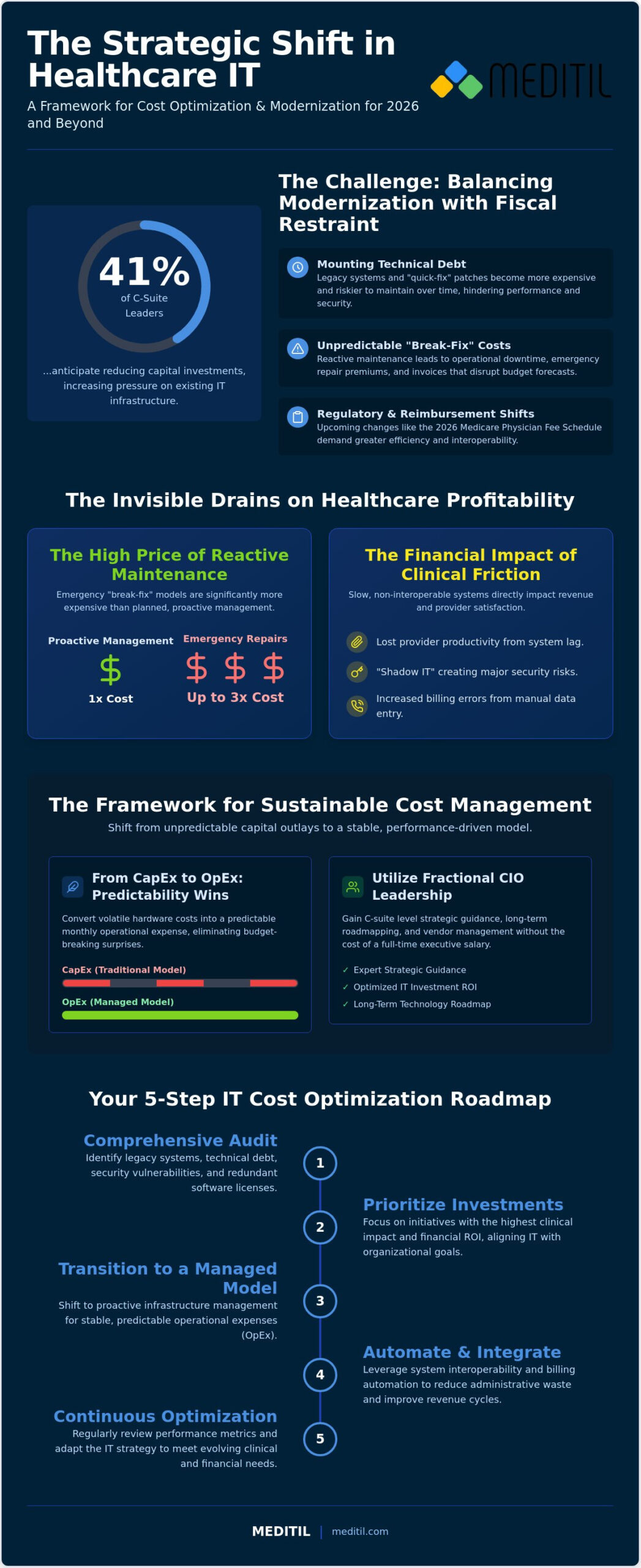
Technical debt is the compounded interest of poor IT decisions. In the context of Health Information Technology, this debt manifests as outdated servers, unpatched software, and “quick-fix” network patches that were never meant to be permanent. Maintaining these systems requires emergency repair premiums and specialized labor that grows more expensive as the technology ages. Security vulnerabilities in unpatched legacy systems also carry a heavy price; the cost of a breach or a ransomware incident far outweighs the investment required for proactive modernization. Organizations often find that reactive “break-fix” models are significantly more expensive than proactive management. Industry data suggests that emergency repairs can cost up to three times more than planned maintenance due to expedited shipping, after-hours labor, and the ripple effect of extended clinical downtime. You can explore a deeper analysis of these financial implications in our resource on Medical IT: Understanding the Cost of Technical Debt.
The Financial Impact of Clinical Friction
Physician burnout is often treated as a human resources issue, but it’s fundamentally a financial one driven by IT friction. Slow networks and non-interoperable software force clinicians to spend more time on administrative tasks than on patient care. When you calculate the cost of lost provider productivity, even a few minutes of lag per patient encounter results in thousands of dollars in lost revenue annually. This frustration frequently leads to “Shadow IT,” where staff use unauthorized apps or personal devices to bypass slow systems. This creates massive security risks and fragmented data that further complicates healthcare IT cost optimization efforts. Legacy systems that don’t communicate with modern billing or diagnostic tools require manual data entry, which increases the likelihood of errors and billing denials. In 2026, the cost of maintaining these silos is no longer sustainable under shifting reimbursement models.
A Strategic Framework for Sustainable Cost Management
Sustainable cost management requires a departure from the traditional model of large, unpredictable capital outlays. In 2026, 41% of C-suite leaders are already planning to reduce their capital investments, according to recent industry data. This shift highlights the necessity of a strategic framework that prioritizes fiscal stability alongside clinical performance. By focusing on utility rather than ownership, organizations can achieve a more resilient financial posture while maintaining high standards of care.
From CapEx to OpEx: Why Predictability Wins
Traditional IT budgeting relies heavily on Capital Expenditure (CapEx), characterized by periodic, high-cost hardware refreshes that strain cash flow. Transitioning to an Operational Expenditure (OpEx) model through subscription-based infrastructure allows for precise budget forecasting. This approach, often referred to as “Infrastructure as a Service” (IaaS), ensures you only pay for the resources you consume. It effectively converts volatile, lumpy costs into a predictable monthly fee. Managed IT services facilitate this transition, removing the burden of managing physical hardware lifecycles while ensuring the environment remains modern, secure, and compliant.
Vendor Consolidation and License Optimization
Redundant software licensing is a frequent source of waste in large medical practices. A thorough audit often reveals “zombie” licenses, which are fees paid for inactive users or software with overlapping functionalities. Consolidating your vendor stack simplifies administration and strengthens your negotiating position. By partnering with a specialized healthcare IT provider, you can eliminate these redundancies and ensure every dollar spent on software directly supports your clinical roadmap. Organizations often find that consulting with a strategic IT partner helps identify these hidden overlaps before they impact the bottom line.
The “Right-Sizing” philosophy involves aligning your hardware and cloud capacity with actual clinical volume. Many organizations over-provision their infrastructure, paying for “just in case” capacity that remains unused. Business Intelligence (BI) tools play a critical role here by identifying IT spend leaks in real time. Analyzing data on system usage and performance allows leaders to adjust resources dynamically. This data-driven approach to healthcare IT cost optimization ensures that the infrastructure scales in tandem with patient volume; it prevents waste without compromising the speed or reliability of clinical applications.
Operational Efficiency: Managed Services vs. Fractional Leadership
The traditional model of maintaining a full-scale, in-house IT department is increasingly difficult to sustain in a high-inflation environment. Recruiting and retaining specialized talent in the healthcare sector requires significant capital, often leading to a cycle of high turnover and expensive training. Operational efficiency in 2026 relies on a more flexible staffing model that prioritizes expertise over headcount. By integrating managed services and fractional leadership, organizations can access top-tier strategic guidance and technical support without the burden of full-time executive salaries or benefit packages.
The demand for specialized management software is a cross-industry trend; for instance, in the residential sector, platforms streamline building maintenance and financial collection in much the same way that healthcare IT systems optimize clinical operations.
The ROI of Fractional CIO Services
A full-time Chief Information Officer (CIO) is often a luxury that mid-sized practices and community health systems cannot afford. However, the lack of strategic oversight leads to fragmented systems and “shiny object syndrome,” where organizations invest in trendy technology that fails to solve core clinical problems. Fractional CIO leadership provides a disciplined roadmap for healthcare IT cost optimization, ensuring every technical investment aligns with long-term clinical goals. By utilizing Virtual CIO Services: Strategic IT Leadership for Healthcare in 2026, leaders gain access to high-level strategy on-demand. This approach allows you to leverage seasoned expertise to navigate complex regulatory changes and interoperability requirements at a fraction of the cost of a permanent executive hire.
Managed IT: Eliminating the Cost of Downtime
The financial impact of clinical downtime is one of the most significant hidden costs in healthcare. While specific losses vary by specialty, industry professionals report that even a single hour of system unavailability can result in thousands of dollars in lost billable revenue and administrative recovery costs. Managed IT services mitigate this risk through 24/7 proactive monitoring and standardized help desk support. This “steady hand” approach prevents minor technical glitches from escalating into expensive emergency interventions. Transitioning to a managed model also allows for the use of augmented IT teams, which can scale support during EHR implementations or facility expansions without the need for permanent new hires.
Standardizing end-user support does more than just fix computers; it preserves provider productivity. When clinicians aren’t battling slow networks or login failures, they can focus entirely on patient care. Research indicates that AI-enabled service desks can lead to a 20-35% reduction in the cost-to-serve, providing a clear path toward healthcare IT cost optimization. This shift from a reactive “break-fix” mentality to a proactive managed environment ensures that your infrastructure remains a stable foundation for growth rather than a source of constant financial and operational friction.
Interoperability and Automation as Revenue Drivers
Interoperability is frequently categorized as a regulatory hurdle, yet its role in healthcare IT cost optimization is fundamentally tied to revenue preservation. When clinical systems, laboratories, and billing platforms operate in silos, the resulting data fragmentation creates significant administrative waste. Manual workarounds required to bridge these gaps don’t just slow down operations; they introduce human errors that lead to costly claim denials. By prioritizing seamless connectivity, organizations can transform their IT infrastructure from a cost center into a driver of financial performance.
Connecting the Silos: The Cost of Disconnection
Data silos increase the cost of patient care coordination by forcing staff to hunt for information across disparate platforms. This disconnection is a primary driver of clinical friction. Utilizing modern standards like HL7 and FHIR (Fast Healthcare Interoperability Resources) reduces the long-term costs of custom integrations. These standards allow for a more modular approach to technology, ensuring that new applications can connect to existing EHRs without expensive, proprietary middle-ware. Effective interoperability is also essential for success in value-based care models, where accurate data exchange is required to meet performance benchmarks and secure incentive payments. If your organization struggles with fragmented data, you can find actionable steps in our Medical Billing Automation Solutions: A Strategic Guide.
Automation: Moving Beyond Manual Workflows
Manual administrative tasks are a significant drain on practice resources. Automating patient intake and insurance verification can lead to substantial reductions in front-desk overhead. Research indicates that automation in revenue cycle management can result in 15-40% administrative cost reductions by streamlining workflows that previously required dozens of man-hours. Beyond the front office, automated telehealth scheduling reduces no-show rates, ensuring that provider time is utilized efficiently. These projects offer a high ROI because they directly address the “Days in AR” (Accounts Receivable) metric, accelerating cash flow and reducing the need for manual collections efforts.
Tracking the success of these initiatives requires robust Business Intelligence (BI) and analytics. Leaders must be able to verify that an automation project is delivering the expected financial return. By monitoring key performance indicators such as claim clean-pass rates and administrative cost-per-patient, you can refine your healthcare IT cost optimization strategy in real time. This data-driven approach ensures that technology serves the clinical mission while maintaining a disciplined focus on the bottom line. If you’re ready to eliminate manual bottlenecks, our team can help you implement billing automation and integration services tailored to your specific clinical environment.
Implementing Your IT Cost Optimization Roadmap
Executing a successful transition from reactive spending to proactive management requires a disciplined, phased approach. Strategy alone cannot resolve deep-seated technical debt; it must be met with operational reality. A structured roadmap ensures that every technical adjustment supports the clinical mission while stabilizing the bottom line. By following a clear sequence of assessment and implementation, organizations can achieve a resilient and predictable financial model for their infrastructure.
The roadmap for healthcare IT cost optimization follows four critical steps:
- Step 1: Conduct a Technical Debt Assessment. Before implementing changes, you must baseline your current state. This involves auditing hardware lifecycles, software versions, and security vulnerabilities to identify where emergency repair premiums are most likely to occur.
- Step 2: Prioritize High-ROI Projects. Align your IT initiatives with clinical impact and financial return. Projects like billing automation or system interoperability often provide the fastest path to recouping investment by reducing “Days in AR” and administrative waste.
- Step 3: Transition to Managed Services. Stabilize your baseline costs by moving from a “break-fix” model to managed IT. This converts unpredictable capital expenses into a steady operational expense, providing immediate budget clarity.
- Step 4: Engage Fractional Leadership. Secure long-term strategic alignment by utilizing a Fractional CIO. This ensures that your IT roadmap remains focused on clinical outcomes and regulatory compliance without the cost of a full-time executive salary.
The 90-Day Efficiency Sprint
Organizational buy-in is best secured through early, measurable successes. A 90-day efficiency sprint focuses on “low-hanging fruit,” such as eliminating redundant software licenses or consolidating vendor contracts. These quick wins provide immediate cost relief and demonstrate the value of the optimization process to stakeholders. During this phase, it’s essential to establish clear Key Performance Indicators (KPIs). Monitoring metrics like cost-per-patient and help desk resolution times allows you to verify that efficiency gains don’t come at the expense of provider support.
Securing the Future: Scaling with Precision
Cost optimization is a continuous process rather than a one-time project. As clinical volumes fluctuate and regulatory requirements like the Transparency in Coverage Final Rule evolve, your infrastructure must remain flexible. Building a scalable environment allows you to add capacity with precision, avoiding the waste of over-provisioning. Partnering with a specialized healthcare IT provider ensures you have the expertise to navigate these complexities. This partnership provides a steady hand at the wheel, allowing you to maintain a modern, secure, and interoperable environment that grows alongside your practice. Sustainable healthcare IT cost optimization isn’t about spending less; it’s about spending with strategic intent to ensure long-term stability and excellence in patient care.
Securing Your Practice’s Financial and Operational Future
Achieving sustainable healthcare IT cost optimization requires more than just budget cuts; it demands a fundamental shift in how your organization manages its digital infrastructure. By addressing the hidden costs of technical debt and transitioning from volatile capital expenditures to predictable operational models, you create a foundation for long-term stability. The integration of fractional leadership and automated workflows ensures that your technology remains a strategic asset rather than a financial burden. These shifts don’t just protect your bottom line; they enhance provider satisfaction and patient safety by reducing clinical friction across the care continuum.
As you navigate the regulatory complexities and reimbursement shifts of 2026, you don’t have to manage these transitions alone. MEDITIL offers a specialized, healthcare-only focus, providing the Fractional CIO strategic leadership and HIPAA-compliant managed services your organization needs to thrive. We act as a steady hand at the wheel, helping you scale with precision and technical confidence. Optimize your healthcare IT strategy with a MEDITIL assessment today.
Your journey toward a modern, interoperable, and cost-efficient infrastructure begins with a single strategic step. We look forward to helping you build a more secure and efficient future for your practice and your patients.
Frequently Asked Questions
How can we reduce healthcare IT costs without compromising cybersecurity?
You reduce costs by investing in automated, HIPAA-compliant security frameworks that prevent expensive breaches. Proactive monitoring and regular patch management are significantly more affordable than the emergency remediation required after a ransomware attack. By integrating security into your baseline managed services, you eliminate the need for redundant, standalone security tools and the specialized personnel required to manage them.
What is the difference between IT cost cutting and IT cost optimization?
IT cost cutting is a reactive, short-term reduction in spending that often leads to increased technical debt and operational risk. In contrast, healthcare it cost optimization is a strategic realignment of resources to ensure every dollar spent supports clinical outcomes. It focuses on eliminating waste, such as redundant software licenses, while modernizing infrastructure to improve long-term efficiency and provider productivity.
How does a Fractional CIO help with IT budgeting?
A Fractional CIO acts as a strategic architect who develops a multi-year IT roadmap without the expense of a full-time executive salary. They provide the expertise needed to negotiate vendor contracts, audit current spending, and prioritize high-ROI projects. This leadership ensures that your IT budget is spent on solutions that solve specific clinical friction points rather than on unnecessary technical flourishes.
Can managed IT services really save our practice money compared to an in-house team?
Managed IT services often provide superior ROI by converting unpredictable capital expenses into stable operational costs. You gain access to a full team of specialists for less than the cost of recruiting and retaining a single in-house IT Director. This model also eliminates the high costs associated with staff turnover, ongoing training, and the specialized benefits packages required for high-level technical talent.
What are the biggest hidden costs in healthcare IT today?
The most significant hidden costs are technical debt and clinical friction. Technical debt leads to emergency repair premiums and high maintenance costs for legacy systems that no longer support modern workflows. Clinical friction, caused by slow networks or non-interoperable software, results in lost provider productivity that can cost a practice thousands of dollars in billable revenue each year.
How does interoperability impact the bottom line of a medical practice?
Interoperability directly improves the bottom line by reducing the manual labor required for data entry and care coordination. When systems exchange data seamlessly, claim clean-pass rates improve and administrative waste decreases. Effective interoperability also positions a practice to succeed in value-based care models, where accurate data exchange is a prerequisite for securing performance-based incentive payments.
Is cloud migration always the most cost-effective option for healthcare?
Cloud migration is typically the most cost-effective path for organizations seeking to eliminate the high costs of physical server maintenance and periodic hardware refreshes. While subscription fees are ongoing, they provide a predictable operational expense and include built-in redundancy and security. However, the true cost-effectiveness depends on an organization’s specific clinical volume and the complexity of their existing legacy applications.
How do we measure the ROI of healthcare IT investments?
Measuring ROI involves tracking specific Key Performance Indicators (KPIs) such as “Days in AR,” system uptime percentages, and administrative cost-per-patient. A successful healthcare IT cost optimization initiative should show a clear reduction in the time clinicians spend on administrative tasks and an increase in the speed of the revenue cycle. These metrics provide the data-driven evidence needed to justify ongoing technical investments.