
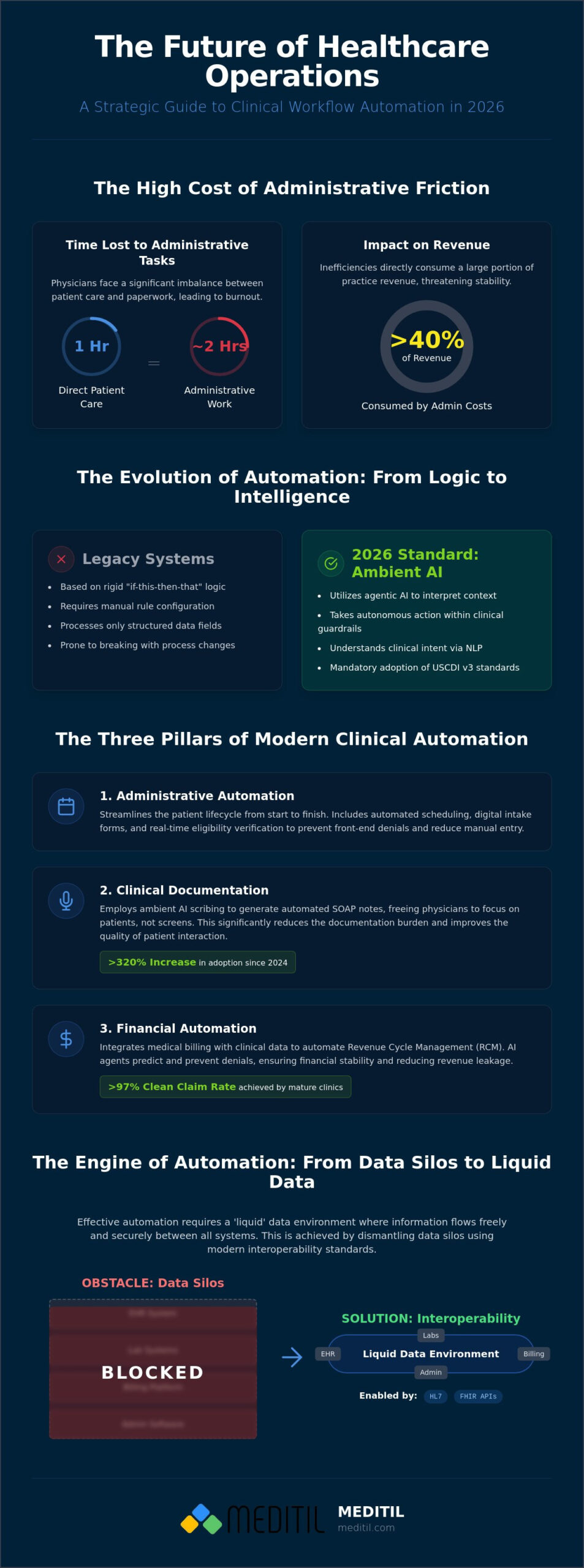
For every hour your physicians spend in direct patient care, they lose nearly two hours to administrative tasks. This inefficiency drives administrative costs above 40% of revenue and accelerates physician burnout across the industry. In 2026, clinical workflow automation is no longer a simple software purchase. It’s a strategic infrastructure evolution that requires expert orchestration to ensure security, interoperability, and clinical sovereignty under new mandates like California SB 351.
You recognize that data silos and excessive charting aren’t just operational inconveniences; they’re systemic risks to your practice’s stability and patient safety. This guide provides a clear roadmap to eliminate administrative friction and improve patient outcomes through strategic clinical workflow automation and robust IT infrastructure. We’ll examine how to achieve a 97% clean claim rate, meet the 2026 HIPAA 72-hour restoration mandate, and transition from fragmented systems to a unified, patient-centered operation that restores the focus to medicine.
Key Takeaways
- Understand the transition from basic logic to AI-driven ambient intelligence as the new standard for clinical workflow automation in 2026.
- Learn why dismantling data silos through HL7 and FHIR standards is the essential first step toward achieving a liquid data environment.
- Identify the “Automation Paradox” to ensure your underlying network infrastructure can support the increased complexity of automated systems.
- Discover how to conduct a comprehensive clinical friction audit to prioritize technology investments based on measurable ROI and staff well-being.
- Explore the strategic necessity of Fractional CIO leadership to bridge the gap between high-level clinical objectives and technical execution.
What is Clinical Workflow Automation in Modern Healthcare?
Clinical workflow automation is the strategic application of technology to execute repetitive clinical and administrative tasks without manual intervention. It involves the orchestration of data and actions across disparate systems to ensure that the right information reaches the right person at the precise moment it’s needed. This evolution is a core component of What is Health Informatics?, as it focuses on optimizing the resources and methods required to improve health outcomes through data management.
We’ve moved beyond the era of basic “if-this-then-that” logic. In 2026, the industry has shifted toward AI-driven ambient intelligence. Unlike early automation that required rigid rules, modern systems use agentic AI to interpret context and take autonomous action within predefined clinical guardrails. This progress is driven by the maturation of Natural Language Processing (NLP) and the mandatory adoption of USCDI Version 3 standards as of January 1, 2026. These advancements allow systems to understand clinical intent, not just structured data fields.
The primary objective is to return the “art of healing” to clinicians by removing digital friction. When technology handles the burden of data entry and logistics, providers can focus entirely on the patient. It’s about stability and precision in an environment where every second matters.
The Three Pillars of Clinical Automation
- Administrative Automation: This layer streamlines the patient lifecycle before the provider even enters the room. It includes automated scheduling, digital intake forms, and real-time eligibility verification to prevent front-end denials.
- Clinical Documentation: The adoption of ambient clinical documentation tools has increased by over 320% since 2024. These systems use ambient AI scribing to generate automated SOAP notes, allowing physicians to maintain eye contact with patients rather than screens.
- Financial Automation: By integrating medical billing with clinical data, organizations can automate revenue cycle management (RCM). Mature clinics now use AI agents to predict denials, achieving clean claim rates of over 97% through precise billing automation and integration.
The Impact on Patient Safety and Experience
Automation serves as a critical safeguard against human error. By automating medication reconciliation and data entry, organizations significantly reduce the risk of transcription mistakes that lead to adverse events. The patient journey also becomes more efficient. When systems communicate seamlessly, the time from check-in to discharge is accelerated, reducing wait times and improving overall satisfaction. It’s a methodical approach to care that prioritizes both safety and operational excellence.
Clinical workflow automation is a strategic imperative for 2026 that transforms healthcare from a series of manual hurdles into a streamlined, patient-centric journey. For an example of how these efficiencies empower specialized virtual providers, you can learn more about Women’s Mental Health Specialist.
The Engine of Automation: Interoperability and EHR Integration
Data silos represent the primary obstacle to effective clinical workflow automation. When patient information remains trapped in isolated databases, automated systems cannot trigger the necessary cross-functional actions required for seamless care. True efficiency depends on a “liquid” data environment where information flows securely between the EHR, laboratory systems, and administrative platforms. Achieving this liquidity requires a deep commitment to modern interoperability standards, specifically HL7 and FHIR (Fast Healthcare Interoperability Resources).
As of 2026, the CMS Interoperability and Prior Authorization Rule requires many payers to implement FHIR APIs, setting a standard that providers must match to maintain operational pace. By adopting these protocols, organizations eliminate the need for manual chart pulling and phone-based data verification. Instead, the system recognizes a clinical trigger—such as a specific diagnosis code—and automatically initiates the next logical step in the care plan or billing cycle. This technical synergy is essential for medical billing automation solutions, ensuring that clinical documentation and financial claims are synchronized in real time to prevent revenue leakage.
Success in this area requires a nuanced understanding of clinical vs. administrative automation. While administrative tasks often follow linear paths, clinical data exchange involves complex variables that demand high-precision integration to ensure patient safety.
Bridging the Gap Between Disparate Systems
Legacy point-to-point integrations are increasingly insufficient for the demands of modern medicine. They’re brittle, difficult to scale, and create maintenance burdens. Proactive leaders are shifting toward API-led connectivity, which allows different software applications to communicate through standardized interfaces. This approach enables the automated flow of lab results directly into the patient record, triggering immediate alerts for critical values. For multi-specialty clinics, establishing a unified data schema ensures that a cardiologist and a primary care physician see the same “single version of truth” without manual data reconciliation. If you’re struggling to connect these layers, our team provides expert Systems Integration & Interoperability services to stabilize your data flow.
Ensuring HIPAA Compliance in Automated Flows
Automation introduces new variables into the compliance equation. Every automated trigger that moves protected health information (PHI) must adhere to strict encryption standards for data in transit and at rest. Under the 2026 HIPAA updates, organizations must also maintain documented and tested plans to restore all clinical and billing data within 72 hours of a system outage. Managing Business Associate Agreements (BAAs) for every automation vendor is no longer optional; it’s a foundational requirement. We implement proactive monitoring tools that detect unauthorized data access in real time, ensuring that as your workflows become faster, they also become more secure.
Why Software Alone Fails: The Infrastructure Requirement
Buying a license for a new tool isn’t the same as solving a problem. Many healthcare leaders fall into the trap of viewing software as a “silver bullet” for operational inefficiency. They assume that a new AI-enabled documentation tool will instantly resolve administrative burdens. This oversight leads to the “Automation Paradox”: adding sophisticated tools to an unstable network actually increases complexity and system risk. Without stable network management, clinical workflow automation can’t perform at the speed of care, leading to dropped sessions and data lag.
Technical debt in legacy healthcare IT systems acts as a hidden tax on every new initiative. Outdated servers and fragmented local networks weren’t built to handle the high-concurrency demands of modern AI agents. When a clinician asks, “We already have an EHR, why do we need more infrastructure?”, the answer lies in the difference between storage and action. Your EHR is a repository; automation is the active transport layer that moves that data across your practice. If the transport layer is weak, the entire system fails. Strategic leaders recognize that high-volume clinical hubs require a foundation that can support the weight of these new digital demands.
The Role of Cloud Services in Scalable Automation
Transitioning from on-premise hardware to high-availability healthcare clouds is a strategic necessity. Ambient AI scribing tools require extremely low-latency performance to process speech-to-text in real time. If your network lags, the clinician’s workflow is disrupted rather than enhanced. Cloud environments also provide the essential redundancy required by the 2026 HIPAA 72-hour restoration rule. We ensure your automation remains functional even during local outages, providing a level of disaster recovery that on-site servers simply can’t match. This shift ensures that your practice remains resilient against hardware failures and local connectivity issues.
Cybersecurity as the Foundation of Trust
Every automated workflow represents a new API connection and a potential entry point for malicious actors. By expanding the digital footprint of your practice, you’re also expanding the attack surface for ransomware. Implementing a Zero Trust architecture is the only way to protect these automated clinical environments. This means every request for data, even those triggered by your own automated systems, is verified and encrypted. Utilizing proactive healthcare cybersecurity services isn’t an optional add-on; it’s the prerequisite for a trustworthy automation strategy. Without a secure perimeter, automation doesn’t just move data; it moves risk.
Building a Clinical Workflow Automation Roadmap
Implementation of clinical workflow automation is a multi-phase journey that demands precise coordination between clinical leadership and technical teams. It’s not a deployment you “finish” but a capability you mature over time. A structured roadmap ensures that every automation initiative aligns with your practice’s long-term stability and regulatory compliance requirements.
- Step 1: Conduct a Clinical Friction Audit. Begin by identifying specific bottlenecks where manual processes impede care. This audit should quantify the time lost to charting, scheduling, and redundant data entry across your departments.
- Step 2: Prioritize by ROI and Burnout. Focus on workflows that offer the highest impact. Healthcare organizations that implement automation effectively see an average return of $3.20 for every dollar invested, alongside a 74% reduction in physician burnout.
- Step 3: Vendor Due Diligence. Evaluate potential partners for their security posture, specifically requiring SOC2 Type II and HIPAA compliance. Interoperability with your existing EHR is a non-negotiable requirement to avoid creating new data silos.
- Step 4: Departmental Pilot. Deploy the automation in a single, controlled environment. This allows you to refine the logic and address technical hurdles before an enterprise-wide rollout.
- Step 5: Continuous Optimization. Establish monitoring cycles to analyze performance data. Automation logic must be regularly updated to reflect changes in payer contracts, USCDI standards, or clinical guidelines.
Aligning IT Budgets with Clinical Outcomes
Funding these initiatives requires a shift from viewing IT as a cost center to viewing it as a strategic asset. Effective strategic IT budgeting allows practices to allocate capital toward tools that provide measurable relief to clinicians. To justify these investments, leaders should track the “Time-to-Care” metric, which measures the specific number of minutes returned to direct patient interaction following an automation deployment. Success is defined by the reclamation of clinical time from administrative tasks rather than just the purchase of new software.
Managing Change and Staff Adoption
The greatest barrier to success is often human, not technical. Clinicians may resist new tools if they perceive them as adding more work or complicating their established routines. Overcoming this hurdle requires user-centric design and transparent training that emphasizes the benefit to the provider. When physicians see that ambient documentation actually works, trust begins to build. It’s essential to involve end-users early in the selection process to ensure the tools solve real-world problems. If you need a partner to guide your practice through this transition, our Project-Based IT Consulting team can help you design a roadmap tailored to your specific clinical environment.
Strategic Leadership: The Role of a Fractional CIO
Successful implementation of clinical workflow automation requires more than technical skill; it demands executive-level vision. Many healthcare organizations struggle because there is a fundamental disconnect between clinical objectives discussed in the boardroom and the technical realities of the server room. A Fractional CIO (vCIO) serves as the essential bridge between these two worlds, ensuring that every technology investment directly supports the practice’s mission. Without this high-level oversight, automation projects often become fragmented, leading to “tool sprawl” that confuses staff and complicates care.
For organizations looking to scale without the overhead of a full-time executive, our Virtual CIO services provide the steady hand at the wheel needed to navigate complex digital transformations. We don’t just offer advice; we manage the entire IT team and operations, taking full responsibility for the stability and performance of your clinical environment. This allows medical directors to focus on patient outcomes while we handle the complexities of infrastructure and application lifecycles.
Orchestrating Complex Integrations
Modern healthcare environments are rarely monolithic. They are ecosystems comprised of multiple vendors, legacy systems, and emerging AI tools. A vCIO orchestrates these disparate elements to ensure seamless connectivity across the entire practice. This includes providing strategic oversight for EMR/EHR implementation and training, ensuring that new software doesn’t disrupt established clinical routines. We also maintain the critical synchronization between clinical documentation and billing automation. When these flows are managed with precision, the practice achieves a level of operational harmony that manual oversight simply cannot replicate. If your staff is struggling with disjointed systems, our team provides the expert Management of IT Teams required to unify your operations.
Future-Proofing Your Clinical Infrastructure
The technological landscape of 2026 is merely the foundation for what is coming in 2027 and beyond. Strategic leadership involves scanning the horizon for emerging trends, such as agentic AI and advanced remote monitoring, to ensure your practice remains competitive. We also prioritize the maintenance of regulatory compliance as automation laws continue to evolve. Whether it is adapting to new AI transparency mandates or ensuring your disaster recovery plans meet the latest restoration standards, a vCIO keeps your practice ahead of the curve. By utilizing an Augmented IT Team, we provide the specialized labor needed to execute rapid deployments without overwhelming your internal staff. This proactive approach ensures that your clinical workflow automation remains a source of strength rather than a source of technical debt.
Optimizing the tools used to manage these complex technical environments is a key part of this strategy, and you can learn more about how professional support for healthcare IT management platforms ensures long-term operational stability.
Securing Your Clinical Future in 2026
The shift toward clinical workflow automation represents more than an operational upgrade; it’s a fundamental commitment to clinician well-being and patient safety. Success in 2026 depends on moving past isolated software purchases to focus on robust infrastructure and seamless data liquidity. By prioritizing interoperability and secure cloud environments, your practice can reclaim valuable time for direct patient care while ensuring compliance with evolving mandates. A methodical approach to these systems ensures that technology remains a supportive partner rather than an administrative burden.
MEDITIL provides the strategic leadership and technical precision required to navigate these high-stakes transitions. Our team has provided Fractional CIO leadership for over 100 healthcare organizations, offering specialized expertise in EMR/EHR interoperability and billing automation. We deliver comprehensive Managed IT services tailored specifically for life-critical environments where system stability is non-negotiable. Schedule a consultation with MEDITIL to audit your clinical workflows. We’re ready to help you build a more efficient and resilient future for your practice.
Frequently Asked Questions
What are the most common clinic workflows to automate first?
Patient intake, eligibility verification, and appointment reminders are the most common workflows to automate first. These administrative tasks provide immediate relief to front-desk staff and reduce the high volume of manual data entry that often leads to errors. Clinical documentation via ambient AI scribing is also a top priority. Automating these areas allows your practice to see immediate improvements in operational efficiency and staff satisfaction during the initial rollout.
Is clinical workflow automation HIPAA compliant?
Yes, clinical workflow automation is HIPAA compliant when implemented with appropriate encryption, access controls, and Business Associate Agreements. In 2026, compliance also requires meeting the 72-hour data restoration mandate for all clinical and billing data. It’s essential to verify that your automation vendors adhere to SOC2 Type II standards. This ensures that as your data moves faster, it remains protected against unauthorized access and system outages.
How does automation reduce physician and staff burnout?
Automation reduces burnout by reclaiming time spent on repetitive tasks like manual charting and prior authorization. Physicians currently spend nearly two hours on administrative tasks for every hour of direct patient care. Healthcare organizations report a 74% reduction in burnout after effectively implementing these tools. By removing digital friction, clinicians can focus on the art of healing instead of managing data entry, which restores professional satisfaction.
Can clinical automation integrate with my existing EHR system?
Most modern clinical automation tools integrate with existing EHR systems through FHIR APIs and HL7 standards. These integrations ensure that automated data flows seamlessly into the patient’s chart without manual transcription or chart pulling. Successful integration depends on a stable network and a unified data schema across your practice. Our team provides specialized expertise in these integrations to ensure your data remains synchronized across all clinical and billing platforms.
What is the difference between an AI scribe and traditional transcription?
Traditional transcription involves a human or software converting recorded audio into text after the visit, often requiring manual review for accuracy. An AI scribe uses ambient intelligence to listen in real time, interpret clinical context, and generate structured SOAP notes immediately. This technology has seen a 320% increase in adoption since 2024. It allows physicians to maintain eye contact with patients rather than typing during the encounter.
How much does it cost to implement clinical workflow automation?
Costs vary based on the scale of your practice and the complexity of the workflows you choose to automate. Rather than focusing on a single price point, leaders should evaluate the return on investment. Organizations typically see an average return of $3.20 for every dollar invested in clinical workflow automation. This ROI is driven by lower operational costs, improved clean claim rates, and the reduction of expensive physician turnover caused by burnout.
What role does interoperability play in healthcare automation?
Interoperability is the foundation of automation, enabling different systems to exchange and use data without friction. As of January 1, 2026, compliance with USCDI Version 3 is mandatory to ensure standardized data exchange across certified health IT. Without interoperability, automation remains limited to isolated tasks. True efficiency requires a “liquid” data environment where information moves securely between your EHR, billing systems, and external labs to provide a unified patient view.
How do I choose the right automation partner for my practice?
Choose a partner that offers strategic leadership, such as Fractional CIO services, rather than just a software vendor. The right partner should demonstrate deep expertise in healthcare cybersecurity, compliance, and systems integration. They should be able to manage your entire IT team and operations, ensuring that automation efforts are supported by a stable, secure infrastructure. Look for a consultant who views automation as a long-term strategy rather than a one-time purchase.