
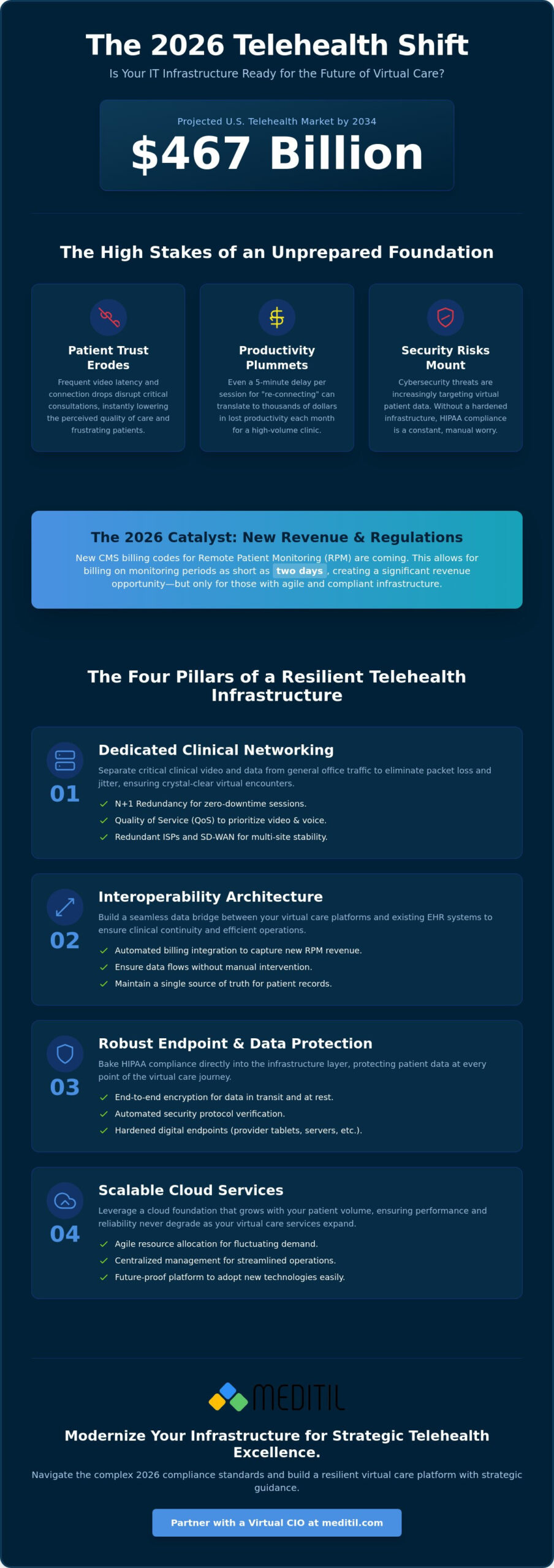
With the U.S. telehealth market projected to reach $467 billion by 2034, is your technical foundation ready for the 2026 regulatory shift? Many healthcare leaders currently struggle with frequent video latency and the mounting complexity of integrating virtual platforms with existing EHR systems. It’s a common frustration, yet the stakes have never been higher. As CMS introduces new 2026 billing codes for Remote Patient Monitoring (RPM) that allow for monitoring periods as short as two days, your telehealth infrastructure support must be agile enough to capture this revenue without adding administrative burden.
While optimizing infrastructure for CMS compliance, it’s also helpful to stay informed about the patient-facing side of Medicare; you can visit Connie Health to see how Part B premiums and coverage details impact your patient population.
We understand that clinical excellence depends on technical stability. You deserve a system where data flows seamlessly between endpoints and HIPAA compliance is a given, not a constant worry. This guide provides a strategic roadmap to help you build a resilient, secure, and scalable foundation for virtual care. We’ll examine how to achieve zero-downtime sessions, automate billing integrations, and protect patient data against the sophisticated cybersecurity threats targeting today’s healthcare networks.
Key Takeaways
- Understand why high-availability networking is the essential pulse of modern virtual medicine, moving beyond basic video tools to a comprehensive digital ecosystem.
- Learn how to implement specialized telehealth infrastructure support through dedicated clinical networking and N+1 redundancy to eliminate session latency.
- Discover the architectural requirements for seamless data flow between virtual platforms and EHR systems to ensure automated billing and clinical continuity.
- Identify the hidden risks of technical debt and consumer-grade hardware that compromise security and reliability in highly regulated environments.
- Gain a step-by-step roadmap for infrastructure modernization, including the strategic role of virtual CIO services in navigating complex 2026 compliance standards.
Defining Telehealth Infrastructure Support in 2026
In the current healthcare environment, telehealth has transitioned from a temporary emergency measure to a permanent, virtual-first service line. Successful Defining Telehealth in 2026 requires looking far beyond the software interface or the quality of a webcam. True telehealth infrastructure support encompasses a complex, integrated ecosystem of high-speed clinical networking, specialized hardware, and interoperable data layers that ensure every virtual encounter matches the quality of an in-person visit.
The standard office network that handles email and web browsing is often insufficient for the rigorous demands of modern clinical video. High-availability networking has become the pulse of modern medicine. While general IT providers might focus on simple connectivity, specialized healthcare IT focuses on eliminating packet loss and jitter. These technical micro-disturbances can compromise a physician’s ability to perform accurate visual assessments or pick up on subtle patient cues. By 2026, the shift toward sustainability means building systems that don’t just work, but scale without degrading clinical performance.
The High Stakes of Clinical Connection Stability
Connection drops and video latency do more than disrupt a conversation; they erode patient trust. When a specialist’s feed freezes during a critical consultation, the perceived quality of care drops instantly. Beyond the patient experience, technical friction carries a heavy financial cost. In high-volume clinics, a five-minute delay caused by “re-connecting” screens can lead to thousands of dollars in lost productivity over a single month. To mitigate these risks, N+1 redundancy is no longer an optional luxury for telehealth hubs. This architecture ensures that if one network path or hardware component fails, a secondary system takes over immediately. This level of resilience is the baseline for any mature virtual care model.
Regulatory Compliance as an Infrastructure Layer
Compliance shouldn’t be an afterthought or a separate manual process. In a robust technical foundation, HIPAA compliance is baked into the infrastructure layer itself. This involves ensuring end-to-end encryption across all network segments, not just the video stream. Managed IT teams now prioritize protecting data at rest and in transit during every virtual session. As cybersecurity threats specifically target virtual patient data, your telehealth infrastructure support must include automated verification of security protocols. This proactive stance ensures that every digital endpoint, from the provider’s tablet to the remote monitoring server, remains a hardened link in the chain of care.
The Four Pillars of Resilient Telehealth Infrastructure
Building a sustainable virtual care model requires a shift from reactive IT fixes to a proactive, architectural approach. While the initial surge in telehealth relied on patchwork solutions, the standards for 2026 demand a more disciplined framework. A truly resilient telehealth infrastructure support strategy rests on four distinct pillars: dedicated clinical networking, interoperability architecture, robust endpoint protection, and scalable cloud services. Each component must work in unison to ensure that the technology remains invisible to both the provider and the patient during a consultation.
The foundation of this framework is the separation of clinical data from general administrative traffic. When a physician’s home office or a satellite clinic’s hub is properly secured, the risk of data breaches decreases significantly. As outlined by resources at Telehealth.HHS.gov, maintaining best practices in policy and security is essential for long-term viability. This structural integrity allows healthcare leaders to focus on clinical outcomes rather than troubleshooting connection failures.
Network Management and Bandwidth Prioritization
Clinical video traffic cannot compete with background software updates or guest Wi-Fi usage. Implementing Quality of Service (QoS) protocols is a non-negotiable step for any high-volume organization. These protocols tag and prioritize video and voice packets, ensuring they receive the necessary bandwidth even during periods of high network congestion. For multi-site clinical organizations, managing an SD-WAN (Software-Defined Wide Area Network) provides the centralized control needed to route traffic efficiently across various locations. It’s also vital to maintain redundant internet service providers (ISPs). If your primary fiber line fails, an automated failover to a secondary provider prevents the immediate cancellation of a full day’s virtual appointments.
Interoperability and EHR Integration
Technical silos are the enemy of efficiency. A telehealth platform that doesn’t “talk” to your Electronic Health Record (EHR) creates significant administrative burden and increases the risk of documentation errors. 2026 standards prioritize seamless data flow, where patient intake data from a virtual portal automatically populates the clinical chart. This integration is particularly critical given the new Medicare RPM and RTM billing codes effective January 1, 2026, which allow for shorter monitoring periods. Capturing this revenue requires precise data syncing between remote devices and the central record. Leveraging medical billing automation solutions ensures that these sessions are coded and submitted without manual intervention. If your current systems feel disconnected, our team can provide the systems integration consulting needed to bridge these gaps and reclaim lost clinical time.
Cybersecurity and Managed Cloud Services
The transition to virtual-first care has expanded the attack surface for cyber threats. Endpoint protection must extend to the physician’s remote workspace, ensuring that every device accessing the network is verified and encrypted. This is supported by managed cloud services that offer healthcare-compliant environments. These cloud layers provide the elasticity to scale your virtual services up or down based on patient volume while maintaining a “steady hand at the wheel” regarding data security and HIPAA compliance.
Common Infrastructure Pitfalls: Why “Good Enough” IT Fails
Relying on a “good enough” approach to technology often creates systemic vulnerabilities that manifest during peak clinical hours. Many organizations fall into the “Consumer-Grade” trap, assuming that residential-class routers or basic hardware can sustain the rigors of a professional virtual clinic. These devices lack the necessary security protocols and Quality of Service (QoS) capabilities required to prioritize life-critical data. When the network fails to distinguish between a high-definition clinical video feed and a background software update, the result is the latency and connection drops that frustrate both providers and patients.
Technical debt is another hidden cost that accumulates when organizations purchase standalone telehealth applications without a cohesive strategy. These unintegrated, siloed tools create manual data entry tasks, increasing the likelihood of human error. If your telehealth infrastructure support doesn’t account for how these systems interact with your EHR, you’re essentially building digital islands that hinder rather than help your staff. This lack of integration often leads to “Shadow IT,” where clinicians resort to unauthorized, consumer-grade communication tools just to finish their rounds. This practice bypasses all security layers and places the organization at extreme risk of a HIPAA violation.
Neglecting the end-user help desk is a final, critical pitfall. Technical friction is a primary driver of provider burnout. If a physician spends ten minutes of a fifteen-minute appointment troubleshooting a microphone or a login error, the clinical mission is already compromised. Reliable support must be proactive, identifying and resolving hardware or software conflicts before the provider even enters the virtual exam room.
Overcoming the “Zoom-Only” Misconception
A common error among healthcare leaders is believing that a video platform represents the entirety of the virtual care solution. In reality, the video interface is only about 10% of the total tech stack. The remaining 90% consists of the network architecture, security layers, and data integration points that keep that video stable. While some argue that specialized telehealth infrastructure support is an unnecessary expense, the cost of a single hour of downtime or a data breach far outweighs the investment in a professional foundation. Strategic alignment requires connecting every IT expenditure directly to clinical outcomes and patient safety metrics.
The Risk of Unmanaged Healthcare IT
Unmanaged environments are prime targets for cyberattacks. Consider a scenario where a preventable breach occurs because a clinician accessed patient data through an unencrypted home network without a secure VPN. Such incidents lead to massive fines and a permanent loss of community trust. Utilizing professional healthcare cybersecurity services is the only way to prevent these life-critical system outages. A reactive “break-fix” model is no longer sufficient; 2026 demands proactive monitoring that detects threats and network bottlenecks in real time, ensuring your virtual doors never close unexpectedly.
A Step-by-Step Roadmap to Infrastructure Modernization
Transitioning from fragmented systems to a unified digital model requires a methodical approach. Modernizing your telehealth infrastructure support isn’t a single event but a sequence of strategic upgrades designed to eliminate technical friction. This roadmap ensures that every technical decision aligns with clinical goals and 2026 regulatory requirements, moving your organization toward a more resilient future.
Phase 1: Audit and Assessment
The first step involves a deep dive into the existing digital environment. We evaluate current bandwidth capabilities, the age of on-site hardware, and existing security gaps that could expose patient data. Identifying “clinical friction” points is essential; these are the moments where slow technology forces a provider to wait, directly impacting patient care quality. A comprehensive audit serves as the essential foundation of all it budgeting for medical practices. By quantifying the current state, leadership can prioritize investments that offer the highest return on clinical efficiency and system stability.
Phase 2: Implementation and Integration
Once the assessment is complete, the focus shifts to deploying enterprise-grade networking and cloud resources. This phase includes implementing N+1 redundancy, ensuring that backup systems are ready to engage if a primary component fails. Network segmentation is also critical, separating telehealth traffic from general office data to prevent bandwidth competition. Integration with EHR/EMR systems via secure APIs or middleware ensures that data flows automatically, reducing the administrative burden on your staff. This level of telehealth infrastructure support ensures that providers can focus entirely on the patient rather than the platform.
Successful modernization also requires a focus on the human element. Training staff on new workflows ensures high adoption rates and minimizes resistance to technical changes. Before going live, we conduct rigorous testing of failover systems to guarantee zero-downtime during peak hours. This phase also includes deploying managed cybersecurity and 24/7 endpoint monitoring to protect every device in the network, whether it’s in the clinic or a provider’s home office.
Establishing a vCIO-led strategic roadmap is the final, ongoing step. A fractional CIO provides the high-level guidance needed to navigate future scalability and evolving compliance standards. This disciplined oversight ensures your organization remains a leader in virtual care delivery. If you’re ready to begin this transition, contact our IT consulting team to schedule your initial infrastructure assessment.
MEDITIL: Your Partner in Strategic Telehealth Excellence
Success in virtual care isn’t achieved through software alone; it requires a specialized partner who understands that technical stability is a clinical necessity. MEDITIL serves as a comprehensive healthcare IT partner, moving beyond the role of a traditional vendor to provide expert telehealth infrastructure support. We recognize that in a high-stakes medical environment, every second of latency or downtime represents a barrier to patient access and a source of professional frustration. Our managed IT and infrastructure services are specifically tailored to the unique operational demands of modern medicine.
Fractional CIO: Strategic Leadership for Virtual Care
Meeting the complexities of 2026 regulatory standards requires more than just technical maintenance; it demands strategic vision. Our virtual CIO services provide the high-level leadership necessary to align your technical infrastructure with long-term business and clinical objectives. We assist with budget optimization and vendor management, ensuring that your telehealth stack is both cost-effective and high-performing. This proactive oversight also includes future-proofing your network for upcoming advancements in AI-powered diagnostics and the Internet of Medical Things (IoMT).
The MEDITIL Advantage: Healthcare-Specific Expertise
General IT providers often struggle with the nuances of a regulated medical environment. Our specialized focus on the healthcare sector eliminates the learning curve associated with generalist firms. We understand the specific low-latency requirements of clinical video and the critical importance of interoperability between disparate systems. Our proactive cybersecurity protocols go beyond basic HIPAA compliance, implementing multi-layered protection to safeguard your organization against evolving threats.
Building a resilient foundation for virtual care is a strategic investment in your practice’s future. Ready to stabilize your virtual care? Contact our expert team today to learn how we can strengthen your telehealth infrastructure support and clinical operations.
Securing the Future of Clinical Connectivity
Navigating the shift toward virtual-first care requires more than just a functional video platform; it demands a technical foundation that’s as reliable as your clinical team. We’ve explored how high-availability networking and seamless EHR integration form the bedrock of modern medicine. By moving away from consumer-grade hardware and unmanaged silos, your organization can eliminate the technical friction that leads to provider burnout and lost revenue. Proactive telehealth infrastructure support ensures that your practice is prepared for the 2026 regulatory environment and the next wave of diagnostic innovation.
MEDITIL provides the steady hand at the wheel that high-stakes medical operations require. With our specialized healthcare-only IT focus and fractional CIO strategic leadership, we help you transition from reactive fixes to long-term stability. Our 24/7 managed cybersecurity and compliance services ensure your patient data remains protected at every digital endpoint. It’s time to build a system that supports your mission without interruption. Secure Your Telehealth Foundation with MEDITIL today. We’re ready to help you achieve a new standard of clinical excellence.
Frequently Asked Questions
What is the minimum bandwidth required for a professional telehealth setup?
A professional setup requires a minimum of 15 Mbps download and upload speed per active HD video stream. For a clinic running multiple concurrent sessions, we recommend a dedicated fiber connection with symmetrical speeds of 100 Mbps or higher. This ensures that background data transfers don’t interfere with clinical assessments. It’s a foundational requirement for maintaining diagnostic accuracy and provider efficiency.
How does telehealth infrastructure support differ from general managed IT services?
Telehealth infrastructure support differs from general managed IT because it focuses specifically on low-latency clinical video and secure medical data transmission. General IT manages standard business applications like email or file sharing. Specialized support prioritizes Quality of Service (QoS) for patient consultations. It also involves deeper expertise in healthcare-specific regulations and the technical requirements of specialized medical peripherals.
Is my current EHR/EMR system compatible with modern telehealth infrastructure?
Most modern EHR systems are compatible through secure API integrations or HL7/FHIR middleware. During our initial infrastructure audit, we verify your system’s interoperability capabilities to ensure seamless data flow. If direct integration isn’t natively supported, we implement bridging solutions to automate patient record syncing and billing workflows. This prevents technical silos from hindering clinical operations and captures revenue more efficiently.
How can I ensure HIPAA compliance across my telehealth network?
You ensure compliance by implementing end-to-end encryption for all data in transit and at rest. This process includes securing every digital endpoint, from provider tablets to remote monitoring servers. We also manage Business Associate Agreements (BAAs) with all technical vendors and conduct regular security audits. This ensures your telehealth infrastructure support remains compliant with evolving federal standards and protects sensitive patient information.
What is the role of a Fractional CIO in telehealth planning?
A Fractional CIO provides high-level strategic leadership without the cost of a full-time executive. They’re responsible for aligning your technical roadmap with clinical goals and optimizing your IT budget. This role is essential for navigating vendor selections, managing complex system integrations, and ensuring your infrastructure is prepared for future scalability. They act as a consultant invested in your long-term operational success.
How do I prevent video lag and connection drops during patient consultations?
Preventing lag requires implementing network segmentation and Quality of Service (QoS) protocols. These tools prioritize video traffic over general administrative data, ensuring a stable connection even during peak hours. We also recommend using wired Ethernet connections for all clinical workstations and maintaining redundant internet service providers. This setup handles automated failovers if a primary line fails, maintaining clinical continuity.
What happens if my telehealth infrastructure goes down during clinic hours?
In a properly designed system with N+1 redundancy, your infrastructure shouldn’t experience total downtime. If a primary hardware component or network path fails, a secondary system takes over immediately. Our proactive monitoring detects these issues in real time. This allows us to resolve the underlying cause while your providers continue their sessions without interruption, preserving patient trust and clinic productivity.
Can MEDITIL manage my existing internal IT team for telehealth projects?
Yes, we offer management of IT teams and augmented IT services to support your current staff. We act as a strategic partner, providing the specialized healthcare expertise your internal team may lack for complex telehealth deployments. This collaborative approach allows your staff to focus on daily operations while we handle the high-level infrastructure design and implementation. It’s an efficient way to scale your technical capabilities.