
The safest way to reduce healthcare IT implementation risk is to sequence integration, data controls, and staff-ready deployment instead of launching major changes all at once. Developing a healthcare IT roadmap means identifying dependencies, assigning ownership, and validating each phase before expanding it. Keep established workflows available during early testing so care and operations can continue while teams assess performance.
Healthcare teams know that disconnected systems and unclear data practices can make technology changes harder to manage. The challenge is turning that awareness into an actionable plan that fits clinical workflows and operational priorities.
This guide explains how to map systems and integration needs, establish practical data governance controls, and phase implementation with clear measures of progress. It also covers how to prepare staff and infrastructure so each initiative has a defined purpose, accountable owners, and a controlled path into everyday use.
Key Takeaways
- Map how clinical and administrative systems exchange information, then validate connections and error handling before launch.
- Define data ownership, access controls, and quality checks so teams can identify and address issues consistently.
- Prioritize roadmap initiatives by their operational impact, dependencies, available resources, and measurable outcomes.
- Use staged deployment and clear performance measures to guide when a change is ready to expand.
Healthcare IT integration with EHRs, labs, pharmacies, payers, devices, and health information exchanges
Before selecting integration work, map how clinical and administrative platforms exchange information. Then prioritize connections based on their effect on care, staff workflows, and reliable data movement.
-
Connect Core Healthcare Systems
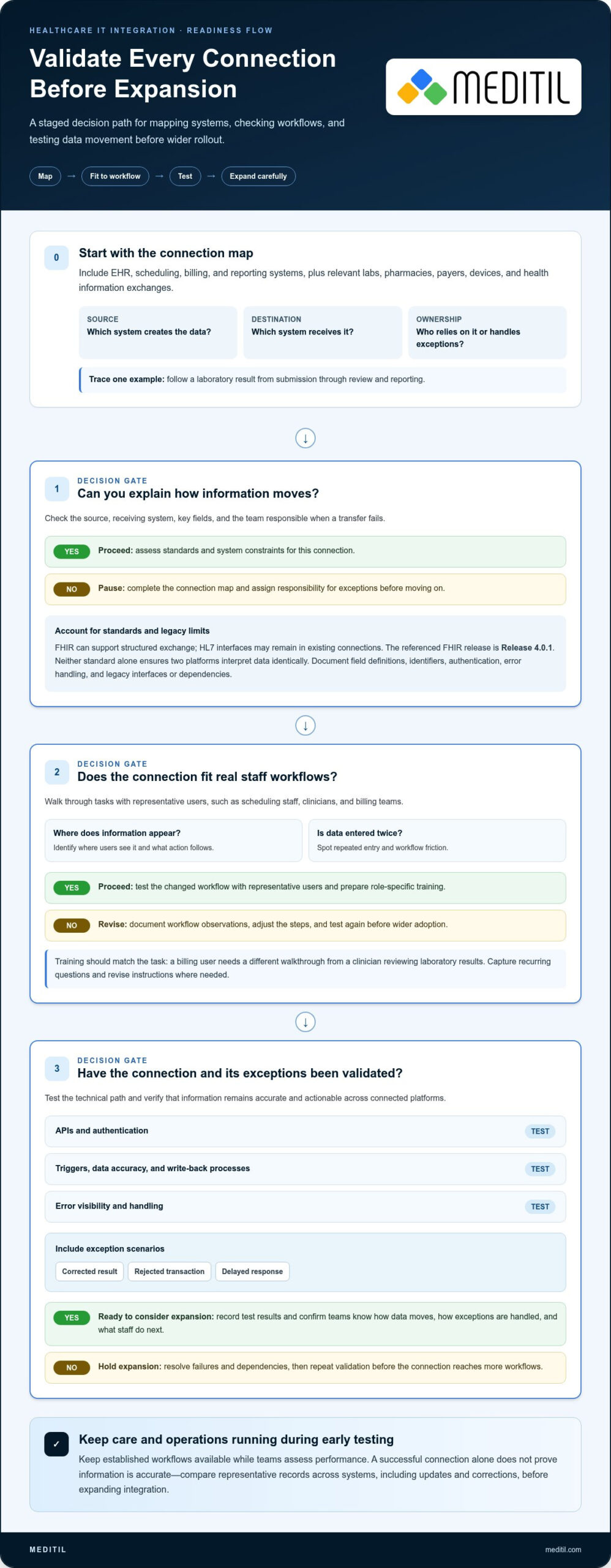
Document the information exchanged among EHR, scheduling, billing, and reporting systems. Add laboratory, pharmacy, payer, device, and health information exchange connections to the same map. For each connection, identify which system creates the data, which receives it, and who relies on it. For example, trace a laboratory result from submission through review and reporting.
Check that receiving platforms interpret key fields consistently and that failed transfers reach a responsible team. A successful connection does not prove that information is accurate. Compare representative records across systems, including updates and corrections, before expanding integration to additional workflows.
-
Bridge Standards and Legacy Systems
Choose an integration approach for each system pair, accounting for supported standards and legacy constraints. According to Assistant Secretary for Technology Policy/Office of the National Coordinator for, HL7® Fast Healthcare Interoperability Resources (FHIR®) Release 4.0.1 (incorporated by reference, see § 170.299) is the referenced FHIR release.
FHIR can support structured exchange, while HL7 interfaces may remain part of existing connections. Neither standard alone ensures that two platforms interpret data identically. Map field definitions, identifiers, authentication, and error handling for each connection. For a legacy system, document its available interface and dependencies before deciding how it fits into the integration sequence.
-
Fit Integration to Staff Workflows
Walk through key workflows with the people who use them, such as scheduling staff, clinicians, and billing teams. Identify where information appears, who acts on it, and whether users must enter the same data twice. Record these observations in the roadmap, then test the changed workflow with representative users before wider adoption.
Prepare role-specific training around the tasks each platform supports. A billing user needs a different walkthrough from a clinician reviewing laboratory results. Capture questions and recurring points of confusion, then revise instructions or workflow steps before rollout.
-
Validate Each Connection Before Expansion
Test APIs, authentication, triggers, data accuracy, write-back processes, and error handling before launch. Use scenarios such as a corrected result, a rejected transaction, or a delayed response. Confirm that errors are visible to the responsible team and that records remain consistent across connected platforms.
Record test results and unresolved dependencies in the roadmap. Advance integration only when teams can explain how information moves, how exceptions are handled, and where staff take the next action. This staged validation makes system dependencies visible before they affect more workflows.
Establishing data governance and quality controls
Align the roadmap with organizational goals by tying each initiative to a clinical or operational priority, such as accurate records or dependable access. Assign an accountable owner and a measurable outcome to each priority so governance decisions can guide investment and implementation.
- Define ownership and quality rules. Identify who maintains each data domain, including patient identity, medications, and encounters. Establish rules for completeness, consistency, duplicate records, and correction workflows. For example, specify who reviews a mismatched patient record and how the correction reaches connected systems. Data governance can improve operational data accuracy by 49% and reduce duplicate healthcare records by 41%.
- Control access and document provenance. Map which roles can view, change, export, or use sensitive data. Record the data source, transformation, and approval history for clinical datasets, especially those used by analytics or AI. In 2025, 97% of organizations that experienced AI-related breaches lacked proper AI access controls. Include access reviews and incident escalation in governance procedures.
- Set oversight for AI and regulatory considerations. Define who approves AI use, monitors performance, and responds when outputs appear unusual. Keep human review for sensitive, unusual, or higher-risk AI decisions. Incorporate HIPAA compliance into access controls, backup strategies, identity management, and vendor oversight from the outset. Document each AI workflow’s intended use, data inputs, review process, and escalation path.
- Prioritize investments against risk and value. Have an IT team oversee the strategy, prioritize initiatives, allocate resources, and monitor progress. Compare proposed work against clinical benefit, data quality, security exposure, and available capacity. Track defined measures, such as record completeness, correction volume, or access exceptions, and use results to adjust priorities. For implementation planning around application workflows, healthcare application support can help teams operationalize system changes.
What Should a 12-Step Healthcare Digital Transformation Roadmap Include?
Prioritize initiatives by clinical and organizational goals, expected impact, dependencies, and available resources. Assign owners, timelines, and measures of success. Address cybersecurity, privacy, and disaster recovery risks from the outset through access controls, backup validation, and incident response planning.
-
Inventory IT Assets and Security Gaps
Inventory hardware, software, data storage locations, and devices connected to the network. Record each asset’s owner, purpose, dependencies, and the patient or administrative records it handles. Then assess access controls, encryption, network security, endpoint protection, and incident response practices.
Use the inventory to identify unsupported systems, unprotected data stores, and unclear ownership. For example, trace where a patient record is stored, which systems access it, and how recovery would restore it. Document each gap, its operational impact, and the initiative needed to address it.
-
Protect Patient Data and Control Access
Classify protected health information by source, sensitivity, and intended use. Establish identity and access controls that give staff permissions suited to their roles. Incorporate HIPAA compliance into access controls, backup strategies, identity management, and vendor oversight from the outset.
Include data encryption, network segmentation, vulnerability management, and backup validation in security planning. Define who reviews access, handles exceptions, and coordinates incident response. For example, a workforce change should trigger a review of system permissions, while a recovery exercise should test whether essential records remain available.
-
Prioritize Initiatives and Track Outcomes
Rank each initiative by alignment with clinical and organizational goals, expected impact, dependencies, and available resources. Assign a responsible owner, timeline, and success measure. Sequence high-priority security and recovery work alongside system changes so dependencies and operational risks shape implementation phases.
Track progress with KPIs tied to care quality, operational efficiency, cybersecurity, and infrastructure reliability. Set baselines for processing time, completion rate, errors, staff workload, and exception volume. Review the measures with system users and decision-makers, then adjust priorities when results reveal unresolved risks or workflow problems. This keeps investment decisions connected to measurable outcomes.
Phasing implementation to reduce operational risk
Sequence changes so teams can test outcomes before expanding deployment. Keep essential workflows available while new systems demonstrate reliable performance.
- Choose a contained starting point. Select an initiative with clear boundaries, a responsible owner, and observable outcomes. Map affected roles, scheduling steps, dependencies, and fallback procedures before implementation begins. For example, introduce a changed administrative workflow to a defined user group, then review exceptions and support needs before including more teams.
- Run parallel tests before switching workflows. Keep existing workflows available during early AI testing until the AI-supported workflow demonstrates reliable performance. Compare outputs with the established process, record errors, and define who resolves exceptions. Use results to refine staff instructions and operational handoffs. Expand only when the team can manage the new process without disrupting essential daily tasks.
- Set phase gates and review points. A 90-day period can structure healthcare AI implementation reviews: use the first 30 days to assess technical stability, 60 days to review staff adoption and workflow performance, and 90 days to assess measurable operational value. Define the evidence required at each gate, such as stable processing, manageable exceptions, and user feedback, before approving expansion.
- Plan the operating model and recovery path. Decide which workloads fit cloud-based managed hosting and document ownership, access, support, and recovery responsibilities. Include scalability, redundancy, backup validation, and business continuity in infrastructure planning. Test how teams restore access to essential systems and records, then address failures before moving more workflows to the cloud.
- Prepare staff for each release. Schedule role-specific training before deployment, with support channels and escalation steps ready for launch. Gather feedback from clinicians and administrative users after each phase, then adjust training and workflow guidance before the next release. For structured EMR/EHR implementation and training, plan your implementation and training with a staged rollout approach.
MEDITIL: Managed IT Services (Ongoing)
MEDITIL helps healthcare organizations maintain the infrastructure and support needed to carry a roadmap into daily operations. Turn to its Managed IT Services when ongoing IT oversight, coordinated support, and implementation follow-through need to work together. Infrastructure & Network Services supports the underlying environment, while Cybersecurity & Compliance helps address security controls and compliance priorities. End-User Support & Help Desk gives staff a clear path to resolve technology issues affecting their work.
This is a practical next step when internal teams need added capacity to manage systems, support users, or maintain infrastructure as initiatives progress. Contact MEDITIL to discuss your healthcare IT priorities and next steps.
Turn the Roadmap Into a Working Plan
A roadmap becomes useful when teams make it part of routine decision-making. Set regular review points to compare active work with current clinical priorities, operational demands, and emerging risks. Use these discussions to resolve ownership gaps, adjust sequencing, and keep planned changes aligned with the organization’s capacity.
For healthcare organizations that need sustained technical coordination, MEDITIL’s Managed IT Services, Infrastructure & Network Services, and Cybersecurity & Compliance support ongoing operations and roadmap execution. These services are a practical next step when internal teams need help managing infrastructure, security priorities, or continuing IT responsibilities. Start with a clear discussion of current priorities and where additional support fits.
Contact MEDITIL to plan your roadmap and move from strategy to a manageable next step. With clear ownership and steady review, developing a healthcare IT roadmap can become an ongoing discipline that supports reliable systems and confident decisions.
Frequently Asked Questions
How can healthcare teams reduce implementation risk?
Reduce risk by identifying failure scenarios before a change reaches live care. For a scheduling change, test appointment creation, cancellations, and downstream notifications using representative cases. Assign a decision-maker who can pause deployment, and document how staff return to the established process if a critical function fails. Review unresolved issues with affected teams before expanding access.
Which workflows should healthcare leaders transform first?
Start with a repetitive workflow that has clear rules, measurable outcomes, and limited operational risk. Scheduling support, document processing, eligibility checks, follow-up communication, and administrative routing are potential candidates. Compare options by frequency, exception patterns, staff burden, and the impact of delays. Choose a workflow with a visible owner and a practical way to assess whether the change helped.
Why should healthcare organizations avoid transforming everything at once?
Changing multiple workflows simultaneously makes it harder to isolate the cause of errors or user difficulties. For example, if scheduling and billing processes change together, a missed claim may stem from either change or their interaction. Staggering releases gives teams time to resolve issues, clarify training, and learn from each deployment before introducing the next operational change.
What is a healthcare IT roadmap and what should it include?
A healthcare IT roadmap is a prioritized plan that connects technology work to organizational and clinical goals. It should show initiatives, dependencies, responsible owners, timing, resource needs, and measures of success. Include affected systems and workflows, key risks, and decision points for adjusting priorities. A useful roadmap makes each initiative’s purpose and place in the sequence clear.
What are the key steps to develop a healthcare IT roadmap?
Begin with organizational and clinical priorities, then document current capabilities and gaps. Identify dependencies, define initiatives and owners, and sequence the work according to impact and available resources. Add outcome measures and review points so leaders can adapt the plan as circumstances change. A decision log can capture why priorities shifted and help teams understand trade-offs over time.
How do you assess current healthcare IT systems, infrastructure, and digital maturity?
Combine an asset inventory with interviews across clinical, administrative, and IT teams. Map how information moves through representative workflows, then note where staff rely on manual workarounds or duplicate data entry. Review infrastructure capacity, recovery arrangements, system dependencies, and recurring support issues. Compare current capabilities with the organization’s desired operating state to identify gaps and sequence practical improvements.