
A polished demonstration can make a new healthcare tool look like an obvious upgrade. But evaluating new healthcare technology means testing whether it supports better care and fits the organization’s workflows, technical environment, security needs, and priorities. The decision should include the people who will use and support the technology, not just the features presented by a vendor.
A technology investment should address a defined problem without adding unnecessary operational strain. This guide explains how to assess clinical, organizational, economic, and ethical impacts; test vendor claims through demonstrations and pilots; and compare options using clear criteria. It also shows how to connect the evaluation to organizational goals, so decision-makers can determine whether a technology works and whether it fits their healthcare organization.
Key Takeaways
- Assess how a technology may affect patient care, staff workflows, organizational capacity, and ethical considerations before committing.
- Use demonstrations and focused pilots to observe real workflows and compare vendors against consistent evaluation criteria.
- Prioritize investments that address defined organizational needs and support measurable strategic goals.
- Evaluate health information technologies for security, accessibility, usability, vendor support, and interoperability.
1. Clinical, social, economic, organizational, and ethical impacts
Evaluating new healthcare technology starts with its effect on patient care, not its feature list. Assess clinical evidence, usability, access, workflow changes, costs, and ethical concerns together. For example, a tool may speed up documentation but add steps for nurses or limit access for patients with disabilities. Involve clinical, administrative, technical, operational, and analytics stakeholders to identify these effects. Include patients when assessing changes to communication, privacy, or treatment choices.
Health technology assessments vary because hospitals, payers, and government programs make different decisions. A hospital may focus on clinical fit, staffing, infrastructure, and implementation risks; a payer may assess coverage and value; a government program may apply criteria specific to its purpose. Compare evidence and requirements with the decision at hand, then document who is accountable for adoption. This prevents a favorable result in one setting from being treated as proof of fit elsewhere.
For medical devices, diagnostics, and digital health tools, determine whether FDA approval, clearance, or another regulatory status applies to the specific product and intended use. Document the applicable status and supporting evidence as part of the assessment. A vendor demonstration alone does not establish regulatory status or clinical effectiveness, so evaluate these questions separately.
Budget impact and return on investment depend on how a technology changes both expenses and operations. Map implementation, integration, training, ongoing support, and workflow costs against measurable outcomes such as staff time, capacity, or reduced duplicate work. State the assumptions behind each estimate and assess whether expected benefits align with organizational priorities. Do not treat projected savings as realized results before adoption data is available.
Review clinical evidence, including peer-reviewed studies and relevant real-world data. Compare study populations, outcomes, and limitations with the organization’s intended use, then set milestones for monitoring performance after implementation. Include security and privacy in the assessment: according to the U.S. Department of Health and Human Services, HIPAA establishes regulations to safeguard protected health information. This integrated review connects evidence, patient impact, operational readiness, and responsible data handling.
2. Using demonstrations, pilots and vendor scoring matrices
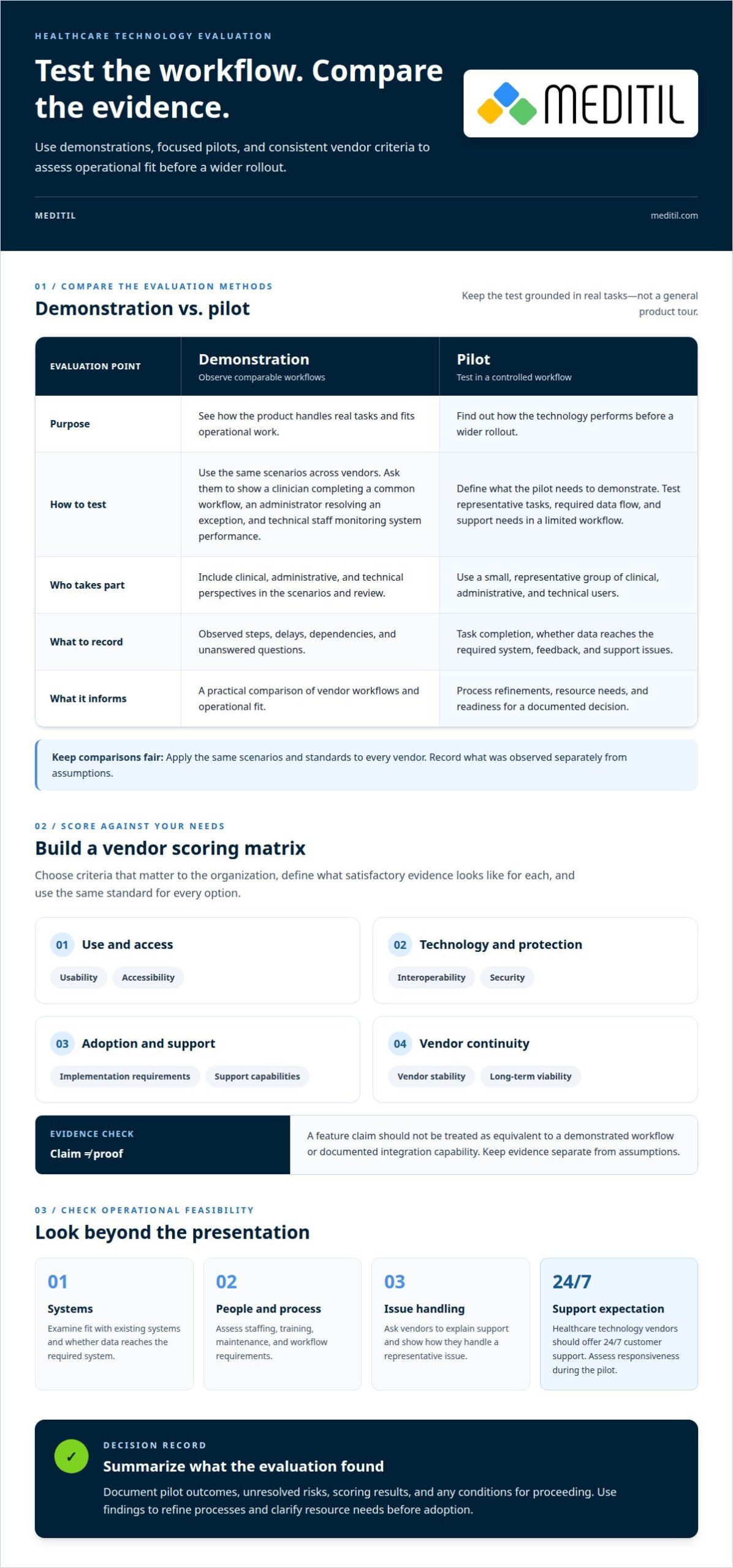
Structure each demonstration around real tasks rather than a general product tour. Ask the vendor to show how a clinician completes a common workflow, how an administrator resolves an exception, and how technical staff monitor system performance. Use the same scenarios across vendors, then record observed steps, delays, dependencies, and unanswered questions. This makes comparisons practical and focuses the evaluation on operational fit.
A pilot lets a small group test the technology in a controlled workflow before wider rollout. Include representative clinical, administrative, and technical users, and define what the pilot needs to demonstrate. For example, track whether staff can complete the intended task, whether data reaches the required system, and what support issues arise. Gather feedback throughout, then use the findings to refine processes and clarify resource needs.
Build a vendor scoring matrix around criteria that matter to the organization. Include usability, accessibility, interoperability, security, implementation requirements, support capabilities, vendor stability, and long-term viability. Define what satisfactory evidence looks like for each criterion, then apply the same standard to every vendor. Record evidence separately from assumptions. A feature claim, for example, should not be assessed as equivalent to a demonstrated workflow or documented integration capability.
Operational feasibility depends on more than whether the technology works during a presentation. Examine how it fits existing systems, staffing, training, maintenance, and escalation processes. Ask vendors to explain their support model and show how they handle a representative issue. Healthcare technology vendors should offer 24/7 customer support. Evaluate responsiveness through the pilot, including the clarity and usefulness of answers, rather than relying only on a sales presentation.
Conclude the assessment with a documented decision that summarizes pilot outcomes, unresolved risks, scoring results, and conditions for proceeding. If application workflows need refinement, healthcare application support can help address technical and user-support requirements during adoption.
3. Aligning technology investments with organizational goals
Start by translating the organization’s strategic plan into specific technology needs. If leadership prioritizes access, assess whether a proposed tool supports remote appointments or reduces scheduling friction. If the goal is reliable reporting, examine how the technology provides usable data. NICE’s topic intelligence team uses system priorities, stakeholder needs, and emerging technologies to support prioritization. This approach connects investment decisions to organizational direction rather than vendor feature lists.
Define the intended outcome before comparing solutions. For example, a practice seeking smoother patient intake could map each step from appointment preparation through check-in. Identify where staff duplicate data entry, where patients encounter delays, and which teams own each handoff. Then describe how the proposed technology should change the workflow. Leadership can use this definition to distinguish essential requirements from preferred features and keep the scope aligned with operational capacity.
Assess usability and workflow fit through representative tasks, not opinions alone. Ask clinicians and operational staff to complete routine work in a demonstration or pilot, then record task completion, navigation barriers, workarounds, and training needs. Compare findings across roles and shifts. Clinician adoption partly depends on whether the system fits established practice, supports clear handoffs, and avoids unnecessary steps. Discuss concerns directly with users and incorporate practical feedback into the implementation plan.
Keep the investment connected to its purpose through clear communication after selection. Assign leadership ownership, identify operational contacts, and explain which workflow changes the technology requires. For example, if a new system changes how staff route results, document the revised responsibilities and escalation path. Set measurable indicators tied to the original goal, such as completion of the intended workflow or reporting availability. Review them with stakeholders and use the findings to adjust training, configuration, or rollout decisions.
4. Evaluating health information technologies
Health technology assessment (HTA) is a structured way to examine a technology’s effects, value, and implementation requirements. It helps decision-makers determine whether evidence and operational needs support adopting a health information technology, rather than relying on features alone.
Use an evaluation framework to define what success means before implementation. A systematic review identified 23 frameworks and 272 recommendations for evaluating health information technologies. The review found that frameworks generally lacked healthcare professional and patient input, and often lacked systematic methods intended to reduce bias. Include both perspectives and document how evidence informs each decision.
Assess clinical performance, accessibility, record security, usability, vendor support, and interoperability. Interoperability allows providers, payers, and government disease-surveillance entities to access and share information. For example, determine whether the technology supports data extraction for required reporting. Check whether users can complete common tasks and whether the system supports the organization’s reporting and care workflows.
Interpret evidence in context. Compare peer-reviewed studies and real-world data with the intended use, population, and outcomes. Record limitations, then set measurable milestones to determine whether implementation is working. A model’s reported performance, for instance, may not show how it will perform within local workflows or with local data. Keep evidence quality distinct from vendor claims.
Assessment continues after launch. Review key performance indicators at three months, six months, and 12 months post-implementation to identify operational effects and emerging gaps. Compare results with the objectives established before selection, then determine whether configuration, training, or workflows need adjustment. This creates a documented basis for ongoing decisions rather than treating installation as the end of evaluation.
Translate findings into an implementation plan with assigned responsibilities, staff preparation, and performance measures. For organizations preparing an electronic health record rollout, structured implementation and training can connect evaluation findings to user readiness and operational workflows.
MEDITIL: Healthcare Application Support
MEDITIL provides Healthcare Application Support for healthcare organizations assessing, implementing, or optimizing application workflows. Use this support when evaluation findings reveal technical dependencies, user-support needs, or implementation challenges that require coordinated attention.
For broader operational requirements, Managed IT Services and Infrastructure & Network Services support the underlying technology environment. Cybersecurity & Compliance addresses security and compliance needs as organizations assess how systems handle sensitive information. Together, these capabilities connect application decisions with the infrastructure and safeguards that support day-to-day healthcare operations.
Share your evaluation priorities, workflow requirements, and implementation concerns with MEDITIL to discuss the appropriate next step. Contact MEDITIL to start the conversation.
Move from evaluation to a supported decision
Keep technology decisions connected to organizational priorities after selection. Use evaluation findings to guide implementation planning, assign ownership, and establish how leadership will review performance. This keeps the original purpose visible as workflows and responsibilities evolve.
Evaluating new healthcare technology is not a one-time approval exercise. It is a disciplined process of making informed choices and adapting as operational needs change. MEDITIL can support the IT environment surrounding those decisions through Managed IT Services, Infrastructure & Network Services, and Cybersecurity & Compliance.
If your team is preparing for an implementation or reassessing technical readiness, start a conversation about the needs and priorities involved. Contact MEDITIL to discuss your needs and identify a practical next step for your organization.
Frequently Asked Questions
What clinical evidence is required to demonstrate the safety and effectiveness of a new medical technology?
Evidence should match the technology’s intended use and the clinical decision it supports. Review study design, participant characteristics, outcomes, adverse events, and follow-up duration. Check whether the studied population resembles the patients who would use the technology in practice. For a diagnostic tool, examine how its results compare with an appropriate reference; for a care intervention, assess meaningful patient outcomes alongside potential harms.
How do randomized trials and real-world evidence compare when evaluating healthcare technology?
Randomized trials can help isolate an intervention’s effect by assigning participants to comparison groups. Real-world evidence draws on routine care data and can show how a technology performs across everyday workflows and patient populations. Each has limitations: trial conditions may differ from practice, while observational data may reflect confounding factors. Consider both sources together, checking data quality, population fit, outcome definitions, and missing information.
How is the cost-effectiveness of new healthcare technology measured, including cost per QALY?
Cost-effectiveness compares an option’s additional costs with its additional health benefits against a relevant alternative. Cost per QALY divides incremental cost by incremental quality-adjusted life years gained. A QALY combines length of life and health-related quality of life into one measure. Decision-makers should examine the time horizon, included costs, assumptions, and uncertainty, then consider affordability and budget impact separately.
What cybersecurity, privacy, interoperability, and data governance risks should be assessed?
Assess who can access sensitive records, how access is controlled, how data is protected, and how incidents are handled. According to the U.S. Department of Health and Human Services, HIPAA establishes regulations to safeguard protected health information. Review data ownership, retention, permitted uses, and auditability. Test whether systems exchange information accurately and support necessary reporting, while identifying data gaps, duplicate records, and unclear stewardship responsibilities.
What steps should a healthcare organization follow to pilot, evaluate, and scale a new technology?
Define the use case, intended users, success measures, and boundaries for a limited pilot. Select a representative workflow and prepare support, training, and escalation arrangements before testing. Collect user feedback and operational results, compare them with baseline measures, and document issues. Resolve critical gaps before expanding. Scale in manageable stages, assign owners to monitor progress, and retain a process for adjusting workflows as implementation evidence develops.