
Training should fit the work, not just the software. Effective EMR user training services prepare staff before go-live, connect instruction to each role’s clinical or administrative workflows, and give users time to practise. Combining one-on-one guidance, instructor-led sessions, and self-paced learning can build confidence while accommodating different schedules.
A standard orientation may cover the basics, yet staff can still struggle when training doesn’t reflect their everyday tasks. Repeated work, uncertainty, and underused features can follow. A deliberate approach treats training as part of implementation, with clear responsibilities, practical exercises, and support as workflows take shape.
This article explains how to structure provider-focused instruction, combine learning formats, and tailor training for clinical, administrative, and billing teams. It also explores how organizational goals, internal support roles, and practice environments shape a plan that works for the people using the system.
Key Takeaways
- Use one-on-one instruction to connect provider training with the clinical workflows they perform.
- Combine in-person, virtual, and self-paced learning to give staff practical options for building proficiency.
- Organize instruction around the distinct tasks of clinical, administrative, and billing teams.
- Align the training plan with organizational needs by setting clear support roles and providing a safe place to practise.
1. One-on-one provider clinical workflow training
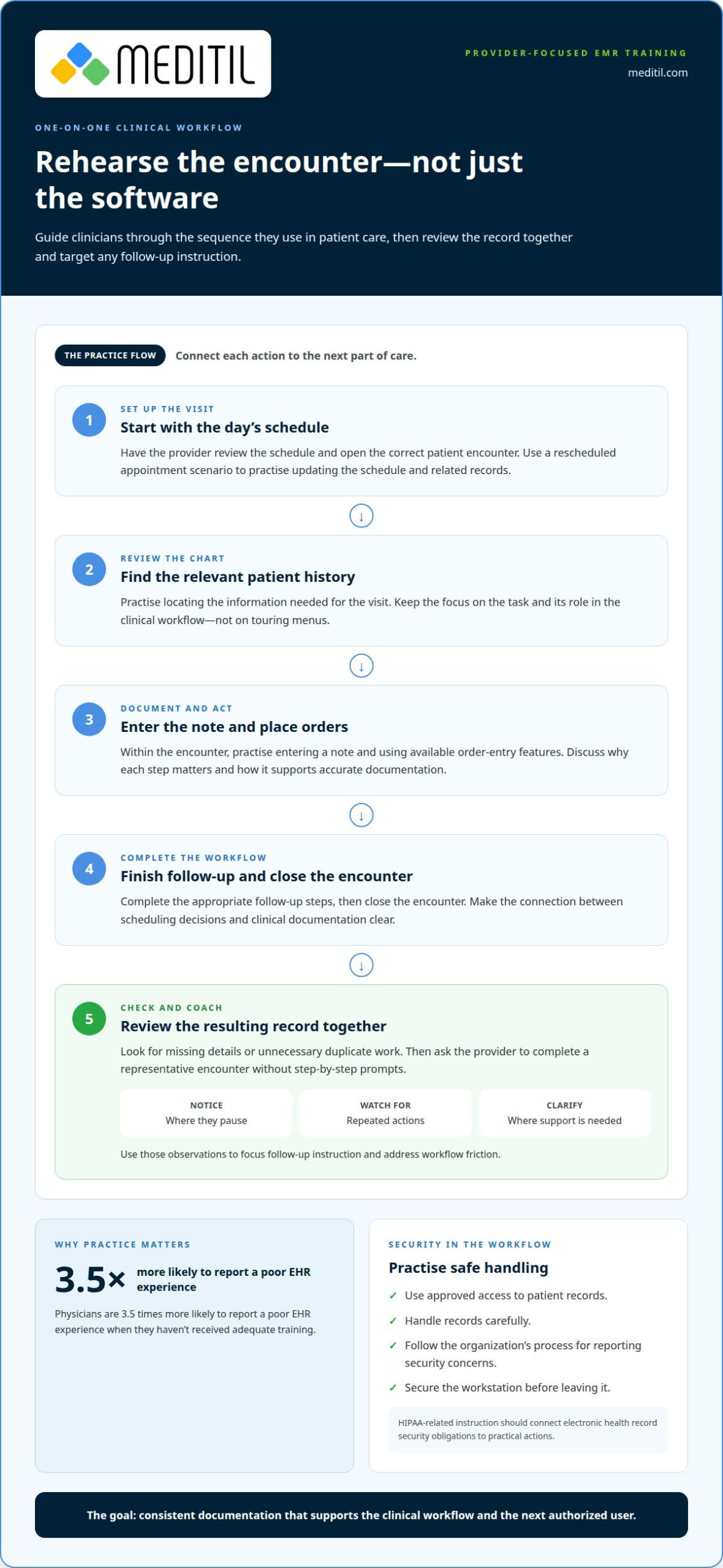
One-on-one sessions let clinicians practise the exact sequence they use during patient care. A trainer can observe a provider opening a chart, reviewing history, entering notes, placing orders, and closing the encounter. This sequence exposes handoffs where duplicate entry or missing details can affect record accuracy. In electronic medical records, the goal isn’t simply faster clicking. It’s consistent documentation that supports the clinical workflow and the next authorized user. EMR education builds workforce skills when providers repeat realistic tasks and explain why each step matters. Inadequate training can lead to repeated work, lower adoption, and underuse of EMR features. Physicians are 3.5 times more likely to report a poor EHR experience when they haven’t received adequate training.
HIPAA-related training should cover approved access, careful handling of patient records, and the organization’s process for reporting security concerns. The U.S. Department of Health and Human Services explains that HIPAA applies to electronic health record security and related obligations. Connect those topics to practical actions, such as securing a workstation before leaving it.
Structure practice around a real appointment workflow. Have providers review the day’s schedule, open the correct patient encounter, document the visit, and complete the appropriate follow-up steps. Use a rescheduled appointment scenario to practise updating the schedule and related records. This helps staff understand how scheduling decisions connect to clinical documentation.
Teach features through tasks, not a tour of menus. For example, a provider can practise entering a note, locating relevant patient history, and using available order-entry features within one encounter. Then review the resulting record together to see whether each action supports accuracy and avoids unnecessary duplicate work.
Close each session with a practical check: ask the provider to complete a representative encounter without step-by-step prompts. Note where they pause, repeat an action, or need clarification, then use those observations to target follow-up instruction. Individual coaching can reveal workflow friction and strengthen consistent EMR use across the healthcare team.
2. Blended in-person, virtual, and self-paced learning
A blended program gives healthcare professionals several ways to learn EMR software without relying on a single session format. Use instructor-led practice for complex workflows, virtual sessions when staff can’t attend together, and self-paced modules for review. For example, a team can attend a live demonstration, practise a task independently, then revisit a short lesson before applying it. Breaking instruction into smaller blocks over several days or weeks can make it easier to schedule and reinforce.
Which EMR vendors offer onsite, virtual, and train-the-trainer programs? EHR software vendors may provide classroom-style sessions and one-on-one instruction, but formats vary by program. A blended plan can pair vendor-led teaching with internal peer support, using each format for the tasks it suits best.
Make digital learning active. A learning experience platform can organize short modules, while microlearning breaks a larger task into focused lessons, such as reviewing a chart or completing a note. Gamification can add progress markers or knowledge checks, and adaptive tools can use performance to flag topics that need more instruction. These methods support continued learning without assuming every healthcare professional has the same needs.
Use an EMR sandbox to simulate realistic workflows without changing live patient information. A trainee might practise correcting an entry or moving through a sample encounter, then discuss the steps with an instructor. On-demand resources, such as searchable job aids and brief demonstrations, give staff a reference during later workflow questions. After each session, optional e-learning tests can reveal knowledge gaps; assessment results and training analytics can guide targeted follow-up.
When learning resources need to stay aligned with healthcare workflows and application changes, healthcare application support can help organizations address that ongoing operational need.
3. Role-based training for clinical, administrative, and billing staff
Role-based training teaches each group the electronic tasks it performs during implementation. Clinical staff need practice with documentation and workflows that support patient care. Front desk teams need to manage registration, scheduling, and demographic updates. Billing staff need instruction on charge entry, claim preparation, and resolving workflow exceptions. These tracks keep users focused on relevant EMR system features instead of a single general course.
Training time can vary by role and curriculum. Basic EMR training typically takes 8-16 hours for clinical staff and 4-8 hours for front desk personnel. Role-based EMR training typically takes 4-16 hours. Treat these ranges as planning references, then map session content to responsibilities, current skill levels, and the system’s configured workflows. Billing instruction should use representative scenarios, such as correcting an incomplete charge before claim submission.
A process-based strategy follows work across roles. For example, map how registration information moves from the front desk to clinical documentation and then to billing. Train each group on its tasks, then rehearse the handoffs together. This can expose missing information, unclear ownership, or duplicate entry that disrupts the process. The Office of the National Coordinator for Health Information Technology reviews role-based, super-user, and process-based strategies for healthcare organizations implementing EMR systems.
Computer-based training platforms can deliver consistent lessons and let staff revisit task-specific material. Use short modules for common actions, then pair them with supervised practice in a training environment. Check understanding with a brief task demonstration, such as finding a record or completing a billing step. Peer resources can answer routine questions, but structured instruction should remain central. This gives colleagues support without making informal guidance the program’s only source of information.
Before launch, document each role’s required tasks, learning format, and completion measure. After launch, review support requests and staff feedback to identify unclear documentation or handoffs. Update the relevant module or practice scenario, then provide focused follow-up. Connecting training to actual work patterns makes future instruction more useful than repeating the same general session.
4. Training tailored to organizational needs
Effective education starts with the organization’s workflows, not a generic course outline. Before training begins, document each user group’s responsibilities, current processes, and expected tasks in the electronic medical record. A clinic with separate specialty teams, for example, can adapt exercises to the documentation and handoffs each team performs. This gives healthcare organizations a practical basis for choosing learning platforms, scheduling instruction, and measuring whether staff can complete their assigned work.
Set training roles and expectations before the program begins. Identify an executive sponsor who understands organizational goals and how the system fits into operations. Assign a project coordinator to manage day-to-day issues and own training outcomes. Department-specific super-users can answer colleagues’ questions and support troubleshooting. Plan for at least one EMR super-user at each clinical site, while keeping formal instruction at the center of staff education.
Build practice around realistic scenarios, not demonstrations alone. An EMR sandbox lets employees rehearse common tasks without affecting live patient information. For example, a department can practise a referral handoff or documentation workflow, then identify unclear steps before using the live system. Review how each scenario supports organizational objectives, and revise it when workflows differ across sites.
Successful training also needs internal management alongside vendor support. Assign responsibility for maintaining learning materials, communicating workflow changes, and directing staff to ongoing assistance. Assess outcomes through staff feedback, practical demonstrations, and available system-usage analytics. If a team struggles with a process, provide focused instruction and reassess that task. This makes training an operational process that responds to actual needs, not a one-time event.
Organizations planning a new rollout or a significant workflow change can plan tailored EMR/EHR implementation and training around their teams, processes, and operational goals.
MEDITIL: Managed IT Services (Ongoing)
MEDITIL provides ongoing Managed IT Services for healthcare organizations that need coordinated support beyond initial EMR training. When staff face access issues, technical obstacles, or changes in their IT environment, End-User Support & Help Desk can address their support needs. Infrastructure & Network Services supports the technology underlying daily clinical workflows, while Cybersecurity & Compliance aligns IT operations with security priorities.
This support is useful when training reveals broader operational needs, such as recurring connectivity problems or questions about secure system use. MEDITIL’s HIPAA-compliant services complement staff education by addressing the surrounding healthcare IT environment, rather than replacing workflow instruction. Contact MEDITIL to discuss your organization’s healthcare IT needs.
Keep training aligned as your organization evolves
A training plan should remain useful beyond initial onboarding. As workflows, staffing, and organizational priorities change, teams need a clear way to identify where instruction should be refreshed and who owns the follow-up. Make training maintenance part of operational planning: capture recurring questions, record workflow changes, and share relevant updates with affected user groups. This keeps guidance connected to current practice and the work staff perform.
When an implementation or workflow change is approaching, include training in the same planning conversation as technical readiness and ongoing support. EMR user training services can help structure instruction around user responsibilities and organizational needs. MEDITIL works with healthcare organizations on EMR/EHR implementation and training, alongside broader IT support. Contact MEDITIL about EMR training to discuss your organization’s next steps. A deliberate plan can help your team approach change with greater clarity.
Frequently Asked Questions
Is It Time to Rethink EMR Training?
Review the approach when staff repeat tasks, avoid useful functions, or often need help with routine work. These patterns may point to a mismatch between instruction and actual responsibilities. Ask team leads to identify recurring trouble spots, then use those examples to update practice scenarios. A focused review can make training more relevant than repeating the same general orientation.
What Does EMR Training for Medical Assistants Actually Cover?
Training prepares medical assistants to complete the electronic tasks assigned to their role within the organization’s workflows. A practical session might cover locating the correct chart, entering assigned information, routing a task to the appropriate team member, and recognizing when an entry needs review. Practice should use scenarios relevant to the clinic, so learners can apply each system step to their daily responsibilities.
What EMR user training services are available for healthcare organizations?
Healthcare organizations can use instructor-led sessions, individual coaching, virtual classes, self-paced modules, and workflow practice. The right combination depends on staff roles, schedules, and implementation needs. MEDITIL provides EMR/EHR Implementation & Training for organizations seeking help with system setup, integration, and staff education. Its HIPAA-compliant healthcare IT services focus on training and workflow needs, not selling EMR or EHR software.
What topics are covered in EMR training for clinicians and administrative staff?
Training topics depend on each group’s tasks and the organization’s configured workflows. A clinician might practise routing a referral and documenting its follow-up, while administrative staff could work through correcting a demographic discrepancy and notifying the appropriate team. Joint exercises can reveal how information passes between departments. Include these handoffs in practice so staff understand their own steps and the next operational dependency.
How do independent EMR training consultants compare with vendor-led training?
Vendor-led training can explain system functions and configuration, while an independent consultant may focus on adapting instruction to local workflows and team responsibilities. Organizations can combine these approaches: use vendor guidance for system-specific features, then practise scenarios that reflect how staff work locally. Clear ownership of training content helps prevent conflicting instructions and keeps updates aligned with the implemented system.
How long does EMR user training take before and after system go-live?
Vendor-led EMR training typically lasts 1-8 weeks, depending on the implementation and training plan. Before go-live, schedule instruction early enough for staff to practise their tasks and resolve questions. After launch, support can continue through at-the-elbow assistance, help desks or chat tools, and refresher sessions. Maintain follow-up as new questions arise, rather than treating go-live as the end of learning.