
A policy alone cannot govern healthcare data. Data governance in healthcare consulting brings together the people, processes, and systems that manage information throughout its lifecycle. It establishes clear expectations for data quality, access, security, use, and accountability across an organization.
Healthcare teams know data must be protected and reliable. The challenge is turning that principle into clear responsibilities and workable controls across clinical, operational, and administrative systems. This article explains what healthcare data governance covers, how access controls and compliance fit into a broader program, and where organizations can start.
You’ll also see how governance frameworks can guide decisions about roles, standards, and oversight. The goal is to make the subject practical: understand the core decisions, identify a sensible starting point, and connect governance to how information is managed and shared.
Key Takeaways
- Clarify who owns each data domain and how information is defined, maintained, and used across systems.
- Connect access controls and security practices to privacy obligations, including breach response responsibilities.
- Begin with priority data needs, accountable stewards, and practical quality measures that teams can review.
- Use a governance framework to align roles, technical standards, and oversight with your organization’s needs.
What is healthcare data governance?
Healthcare data governance defines how people, processes, and systems manage information throughout its lifecycle. It connects data management decisions to patient care, operations, and analytics.
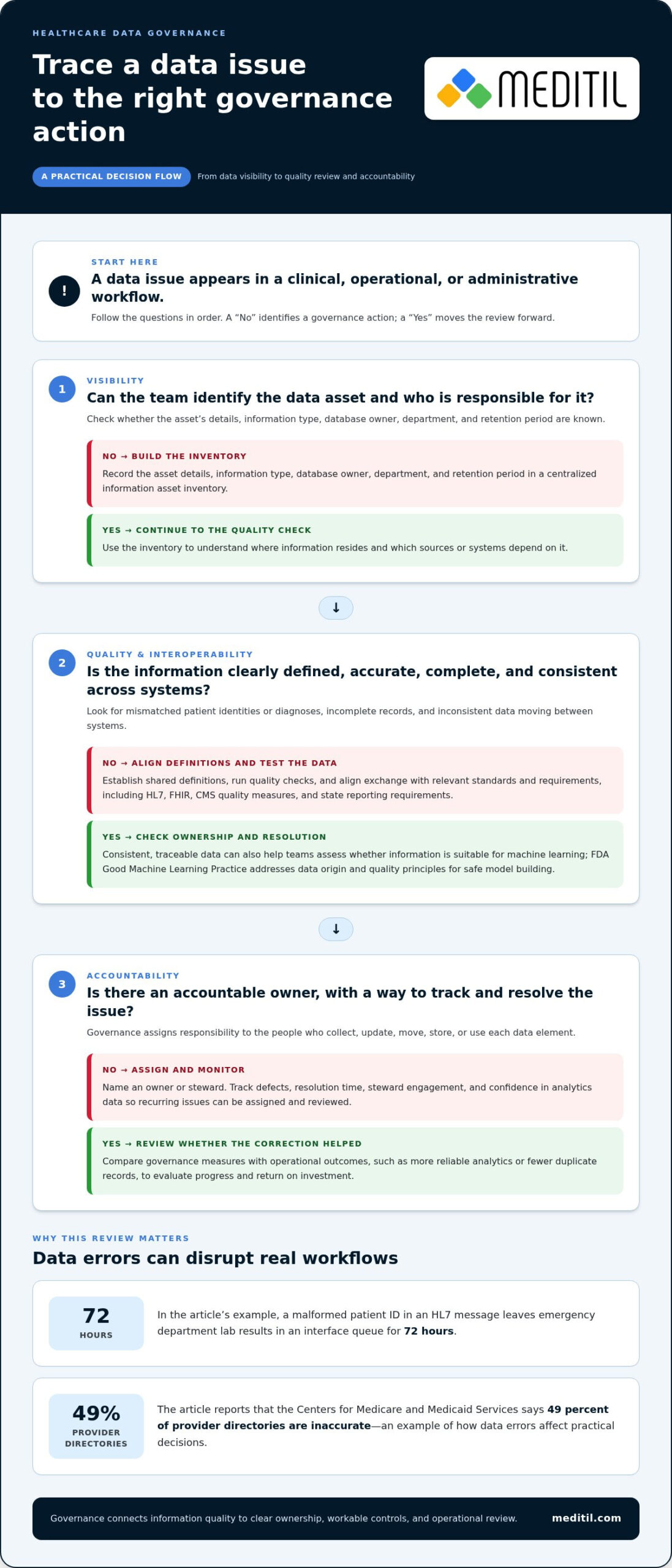
Assess program maturity by reviewing domain ownership, data quality, steward engagement, and issue-resolution time. Compare these measures with operational outcomes, such as more reliable analytics or fewer duplicate records, to evaluate progress and return on investment.
Quality and Interoperability Challenges
Healthcare data quality and interoperability challenges arise when patient information is incomplete, inaccurate, or inconsistent across systems. Recording a diagnosis or patient identity differently can distort analytics and operational decisions. Governance establishes shared definitions and assigns accountability to the people who collect, update, move, store, or use each data element.
For example, a malformed patient ID in an HL7 message can leave emergency department lab results in an interface queue for 72 hours. Aligning definitions with HL7, FHIR, CMS quality measures, and state reporting requirements supports consistent exchange. The Centers for Medicare and Medicaid Services reports that 49 percent of provider directories are inaccurate, illustrating how data errors affect practical decisions.
Consistent, traceable data also helps teams assess whether information is suitable for machine learning. FDA Good Machine Learning Practice addresses data origin and quality principles for safe model building.
Inventories, Access Controls, and Quality Checks
A centralized information asset inventory shows what data exists, where it resides, and who is responsible for it. Record each asset’s details, information type, database owner, department, and retention period. This overview helps teams identify critical data sources and understand dependencies before expanding analytics or integrating systems.
Access controls turn governance decisions into permissions based on work responsibilities and information needs. Policies can also track and manage internal and external data requests, supporting secure, efficient sharing. For example, a team can define who may use patient information for a specific operational purpose and document the request.
Quality checks test whether data is clearly defined, accurate, complete, and consistent across systems. During operational reviews, track defects, resolution time, steward engagement, and confidence in analytics data. Teams can then identify recurring issues, assign an owner, and assess whether corrections improve reporting or patient workflows.
Access controls, security, and compliance certification
Governance translates privacy and security expectations into defined access rules, responsibilities, and oversight. For U.S. organizations, HIPAA provides a foundation for protecting patient health information.
Privacy, Security, and Transparency
Privacy, security, and transparency connect approved data use with safeguards and clear accountability. HIPAA sets national standards focused on privacy and security, according to the U.S. Department of Health and Human Services, but it is not itself a data governance program. Policies should define permitted uses, document how internal and external requests are handled, and make access decisions traceable. These controls help organizations explain how information is protected and shared.
Access models should reflect the purpose of each request, not simply an employee’s ability to open a system. For example, a billing role may need payment details without the same access to clinical records as a care team. Defined permissions reduce unnecessary exposure while supporting accurate, timely work.
Employee Data Access
Employee access controls assign system permissions according to job duties and approved responsibilities. Each role should have access to the information it needs, while managers and system owners review whether permissions remain appropriate. A role change, for example, should prompt a review of existing access so outdated permissions are not left in place.
Security also depends on employees understanding how to handle information and report concerns. Governance policies can specify request approval, access logging, and escalation routes. These operational controls make responsibility visible across departments instead of placing data protection solely with IT.
HIPAA breach notification procedures require a 60-day timeline for large breaches, according to the U.S. Department of Health and Human Services. An incident process should connect detection, response ownership, documentation, and required notification. Clear responsibilities help teams act consistently when an event affects patient information.
As EHR environments grow and connect more systems, governance must coordinate access across applications and data exchanges. Organizations can consider HIPAA requirements alongside HITRUST control frameworks and NIST security standards. These references can inform control design and evidence collection, but they do not replace defined ownership or operational review.
For organizations aligning technical safeguards with governance responsibilities, Cybersecurity & Compliance support can help address security and compliance needs.
Governance program implementation starting points
Implementation works best when healthcare organizations connect governance priorities to clinical and operational needs. A defined roadmap gives leaders milestones for assigning responsibility, setting standards, and reviewing progress.
Leadership Buy-In and Planning
Leadership buy-in means executives support the governance program with clear authority, participation, and organizational priorities. It matters because clinical, financial, and IT teams must make coordinated decisions about shared data. Leaders can establish a governance council, identify priority domains, and name owners and stewards. A patient identity domain, for example, needs input from both clinical and administrative teams.
Engagement costs depend on scope, systems, staffing, and deliverables; pricing is provided after a quote request. Planned durations vary by work: healthcare data governance assessment and strategy takes 1-2 weeks, framework development takes 3-4 weeks, and implementation takes 5-12 weeks.
Consultant Assessment and Implementation Steps
Consultants assess current data practices, identify gaps, and turn findings into policies, roles, and measurable priorities. This helps healthcare organizations focus effort on specific needs, such as inconsistent clinical definitions or unclear ownership. An assessment considers data sources, existing standards, access practices, and the people responsible for decisions.
Implementation then assigns owners and stewards, establishes procedures, educates staff, and monitors data quality and initiative outcomes. A practical sequence starts with baseline findings, moves to governance decisions, and tests controls in priority domains. For example, a team can apply an initial quality rule to a selected reporting measure before expanding it.
A 90-day roadmap can structure early work without treating governance as a one-time project. During days 1-30, identify priority domains, assign owners and stewards, and inventory definitions and data sources. During days 31-60, create a governance council, draft an initial data dictionary, and implement basic quality rules. During days 61-90, launch monthly committees, monitor quality KPIs, and document lineage for high-value measures.
Once the roadmap is in place, leaders can review whether clinical and operational programs use consistent definitions. Regular reviews of measures, open issues, and initiative outcomes help keep responsibilities active beyond implementation.
Healthcare data governance frameworks
A framework turns governance principles into an organization-wide structure for decisions, accountability, and improvement. Its charter can define scope, goals, roles, responsibilities, and guiding principles. This makes policies actionable: teams can see who approves definitions, handles quality issues, and maintains reporting requirements.
Design the structure around named individuals responsible for defined data domains. A governance committee can review definitions, approve changes, and assess open quality issues monthly. Organization-wide implementation matters because clinical, financial, and administrative data often cross departmental boundaries. A framework confined to one team cannot reliably guide shared data decisions.
Technical standards help teams format and exchange information consistently. HL7 and FHIR support healthcare data structuring and exchange, while LOINC provides terminology for observations. For example, a shared definition and format for a laboratory result can support consistent interpretation across connected systems. Standards should inform local policies, not replace clear ownership and review.
Compliance requirements also shape a framework’s scope. Healthcare organizations need to account for federal requirements, state laws, and international regulations when patients cross borders. Research data governance can incorporate the Common Rule and GCP. These obligations belong alongside operational controls, so policies address the information’s purpose, handling, and reporting context.
Frameworks also guide oversight of emerging uses. A 2026 systematic review in npj Digital Medicine analyzed 35 healthcare AI oversight frameworks. That breadth underscores why organizations should define review responsibilities and adapt governance to specific use cases. A health system should be able to assess whether its data supports a proposed use, rather than assuming availability means suitability.
Use a framework as a working reference: connect each policy to a responsible role, technical standard, review process, and improvement measure. To align application practices with governance requirements, discuss healthcare application support.
MEDITIL: Managed IT Services (Ongoing)
MEDITIL’s Managed IT Services (Ongoing) can support healthcare organizations that need governance controls maintained alongside daily IT operations. When access responsibilities, security practices, or infrastructure changes require coordination, MEDITIL can help manage the underlying healthcare IT environment.
Infrastructure & Network Services support the systems that connect healthcare teams and information. Cybersecurity & Compliance addresses security and compliance needs, while End-User Support & Help Desk helps staff resolve technology issues affecting established processes. These services can complement a governance program by supporting the operational systems and users it depends on.
If your organization needs ongoing IT support to sustain its governance practices, contact MEDITIL to discuss your needs.
Put Governance into the Work Ahead
Governance gains traction when ownership is part of routine work, not just policy documents. Choose an upcoming operational decision that depends on shared information, then make its decision owner, data owner, and review path explicit. This gives teams a practical way to assess whether governance supports their work or creates a parallel process. The result can guide how responsibilities fit into existing operations.
The next step can be aligning technology operations with those responsibilities. MEDITIL offers Managed IT Services (Ongoing), Infrastructure & Network Services, and Cybersecurity & Compliance. These services support the IT environment and security work surrounding governance, while organizational leaders retain ownership of policy and data decisions.
If you’re assessing data governance in healthcare consulting, focus your next discussion on the decisions your organization needs to enable, its operational constraints, and how ongoing IT support fits. Contact MEDITIL to discuss your needs. A clear starting point can help turn governance priorities into sustainable work.
Frequently Asked Questions
What does data governance in healthcare consulting include?
Data governance consulting provides advice and operational planning for managing healthcare information throughout its lifecycle. An engagement may clarify decision rights, assess data practices, define controls, and align technology processes with organizational priorities. For example, a health system preparing analytics for care planning could map data sources, identify approval responsibilities, and set criteria for reliable use. The work should fit the organization’s clinical workflows and governance needs.
What are the key components of a healthcare data governance framework?
A useful framework connects decision authority, policies, assigned responsibilities, data definitions, and review processes. It should also explain how teams handle exceptions and resolve competing interpretations. For example, if finance and clinical teams define an encounter differently, the framework can specify who approves a shared definition and how affected reports are updated. Include an ongoing review mechanism so changes to workflows or information use prompt appropriate governance decisions.
Which U.S. laws and regulations affect healthcare data governance, including HIPAA and 42 CFR Part 2?
HIPAA sets national standards focused on protecting patient health information, according to the U.S. Department of Health and Human Services. Organizations should also include 42 CFR Part 2 in their legal and privacy review when relevant to their records and workflows. Build a requirements map that links each applicable rule to affected information, responsible roles, safeguards, and procedures. This helps teams translate legal obligations into operational controls.
How should healthcare organizations establish data governance roles, councils, and accountability?
Give executive sponsors, domain owners, data stewards, and technical custodians clear decision-making responsibilities. A council can resolve cross-department issues, while domain owners approve definitions and stewards coordinate day-to-day quality work. For example, a referral-data dispute may require clinical operations to decide what the data means, with technical staff implementing the approved change. Record decisions, ownership, escalation paths, and follow-up actions so accountability remains clear as staff and priorities change.
How do healthcare data governance programs address data quality, standards, and interoperability?
Effective programs connect quality rules with shared terminology and interface validation. For example, before combining laboratory results from different systems, teams can map local test names to consistent codes, define required fields, and test how missing or malformed values are handled. Assign an owner to approve mappings and establish a process for investigating exceptions. This makes exchanged information easier to interpret for reporting and analytics, without assuming that system connectivity guarantees consistent data.
What are common risks and challenges in healthcare data governance implementation?
Common risks include unclear ownership, competing definitions, poorly scoped priorities, and controls that staff cannot follow in daily work. An access rule may be technically sound yet disrupt a clinical workflow if roles and exceptions are overlooked. Legacy interfaces can also create inconsistent records or incomplete reporting. Reduce these risks by testing policies against real workflows, documenting exceptions, and assigning responsibility for reviewing unresolved issues.