
Approximately 88% of data breaches are attributed to employee mistakes, making human error a central healthcare security risk, though not the only one. Effective cyber security training for hospital staff helps people recognize social engineering and respond safely when suspicious messages reach them. The HIPAA Security Rule requires workforce security awareness and training under 45 CFR §164.308(a)(5), but doesn’t prescribe a specific training format or phishing simulation.
That flexibility matters in hospitals, where staff need practical guidance that fits clinical workflows, not just policies to memorize. This article explains why healthcare teams are targeted, how to build useful phishing exercises, and which free resources smaller providers can use for ongoing training. You’ll also find clear steps staff can practice, from spotting suspicious emails, texts, and websites to reporting a suspected incident. The goal is to strengthen everyday decisions without adding unnecessary complexity to patient care.
Key Takeaways
- Build recurring, practical training around clinical workflows, with brief modules that staff can apply during a busy shift.
- Use realistic phishing exercises to help teams spot suspicious emails, texts, and websites, then practice reporting and response steps.
- Connect social engineering risks to hospital operations, including how ransomware can disrupt care and require coordinated incident response.
- Use healthcare-focused resources from the HHS Cyber Gateway and Healthcare Sector Council to support staff learning, especially in smaller organizations.
Cybersecurity training and exercises for healthcare staff
Healthcare practices rely on connected systems for records, communication, and patient care. That reliance also gives attackers more opportunities to target employees with phishing or ransomware. Practical cyber security training for hospital staff helps protect sensitive information during routine clinical work. Effective training shows employees how to apply security practices while using clinical systems and sharing data with authorized people.
Under the HIPAA Security Rule, covered entities must provide workforce security awareness and training under 45 CFR §164.308(a)(5). The rule doesn’t prescribe a training format, schedule, or phishing-simulation method. Build the program around practical tasks: use strong, unique passwords, encrypt sensitive information, and share it securely with authorized recipients.
What are the best cybersecurity training programs for hospitals? Choose role-based training that combines short lessons, realistic phishing exercises, and clear incident-reporting steps. The HHS Cyber Gateway offers healthcare-focused cyber hygiene resources, while the “Cybersecurity for the Clinician” series provides a clinician-oriented learning option.
Are there state-specific cybersecurity training requirements for hospital employees in the United States? HIPAA sets a federal training requirement for covered entities. Staff instruction should also reflect the privacy and breach-notification rules that apply in the hospital’s state.
Exercises should rehearse decisions, not just test recall. For example, present a message that appears to come from a clinical colleague and asks an employee to open an attachment. Staff can practice checking the sender, avoiding the attachment, and reporting the message through the hospital’s established process. A separate ransomware scenario can test whom to notify and how to preserve evidence. These exercises make cyber security training for hospital staff relevant to real decisions.
Training should include clinicians, administrative employees, students, and temporary staff. A student handling patient information needs the same practical guidance on secure sharing as an experienced employee. Use plain language, then tailor examples to each role, such as suspicious appointment texts for reception staff or unexpected document requests for clinical teams.
- HHS Cyber Gateway: Use its healthcare cyber hygiene resources and staff reminders to reinforce everyday practices.
- Phishing Campaign Assessments: Use these to assess how employees recognize and report simulated phishing attempts.
- “Cybersecurity for the Clinician”: Use this clinician-focused series to support staff learning.
What Makes Healthcare Uniquely Vulnerable to Social Engineering?
Hospital work depends on quick coordination, frequent messages, and access to sensitive patient information. Those conditions can make an urgent request seem routine. A caller claiming to be a colleague may ask staff to reset an account or share a file before a shift change. Vishing attacks more than doubled in the first half of 2025, according to CrowdStrike’s global threat report. Awareness training should teach employees to pause, verify unusual requests through a known channel, and avoid sharing credentials.
Social engineering can also open a path to malware or ransomware. An employee might click a link in a message that imitates a supplier, then enter login details on a fraudulent page. The consequences can extend beyond data exposure. In September 2020, a ransomware attack on Universal Health Services caused affected hospitals to use manual backups, divert ambulances, and reschedule surgeries. Exercises should connect suspicious messages to patient safety and the organization’s response procedures.
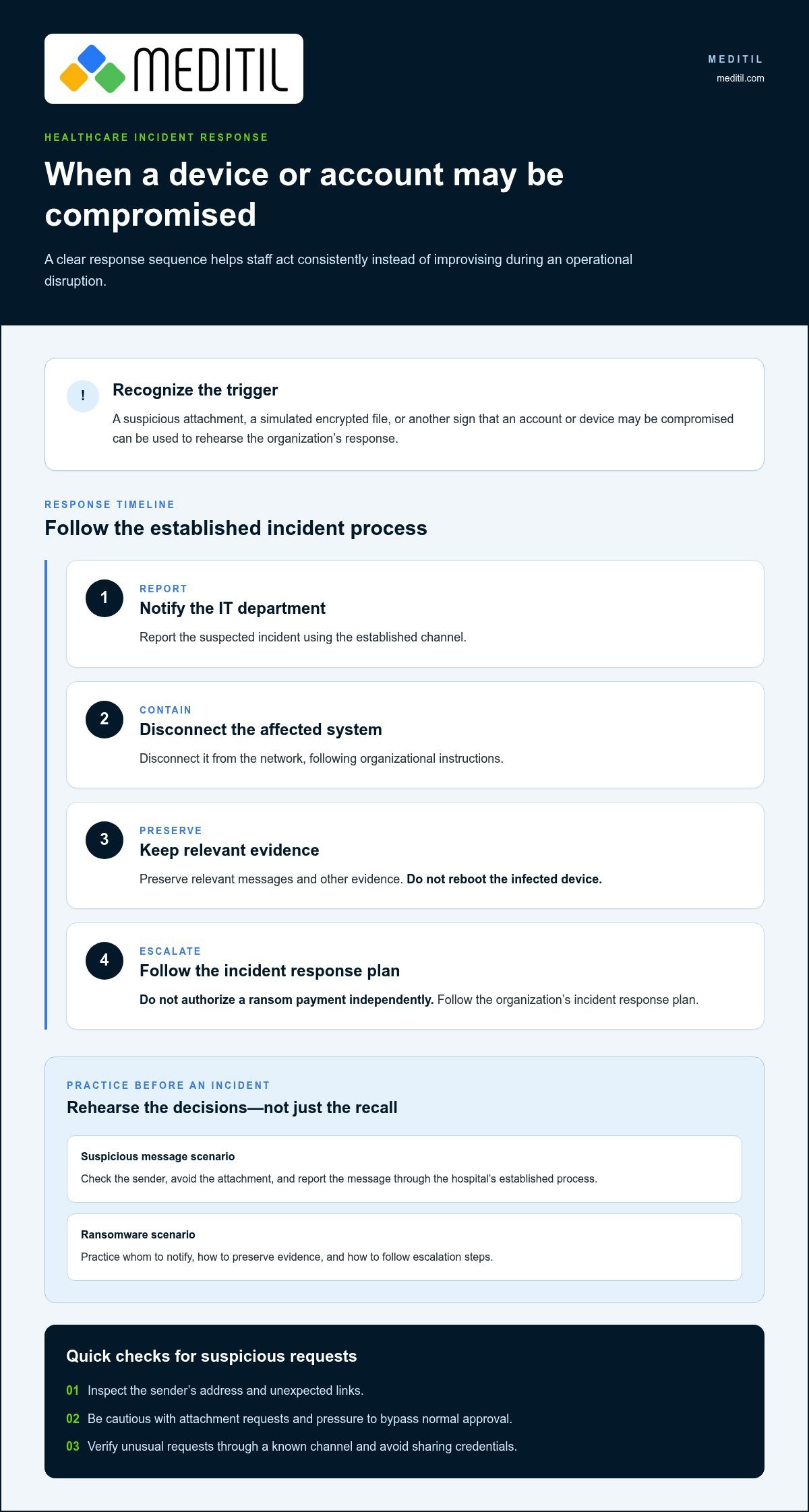
Train staff to act promptly when a device or account may be compromised. Make the response clear before an incident occurs:
- Report the suspected incident to the IT department using the established channel.
- Disconnect the affected system from the network, following organizational instructions.
- Preserve relevant messages and other evidence, and don’t reboot the infected device.
- Don’t authorize a ransom payment independently; follow the organization’s incident response plan.
Ransomware exercises can rehearse these actions using a simulated encrypted file or suspicious attachment. The HHS Cyber Gateway lists training resources on social engineering, ransomware, data loss, and attacks against network-connected medical devices. StopRansomware.gov is the federal government’s official one-stop location for ransomware resources. Use these materials to reinforce response awareness, then practice escalation steps so staff know whom to contact and what information to preserve. Clear procedures help employees respond consistently rather than improvise during an operational disruption.
Social engineering and phishing
Phishing messages exploit trust, urgency, and familiar healthcare workflows. A spear-phishing email might imitate a department head and request patient files before a meeting. Train staff to inspect the sender’s address, unexpected links, attachment requests, and pressure to bypass normal approval. The same checks apply to texts and websites that ask for credentials.
How often should hospital employees receive cybersecurity awareness training? HIPAA doesn’t set a specific frequency or prescribe a format. Use recurring learning, with short refreshers when new attack patterns emerge or exercise results reveal a gap.
How can hospitals train staff to recognize phishing and social engineering? Pair brief instruction with scenario-based practice. Show an example message, ask staff to identify warning signs, then rehearse reporting it through the organization’s established process. Just-in-time microlearning can explain a specific clue when an employee encounters a simulated message.
Simulations should reflect distinct roles and realistic consequences without shaming participants. For example, a mock message could ask a billing employee to open an invoice, while a clinical scenario requests access to a patient record. After each exercise, explain the red flags and safer response. The Cyber Resource Hub’s Phishing Campaign Assessments can help organizations assess simulated phishing campaigns.
How can hospitals measure the effectiveness of cybersecurity training? Track whether employees report simulated attacks, identify suspicious indicators, and follow reporting steps. Compare results across exercises and roles, then adjust the program to address recurring vulnerabilities. Use learning outcomes, not click rates alone, to guide improvements.
- Simulated phishing emails: Practice recognizing suspicious requests in a controlled scenario.
- Scenario-based exercises: Rehearse decisions tied to patient records, billing, or clinical workflows.
- Microlearning: Reinforce a specific lesson immediately after an exercise.
Cybersecurity training resources for smaller providers
Smaller healthcare providers can build a practical learning plan from public, sector-specific resources instead of creating every material from scratch. Start with the HHS Cyber Gateway, which offers free cyber hygiene resources for organizations of different sizes. Its staff posters and reminders can reinforce daily cybersecurity practices in shared work areas, while its healthcare-focused materials help connect security actions with patient protection.
Use each resource for a distinct purpose. The Healthcare Sector Council Publications offer best-practice guidance developed by health industry cyber practitioners for organizations across healthcare subsectors. The Cyber Resource Hub adds assessment tools to help identify vulnerabilities in connected systems and phishing awareness.
- HHS Cyber Gateway posters and reminders: Reinforce simple actions, such as reporting a suspicious message, at points where staff work.
- Healthcare Sector Council Publications: Support policy discussions with healthcare-specific practices and recommendations.
- Cyber Resource Hub: Use Cyber Hygiene Vulnerability Scanning to identify weaknesses, Web Application Scanning to assess web applications, and Phishing Campaign Assessments to evaluate staff awareness.
Smaller providers can turn these materials into a repeatable routine. Assign one professional to select a resource, discuss one action at a staff meeting, and record follow-up questions. For example, after sharing a phishing reminder, review how employees report a suspicious email. If an incident reveals confusion, use that finding to shape the next exercise. This approach makes resources actionable without treating a poster as a complete training program.
How much does cybersecurity awareness training for healthcare staff cost? Cost depends on the program’s scope, delivery format, staff roles, and whether it includes exercises or case studies. Training costs are determined after a quote request, based on those requirements.
For a practical next step, review healthcare cybersecurity support to connect staff awareness with broader security practices and incident readiness.
MEDITIL: Managed IT Services (Ongoing)
MEDITIL supports healthcare organizations that need to connect staff awareness with consistent IT operations. Its Managed IT Services (Ongoing) help manage ongoing IT needs, while Cybersecurity & Compliance addresses security and compliance priorities. These services can be a practical next step when training identifies process gaps, incident reporting needs clearer coordination, or cybersecurity responsibilities require ongoing support.
Infrastructure & Network Services supports the underlying environment employees rely on, while End-User Support & Help Desk gives staff a path to get help with technology. Together, these services can align security practices with daily operations, rather than treating training as a standalone activity.
Contact MEDITIL to discuss how its healthcare IT services can support your organization’s cybersecurity priorities.
Make staff learning part of everyday operations
Cyber security training for hospital staff is most useful when it continues beyond a scheduled exercise. Assign the program an owner, establish a process for reviewing staff feedback, and use emerging questions to shape future learning scenarios. This keeps guidance connected to actual workflows as systems and responsibilities change. Reviewing what employees find confusing gives leaders a clear basis for refining future training.
When a hospital needs support aligning training priorities with its technology environment, MEDITIL provides Managed IT Services (Ongoing), Infrastructure & Network Services, and Cybersecurity & Compliance. These services support operational and security priorities as part of a coordinated healthcare IT approach.
To discuss how staff training fits your organization’s needs, contact MEDITIL about staff training. Keep the next step grounded in your teams’ daily work and continue building practical, relevant security habits.
Frequently Asked Questions
Is Human Error the Dominant Cause of Healthcare Data Breaches?
Employee mistakes are a leading contributor: one reported estimate puts them behind approximately 88% of data breaches. That figure doesn’t mean every breach begins with a staff action. Compromised vendors, weak configurations, and stolen credentials can also play roles. Treat human error as a high-priority training risk while reviewing technical controls and vendor access alongside workforce practices.
What cybersecurity training is required for hospital staff under HIPAA?
HIPAA requires covered entities to provide workforce security awareness and training under 45 CFR §164.308(a)(5). The Security Rule doesn’t prescribe a course length, delivery method, or phishing simulation format, and it doesn’t set a specific training frequency. Hospitals should maintain training that reflects their security risks and workforce roles. Documenting the program and adapting it after workflow or threat changes helps keep instruction relevant.
What topics should cybersecurity training cover for hospital staff?
Cover how to protect sensitive information throughout its lifecycle, including safe access, storage, and authorized disclosure. Staff should understand why each account needs a strong, unique password and how to handle unexpected requests for patient details. Include practical decision points, such as verifying a recipient before sending a document and recognizing when a request exceeds someone’s access needs.
What cybersecurity training is appropriate for nurses, clinicians, and administrative staff?
Use shared core instruction, then apply role-specific examples. Nurses and clinicians can work through scenarios involving access to records during handoffs or unfamiliar requests for patient information. Administrative staff can practice handling unexpected billing documents or requests to change payment details. Students and temporary workers also need examples tied to their assigned access, so they understand what information they may use and disclose.
What cybersecurity risks and incidents should hospital staff training address?
Include phishing, ransomware, data loss, unauthorized access, and threats involving network-connected medical devices. Staff should recognize that an incident may begin with a suspicious message, an unusual system prompt, or unexpected device behavior. Training can ask whom to notify, what information to record, and how to avoid altering evidence. The HHS Cyber Gateway lists healthcare threat-training resources covering these areas.