
What if improving clinical workflows starts with changing the work, not buying more technology? Clinical workflow optimization consulting helps healthcare leaders examine how tasks and information move across teams before deciding whether systems need to change. That distinction matters when disconnected processes create avoidable administrative work and new tools risk adding complexity instead of resolving the underlying friction.
Staff concerns matter, too. A redesigned process that disrupts established clinical routines may be difficult to adopt, even when its goals are sound. Frontline input can reveal where delays, duplicate steps, and handoff gaps occur, as well as which changes are practical within the organization’s clinical and technical environment.
This guide explains how to identify workflow bottlenecks with the people closest to the work, evaluate technology in context, and build an improvement plan with clear measures and accountability. It also outlines how healthcare IT consulting can connect workflow needs with appropriate integration, implementation, or training decisions. The goal is a disciplined path to improvement that supports care teams without adding unnecessary technology or avoidable disruption.
Key Takeaways
- Use frontline observation and staff interviews to reveal where work stalls, repeats, or loses information.
- Clinical workflow optimization consulting should clarify the process problem before recommending changes to software or systems.
- Compare workflow consulting, EHR configuration, integration, and managed IT support against the specific issue you need to resolve.
- Plan improvements in phases, with accountable owners, staff communication, testing, and measures tied to the workflow.
- Connect workflow priorities to relevant capabilities, such as EHR implementation and training, integration, billing automation, or business intelligence.
What Clinical Workflow Optimization Consulting Addresses in Healthcare
Clinical workflow optimization consulting is a structured review of how clinical and administrative work gets done, where tasks or information encounter friction, and what changes could make those processes clearer and more reliable. It considers the people doing the work, the steps they follow, the information they need, and the technology involved. The first job is to understand the process, then determine whether it needs to change.
A concise definition: Workflow improvement redesigns how work moves through an organization; technology procurement selects tools that may support that work. The distinction matters. A software purchase or configuration project may address a defined need, but it won’t necessarily resolve unclear responsibilities, duplicate data entry, or a handoff that routinely loses information. General IT support maintains or assists with technology, but may not examine the entire workflow around it.
Friction can surface in documentation, scheduling, billing, handoffs, and data entry. Because these processes depend on accurate information moving between people and systems, Health information management is a useful foundation for understanding the information dimension of workflow design.
Which clinical and administrative workflows can be improved?
A review may include patient intake, rooming, clinical documentation, orders, referrals, and follow-up. Revenue-cycle touchpoints also matter, including charge capture and the handoff of information for billing. For example, a team might trace where staff re-enter information, how referral status is communicated, or which steps are needed to route a completed encounter onward.
These are possible areas of focus, not a standard checklist. Priorities depend on organizational goals, specialty, staffing, and current processes. A workflow that needs attention in one setting may function differently in another, so recommendations should reflect the people involved and the operational environment.
How workflow consulting differs from an EHR project
An EHR project typically focuses on system selection, configuration, implementation, or training. Workflow consulting examines people, process, information, and technology together. It asks what the work requires before concluding that a system change is necessary. An EHR configuration adjustment may help, but it isn’t automatically the right answer if the underlying issue is a process gap or unclear ownership.
MEDITIL advises healthcare organizations on workflow priorities and related IT decisions, including EHR implementation and integration. MEDITIL does not sell EHR software. This distinction helps leaders assess technology as one possible part of an improvement plan, rather than treating procurement as the plan itself.
How Consultants Find Clinical Workflow Bottlenecks Before Recommending Changes
Effective discovery starts with the work itself, not a preferred technology solution. In clinical workflow optimization consulting, the aim is to understand what staff experience, how information moves, and where a process breaks down before proposing a redesign. This can help leaders avoid fixing a visible symptom while leaving its cause in place.
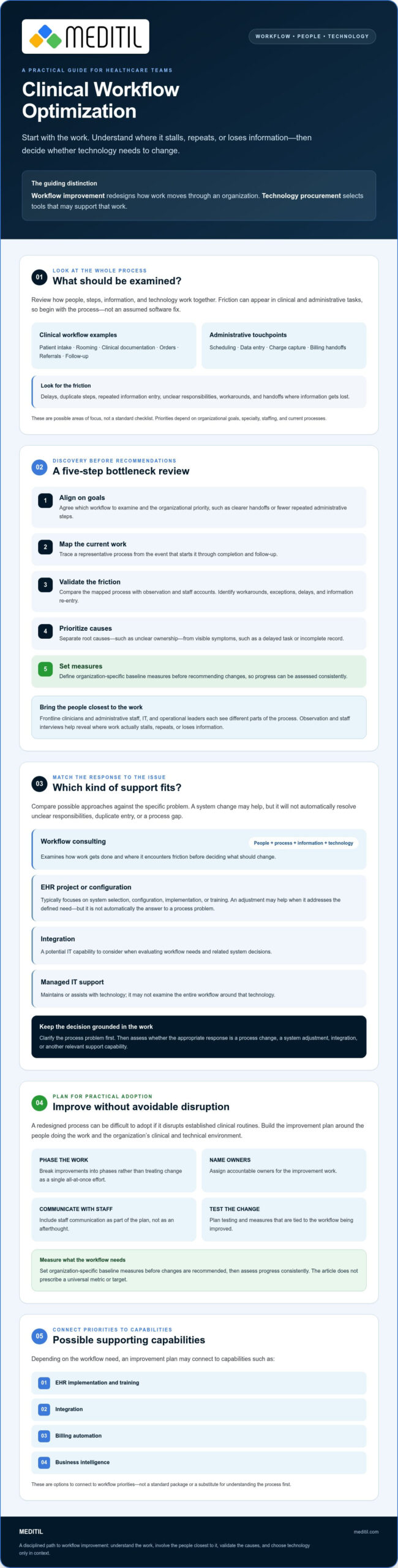
A practical discovery sequence keeps the assessment focused:
- Align on goals. Agree on the workflow to examine and the organizational priority, such as clearer handoffs or fewer repeated administrative steps.
- Map the current work. Trace a representative process from the event that starts it through completion and follow-up.
- Validate friction. Compare the documented process with observation and staff accounts. Identify workarounds, exceptions, delays, and information re-entry.
- Prioritize causes. Distinguish root causes, such as unclear ownership, from symptoms, such as a delayed task or incomplete record.
- Set measures. Define organization-specific baseline measures before recommending changes, so progress can be assessed consistently.
Map the current state with the people doing the work
Include clinicians, administrative staff, IT, and operational leaders in discovery. Each group sees different parts of the process. A change that looks efficient on paper may create an extra step for a frontline team or interrupt a time-sensitive handoff. Combine observation and staff interviews with existing process documents and system information. The Workflow Assessment for Health IT Toolkit from the Agency for Healthcare Research and Quality offers a relevant resource for examining workflow around health IT.
Follow ordinary cases as well as exception paths. Note who performs each step, what information they need, where responsibility transfers, and whether details must be entered again. Record workarounds without assigning blame. They may indicate that the documented process, available tools, or role expectations don’t match the demands of actual work.
Validate the current workflow with frontline staff before redesigning it. Their experience can show how a proposed change may affect daily work and care continuity.
Prioritize bottlenecks with evidence and agreed measures
Check observations against available scheduling, documentation, billing, or support data. Staff may describe a slow handoff, for example, while process records help pinpoint where delays occur and which steps are involved. Neither source provides a complete explanation on its own, so compare them before settling on a cause.
Agree on each measure and its definition before proposing changes. Depending on the workflow, an organization might track completion time, rework frequency, or the number of handoffs requiring follow-up. Use the organization’s own baseline rather than assuming a universal benchmark. Healthcare leaders seeking support with this discovery process can explore MEDITIL healthcare IT consulting.
Workflow Consulting, EHR Optimization, or Integration: Which Approach Fits?
The right engagement depends on what is causing the problem. Clinical workflow optimization consulting examines how work is organized before determining whether the process, EHR configuration, system connections, or ongoing IT support needs attention. These approaches can be combined, but the workflow issue should define the scope rather than a preferred technology.
| Approach | Problem addressed | Typical scope | Stakeholders and evidence to begin |
|---|---|---|---|
| Workflow consulting | Unclear roles, repeated steps, inconsistent processes, or handoff delays. | Review and redesign of how people, information, and systems support a workflow. | Frontline staff, operational leaders, and IT. Begin with a defined process concern, staff input, and current-state documentation. |
| EHR configuration | System settings or templates that don’t support an agreed process. | Assessment and adjustment of available EHR configuration, often with testing and training. | Clinical users, application specialists, and IT. Begin with a validated workflow requirement and examples of the configuration issue. |
| Systems integration | Disconnected systems or duplicate information entry. | Assessment of data exchange and connections between applications. | Application owners, IT, and affected teams. Begin with the systems involved, the information that must move, and where exchange breaks down. |
| Managed IT support | Ongoing technology operations, maintenance, or user-support needs. | Continuing support for the organization’s IT environment. | IT leaders, operational owners, and users. Begin with support needs, recurring issues, and the current environment. |
When process redesign should come before a technology change
Look first for unclear ownership, redundant steps, inconsistent policies, or handoffs that add avoidable work. If staff use different workarounds for the same task, changing software alone may preserve a process the organization hasn’t fully understood. Document the desired workflow and validate it with affected staff before starting configuration work. Their feedback can surface practical constraints and help leaders plan changes with continuity in mind.
When EHR integration or billing automation may be relevant
Duplicate data entry or information that doesn’t move reliably between systems may justify an integration assessment. If the main concern is a billing handoff, review where required information is created, transferred, and checked. MEDITIL’s billing automation capabilities may be relevant to that evaluation. For data-exchange constraints, healthcare interoperability guidance can help leaders identify questions to raise with their technical teams.
Standards such as HL7 FHIR can inform technical planning, but adopting a standard doesn’t resolve unclear responsibilities or a poorly defined process by itself. MEDITIL provides systems integration and interoperability services, as well as EHR implementation and training guidance. The approach should follow the verified need and the organization’s existing environment.
How to Plan Clinical Workflow Improvements Without Disrupting Care
A workflow change can affect more than the steps being redesigned. It may alter staff responsibilities, system dependencies, or the timing of information handoffs. A phased plan helps leaders identify those effects, test changes before wider adoption, and give staff a clear route for raising operational issues.
Build a practical implementation and change-management plan
Before rollout, define the workflow in scope, decision-makers, affected roles, dependencies, and sequence of work. Assign an accountable owner who can coordinate operational, clinical, and technical input. Staff should know what is changing, why it is changing, when it will affect their work, and where to raise concerns.
Use a controlled sequence suited to the organization’s needs:
- Prepare: Confirm responsibilities, communication channels, privacy review needs, and escalation paths if the process creates an operational issue.
- Test: Walk through representative scenarios with affected staff, including routine cases and exceptions. Test revised procedures and related system changes before broader use.
- Introduce: Phase the change where practical, with training and support aligned to staff responsibilities and operational constraints.
- Review: Set review points to check adoption, resolve issues, and decide whether to continue, adjust, or pause the change.
Testing should go beyond checking whether a system accepts an entry. Confirm that staff can complete the full process, handoffs remain clear, and information is available to the next person who needs it. Establish a contingency plan for reverting or using an approved alternate process if an issue affects reliable operations. Define who receives escalations and who has authority to act.
Measure adoption and outcomes after the workflow changes
Select measures that reflect the workflow’s purpose. Depending on the change, these could include completion time, rework frequency, or whether required handoffs are completed. Compare results after the change with the agreed baseline, using consistent definitions. Record relevant context, such as staffing or process changes, that may affect interpretation.
Numbers alone don’t show how a change feels in daily work. Pair operational indicators with staff feedback, observation, and attention to workarounds or unintended effects. If a new step shifts effort to another team or creates a different delay, the review should capture that rather than treating the original measure in isolation.
A defined baseline, a targeted change, and scheduled follow-up measurement give leaders a practical way to assess whether a workflow improvement is working. Keep review dates and owners visible so implementation leads to ongoing refinement, not an assumption that the work is finished at rollout. For support aligning workflow priorities with IT decisions, connect with MEDITIL about healthcare IT consulting.
How MEDITIL Can Support Clinical Workflow Optimization
MEDITIL’s healthcare IT consulting can help connect operational priorities with infrastructure and application decisions. The focus is not a predetermined product or system change. Clinical workflow optimization consulting can start with the process challenge, then assess whether capabilities such as EHR implementation and training, systems integration, billing automation, or business intelligence are relevant to the organization’s needs.
What a healthcare workflow consulting engagement may include
Depending on the agreed scope, work may include discovery, current-state assessment, prioritized recommendations, and coordination of implementation where appropriate. MEDITIL’s EHR and integration experience can inform recommendations about existing applications and information exchange. Fractional CIO guidance may also help leaders assess how a workflow initiative fits broader IT priorities and dependencies. The organization and MEDITIL should define the engagement’s activities together rather than assume them in advance.
Questions to ask before selecting a consulting partner
Before proceeding, clarify how the consulting approach will account for staff experience, current systems, and operational requirements. Consider asking:
- How will frontline staff participate in assessment, validation, and rollout planning?
- How will recommendations account for existing EHR configuration, integration, security, and support requirements?
- How will measures, ownership, and post-implementation review be agreed upon?
Clear answers help establish how findings will inform decisions, who will be accountable, and how the organization will evaluate progress. They also help ensure recommendations fit the existing environment instead of assuming a broad technology replacement.
Discuss your workflow priorities with MEDITIL
A useful first step is to identify one priority process and describe where friction occurs, which teams are affected, what systems are involved, and what the organization would like to measure. This gives the discussion a practical starting point without presuming the cause or promising a specific result. Leaders can also raise dependencies or constraints that may shape the scope.
If your organization is assessing a workflow challenge, discuss your healthcare workflow priorities with MEDITIL. A discovery conversation can clarify the process under review, stakeholders to involve, current systems, and measures that may help guide next steps.
Turn Workflow Findings Into Practical Next Steps
Clinical workflow improvement starts with understanding how work happens across teams, not assuming that a new system will solve every point of friction. Clinical workflow optimization consulting helps leaders identify root causes, choose an approach that fits the process, and define measures before introducing changes.
Keep frontline experience central throughout discovery and rollout. A phased plan with clear ownership, staff communication, testing, and scheduled review helps teams assess changes while staying attentive to care continuity. Measures such as completion time or rework frequency provide useful context when compared with an agreed baseline and staff feedback.
MEDITIL brings healthcare-focused consulting and fractional CIO services together with capabilities in EHR implementation and training, systems integration, billing automation, and business intelligence. These capabilities can connect workflow priorities to relevant IT decisions without presuming that every challenge requires a technology change.
Start with one process, the teams it affects, the friction they encounter, and the outcomes you want to measure. Discuss your clinical workflow priorities with MEDITIL to explore an appropriate next step. With a clear problem and a measured plan, your organization can make progress thoughtfully.
Frequently Asked Questions
What is clinical workflow optimization consulting?
Clinical workflow optimization consulting is a structured assessment of how clinical and administrative tasks, responsibilities, and information move through a healthcare organization. It identifies friction, such as duplicate data entry, unclear ownership, or delayed handoffs, then helps leaders evaluate practical changes. Technology may support a redesigned process, but the work begins by understanding the workflow, not by assuming new software or an EHR replacement is required.
How does clinical workflow optimization consulting work?
The process typically starts by agreeing on a priority workflow and the outcome the organization wants to assess. Consultants may review existing documentation and system information, observe work, and interview affected staff. They map the current process, validate where friction occurs, and distinguish symptoms from root causes. Next, stakeholders prioritize possible changes, agree on baseline measures, and plan testing, communication, ownership, and follow-up reviews.
Can workflow consulting improve EHR efficiency without replacing the EHR?
Yes. A review may identify opportunities to improve existing workflows or make appropriate use of current EHR configuration, implementation, or training support. For example, repeated information entry could stem from process design, system configuration, or disconnected applications, and each cause calls for a different response. MEDITIL provides EHR implementation and training guidance, but does not sell EHR software. A replacement should not be assumed before the cause is understood.
When should a healthcare organization hire a workflow optimization consultant?
Consider consulting when a recurring process problem affects multiple roles or teams, creates avoidable administrative work, or remains unresolved despite local adjustments. It can also help before a technology project, when leaders want to confirm that the proposed change addresses the actual workflow need. Start with a defined process and the people involved. If the issue is limited to routine IT support, managed IT or help desk support may be a closer fit.
How do consultants measure clinical workflow improvement?
Measurement starts with an agreed baseline and a clear definition of the selected indicator. Depending on the workflow, an organization might track completion time, rework frequency, or whether required handoffs are completed. After a change, compare results using the same definitions and note relevant context, such as process or staffing changes. Pair operational measures with staff feedback and observation to identify workarounds or unintended effects, then review findings on a scheduled basis.
What happens if staff resist a redesigned clinical workflow?
Resistance should prompt leaders to understand what staff are experiencing rather than treat concerns as simple noncompliance. A change may add steps, conflict with established responsibilities, or fail to account for exceptions in real work. Involve affected staff in validating the process, explaining the reason for change, testing representative scenarios, and identifying training needs. Provide clear feedback and escalation channels, then use staff input and workflow measures to refine the approach.
How is workflow optimization consulting different from healthcare IT consulting?
Workflow optimization consulting focuses on how work is performed and where a process can be improved. Healthcare IT consulting has a broader scope that may include strategic technology decisions, infrastructure, integration, applications, or implementation planning. The two can overlap: a workflow assessment may show that an IT change is appropriate, while broader IT consulting helps evaluate technical fit. MEDITIL provides healthcare IT consulting and fractional CIO services alongside EHR implementation, integration, and training capabilities.