
What if your highest-priority healthcare IT risk isn’t the system with the most visible vulnerability, but the one that could disrupt access to patient records or interrupt a critical workflow? Assessing healthcare IT security risks means looking beyond technical findings to understand how systems, vendors, and daily operations affect patient care.
A checklist alone won’t show which issues need attention first. This guide explains how to define assessment scope, connect findings to the HIPAA Security Rule’s risk analysis process, and prioritize concerns using evidence, likelihood, impact, and clinical context. You’ll also learn how to turn assessment results into practical remediation steps, with clear ownership and a process for review. From clinical applications and infrastructure to third-party relationships and operational workflows, the goal is a risk picture that supports sound security decisions and continuity of care.
Key Takeaways
- Assessing healthcare IT security risks starts with understanding where ePHI moves across clinical, administrative, and vendor-connected systems.
- HIPAA risk analysis informs security decisions, but completing an assessment alone doesn’t guarantee compliance.
- Evaluate likelihood and impact separately, including potential consequences for patient care and essential operations.
- Turn findings into a tracked risk plan with assigned owners, documented response decisions, and progress reviews.
- Connect assessment priorities to practical remediation and ongoing infrastructure management.
What Assessing Healthcare IT Security Risks Means for Patient Care
Assessing healthcare IT security risks is an evidence-based process for identifying threats and vulnerabilities that could affect electronic protected health information (ePHI), evaluating their potential consequences, and deciding how to address them. In healthcare, the impact isn’t limited to data exposure. A security weakness can also affect whether clinicians can access records, teams can coordinate care, and essential services can continue.
Definition: A healthcare IT security risk assessment is a documented evaluation of how threats and vulnerabilities could compromise ePHI or disrupt care and operations. It helps guide risk decisions and action. It’s not a one-time checklist or vulnerability scan. A scan may identify technical weaknesses, but it doesn’t establish on its own how likely they are to be exploited or what their consequences could be in a specific clinical environment.
The Security Rule’s focus on protecting the confidentiality, integrity, and availability of ePHI connects directly to patient care:
- Confidentiality: Information is accessible only to people and systems authorized to use it. Unauthorized access can expose sensitive records and undermine patient trust.
- Integrity: Information remains accurate and isn’t improperly altered or destroyed. Clinicians and staff rely on dependable records to make decisions and complete workflows.
- Availability: Authorized users can access information when needed. An outage can hinder care coordination, scheduling, or access to patient records.
These dimensions help organizations assess what a vulnerability could affect and which safeguards or response measures may be appropriate. A risk assessment informs risk management; completing one alone doesn’t guarantee compliance or eliminate risk.
What does the HIPAA Security Rule require organizations to assess?
The HIPAA Security Rule requires covered entities and business associates to conduct a risk analysis addressing potential risks and vulnerabilities to the confidentiality, integrity, and availability of ePHI. The analysis should reflect the organization’s environment and the ePHI it creates, receives, maintains, or transmits. The Rule doesn’t prescribe one universal assessment tool, checklist, or scoring formula. Use an approach that supports a meaningful, documented analysis rather than treating a score as certainty.
Why can a technical weakness become a clinical risk?
Technical findings matter because systems support connected clinical and administrative work. If a system becomes unavailable, staff may lose access to records, scheduling information, or other tools used to coordinate care. If an account is accessed without authorization, the resulting exposure can affect ePHI confidentiality and patients’ confidence in how their information is handled.
Hypothetical example: A clinic identifies a weakness in remote access to a system containing patient information. The assessment considers more than the vulnerability itself: which users and workflows depend on that access, what ePHI is reachable, and what could happen if access is misused or interrupted. That context helps leaders prioritize the issue and select a response that addresses security without overlooking operational needs.
How to Map ePHI, Healthcare Systems, and Security Risks
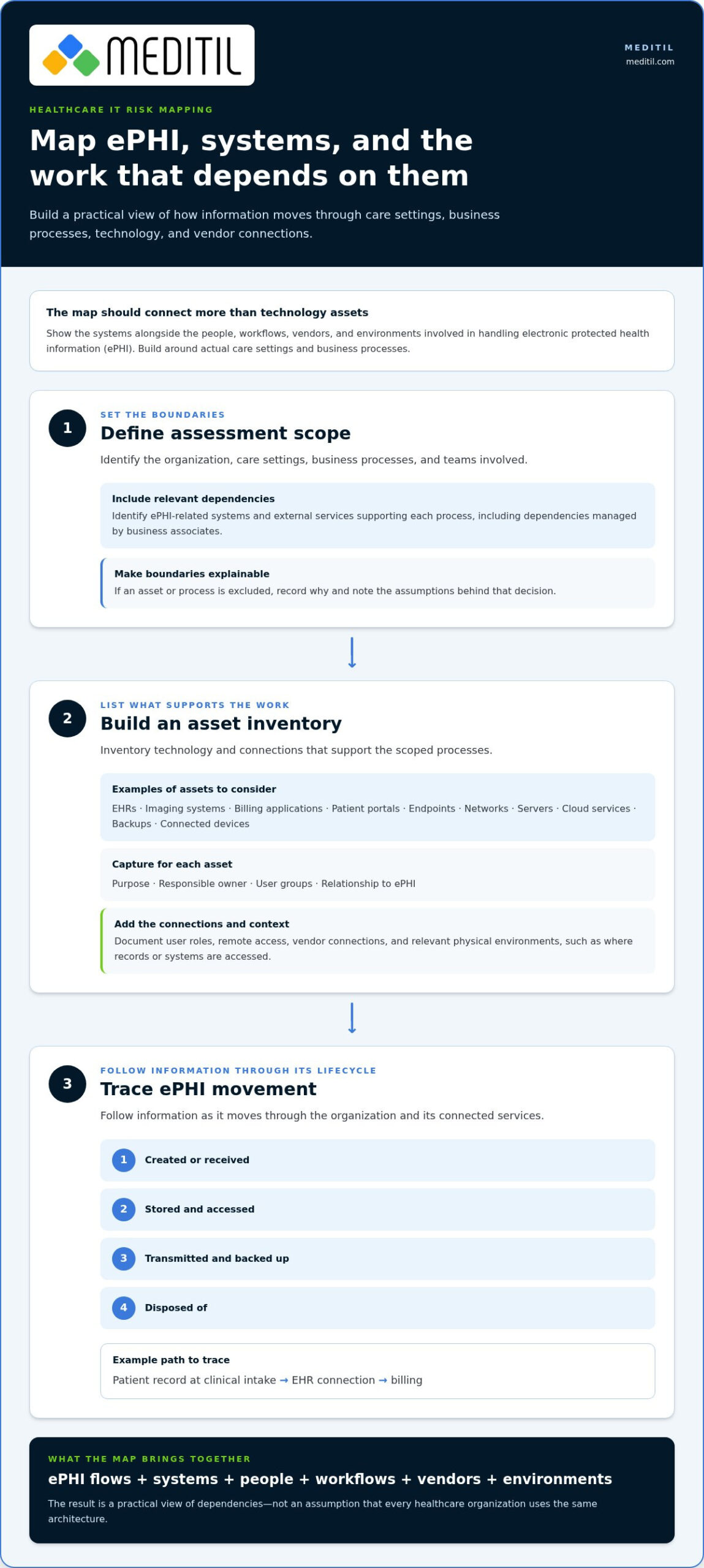
A useful map shows more than a list of technology assets. It connects each system to the people, workflows, vendors, and environments involved in handling electronic protected health information (ePHI). That view can reveal overlooked dependencies, such as a billing service that receives data from an EHR or a remote connection used to support a clinical application. Build the map around actual care settings and business processes, since details vary between organizations.
How should an organization define assessment scope?
Set boundaries around the organization, its care settings, relevant business processes, and systems that create, receive, maintain, or transmit ePHI. Include business associates and technology dependencies in the data-flow discussion. If an asset or process is excluded, record why and note any assumptions behind the decision. This makes the scope understandable to leadership and technical teams, and easier to revisit when operations change.
Which healthcare assets and data flows should be mapped?
Inventory the technology and connections that support those processes. Depending on the environment—from large health systems to specialized clinics like Mountain West Dental Specialists—this may include EHRs, imaging systems, billing applications, patient portals, endpoints, networks, servers, cloud services, backups, and connected devices. Document user roles, remote access, vendor connections, and relevant physical environments, such as where records or systems are accessed. The objective is a practical map, not an assumption that every provider uses the same architecture.
Use this workflow to build and validate the map:
- Define scope. Identify organizational boundaries, care settings, business processes, and teams involved. Note which ePHI-related systems and external services support each process, including dependencies managed by business associates.
- Build an asset inventory. Record applications, endpoints, network components, servers, cloud environments, backup locations, and connected devices. For each asset, capture its purpose, responsible owner, user groups, and relationship to ePHI.
- Trace ePHI movement. Follow information as it is created, received, stored, accessed, transmitted, backed up, and disposed of. For example, trace a patient record from clinical intake through an EHR connection to billing, including vendor systems that receive relevant information. In administrative workflows that handle financial details or confidential records, data discovery software like EmberHound can help locate sensitive information stored across systems.
- Review access and dependencies. Identify who uses each system, how remote users connect, and which third parties support or exchange data with it. Consider the infrastructure and physical environments involved, such as network equipment, workstations, or records accessed at a care site.
- Document and validate. Create a simple system-and-data-flow diagram showing key systems, users, vendors, and information exchanges. Review it with operational leaders and technical staff, then record gaps, exclusions, and assumptions for follow-up.
Keep the diagram readable. Label where data enters and leaves a system, and distinguish internal connections from vendor or cloud links. A concise, reviewed map gives teams a shared reference for threat analysis and prioritization. Organizations seeking support with healthcare infrastructure and ongoing management can explore MEDITIL’s healthcare IT services.
How to Evaluate and Prioritize Healthcare IT Security Risks
A finding becomes useful when an organization can explain what could happen, how plausible it is, and which safeguards already reduce exposure. Assessing healthcare IT security risks therefore requires more than sorting scan results by severity. Consider the system’s role, the ePHI involved, who can reach it, and the consequences if information is exposed, altered, or unavailable.
Healthcare risk priorities must reflect not only the weakness itself, but also its potential effect on patient care and essential operations. A technical issue affecting a noncritical function may warrant a different response from a similar issue affecting a system needed for time-sensitive clinical work.
How can teams compare likelihood and impact consistently?
Before rating findings, define what each likelihood and impact level means for your organization. Use shared descriptions, such as the evidence needed to rate likelihood as “high” or the operational consequences that count as “major” impact. This keeps ratings more consistent across teams. Scores support comparison, but they’re judgments based on available evidence, not objective predictions.
Record the reasoning alongside each rating. A compact comparison can include:
- Likelihood: Evidence of exposure or exploitation, including known weaknesses, access paths, and relevant threat information.
- Impact: Potential effects on ePHI confidentiality or integrity, care delivery, essential systems, business operations, and regulatory responsibilities.
- Existing controls: Administrative, physical, and technical safeguards that may prevent, detect, or limit harm. Note whether they’re implemented and supported by evidence.
- Residual risk: The remaining concern after accounting for safeguards, with assumptions and unresolved questions clearly documented.
This record helps reviewers understand why two findings received different priorities, even if they appear technically similar. It also makes uncertainty visible. If evidence is incomplete, state what is unknown instead of treating a precise-looking score as certainty.
How should teams distinguish vulnerability findings from risk priorities?
A vulnerability scan identifies technical weaknesses within its coverage. Broader risk analysis considers those findings alongside system purpose, exposure, users, data, safeguards, and potential consequences. Neither activity replaces the other. Scanning can supply valuable evidence, while contextual analysis helps decision-makers determine what that evidence means for the organization.
Hypothetical example: A scan flags an outdated component on an imaging system. The team checks whether the component is reachable, what safeguards limit access, whether ePHI is involved, and how disruption could affect imaging workflows. A similar finding on an isolated test environment may have different implications. These hypothetical circumstances don’t establish a universal rating; they show why context changes priority.
Apply the same criteria across departments, then have technical and operational reviewers examine high-priority or uncertain findings together. Clinical teams can clarify workflow dependencies; IT and security staff can validate exposure and control evidence. This joint review makes priorities easier to explain and act on.
How to Turn Assessment Findings into a Tracked Risk Plan
An assessment drives improvement only when findings lead to decisions, assigned work, and follow-up. A risk plan makes that chain visible. For each finding, document what is at risk, who is accountable, what response has been approved, and what evidence will show whether the action is complete. This gives technical teams a working plan and helps leadership see unresolved exposure, dependencies, and decisions requiring oversight.
Use a consistent sequence to move from finding to tracked action:
- Record the finding. Describe the affected asset, ePHI exposure, relevant threat and vulnerability, existing safeguards, assessment evidence, and any assumptions or information gaps.
- Confirm priority and ownership. Carry forward the likelihood and impact rationale, then name an accountable risk owner with authority to coordinate the response. Technical staff may complete tasks, but tracking ownership should remain clear.
- Select and document a response. Choose mitigation, acceptance, transfer, or avoidance as appropriate. Record why that response fits the organization’s circumstances, including constraints or dependencies.
- Set the action plan. Define specific work, responsible parties, target dates, required resources, and dependencies, such as a maintenance window, vendor change, or workflow approval.
- Verify and review. Attach completion evidence, update residual risk, and record review status. If work is delayed or the evidence doesn’t show reduced exposure, revise the plan or elevate the decision.
What belongs in a healthcare IT risk register?
A useful register combines technical detail with decision-ready context. For each risk, capture the affected asset and process, ePHI exposure, threat, vulnerability, safeguards, evidence, likelihood, impact, and relative priority. Add the accountable owner, chosen response, planned actions, target dates, dependencies, residual risk, and current status. Use concise language and define technical terms where needed, so leaders can understand the consequences and decisions without losing the detail technical teams need to act.
- Decision record: State the rationale for the selected response and identify who approved acceptance or another significant risk decision.
- Progress record: Track milestones, blockers, evidence of completed work, outstanding actions, and the next review point.
Acceptance should be an explicit, documented organizational decision, not an assumption that a risk has disappeared. Transfer arrangements, such as contractual provisions or insurance, also shouldn’t be treated as proof that every underlying responsibility has been resolved.
How can organizations keep risk management active?
Establish a review cadence suited to organizational needs and applicable guidance rather than relying on a universal interval. Revisit a finding when a material technology, vendor, workflow, threat, or organizational change could alter its likelihood, impact, safeguards, or owner. Connect planned work to operational processes, including monitoring, patch management, backup, and disaster recovery, so remediation stays visible after the assessment is complete.
Use leadership review to resolve resource conflicts, approve documented risk decisions, and address overdue work. For support connecting remediation priorities with ongoing healthcare IT management, work with MEDITIL on healthcare IT risk remediation.
How MEDITIL Supports Healthcare IT Risk Reduction
An assessment identifies priorities; sustained risk reduction depends on connecting those priorities to accountable technical work and ongoing oversight. MEDITIL supports healthcare organizations with healthcare-focused infrastructure, cybersecurity, cloud, and managed IT services. Its “100% focus on healthcare IT environments” informs an approach designed around the systems and operational needs of care providers.
Assessment findings can guide how an organization uses MEDITIL’s Cybersecurity & Compliance, Infrastructure & Network Services, and Managed Services (Ongoing). For example, a finding involving a network weakness can inform infrastructure remediation and ongoing monitoring. A gap related to outdated systems can guide patch management planning. Vendor management and on-demand IT staffing can support coordination and execution when internal teams need additional capacity or oversight.
How can healthcare IT services support remediation?
Remediation should match the finding and its operational context. Infrastructure, network, and cloud work can address identified technology priorities, while backup and disaster recovery planning can help organizations account for recovery needs and continuity dependencies. Specific actions should reflect the systems involved, their users, and the risk plan’s assigned owners.
MEDITIL’s managed services include proactive network monitoring, patch management, SLA-based support, vendor management, and on-demand IT staffing. These capabilities support ongoing work on identified priorities; they aren’t a guarantee that incidents or disruptions won’t occur. MEDITIL provides HIPAA-compliant and HIPAA-ready services to support healthcare organizations as they align technical work with their security and compliance needs.
Fractional CIO guidance can help leaders connect remediation decisions to organizational objectives, available resources, and operational priorities. This can help teams sequence competing work, coordinate across departments, and clarify how a technical decision supports broader organizational goals. The aim is a workable path from assessment evidence to informed decisions and managed follow-through.
What is a practical next step after the assessment?
Bring the risk register and proposed remediation plan to a review with organizational leadership and the healthcare IT team. Confirm that each priority has an accountable owner, a clear next action, realistic target dates, and documented dependencies. Discuss how proposed changes could affect clinical workflows, vendor relationships, monitoring, patch management, and recovery planning. Then agree how progress and unresolved risks will be reviewed.
MEDITIL works as a nationwide healthcare IT partner, helping providers connect cybersecurity and infrastructure priorities with ongoing IT management. Its positioning is “Smart. Secure. Scalable.” and “Healthcare IT, Simplified.” Its healthcare-focused services and guidance help organizations align risk reduction work with their technology and operational needs.
Discuss your healthcare IT priorities with MEDITIL to explore how HIPAA-compliant and HIPAA-ready services can support your remediation and infrastructure objectives.
Make Security Progress Part of Everyday Healthcare Operations
Treat risk management as an ongoing leadership practice, not a project that ends when assessment findings are documented. As priorities, systems, and workflows change, keep ownership visible and make security decisions part of operational planning. That discipline helps teams adapt without losing sight of patient care.
For healthcare organizations, the right technology partner can help carry priorities into practical infrastructure and security work. MEDITIL’s experience includes a “95% reduction in downtime for urgent care clients” and a “400GB patient data migration with zero compliance issues.” Its HIPAA-compliant and HIPAA-ready services are tailored to healthcare environments, supporting providers as they put assessment decisions into action.
Assessing healthcare IT security risks is ultimately about building a stronger connection between technology decisions and the care your organization delivers. Take the next step with a partner focused on healthcare IT. Discuss your healthcare IT priorities, and move forward with a clear, achievable plan.
Frequently Asked Questions
Is a healthcare IT security risk assessment required under HIPAA?
Yes. The HIPAA Security Rule requires covered entities and business associates to conduct a risk analysis regarding ePHI. The analysis should inform risk management and safeguard decisions, but completing it alone doesn’t guarantee compliance. For an authoritative interpretation of current requirements, consult current guidance from the HHS Office for Civil Rights (OCR). Organizations can use an approach suited to their environment; HIPAA doesn’t make one particular assessment tool mandatory.
Can the ONC Security Risk Assessment Tool complete an assessment for a healthcare organization?
No. The ONC Security Risk Assessment Tool is designed to guide providers through assessment activities, particularly small and medium-sized providers, but it can’t supply the organization’s facts or make its decisions. Staff still need to describe actual systems, workflows, safeguards, and risks accurately. Treat the tool as a resource for organizing assessment work, not as an automatic compliance certification or a substitute for informed organizational judgment.
Does a vulnerability scan count as a healthcare security risk assessment?
Not by itself. A vulnerability scan can identify technical weaknesses in the assets it examines, making its results useful evidence when assessing healthcare IT security risks. A broader risk analysis also considers ePHI exposure, relevant threats, likelihood, potential impact, safeguards, and organizational circumstances. For example, a scan may flag an unpatched server, while the assessment examines what information it supports and which operational dependencies could be affected.
How often should a healthcare organization reassess its IT security risks?
Review risk information on a repeatable schedule that fits the organization’s needs, and revisit it when meaningful changes could alter exposure. A new vendor connection, major workflow change, system replacement, or emerging threat may warrant an earlier review. HIPAA doesn’t establish a universal annual assessment interval. Document the review approach, changes considered, decisions, and resulting updates, and verify current interpretations against HHS Office for Civil Rights guidance.
Do cloud systems and business associates belong in a healthcare risk assessment?
Yes, when they’re part of how ePHI is created, received, maintained, or transmitted. Map relevant cloud services, vendor connections, and information exchanges rather than treating outsourced technology as separate from the organization’s risk picture. Clarify applicable responsibilities and dependencies. Using a cloud service doesn’t automatically establish or eliminate compliance; the organization’s assessment should reflect how that service is configured and used in its environment.
Does HIPAA require a specific risk-scoring method?
No universal numerical scale or assessment template should be assumed to be mandated by HIPAA. Organizations need a defensible approach that helps them analyze and compare risks. Define likelihood and impact criteria that account for ePHI, clinical workflows, operations, and existing safeguards. Document evidence, assumptions, and the rationale for decisions so reviewers can understand how priorities were reached. Check current regulatory interpretations against official HHS guidance.