
What if the video platform is the least complicated part of a telehealth launch? The real test is whether your network, security controls, clinical systems, and support operations work together during a patient visit. That’s why telehealth IT infrastructure requirements extend well beyond bandwidth and camera quality.
Clear video and an easy patient experience matter, but dependable virtual care also relies on resilient connectivity, safeguards for patient information, and workflows that connect clinicians with the systems they already use. A gap in any one area can create friction for staff or interrupt care.
This 2026 buying guide gives you a practical framework for assessing requirements before selecting or expanding a telehealth solution. Compare network capacity and resilience, cybersecurity, EHR and identity integrations, and ongoing support. The goal is to evaluate options beyond the video experience and plan an implementation that fits your organization’s clinical workflows and existing IT environment.
Key Takeaways
- Start with the clinical use case to define which technology and operating processes each type of virtual visit depends on.
- Assess network capacity, endpoints, and resilience across clinics and remote settings, using the selected platform’s published technical requirements.
- Use the telehealth IT infrastructure requirements framework to compare security, workflow fit, accessibility, interoperability, and support responsibilities.
- Turn readiness findings into an implementation sequence with clear owners for testing, controls, vendor coordination, and ongoing monitoring.
Telehealth IT infrastructure requirements start with the clinical use case
A dependable virtual visit relies on more than the application carrying the call. Telehealth IT infrastructure is the connected technology and operating processes that enable patients and clinicians to access, conduct, and document virtual care. It includes supporting networks, devices, identity and access systems, EHR connectivity, security controls, and user support. The telehealth application provides the visit interface; the infrastructure lets it function within the organization’s clinical environment.
This distinction helps clinics set scope before comparing solutions. A telehealth service may involve video, phone, or remote monitoring, and each model places different demands on staff, systems, and patient access. The broader Telehealth overview describes the range of care delivered through telecommunications. For infrastructure planning, the practical question is how each service connects to existing workflows and technology.
Requirements vary by visit type, patient population, clinician work pattern, and service hours. A scheduled consultation may depend on a patient’s browser or mobile device and the clinician’s EHR access. A remote monitoring workflow may also rely on connected systems that receive and route patient information. Patients may have different levels of digital access or need accessible interfaces, while clinicians may work from a clinic, home, or multiple sites. Documenting these differences early grounds requirements in care delivery instead of assumptions about a standard visit.
Map the virtual visit from patient access to clinical documentation
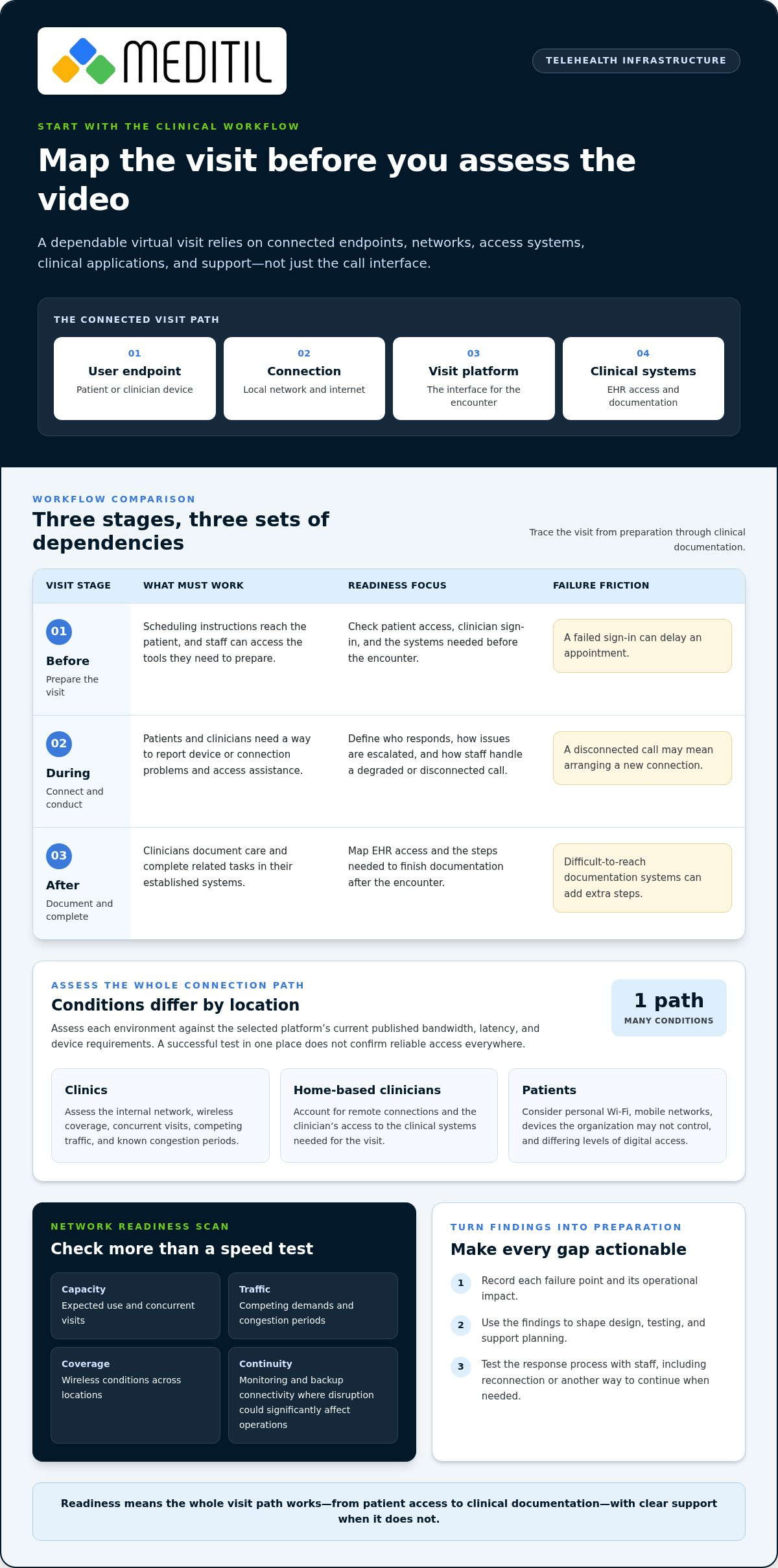
Trace the visit from appointment scheduling and identity verification through connection, clinician interaction, and documentation. At each step, identify the endpoint, network connection, application, EHR access, or support process required. This workflow map can expose dependencies a video-quality assessment alone will miss.
- Before the visit: Confirm that scheduling instructions reach the patient and staff can access the tools needed to prepare.
- During the visit: Define how patients and clinicians report device or connection problems and what assistance they can use.
- After the visit: Map how clinicians document care and complete related tasks in their established systems.
A failed sign-in can delay an appointment; a disconnected call can require staff to arrange a new connection. If documentation systems are difficult to reach, clinicians may need extra steps after the encounter. Record each failure point and its operational impact so it can inform design, testing, and support planning.
Set requirements around care delivery, not just video quality
Define what the service must support beyond a clear call. Consider accessibility and ease of use for patients, privacy in the settings where visits occur, and usability for care teams. Record service hours, who responds to technical issues, and how staff escalate problems that could affect a clinically important visit. Base these expectations on the organization’s care model.
- Separate routine virtual visits from services that depend on remote monitoring or other connected systems.
- Identify patient and clinician access needs, including device and workflow considerations.
- Document support ownership and escalation paths before launch, then use them to shape testing.
These decisions establish a practical foundation for the telehealth IT infrastructure requirements to assess next: network capacity, endpoints, resilience, security, integration, and ongoing support.
Core telehealth infrastructure requirements: network, endpoints, and resilience
A telehealth visit depends on a chain of connections, not a single broadband plan. Patient and clinician devices connect through local networks and internet services to the selected platform, while clinicians may also need access to clinical systems. Network readiness depends on the complete visit path, from each user’s endpoint to the services required for the encounter, not on one speed test. A path-based assessment is therefore central to telehealth IT infrastructure requirements.
Conditions vary across clinics, home-based clinicians, and patients. A clinic can manage its internal network, but remote users may connect through personal Wi-Fi, mobile networks, or devices the organization doesn’t control. Assess each environment against the selected platform’s current published bandwidth, latency, and device requirements. A successful test at one location does not show that every user will have a reliable connection.
Evaluate network capacity and continuity for virtual visits
Compare expected use with real network conditions, including concurrent visits, competing traffic, wireless coverage, and known congestion periods. Where the architecture supports it, traffic prioritization can help manage competing demands, while segmentation can separate systems or device groups according to the organization’s design. Monitoring can help teams identify recurring quality problems. Backup connectivity—such as cellular failover and fixed wireless services supported by connectivity specialists like Choice IoT—may be appropriate where a disruption would significantly affect operations.
Define a response to connection problems as part of readiness planning. Document how a patient or clinician reports degraded audio or video, who provides assistance, and what staff do if a visit disconnects. Depending on the clinical workflow and available communication channels, the response may include trying to reconnect or arranging another way to continue the encounter. Test the process with staff so responsibilities are clear before a disruption occurs.
Include clinician and patient endpoints in the assessment
Network conditions are only part of the assessment. Inventory the computers and mobile devices used for visits, along with their cameras, microphones, operating systems, and access to required clinical applications. Compare the inventory with platform documentation, then identify who manages configuration, patching, access controls, and user support. Endpoint standards should fit the organization’s environment rather than assume every clinician uses the same device.
Remote clinicians and patients introduce additional variation. A clinician may use a managed workstation away from the clinic, connect to clinical systems through virtual server hosting from Snel.com, or rely on secure web portals, while a patient may join from a personal device over a home connection. Consider whether instructions are understandable, whether patients can join using the devices they are expected to use, and how users get help with common connection or audio issues. These considerations turn an endpoint inventory into a usable support plan.
Record findings by location and user group. A practical assessment identifies the platform’s published requirements, current conditions, gaps, responsible support owners, and response steps for interruptions. Healthcare-focused infrastructure and network planning can help align these elements with the organization’s environment and care workflows.
Compare telehealth solutions by security, HIPAA responsibilities, and integration
A telehealth solution should fit the clinic’s security model and clinical operations, not simply provide a satisfactory video experience. Compare options against the same criteria: access controls, authentication, encryption, audit logging, interoperability, accessibility, workflow fit, and support responsibilities. Evaluate how information moves between the patient-facing service and the systems clinicians use to deliver care.
HIPAA responsibilities depend on an organization’s role and its relationship with the technology vendor. A platform’s security features, or a vendor’s use of the word “compliant,” don’t by themselves establish that an organization has met its obligations. Review applicable arrangements, including whether a business associate relationship is involved, with the organization’s privacy and legal advisers. Assess technical safeguards as part of a wider risk-management process, not as a compliance guarantee.
Assess privacy and security across the telehealth workflow
Trace the information created or used during a visit, from account access and appointment details to communications and clinical documentation. At each step, identify who can access the information, how authentication works, whether data is encrypted in transit and at rest, and what records are available for review. Clarify how users report suspected incidents and which organizational teams coordinate the response.
Align vendor review with the clinic’s own risk-management responsibilities. Document the vendor’s role, relevant contractual terms, access needs, and the process for addressing security concerns. Broader healthcare cybersecurity services can support planning across telehealth, infrastructure, and connected clinical systems.
Evaluate EHR interoperability and operational fit
Map the data exchanged at each workflow point. Determine whether staff need to coordinate appointment details, whether clinicians document the encounter in the existing EHR, and whether relevant information must pass between systems. Identify where information is entered, viewed, or reconciled, and who owns each step. Repeated manual entry can add staff burden and introduce avoidable inconsistencies.
Consider standards such as HL7 FHIR when they fit the use case and are supported by the systems involved. The objective is not to adopt a standard for its own sake, but to define the data exchange needed for care and confirm how it will work in practice. Healthcare interoperability architecture should account for existing systems, interfaces, and operational ownership.
- Security: Compare access management, authentication, encryption, logging, and incident processes.
- Integration: Map required data flows and identify manual steps, system dependencies, and accountable teams.
- Usability and support: Assess accessibility for patients and care teams, plus clear ownership for user assistance and issue escalation.
These criteria make telehealth IT infrastructure requirements concrete: assess the solution as one part of a connected clinical environment, considering security, information exchange, and daily operations together.
Build a telehealth infrastructure readiness and implementation plan
A structured rollout turns requirements into assigned work, testable outcomes, and ongoing oversight. Treat implementation as a clinical operations and IT project, not a configuration task in isolation. This sequence helps teams surface dependencies early, address consequential gaps, and establish ownership before expanding access.
- Define workflows. Document the visit types, users, systems, and service expectations the implementation must support. Clinical operations should own workflow decisions and identify where virtual care fits into existing practice.
- Assess systems. Inventory networks, endpoints, identity systems, EHR connections, support coverage, and relevant data flows. IT should coordinate the technical baseline with clinical, security, and application teams.
- Identify gaps. Compare the baseline with workflow needs and platform requirements. Record dependencies, constraints, and gaps, then prioritize remediation by clinical impact, risk, and implementation sequence.
- Plan controls. Assign security owners to review access, privacy, and risk-management controls. Name a vendor coordinator to track dependencies and responsibilities across external and internal teams.
- Test and pilot. Use representative workflows and user groups to validate access, visit completion, documentation, and support processes before a broader rollout.
- Monitor and refine. Define who reviews operational issues, how incidents are routed, and when the team evaluates whether workflows or controls need adjustment.
Create a baseline assessment before selecting or expanding a solution
A useful baseline describes how systems work together, not just which assets the organization owns. Map connections between endpoints, identity services, clinical systems, and support processes. Capture operational constraints such as staff capacity, existing interfaces, and coverage expectations. This record helps teams distinguish technology gaps from workflow issues and sequence remediation without overlooking dependencies.
Assign owners across the work: clinical operations for care workflows, IT for infrastructure and access, security for control planning, vendor coordination for external dependencies, and user support for staff and patient assistance. One person may cover multiple roles, but accountability should remain explicit. Managed IT services for healthcare can support coordinated infrastructure planning across these responsibilities.
Test reliability, security, and staff readiness before launch
Set acceptance criteria before the pilot begins. Test representative visit scenarios, user access, documentation steps, and recovery procedures for interrupted connections. Record expected results, observed issues, owners, and resolution status. Train staff on escalation paths and give patients clear, accessible instructions for joining a visit and getting technical help.
Before expanding use, define post-launch monitoring and review ownership. Decide which operational issues the team will track, how incidents reach responsible teams, and how often stakeholders review findings. A repeatable review process helps the clinic respond to emerging friction and adjust implementation to its workflows and environment. MEDITIL provides coordinated planning through healthcare IT implementation services.
Plan ongoing telehealth IT support with a healthcare-focused partner
Telehealth infrastructure needs attention after launch. Changes to clinical workflows, connected systems, security controls, or user needs can affect how a service operates. Ongoing coordination across infrastructure, cybersecurity, applications, and user support helps keep responsibilities clear as the program evolves. The telehealth IT infrastructure requirements identified during planning should inform both implementation and the support model that follows.
Support arrangements should reflect the organization’s staffing and operating model. A clinic with an established IT team may need targeted project consulting or added capacity for a defined implementation. An organization seeking continuing operational assistance may use managed IT support. Fractional CIO support can provide strategic oversight, align priorities with organizational goals, and coordinate decisions across clinical and technical stakeholders. These approaches can be shaped around the existing environment rather than treated as interchangeable packages.
Match support responsibilities to the organization’s operating model
Write down who monitors infrastructure, manages incidents, supports clinicians and patients, and coordinates platform or system vendors. Clarify how issues move between the help desk, application support, IT, and security teams. With internal team augmentation, existing staff retain day-to-day ownership while added capacity supports their work. Managed operational support can place more responsibility for ongoing IT functions with a service partner, according to the agreed scope. Virtual CIO services can add strategic oversight to this operating model.
MEDITIL brings healthcare-focused expertise across infrastructure, cybersecurity, cloud services, systems integration, telehealth and remote monitoring consulting, and fractional CIO support. This coordinated perspective connects technical planning with clinical workflows and operational responsibilities, rather than treating virtual care as an isolated technology decision.
Turn infrastructure requirements into a practical next step
Convert assessment findings into a concise readiness brief. Keep it useful for decision-makers and implementation teams by recording:
- Priority requirements: The workflows, connections, safeguards, and support functions the service depends on.
- Open decisions: Unresolved questions about ownership, integration, access, or operational expectations.
- Planned actions: Remediation, testing, and monitoring tasks, with responsible owners and dependencies.
Review the brief with clinical operations, IT, security, and integration stakeholders. A shared review can clarify trade-offs, surface conflicting assumptions, and keep decisions grounded in the organization’s care model. Update the document as implementation progresses so it remains a practical reference for ongoing operations.
For a new virtual care workflow or an existing one, MEDITIL can help organizations plan across infrastructure, integration, security, and support. Use the assessment findings to identify priorities and define a practical path from planning to implementation.
Make your next telehealth decision with confidence
Turn infrastructure priorities into decisions with clear owners and a sequence that fits your clinic’s capacity. Start with the issue that most affects your planned care model, then align the people responsible for clinical operations, technology, and security on how to address it. A focused plan keeps future telehealth changes connected to operational needs instead of treating them as isolated technology projects.
MEDITIL brings healthcare-focused managed IT and infrastructure services together with cybersecurity, systems integration, and telehealth consulting. This combination supports coordinated planning as your organization defines priorities and works within its existing environment.
Ready to move from assessment to action? Discuss your telehealth IT infrastructure requirements with MEDITIL and identify a practical path forward. Clear priorities and ownership give your team a stronger foundation for virtual care planning.
Frequently Asked Questions
What are the minimum IT infrastructure requirements for telehealth?
Minimum requirements depend on the care workflow and selected platform. Start with its current network and device specifications, then confirm that users can connect through secure, appropriate access controls. Check dependencies such as identity services, clinical-system access, and tools needed to complete the visit. Include a defined support process for login, audio, or connection issues. Validate these baseline telehealth IT infrastructure requirements in the environments where visits will take place.
Does telehealth need a separate network from the rest of a healthcare organization?
Not necessarily. Network design should reflect the organization’s risk assessment, existing architecture, and the systems involved in each care workflow. Segmentation can help separate traffic or limit how systems communicate, but it isn’t a universal requirement for every telehealth deployment. For example, a clinic might assess whether guest devices, clinical workstations, and connected care systems need distinct access policies. Security and IT teams should document the rationale and operational impact of the chosen design.
Is a video platform automatically HIPAA compliant?
No platform feature alone establishes that an organization has met its HIPAA responsibilities. Consider the vendor’s security capabilities alongside the organization’s role, configuration choices, access practices, risk-management process, and any applicable business associate arrangements. A vendor agreement may be relevant, but it doesn’t replace the organization’s own review. Because obligations depend on the circumstances, have current legal and compliance advisers assess the arrangement and applicable guidance before relying on a platform for care.
Can telehealth integrate with an EHR?
Yes, integration may be possible, depending on the systems involved, supported interfaces, and clinic workflow. Map what staff need to do before and after an appointment. For example, determine whether scheduling details need to move between systems and where clinicians will enter or review visit documentation. Identify manual steps, ownership for resolving data mismatches, and the testing needed to confirm that information reaches the intended clinical workflow.
How much internet bandwidth does a telehealth visit require?
There isn’t one reliable bandwidth figure for every telehealth visit. Use the selected platform’s current published specifications, including its requirements for network performance and supported devices. Plan for actual operating conditions: concurrent visits, other network traffic, wireless coverage, and the connections remote clinicians use. A speed test provides a snapshot, but shouldn’t be the only readiness measure. Evaluate the full path users rely on and test during representative workloads.
What happens if the connection drops during a telehealth appointment?
The response should follow a documented procedure rather than depend on improvisation. For example, the patient and clinician may attempt to reconnect, then use the clinic’s approved communication channel to coordinate next steps. Staff should know how to escalate technical problems and how the clinical team will decide whether to resume, reschedule, or use another appropriate workflow. Explain patient-facing instructions in advance, and record connection interruptions through the organization’s usual operational process.
How often should telehealth infrastructure be reviewed?
Review it on an established governance cadence and after material changes, such as a new care workflow, significant system integration, or a change to access arrangements. The appropriate frequency depends on the organization’s risk, environment, and operational needs, so there isn’t a universal interval. Assign review ownership across clinical operations, IT, and security. Track changes, recurring support issues, and unresolved risks so each review leads to clear decisions and accountable follow-up.