
What happens to clinical workflows when an EMR’s database, network, or identity service fails, even if the application itself is still running? A high availability architecture for EMR must account for the systems and connections clinicians rely on to access patient records, not just where the software is hosted. Redundancy and planned failover can help limit disruption when a component fails, but only if the design covers the full path users need to complete their work.
Backups are essential for protecting patient data, but they don’t keep a live system available. High availability and disaster recovery address different risks, and both can contribute to operational continuity. The right design depends on clinical priorities, system dependencies, recovery objectives, and the resources available to maintain and test it.
This guide explains the core building blocks of EMR high availability, including application, database, storage, and network resilience. You’ll compare redundancy and recovery options, distinguish high availability from backup and disaster recovery, and find practical steps for planning and testing in a healthcare environment. MEDITIL’s healthcare-focused infrastructure services and fractional CIO guidance can help organizations assess these decisions and align resilience planning with clinical workflows.
Key Takeaways
- Plan high availability architecture for EMR around the dependencies that support clinical access, not only the application server.
- Distinguish high availability from disaster recovery so each measure addresses the right type of disruption.
- Compare redundancy and recovery approaches by their objectives, complexity, dependencies, and testing needs.
- Align recovery objectives with clinical workflows, operational requirements, security priorities, and leadership input.
- Healthcare IT, infrastructure, cloud, and fractional CIO support can help coordinate resilience planning and ongoing operations.
What High Availability Architecture for EMR Means in Healthcare
For a healthcare organization, high availability means clinicians and staff can continue accessing electronic medical records when an individual component or service is disrupted. That component could be a server, network connection, identity service, database, or integration. A high availability architecture for EMR maps these dependencies, detects failures, and provides a way to maintain or restore access instead of relying on a single point of failure.
Quotable definition: EMR availability is the ability to sustain access to patient information and essential clinical workflows when supporting systems fail or become unavailable.
Here, EMR refers to healthcare electronic medical records, not Amazon EMR, an AWS service for processing and analyzing data. The underlying principles of redundancy, failure detection, and reliable failover are described in High Availability Concepts. Applying them to healthcare also means understanding how clinical work happens and which interruptions affect care.
Availability has a distinct role from related resilience measures. High availability aims to limit interruption when components fail. Backups preserve copies of data for recovery, but restoring from a backup may take the system offline. Disaster recovery addresses restoration after a broader disruption, such as the loss of a site. Business continuity is wider still: it coordinates people, processes, communications, and workarounds so the organization can keep operating during disruption.
Which EMR workflows depend on continuous access?
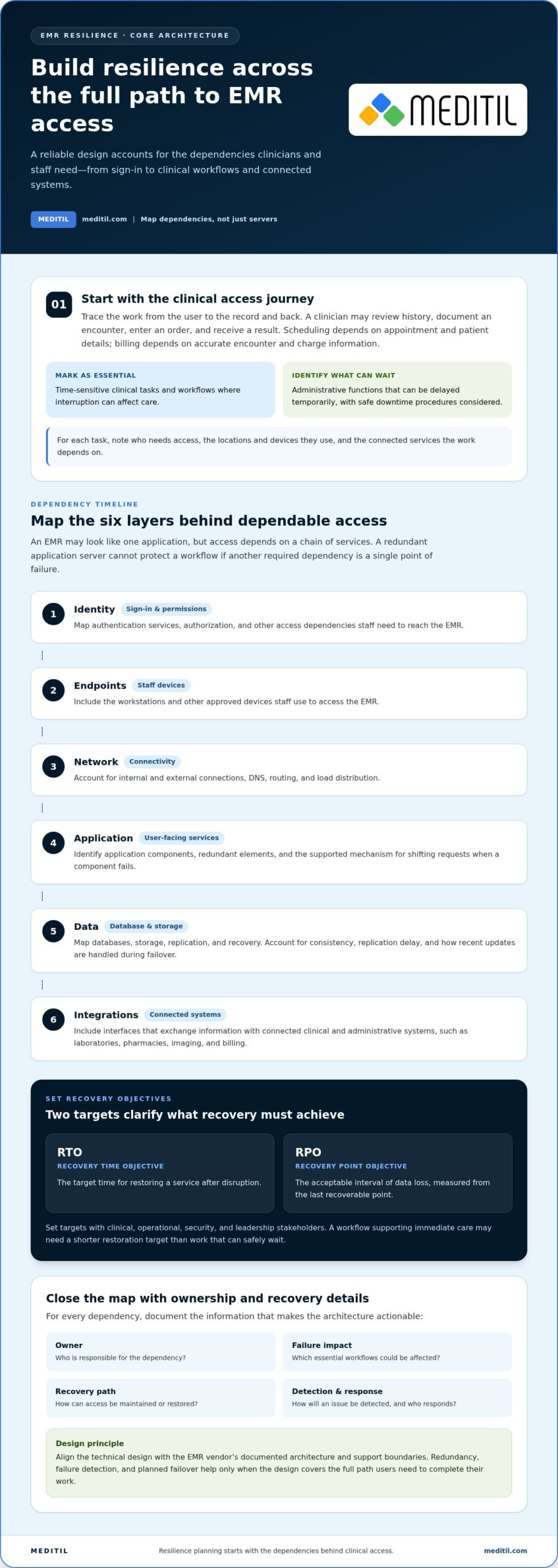
Trace work from the user to the record and back. A clinician may need to review history, document an encounter, enter an order, and receive a result. Scheduling teams need appointment and patient details, while billing staff rely on accurate encounter and charge information. The consequences and urgency of an interruption vary across these workflows.
For each task, record who needs access, which locations and devices they use, and which connected services the task depends on. Include interfaces to laboratories, pharmacies, imaging, billing, and identity systems where relevant. Mark time-sensitive clinical tasks as essential, then identify administrative functions that can be delayed temporarily. This distinction helps prioritize resilience investments and define safe downtime procedures.
How do RTO and RPO shape an availability plan?
Recovery time objective (RTO) is the target time for restoring a service after disruption. Recovery point objective (RPO) is the acceptable interval of data loss, measured from the last recoverable point. These objectives describe what recovery should achieve, but they don’t determine the architecture on their own.
Set targets with clinical, operational, security, and leadership stakeholders. A workflow that supports immediate care may need a shorter restoration target than a task that can safely wait. Consider data entry separately: teams should understand whether recent changes could be lost and how records will be reconciled. Document assumptions, responsibilities, and approved workarounds, then use those requirements to guide the technical design.
The Core Layers of a Resilient EMR Architecture
An EMR may appear to users as one application, but dependable access relies on a chain of services. A high availability architecture for EMR should map each dependency from sign-in through clinical use and connected systems. A redundant application server cannot protect workflows if authentication, network connectivity, or a required interface remains a single point of failure.
Include these layers in the dependency map:
- Application: User-facing services, application components, and supported failover paths.
- Data: Databases, storage, replication, and recovery mechanisms.
- Identity: Authentication services, authorization, and access dependencies.
- Network: Internal and external connectivity, DNS, routing, and load distribution.
- Endpoints: Workstations and other approved devices staff use to reach the EMR.
- Integrations: Interfaces that exchange information with connected clinical and administrative systems.
For each dependency, record its owner, failure impact, recovery path, and relationship to essential workflows. Also note how the team will detect an issue and who is responsible for responding. This makes it easier to identify a local fault that could cascade into a wider access problem.
How should application and data layers be made resilient?
Application resilience may use redundant components and a supported mechanism to shift requests when a component fails. Data resilience requires a separate design decision. Replication can support recovery, but teams need to account for consistency, replication delay, and how recent updates are handled during failover. There is no universal configuration. The EMR vendor’s documented architecture and support boundaries matter because the infrastructure design must work with the application’s supported deployment and recovery model.
Why do identity, network, and integrations matter?
Staff may lose practical access even when application servers and databases are healthy. Authentication services, DNS resolution, network paths, and endpoint configuration can each block sign-in or communication. Map external interfaces too. HL7 or FHIR connections may support the exchange of orders, results, or other information, depending on the organization’s workflows. Include monitoring and recovery ownership for these connections, not just the EMR itself.
Cloud or data-center designs may distribute components across availability zones or equivalent fault domains to reduce exposure to a localized infrastructure failure. This is a design option, not a guarantee of uninterrupted service. Availability still depends on how components are distributed, how failover works, and whether shared services or connections create common points of failure. IBM’s overview of High Availability Architecture and Benefits provides additional context on designing resilient systems.
Architecture controls can support an organization’s security program, but they are not the same as compliance with the HIPAA Security Rule. Security and resilience planning should address access protections, safeguards, and operational procedures together, with the organization assessing its own obligations.
Healthcare organizations can coordinate these dependencies through healthcare infrastructure and IT planning, connecting technical design with clinical operations and systems integration.
Comparing EMR High Availability and Disaster Recovery Approaches
High availability and disaster recovery address related but different failure conditions. High availability aims to reduce interruption when a component or service fails, such as an application node or network path. Disaster recovery focuses on restoring systems after a broader disruption or loss, such as an unavailable facility or region. A healthcare organization may need both, with separate recovery objectives for keeping essential workflows running and restoring service after a major event.
Backups are essential to recovery, but they don’t necessarily keep the application accessible. If staff must restore data, rebuild systems, or reconnect interfaces before resuming work, that process involves downtime. Likewise, hosting an EMR in the cloud doesn’t automatically make it highly available. The design still depends on how application services, data, connectivity, identity, and recovery processes are configured and managed.
How should organizations compare architecture patterns?
Compare each pattern using the same operational questions: What disruption does it address? How quickly can essential workflows resume? What data could be missing or need reconciliation? Which technical components and staff are required? Assess a high availability architecture for EMR against clinical consequences as well as infrastructure requirements. Avoid assuming a universal recovery time or uptime target.
| Approach | Recovery objectives and dependencies | Complexity and testing | Suitable scenarios |
|---|---|---|---|
| Single-site redundancy | Can reduce interruption from component failures within the site; relies on local infrastructure and shared services. | Requires failover testing and checks for shared points of failure. | Service continuity when the site remains operational. |
| Multi-site failover | Can support recovery at another site; depends on replicated data, connectivity, and compatible application environments. | Requires coordination across locations, data consistency checks, and end-to-end failover exercises. | Disruption affecting a primary facility or site. |
| Cloud-based recovery | Recovery depends on the chosen cloud design, data replication, access controls, and application support. | Requires validating recovery procedures, network access, identity, and integrations. | Organizations planning recovery using cloud infrastructure. |
| Backup-led restoration | Restores data and systems from available backups; recovery depends on backup integrity and restoration steps. | Requires restore tests, documented responsibilities, and verification of recovered records. | Data recovery or rebuilding after loss, where interruption is acceptable under the plan. |
These approaches can be combined. Local redundancy may address an individual component failure, while separate backups and a recovery environment address broader loss. Each layer adds operational dependencies, so account for application support boundaries, data consistency, staff responsibilities, and clinical procedures during an outage. Regular exercises reveal whether teams can execute the design, not simply whether the infrastructure is in place.
How to Plan and Validate an EMR Availability Strategy
A dependable plan connects technical recovery to clinical priorities and clear operational ownership. Build it in stages, then validate that staff and systems can carry out the documented response. The sequence below gives clinical, IT, security, and leadership teams a shared basis for planning a high availability architecture for EMR.
- Map essential workflows. Document how clinicians and staff use the EMR for priority tasks, where those users work, and which processes must continue during disruption. Identify approved downtime procedures and note which activities can be deferred safely.
- Inventory dependencies and owners. Record hosting, application components, data stores, identity services, networks, DNS, endpoints, integrations, and support responsibilities. For each dependency, note which workflows a failure affects, how teams will detect the issue, and any practical workaround.
- Assess risks and set recovery objectives. Consider component failures, connectivity loss, data corruption, security incidents, and broader site disruption. Clinical, operational, security, and leadership stakeholders should agree on recovery priorities and acceptable data loss based on impact, not assumptions. The NIST Cybersecurity Framework can help structure risk discussions; using it as a reference does not imply certification.
- Assign response roles and escalation paths. Specify who declares an incident, coordinates technical recovery, informs affected departments, and approves a return to normal operations. Include relevant application, infrastructure, security, and integration contacts, and keep responsibilities current as systems and teams change.
- Test, document, and review. Schedule controlled failover exercises and backup restoration tests. Capture what worked, what failed, who owns remediation, and when corrective actions will be retested. Revisit the plan after material changes to applications, infrastructure, workflows, or support arrangements.
What should an EMR dependency and risk assessment include?
Make the inventory useful by linking every dependency to an affected workflow and a response. For example, a failed identity service may prevent sign-in even when the EMR is functioning. An unavailable interface may delay information exchange while other functions remain accessible. Record system owners, recovery procedures, escalation contacts, and documented workarounds. Include security planning in the assessment. MEDITIL’s healthcare cybersecurity services guide offers additional context for aligning resilience planning with security considerations.
How can teams test recovery without disrupting care?
Before each exercise, define its scope, participants, communication plan, success criteria, and rollback conditions. Start in a controlled environment where possible, then plan operational exercises with clinical leaders to limit risk to active care. Test whether authorized users can reach the service, essential functions work, and restored data and connected interfaces behave as expected. A completed backup job alone doesn’t prove that restoration will succeed.
Maintain a record of results, decisions, remediation owners, and retest dates. MEDITIL provides healthcare infrastructure and availability planning support through resilience planning.
How MEDITIL Supports Healthcare EMR Resilience
Reliable EMR access depends on more than a technical design. It also requires coordinated infrastructure, security, application support, and clear ownership as systems evolve. MEDITIL works with healthcare organizations across these areas, connecting resilience planning to clinical workflows and operational priorities. MEDITIL provides healthcare IT services, not EMR/EHR software.
Managed IT services support ongoing infrastructure operations and coordination across networks, cloud environments, security, and healthcare applications. This helps organizations maintain visibility into the systems that support EMR access and coordinate responses when an issue affects connected services. End-user support matters too: a resilient system must be usable by clinical and administrative staff, with access issues and workflow impacts handled as part of the broader support picture.
For an organization developing a high availability architecture for EMR, infrastructure and application considerations need to align with vendor-supported designs and operational needs. MEDITIL supports EMR/EHR implementation and training, along with systems integration, helping organizations coordinate technology decisions with deployment, connected workflows, and staff adoption.
Where can managed healthcare IT support the availability lifecycle?
Resilience is an ongoing lifecycle, not a one-time architecture decision. Managed services can help coordinate planning, implementation, monitoring, support, and continuous improvement across the infrastructure and applications clinical teams depend on. The managed IT services for healthcare guide provides further context on how ongoing IT management fits healthcare operations.
Fractional CIO guidance complements technical delivery by helping leaders assess priorities, dependencies, and governance. It can bring clinical, operational, security, and IT perspectives into decisions about resilience objectives, investment, and accountability. The virtual CIO services guide explores how strategic IT leadership can support that alignment.
What are practical next steps for healthcare leaders?
Begin with a focused review of essential workflows, system dependencies, recovery objectives, and known gaps. Bring clinical leadership, IT, security, and relevant application and infrastructure stakeholders into the same planning process. That shared view helps distinguish a technical design issue from a workflow, communications, or ownership gap.
Next, assign owners to priority improvements and establish a review cycle. Track whether recovery procedures are documented, support responsibilities are clear, and planned tests lead to completed remediation. As systems or workflows change, revisit the assumptions behind the resilience plan so it continues to reflect operational reality.
Organizations can align infrastructure planning, managed IT, and strategic guidance with clinical priorities through healthcare IT resilience support.
Make EMR Resilience an Ongoing Practice
A resilience plan should evolve alongside clinical workflows, infrastructure, and organizational priorities. Use each review to confirm that recovery assumptions still fit how care is delivered, responsibilities remain clear, and previous test findings have led to meaningful improvements. This discipline turns the high availability architecture for EMR from a technical design into a capability the organization can maintain over time.
Choose a practical starting point: identify one critical workflow, trace the systems it depends on, and bring the right stakeholders together to address gaps. MEDITIL can help healthcare organizations connect infrastructure planning with operational priorities through healthcare-focused IT support, fractional CIO guidance, and project-based consulting.
Discuss your healthcare IT resilience needs and take a considered next step toward dependable clinical operations. Clear ownership and regular review help strengthen resilience over time.
Frequently Asked Questions
What does high availability mean for an EMR system?
High availability means the EMR remains usable, or access is restored with limited disruption, when part of its supporting environment fails. Don’t assess availability only by whether the login page loads. Can an authorized clinician retrieve a chart, save documentation, and complete essential tasks? Monitoring these user-facing functions helps teams distinguish a partial outage from normal operation and respond according to its effect on care.
Is high availability the same as EMR disaster recovery?
No. High availability focuses on limiting the effect of localized service or component failures, while disaster recovery addresses larger disruptions that may require restoration in a separate environment. A plan should account for both. A failed network component may call for a local failover response, while loss of a primary hosting environment may require a broader recovery process with separate approvals, communications, and data validation before staff resume normal work.
Does cloud hosting guarantee high availability for an EMR?
No. Cloud hosting provides infrastructure options, but availability depends on the full design and its operation. A service may still be affected by an incorrectly configured dependency, an unavailable identity provider, network disruption, or an application limitation. Review which components the cloud design covers and which remain the organization’s responsibility. Confirm that the recovery approach fits the EMR’s supported architecture and that staff can access it through tested paths.
How should a healthcare organization set EMR recovery objectives?
Set objectives by evaluating the consequences of disruption for specific work, rather than choosing a generic target. Ask clinical and operational leaders what decisions or tasks would be delayed, what temporary process is safe, and how much recent data could require re-entry or reconciliation. Then assess those priorities with IT, security, and leadership. For high availability architecture for EMR, document assumptions by workflow and revisit them when service dependencies or care processes change.
Can EMR high availability protect integrations and connected systems?
It can include integration resilience, but protecting the EMR alone doesn’t ensure connected systems keep exchanging information. Map each interface’s direction, purpose, owner, and behavior during interruption. For example, determine how staff will identify whether an order was transmitted, queued, or needs reconciliation after service returns. Include relevant HL7 or FHIR interfaces in monitoring and recovery exercises, and coordinate procedures with the teams responsible for connected systems.
How often should an EMR recovery plan be tested?
Test it on a schedule that reflects clinical risk, system complexity, and organizational policy, and repeat relevant tests after significant changes to applications, infrastructure, interfaces, or responsibilities. Use more than one format: a discussion-based exercise can clarify escalation and decision-making, while a controlled restoration test checks whether data and access can be recovered. Record findings, assign remediation owners, and track retesting so unresolved gaps don’t disappear between reviews.