
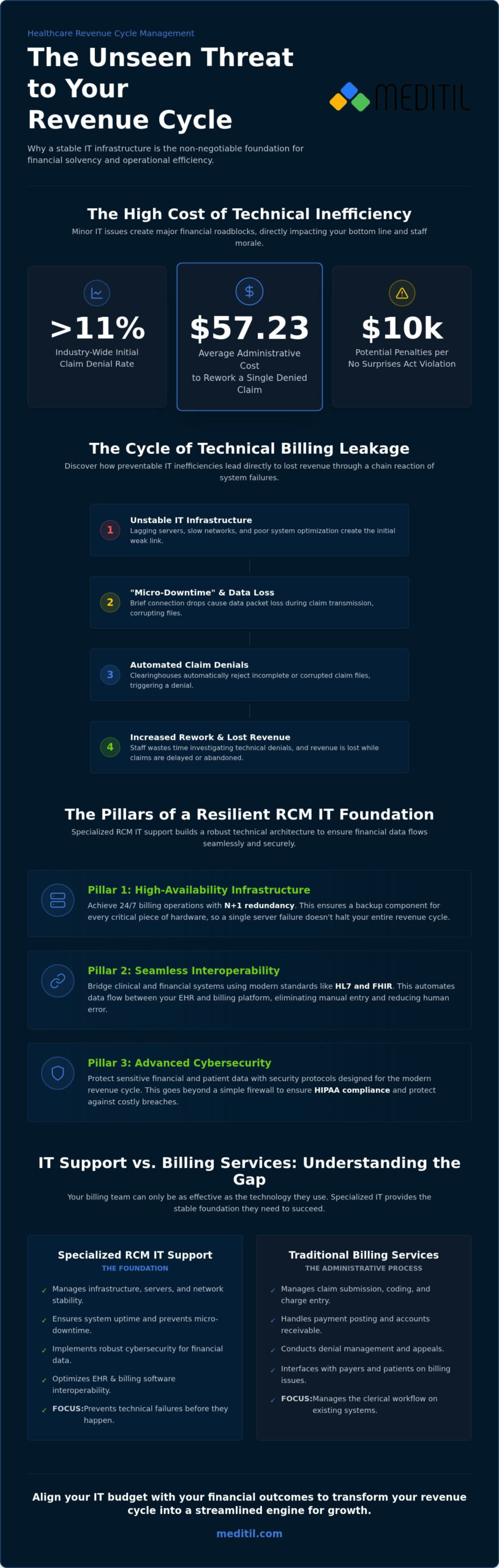
Did you know that the administrative cost to rework a single denied claim has climbed to $57.23 in 2026? With industry-wide initial denial rates now exceeding 11 percent, these technical inefficiencies are no longer just a clerical nuisance; they represent a direct threat to your organization’s financial solvency. Most healthcare executives recognize that the revenue cycle is becoming increasingly complex, yet many still struggle with frequent system downtime and poor interoperability between EHRs and billing platforms. You shouldn’t have to fear a HIPAA breach every time you transfer financial data or worry about the $10,000 penalties associated with the latest No Surprises Act enforcement measures.
We believe that a reliable, high-performing IT infrastructure is the essential foundation of a healthy bottom line. This strategic guide explores how specialized healthcare revenue cycle management IT support eliminates technical friction to ensure long-term stability. You’ll discover how to achieve seamless data flow between clinical and financial systems, maintain zero downtime during peak billing cycles, and leverage expert guidance to automate manual workflows. By the end of this article, you’ll have a clear roadmap to align your IT budget with your financial outcomes, transforming your revenue cycle into a streamlined engine for growth.
Key Takeaways
- Learn why your billing success is fundamentally tied to IT infrastructure and how preventing micro-downtime protects your first-pass claim acceptance rates.
- Identify the technical pillars necessary for seamless data flow between EHR and billing platforms while maintaining rigorous cybersecurity protocols for financial data.
- Understand the critical distinction between billing services and specialized healthcare revenue cycle management IT support to ensure your technical foundation supports your administrative team.
- Discover how to build a resilient 2026 roadmap by conducting technical audits and implementing automated redundancy for mission-critical billing data.
- Explore the role of a Fractional CIO in aligning your technology investments with long-term financial goals and operational stability.
Why Your Revenue Cycle is Only as Strong as Your IT Infrastructure
The efficacy of your financial operations depends entirely on the stability of the hardware and software hosting them. While many administrators view billing as a purely clerical function, it’s actually an infrastructure challenge. If your network experiences even brief interruptions, your first-pass claim acceptance rates will suffer. Specialized healthcare revenue cycle management IT support ensures that these systems remain online and optimized, preventing the technical bottlenecks that lead to revenue loss. Revenue cycle management (RCM) is a complex chain of events; if the underlying server is sluggish, the entire chain breaks.
General IT providers often treat a printer failure and a billing server lag with the same level of priority. This lack of industry-specific knowledge is dangerous for a medical practice. In a high-volume environment, “micro-downtime”—lags lasting only seconds—can disrupt batch submissions and cause missed payer deadlines. These inefficiencies don’t just affect the bottom line; they drive physician burnout. When clinical staff must wait for an unresponsive EHR to sync with financial modules, patient care suffers and administrative backlogs grow. It’s a systemic failure that starts with the network and ends with your staff’s morale.
The Concept of Technical Billing Leakage
Technical billing leakage occurs when revenue is lost due to preventable IT inefficiencies. This often manifests through slow networks that cause data packet loss during the electronic transmission of claims. If a claim file is corrupted or incomplete because of a momentary connection drop, it triggers an automatic denial. The correlation is clear; higher system latency leads directly to increased denial rates. By stabilizing the connection between your facility and the clearinghouse, you eliminate the “silent” denials that frustrate your billing team. Technical billing leakage is revenue lost due to preventable IT inefficiencies.
Infrastructure as the Engine of Financial Stability
To maintain financial health, your organization needs high-availability servers that support 24/7 billing operations. We recommend N+1 redundancy for all mission-critical systems. This means having a backup component for every primary piece of equipment, ensuring that a single hardware failure doesn’t halt your entire billing cycle. A robust infrastructure is also the prerequisite for transitioning to value-based care models. You can’t manage complex, outcome-driven financial models if your basic data architecture is prone to failure. Specialized healthcare revenue cycle management IT support provides the steady hand needed to navigate these technical complexities with precision.
The Technical Pillars of Specialized RCM IT Support
A successful revenue cycle isn’t built on clerical effort alone. It’s sustained by a technical architecture designed to handle high-stakes data transfers with absolute precision. Robust healthcare revenue cycle management IT support prioritizes the integrity of these systems, ensuring that clinical inputs translate perfectly into financial outputs. Without these pillars, even the most skilled billing team will struggle against systemic failures that lead to claim denials and lost revenue. Proactive monitoring identifies these technical bottlenecks before they ever impact your bottom line.
Interoperability: Bridging Clinical and Financial Data
In 2026, interoperability is the cornerstone of administrative efficiency. Modern standards like HL7 and FHIR (Fast Healthcare Interoperability Resources) facilitate the secure exchange of health information across disparate systems. When your EHR and billing software communicate effectively, you eliminate the need for manual data entry. This automation reduces human error and significantly accelerates the submission timeline. For organizations looking to optimize these connections, exploring Medical Billing Automation Solutions is a critical step toward achieving a frictionless workflow.
Cybersecurity for the Modern Revenue Cycle
Protecting end-to-end revenue cycle operations requires more than a simple firewall. The “billing endpoint,” which is the specific device or interface where financial data is processed, remains a prime target for ransomware and phishing attacks. We implement advanced encryption protocols to secure payment processing and ensure that every third-party clearinghouse integration remains HIPAA compliant. Security isn’t just about blocking threats. It’s about verifying every handshake between systems to maintain a closed, protected loop for your sensitive financial data.
Cloud Solutions and Proactive Infrastructure
Cloud-based RCM solutions offer unparalleled accessibility for remote billing teams, yet they must be configured with rigorous security controls to prevent unauthorized access. We utilize proactive monitoring tools to identify technical bottlenecks before they stall your billing cycle. If a database query slows down or a server reaches capacity, a specialized healthcare revenue cycle management IT support team intervenes immediately. This level of oversight ensures that your financial data remains both accessible and invulnerable. If you’re ready to stabilize your infrastructure, our managed IT services provide the steady hand your practice requires.
IT Support vs. Billing Services: Understanding the Gap
Many healthcare executives assume that outsourcing to a billing service will resolve their financial friction. However, a billing service is an administrative solution, not a technical one. While these services manage the processing of claims, they remain entirely dependent on the underlying technology environment. If your internal servers are sluggish or your VPN is unstable, an outsourced team will face the same delays as your in-house staff. Specialized healthcare revenue cycle management IT support bridges this gap by ensuring the environment itself is optimized for high-speed data transmission.
There’s a critical synergy between a functional billing team and a proactive IT partner. A billing service focuses on the “what”—the codes and payer rules. Your IT partner focuses on the “how”—the connectivity, security, and hardware reliability. Without this technical foundation, “billing chaos” often ensues. This chaos manifests as lost files, timed-out sessions, and corrupted data packets. Comprehensive infrastructure management goes far beyond the basic software support offered by EMR vendors; it involves the holistic oversight of every hardware and software component in the cycle.
When to Optimize Infrastructure Before Outsourcing
It’s essential to identify whether your RCM challenges are clerical or technical. Signs of technical failure include slow screen refresh rates, frequent software crashes, or packet loss during claim submissions. These issues often lead to poor performance among remote billing staff who rely on stable home-office connectivity. Before committing to the high labor costs of an external billing service, evaluate the ROI of IT optimization. Fixing a network bottleneck is a fixed cost that can improve the productivity of your existing team by 15 percent or more, which is far more cost-effective than scaling labor to compensate for broken systems.
Supporting the Billing Software Ecosystem
The billing software ecosystem is a complex web of integrated applications. Maintaining this environment requires constant vigilance through regular updates and security patches. General IT providers often lack the expertise to troubleshoot clearinghouse connection errors in real-time, leading to costly submission delays. Specialized healthcare revenue cycle management IT support provides a dedicated help desk that understands the urgency of billing deadlines. We manage the delicate balance of keeping software current while ensuring that new patches don’t disrupt the critical links between your clinical and financial modules. This steady hand ensures that your team stays focused on revenue generation rather than technical troubleshooting. For organizations looking to integrate these processes with broader business automation tools like Zoho, apollonix.com.br offers specialized consultancy to streamline those technical connections.
A resilient financial future requires a transition from reactive troubleshooting to a proactive, multi-year strategy. For organizations looking to optimize their broader business processes and increase margins, you might check out ITmore for strategic consulting. As regulatory requirements and payer rules grow more complex, your infrastructure must adapt to maintain operational continuity. Specialized healthcare revenue cycle management IT support provides the framework for this evolution, ensuring that your technology stack remains an asset rather than a liability. Stability is the goal.
The first phase of a strategic roadmap is a comprehensive technical audit. We evaluate the age and performance of your hardware, as legacy servers often struggle to support the resource-intensive demands of modern billing software. This audit also includes a rigorous review of network security protocols to ensure that financial data transfers remain encrypted and compliant. By mapping the flow of information, we identify technical silos that prevent clinical data from reaching the billing department efficiently. Eliminating these gaps is the only way to ensure a seamless end-to-end process.
Step 2: Automating the Billing Lifecycle
Automation is the most effective way to combat rising administrative costs. By implementing automated eligibility verification at the point of care, you reduce the risk of front-end denials before the patient even leaves the office. We also recommend setting up automated denial management alerts that specifically flag IT-related failures, such as submission timeouts or clearinghouse connection errors. To properly allocate resources for these upgrades, consult our guide on Strategic IT Budgeting for Medical Practices. This financial alignment ensures that your technical improvements are sustainable and results-oriented.
Mission-critical billing data requires real-time, automated redundancy to prevent loss during system failures or cyberattacks. Additionally, training your staff on the technical aspects of new RCM software integrations ensures they can utilize these tools to their full potential. As your practice grows and patient volume increases, your IT infrastructure must scale proportionally to prevent performance degradation. Our team provides the specialized healthcare revenue cycle management IT support required to maintain this balance. If you’re ready to begin your technical transformation, our managed IT services offer the steady hand needed to execute a custom roadmap.
Strategic RCM Optimization with MEDITIL’s Managed IT
MEDITIL serves as the steady hand at the wheel for organizations navigating the intersection of clinical care and financial performance. We don’t just fix broken systems; we build and maintain the digital infrastructure that powers your entire billing lifecycle. Our healthcare revenue cycle management IT support is built on the principle that technical friction is a choice, not an inevitability. By providing customized infrastructure solutions designed for high-volume environments, we ensure that your systems are always ready for the next batch of claims. Stability is the baseline for everything we do.
Our approach goes beyond reactive help desk tickets. We prioritize both clinical and financial uptime to ensure that patient care and billing processes run in parallel without interference. When your IT strategy is aligned with your financial goals, you eliminate the “silent” revenue leaks caused by system latency and connectivity drops. This level of synchronization is essential for maintaining financial health in a regulated environment where every second of downtime translates to delayed payments.
Fractional CIO: Leadership for Financial Health
Effective leadership is required to bridge the communication gap that often exists between technical teams and financial officers. A Fractional CIO provides the strategic advisory necessary to select and implement RCM technology that actually moves the needle on denial rates. Instead of making isolated technical decisions, we align every IT investment with your specific revenue goals. This proactive guidance helps you navigate complex vendor selections and software integrations with confidence. Explore our Virtual CIO Services to see how strategic leadership transforms your operational roadmap and secures your bottom line.
Augmented IT Teams for RCM Support
Many organizations struggle with the technical overhead of EMR/EHR implementation and training. Our augmented IT teams provide the specialized support needed to manage these transitions without disrupting your existing billing cycle. We ensure that your staff is fully equipped to handle new workflows while we manage the backend connectivity that keeps the data flowing. This includes ensuring seamless connectivity for telehealth and remote monitoring billing, which are critical components of the 2026 revenue landscape. By managing these technical complexities, we allow your administrative staff to focus on high-value tasks rather than troubleshooting software errors. Partner with MEDITIL to secure your revenue cycle today.
Securing Your Financial Future Through Technical Excellence
The complexity of the 2026 healthcare landscape requires more than just administrative diligence; it demands a technical foundation that is both resilient and proactive. By prioritizing seamless interoperability and eliminating micro-downtime, you transform your billing process from a source of friction into a reliable engine for growth. A robust strategy ensures that your organization remains compliant with evolving regulations while protecting sensitive financial data from sophisticated threats. Every handshake between your EHR and billing platform must be verified and secure to maintain the integrity of your bottom line.
Implementing specialized healthcare revenue cycle management IT support is the most effective way to align your operational infrastructure with your long-term revenue goals. At MEDITIL, we provide a steady hand through specialized healthcare IT expertise and Fractional CIO leadership. Our managed infrastructure for 24/7 operations ensures that your clinical and financial systems remain perfectly synchronized, allowing your team to focus on patient outcomes rather than technical troubleshooting. Optimize Your Revenue Cycle with MEDITIL’s Strategic IT Support. Your path to financial stability starts with a partner who understands that every data packet represents your organization’s success.
Frequently Asked Questions
How does IT support impact my medical billing denial rate?
IT support reduces denials by eliminating technical transmission errors and ensuring data integrity between systems. When claim files are corrupted due to network latency or packet loss, payers automatically reject them. Robust healthcare revenue cycle management IT support monitors these connections in real-time to prevent silent denials. By stabilizing the infrastructure, you ensure that every claim reaches the clearinghouse in a clean, readable format without technical interruptions.
Can specialized IT support help with EHR and billing system interoperability?
Yes, specialized support facilitates the seamless exchange of data between clinical and financial platforms using modern standards like HL7 and FHIR. We implement systems integration and interoperability solutions that allow clinical inputs to flow directly into billing modules without manual intervention. This reduces human error and ensures that patient encounter data is accurately captured for claim generation. Technical alignment between these systems is the cornerstone of a frictionless revenue cycle.
What is the role of a Virtual CIO in revenue cycle management?
A Virtual CIO provides strategic leadership to align your technology investments with your organization’s financial goals. They advise on selecting the right RCM technology stack and manage complex vendor relationships. By bridging the gap between clinical operations and financial outcomes, a Fractional CIO ensures that your IT roadmap supports long-term stability. This high-level guidance is essential for navigating regulatory changes and optimizing your practice’s technical infrastructure.
How do I ensure my billing data transfers are HIPAA compliant?
Ensuring compliance requires end-to-end encryption and secure, verified endpoints for every data transfer. We implement rigorous cybersecurity protocols that protect financial data during transmission to third-party clearinghouses. This includes multi-factor authentication, regular security audits, and proactive monitoring of all billing endpoints. By maintaining a closed, protected loop for your sensitive information, you minimize the risk of breaches and avoid the significant penalties associated with regulatory non-compliance.
What are the most common IT-related bottlenecks in the revenue cycle?
The most frequent bottlenecks include system latency, poor software integration, and network micro-downtime. When a network is slow, it causes data packet loss during claim submissions, leading to immediate rejections. Siloed systems that require manual data re-entry also create significant delays and increase the likelihood of clerical errors. Proactive infrastructure management identifies these technical hurdles before they stall your billing cycle, ensuring a steady, predictable flow of revenue.
Is cloud-based RCM software more secure than on-premise solutions?
Cloud-based solutions often provide superior security because they leverage the advanced encryption and redundancy of enterprise-level data centers. However, security depends on proper configuration and rigorous access controls. We manage these cloud environments to ensure they meet healthcare-specific regulatory standards while providing the accessibility required for remote billing teams. Whether you choose cloud or on-premise, the key is having a proactive IT partner to monitor and protect the underlying infrastructure.
How can IT automation reduce the administrative burden on my billing staff?
Automation streamlines repetitive tasks like eligibility verification and denial management alerts, allowing your staff to focus on high-value work. By integrating healthcare revenue cycle management IT support with billing automation, you can trigger real-time updates at the point of care. This reduces the time spent on manual data entry and minimizes the need for reworking denied claims. Efficient automation transforms your billing department into a high-performing, results-oriented team that operates with precision.
What should I look for in a healthcare-specific managed IT provider?
Look for a provider with deep expertise in both medical infrastructure and regulatory compliance. A strategic partner should offer more than just basic help desk support; they must understand the urgency of billing deadlines and the complexities of EHR interoperability. Prioritize providers that offer Fractional CIO leadership and customized infrastructure solutions. You need a steady hand at the wheel who is invested in your organization’s long-term financial health and operational stability.