
Healthcare data integration isn’t just a technical box to check for compliance. It’s a strategic asset that determines whether your clinical workflows empower or hinder your financial performance. You’ve likely felt the strain of fragmented patient data or the high costs of manual entry between your EHR and billing systems. The fear of a HIPAA breach during migration or facing a $1 million penalty for information blocking is a heavy burden for any administrator. Choosing professional healthcare data integration services is the first step toward moving from a reactive state to a position of technical authority and clinical precision.
We understand that you need a stable, managed infrastructure that doesn’t break every time a system updates. This guide will show you how to eliminate data silos and achieve seamless interoperability through expert-led strategies that align with the 2026 USCDI v3 standards. You’ll discover how to leverage FHIR R4 protocols and fractional CIO leadership to automate billing and secure real-time data exchange across all platforms. By the end of this article, you’ll have a clear roadmap for addressing the HTI-1 Final Rule while building a resilient environment that protects your patients and your practice.
Key Takeaways
- Identify the hidden costs of data fragmentation and how unified systems reduce provider burnout and clinical errors.
- Understand the transition from legacy HL7 v2 standards to modern FHIR APIs for secure, real-time synchronization of patient health information.
- Evaluate different service models to determine whether project-based consulting or managed IT services best support your long-term infrastructure goals.
- Follow a phased strategic roadmap for healthcare data integration services that prioritizes HIPAA compliance and rigorous security audits.
- Learn how fractional CIO leadership can bridge the gap between high-level strategy and the technical execution required for seamless interoperability.
The Business Case for Unified Healthcare Data Integration
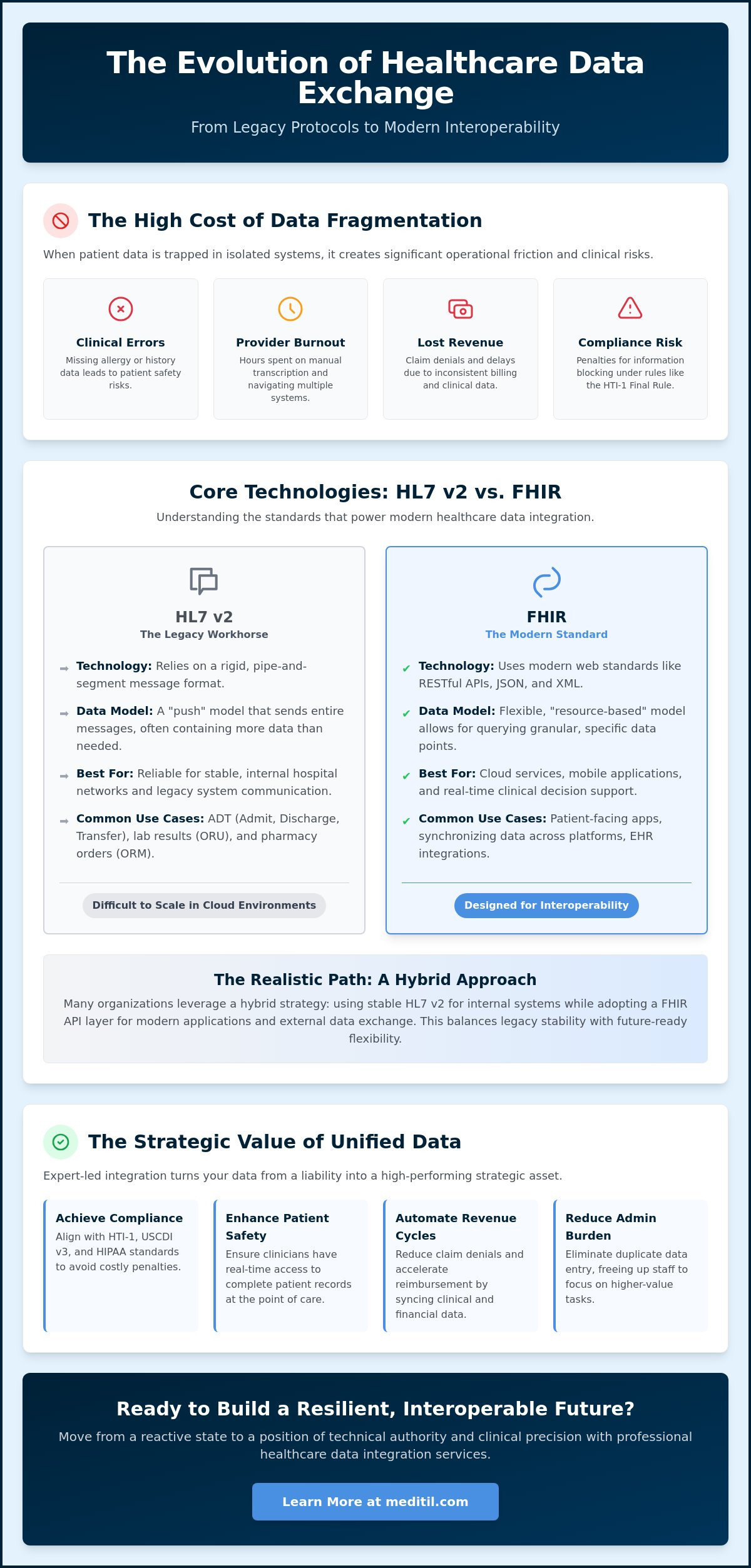
Data silos represent more than a technical inconvenience. For modern clinics, they function as a significant drain on operational resources and clinical efficacy. When patient information remains trapped within isolated systems, the result is administrative bloat and heightened clinical friction. Professional healthcare data integration services address these inefficiencies by creating a unified architecture where data flows securely and predictably between disparate platforms.
Fragmented data environments force staff to spend hours on manual transcription, which increases the likelihood of human error. These errors aren’t just administrative; they directly impact patient safety. A lack of historical context or missing allergy information can lead to clinical mistakes. Shifting from a reactive model of fixing data errors to a proactive interoperability strategy ensures that your facility remains compliant with the HTI-1 Final Rule and the USCDI v3 standards. It’s about building a foundation that supports both care delivery and business growth.
Reducing Clinical Friction and Provider Burnout
Clinicians often face fatigue when they have to navigate multiple EHR and specialty software interfaces. By eliminating duplicate data entry, you allow providers to focus on patient care rather than data management. Seamless connectivity through a robust Health Information Exchange (HIE) framework ensures that records are available at the point of care in real time. This immediate access improves diagnostic accuracy and accelerates treatment timelines. It removes the technical barriers that contribute to provider burnout and ensures that every team member has the information they need to perform their roles effectively.
The ROI of Integrated Billing and Revenue Cycles
The financial justification for integration is most evident within the revenue cycle. Many organizations overlook the substantial revenue lost because clinical and financial systems don’t communicate. Efficient healthcare data integration services reduce claim denials by automatically verifying patient data against clinical records before submission. This level of precision removes the necessity for manual reconciliation, which is both expensive and prone to error. By accelerating the reimbursement cycle, you improve cash flow and provide a more predictable financial outlook. Investing in a sophisticated data pipeline creates long-term savings by reducing the administrative burden and minimizing the risk of regulatory penalties. A stable, managed infrastructure ensures these systems remain synchronized as your practice grows, turning your data from a liability into a high-performing asset. For healthcare organizations looking to expand their clinical or administrative reach into European markets, CiDATax SRL helps businesses explore Italian Fiscal Representation to maintain full tax and regulatory compliance across borders.
Core Technologies Powering Modern Healthcare Integration
Modern healthcare data integration services revolve around the secure, automated synchronization of Protected Health Information (PHI) between disparate platforms. This technical framework is essential for clinics that aim to align with the national vision for interoperability. By moving away from manual data handling, organizations can ensure that patient records are accurate and accessible across the entire care continuum. It isn’t just about moving data; it’s about ensuring that data remains actionable and secure throughout its lifecycle.
Understanding HL7 and FHIR Standards
The industry has seen a significant shift in data exchange protocols over the last decade. HL7 v2 has long been the workhorse of hospital messaging, handling critical functions like Admission, Discharge, and Transfer (ADT) messages, pharmacy orders (ORM), and laboratory results (ORU). While reliable for internal hospital networks, HL7 v2 often struggles with the demands of modern, cloud-based environments. It relies on a “push” model that can be rigid and difficult to scale.
Fast Healthcare Interoperability Resources (FHIR) represents the next stage of this evolution. Unlike its predecessors, FHIR uses modern web technologies and RESTful APIs to allow for more granular data access. It’s particularly effective for organizations that rely on cloud services or require real-time updates for clinical decision support. When choosing a standard, your specific clinical use case dictates the approach. Legacy systems may still require HL7 for internal stability, while new patient-facing tools demand the flexibility of FHIR. For many, a hybrid approach is the most realistic path forward. Developing a comprehensive healthcare API integration strategy is essential for organizations navigating this transition and preparing for the evolving FHIR R4 and USCDI v3 mandates ahead.
The Critical Role of Secure APIs
Secure Application Programming Interfaces (APIs) are the engines that drive real-time data exchange. They allow different software systems to communicate without the need for manual exports or cumbersome batch processing. This connectivity is vital for integrating telehealth platforms and remote monitoring tools into your central clinical workflow. FHIR serves as the essential bridge between legacy clinical records and modern mobile health applications. By using these APIs, clinics can create a seamless experience where data from a patient’s wearable device flows directly into their medical record.
Maintaining HIPAA compliance in these API-driven environments requires a disciplined approach to cybersecurity. Encryption and strict authentication protocols ensure that data remains protected while in transit. SMART on FHIR has emerged as the gold standard for this level of application interoperability, providing a secure way to run third-party apps within an EHR without compromising the underlying system. Implementing these technologies correctly requires a deep understanding of both technical standards and regulatory requirements. If you’re looking to modernize your infrastructure, seeking strategic interoperability advising can help ensure your systems are both high-performing and compliant.
The transition to these technologies is no longer optional for clinics that want to remain competitive. As regulatory pressure increases, the ability to exchange data quickly and securely becomes a primary differentiator. High-quality healthcare data integration services provide the expertise needed to navigate these complex technical shifts, ensuring that your clinic stays ahead of the curve while maintaining the highest standards of patient care.
Service Provider Models: Consulting vs. Managed IT Services
Selecting the right partner for healthcare data integration services requires a clear understanding of how different service models align with your clinical objectives. The market generally offers three pathways: project-based consulting, integration platforms (iPaaS), and managed healthcare IT services. Each approach serves a specific purpose depending on the maturity of your internal infrastructure and the technical proficiency of your staff. For many clinics, the decision rests on whether they require a one-time technical bridge or a long-term strategic partnership.
Integration Platforms (iPaaS) provide the tools necessary for data exchange but often require a robust internal development team to manage the logic and maintenance of those connections. If your organization lacks these specialized resources, a platform-only approach can lead to significant technical debt. In contrast, the “Steady Hand” approach of a managed model ensures that the systems don’t just function at the point of implementation; they remain stable through every subsequent software update and regulatory shift. This continuity is vital in a regulated environment where a single synchronization failure can lead to clinical errors or financial discrepancies.
When to Hire a Healthcare IT Consultant
Traditional project-based IT consulting is most effective during major transitions, such as an EMR/EHR implementation or a large-scale data migration. These consultants bring specialized knowledge in architecture design and staff training, ensuring that your team is prepared for the new workflow. When evaluating a consultant, it’s essential to verify their track record with your specific software stack and their familiarity with regulatory standards like HIPAA and SOC 2. A consultant acts as a proactive guide during high-stakes projects, but their involvement typically ends once the project reaches its defined milestone. This model is ideal for organizations that have the internal capacity to handle day-to-day maintenance but need external expertise for complex, high-level strategy.
The Benefits of the Managed Integration Model
For clinics that prioritize long-term stability and predictable overhead, the managed integration model offers a more comprehensive solution. This approach combines the strategic planning of a Fractional CIO with the operational support of managed IT services. One of the primary advantages is the continuity of care for your network. The team that designs and builds your integration remains responsible for its performance, which eliminates the finger-pointing that often occurs between different vendors.
Managed services shift your technical costs from unpredictable project fees to a stable managed service agreement, allowing for better financial planning. Beyond cost control, this model provides proactive monitoring that catches synchronization errors before they impact patient care or billing cycles. By integrating your infrastructure, cybersecurity, and application support under one disciplined management structure, you create a resilient environment that supports both clinical excellence and administrative efficiency. This level of oversight ensures your data remains secure, compliant, and accessible when it’s needed most.
A Strategic Roadmap for HIPAA-Compliant Data Integration
Implementing a unified data environment requires more than technical connectivity. It demands a disciplined, multi-phase roadmap that aligns with both clinical needs and regulatory standards. Professional healthcare data integration services provide the structure needed to move from fragmented silos to a cohesive, compliant ecosystem. This process is designed to mitigate risk while ensuring that the final architecture supports clinical workflows and administrative efficiency. A methodical approach prevents the common cycle of system failures that often follow hasty, unmanaged implementations.
The transition typically follows a five-phase progression to ensure stability:
- Phase 1: Discovery and data mapping across all clinical and financial systems.
- Phase 2: Security and compliance audit of data at rest and in transit.
- Phase 3: Selection of the integration engine or API architecture based on specific clinical use cases.
- Phase 4: Pilot testing and validation of data integrity between connected platforms.
- Phase 5: Full-scale rollout accompanied by staff workflow optimization and training.
Discovery and Gap Analysis
The initial phase focuses on identifying every data silo within your existing network. It involves mapping how Protected Health Information (PHI) moves between clinical software, billing platforms, and third-party tools. A critical objective here is determining the “Source of Truth” for patient records. This prevents conflicting data entries from compromising care and ensures that the most accurate information is always prioritized. This analysis reveals the specific points where manual intervention is currently required, setting a clear stage for automation and reduced administrative bloat.
Ensuring Compliance During Migration
Security must be the primary consideration during any data transfer. Implementing end-to-end encryption ensures that sensitive information remains protected as it moves across your network. HIPAA compliance requires encryption both at rest and in transit during the entire integration process. Beyond encryption, establishing strict access controls and comprehensive audit logging allows you to monitor who interacts with PHI at every stage. This level of verification is essential for passing regulatory audits and maintaining the long-term integrity of your infrastructure.
Validation serves as the final safeguard before a full-scale launch. Pilot testing ensures that data remains consistent as it travels between disparate systems. This phase allows for the refinement of staff workflows, ensuring that the new technology serves the clinical team rather than complicating their daily tasks. If your organization is ready to modernize its network with a secure, managed approach, our team provides comprehensive systems integration and interoperability support to guide your transition from end to end.
Unifying Strategy and Execution with MEDITIL Services
Successful interoperability requires a partner who understands that technical connectivity is only half of the equation. MEDITIL ensures that healthcare data integration services aren’t just a one-time project but a sustainable part of your clinic’s infrastructure. We bridge the gap between high-level strategic planning and the granular technical execution required for long-term stability. Our approach moves beyond simple connectivity; we provide a managed environment where systems are monitored, secured, and optimized for performance. This model addresses the common failure of project-based integration, where systems often degrade after the initial consultants depart. By providing a steady hand at the wheel, we help organizations maintain a reliable, high-performing specialist presence.
Strategic Advisory and Fractional CIO Leadership
A Fractional CIO provides your organization with the strategic roadmap development of a seasoned executive without the overhead of a full-time salary. This leadership is essential for aligning your IT budget with both clinical and business outcomes. We help you navigate the complexities of EHR implementation and interoperability, ensuring that every technical decision supports your long-term goals. Our advising services focus on creating a disciplined architecture that scales with your practice. Proactive cybersecurity monitoring is integrated directly into this strategy, protecting your data as it moves through new pipelines. This high-level oversight ensures that your infrastructure doesn’t just meet today’s standards but is prepared for future regulatory shifts.
Expert Implementation and Ongoing Support
We offer more than advice; we provide the technical expertise to execute complex interoperability projects through our augmented IT team and comprehensive management of IT teams. Whether you need to supplement your current staff or require a fully managed solution, we ensure that your infrastructure remains resilient. Our services include seamlessly integrating billing, labs, and imaging into your primary clinical workflow. We specialize in billing automation and telehealth integration, turning fragmented tools into a unified system that improves revenue cycle performance. This level of support ensures that synchronization errors are caught before they impact care or financial reporting.
Our commitment to your organization extends beyond the initial implementation phase. We provide ongoing healthcare application support and managed IT services to guarantee that your systems remain secure and compliant. By consolidating your technology needs under one expert provider, you eliminate the friction caused by multiple vendors and fragmented support models. You gain a strategic partner invested in your long-term success and operational stability. If you’re ready to stabilize your technical environment and achieve true interoperability, contact MEDITIL today to discuss your integration roadmap.
Securing Your Clinical Future Through Strategic Interoperability
Transitioning to a unified data environment is a requirement for regulatory compliance and clinical excellence. You’ve seen how modern standards like FHIR APIs and USCDI v3 are reshaping the industry landscape. By moving away from fragmented silos and embracing a managed infrastructure, your clinic can eliminate manual entry errors and protect patient data against evolving threats. These improvements aren’t just technical. They’re foundational to reducing provider burnout and ensuring financial stability through automated billing. Implementing professional healthcare data integration services is the final step in moving from a reactive state to a position of technical authority.
Achieving this level of precision requires more than a temporary fix. It’s about finding a strategic partner who understands the high-stakes nature of healthcare. MEDITIL offers the specialized healthcare IT expertise and Fractional CIO strategic guidance needed to navigate these complex transitions. Our HIPAA-compliant managed services provide a steady hand at the wheel, ensuring your systems remain stable and high-performing. Partner with MEDITIL for Strategic Healthcare IT Integration to build a resilient, interoperable future for your practice. Your team and your patients deserve the security of a well-managed network.
Frequently Asked Questions
What is the difference between healthcare data integration and interoperability?
Data integration is the technical process of connecting different systems to ensure information flows between them. Interoperability is the broader ability of these systems to exchange and use that information meaningfully across different organizations. While integration focuses on the technical plumbing of the network, interoperability ensures that clinicians can interpret and act on the data regardless of its source. Both are essential for achieving a unified clinical environment that supports real-time decision making.
How much do healthcare data integration services typically cost?
The cost of healthcare data integration services depends on the complexity of your current infrastructure and the total number of systems being connected. Factors such as the volume of data being migrated, the use of legacy protocols, and the need for custom API development influence the final investment. Organizations should evaluate these services based on long-term operational savings rather than just initial project fees. A structured assessment helps determine the specific budgetary requirements for your practice.
How do you ensure HIPAA compliance during a data integration project?
HIPAA compliance is maintained through a combination of end-to-end encryption and rigorous access controls. Data must be protected both at rest and in transit using industry-standard protocols. Additionally, comprehensive audit logging tracks every interaction with Protected Health Information (PHI) to ensure accountability. Regular security audits and business associate agreements provide the necessary legal and technical framework to protect patient privacy throughout the entire integration lifecycle. This disciplined approach prevents breaches during sensitive data migrations.
What are the most common challenges in EHR data integration?
Common challenges include inconsistent data mapping between disparate systems and the presence of information blocking by certain software vendors. Technical hurdles often arise when trying to sync legacy HL7 v2 messages with modern FHIR-based platforms. These discrepancies can lead to data duplication or clinical errors if they aren’t managed correctly. Overcoming these obstacles requires a methodical approach to data governance and a deep understanding of varied healthcare messaging standards to ensure data integrity.
Can you integrate legacy medical systems with modern cloud-based platforms?
Yes, legacy medical systems can be integrated with modern cloud-based platforms through the use of integration engines and secure APIs. These tools act as a translation layer, converting older data formats into modern protocols like FHIR R4. This allows clinics to extend the life of their existing infrastructure while benefiting from the scalability of the cloud. It’s a strategic way to modernize your operations without the disruption of a complete system overhaul or replacement.
How long does a typical healthcare data integration project take to implement?
The timeline for healthcare data integration services typically ranges from several weeks to several months. A simple connection between two modern systems may be completed quickly, whereas a full-scale migration of legacy records across a multi-clinic network requires more extensive testing and validation. Each phase, from discovery to pilot testing, must be executed intentionally to ensure system stability. A clear roadmap helps manage expectations and ensures a predictable rollout for your clinical staff.
What is the role of a vCIO in healthcare data management?
A Virtual Chief Information Officer (vCIO) provides high-level strategic guidance to align your technology investments with clinical outcomes. They manage the long-term roadmap for your infrastructure, ensuring that data integration projects remain on schedule and within budget. By acting as a proactive guide, a vCIO helps clinics navigate regulatory changes and cybersecurity threats. This role is essential for organizations that need executive-level IT leadership and disciplined management without the cost of a full-time hire.
Does data integration help with medical billing and revenue cycle management?
Data integration significantly improves medical billing and revenue cycle management by automating the flow of clinical documentation into billing systems. This synchronization reduces manual entry errors and minimizes the risk of claim denials due to inaccurate patient information. By creating a seamless data pipeline, clinics can accelerate their reimbursement cycles and improve overall cash flow. It turns administrative tasks into a streamlined, high-performing process that directly supports the financial health of the practice.
2 Responses