
Hospital cybersecurity is a patient-safety function, not just an IT safeguard. Hospital network security services protect clinical systems and patient information through layered defenses, identity and access controls, and planned responses to suspected breaches. The aim is to reduce disruption and help clinicians and staff access the systems they need to provide care.
That protection matters across connected networks, from healthcare applications and communications to older equipment that may be difficult to patch. Effective security combines measures such as multi-factor authentication, role-based access, network safeguards, and a clear incident response plan. This article explains what healthcare cybersecurity covers, how identity and access management can limit inappropriate access, and how breach response planning supports safer, more resilient operations.
Key Takeaways
- Understand how protecting electronic patient information involves more than securing a single system, especially when clinical tools and communications connect across a hospital network.
- Assess cybersecurity as part of patient safety and enterprise risk, since an incident can disrupt the systems clinicians rely on to provide care.
- Learn how identity and access controls help ensure patients and clinicians can reach the information and services appropriate to their roles.
- See how a defined breach response plan supports coordinated action, while MEDITIL’s infrastructure, network, and cybersecurity services can help healthcare organizations strengthen their approach.
What is Healthcare Cybersecurity?
Healthcare cybersecurity protects electronic protected health information (ePHI), clinical infrastructure, devices, and communications from unauthorized access or disruption. U.S. hospitals can explore federal or state grants and preparedness funding that allows cybersecurity spending; each program’s eligibility and allowable costs determine fit.
EPHI Security and Data-Leak Prevention
ePHI security means protecting identifiable patient information stored or transmitted electronically from exposure, alteration, or loss. Hospitals handle records across applications, connected devices, and communications, so safeguards need to cover the pathways between them. Restricting access to patient files and protecting information as it moves between systems, for example, can reduce opportunities for a data leak. Phishing, malware, and ransomware can target these pathways, making coordinated protection important for operational continuity.
Healthcare Cybersecurity Frameworks and Practices
A cybersecurity framework organizes how an organization identifies risks, protects systems, detects threats, and responds to incidents. The NIST Framework provides a common language and systematic approach to cybersecurity risk management. HHS 405(d) Health Industry Cybersecurity Practices offers healthcare-focused guidance, and it is integrated into the NIST framework. These references help organizations structure priorities across infrastructure, records, devices, and communications. They also support consistent planning instead of treating each security concern as an isolated technical problem.
Access Controls for Protected Health Information
Access controls determine which users can view or change protected health information based on their identity and work responsibilities. Role-based access can limit staff permissions to the records and functions needed for their roles. Multi-factor authentication adds a verification step for healthcare applications and communications, reducing reliance on passwords alone. Together, these controls can make unauthorized access and data exfiltration harder while supporting appropriate access for clinical and administrative staff.
Cybersecurity as a patient safety and enterprise risk priority
Hospital cybersecurity protects the systems that support patient care and the organization’s mission. The main risks include phishing, equipment loss or theft, and attacks on connected medical devices, which HHS identifies as a healthcare cybersecurity threat.
Cybersecurity Risk Assessments and Controls
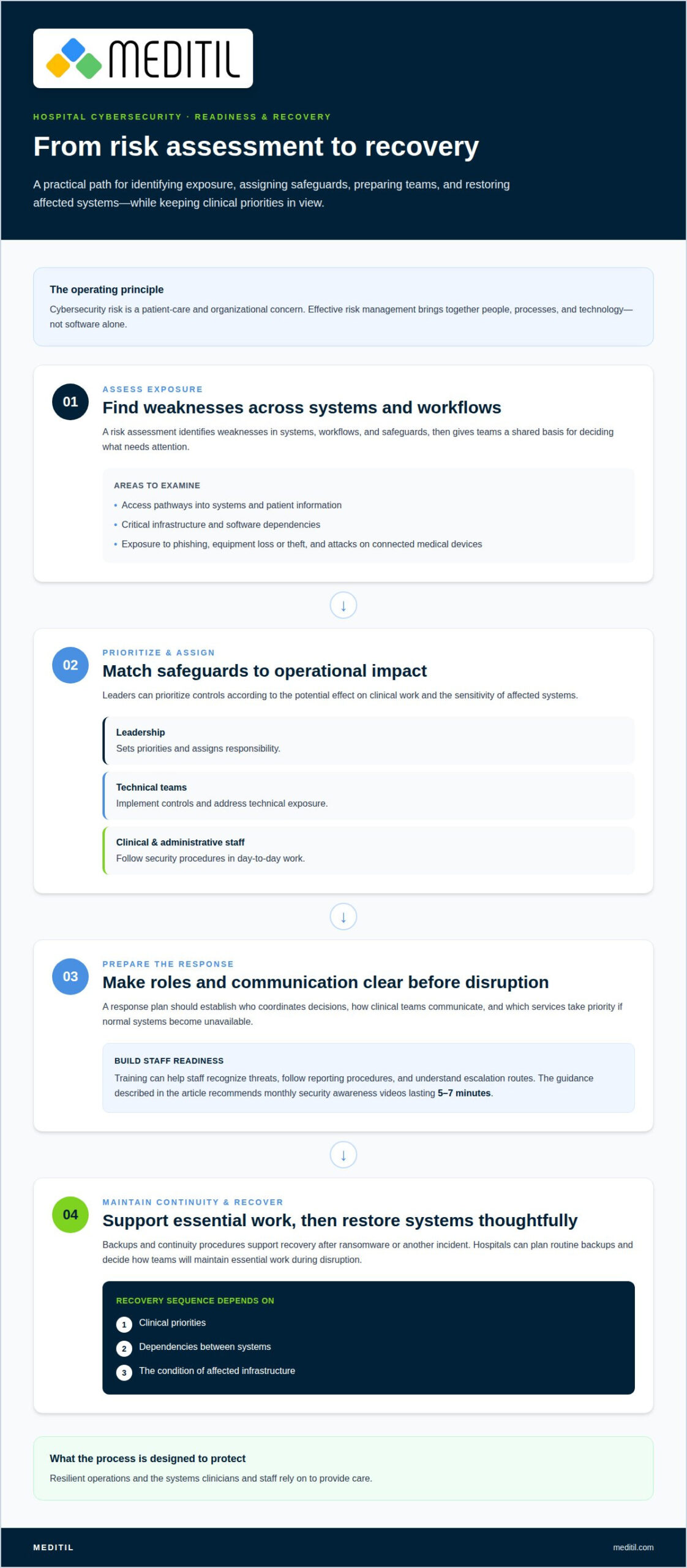
A cybersecurity risk assessment identifies weaknesses in systems, workflows, and safeguards, then helps determine which controls need attention. For hospital leaders, this connects technical exposure to patient-care operations and organizational priorities. Assessing access pathways, critical infrastructure, and software dependencies, for example, can reveal where an incident might disrupt clinical work. Leaders can then prioritize safeguards based on operational impact and the sensitivity of affected systems.
Effective risk management involves people, processes, and technology, not software alone. Leadership sets priorities and assigns responsibility, technical teams implement controls, and clinical and administrative staff follow security procedures. A documented assessment gives these groups a shared basis for deciding which risks to address first and tracking changes as systems and workflows evolve.
Cyberattack Readiness and Recovery
Cyberattack readiness and recovery bring together preparation, incident response, resilient operations, and restoration of affected systems. A response plan should define who coordinates decisions, how clinical teams communicate, and which services take priority during disruption. Clear roles reduce confusion when normal systems become unavailable, while recovery planning guides the return to routine patient care.
Backups and continuity procedures support recovery after ransomware or another incident. Hospitals can plan routine backups and decide how teams will maintain essential work if systems are disrupted. The appropriate recovery sequence depends on clinical priorities, system dependencies, and the condition of affected infrastructure.
Training helps staff recognize threats and follow reporting procedures. The guidance described in the research recommends monthly security awareness videos lasting 5-7 minutes. Leadership exercises and front-line training can clarify escalation routes before an incident. A focused cybersecurity risk assessment can help connect these priorities to hospital infrastructure.
Patient and clinician identity and access management
Identity and access management links each patient, clinician, administrator, and vendor to appropriate electronic health information. Clinician access should reflect job responsibilities, while patient-facing accounts need safeguards that protect sensitive records without obstructing legitimate use. Strong passwords of at least eight characters are one recommended safeguard; authentication controls and access reviews add further layers.
Third-party and SaaS vendors create additional access pathways. A vendor supporting a clinical application may need limited system access, but that connection can also introduce vulnerabilities. Hospitals can reduce exposure by identifying vendor connections, limiting permissions to necessary functions, and including third-party data exchanges in security policies. This helps organizations address supply-chain risks as systems and relationships evolve.
Building management systems also need deliberate protection. These systems may control facility functions, so safeguards should include strong access controls, secure communications, and network segmentation from other healthcare networks. For medical devices and IoT networks, professional providers assess device connections, known vulnerabilities, and operational dependencies, then apply layered protections where equipment cannot be patched readily.
How much do hospital network security services cost? Pricing depends on factors such as network scope, device inventory, integrations, and monitoring coverage; it is provided after a quote request.
Managed security service providers and managed detection and response services can support ongoing threat monitoring and incident handling. A provider can review alerts, investigate suspicious activity, and coordinate response steps with hospital teams. For ransomware or a network breach, response focuses on identifying affected systems, limiting further access, and supporting recovery under the organization’s incident plan. This connects detection to operational decisions rather than treating an alert as an isolated technical issue.
Data breaches and incident response planning
A breach response plan coordinates technical containment, clinical operations, investigation, and required notifications. Healthcare organizations need clear roles to assess and manage an attack involving protected health information without delaying essential decisions.
During an incident, the response team first confirms which systems and records may be affected. It then limits unauthorized access, preserves relevant logs, and records key decisions for investigation. Isolating an affected network segment, for example, can help contain an attack while teams assess its connection to clinical systems. Clinical and administrative leaders should coordinate these actions because technical containment can affect patient care.
Next, the organization determines whether protected health information was involved and which individuals may be affected. Teams need to identify the information, systems, and access pathways involved. A documented timeline helps incident responders and compliance leaders align their findings, prepare communications, and make notification decisions based on the breach facts.
Organizations should assess whether protected health information was involved and determine whether notifications are appropriate. A coordinated process assigns responsibility for assessing the incident, documenting findings, and preparing notifications. Healthcare organizations should include compliance and legal leadership in those decisions, while technical teams provide evidence about affected systems and records. The plan should also clarify how employees escalate suspected incidents and preserve information relevant to the investigation.
After containment, teams review how the attack entered, which safeguards failed, and what needs correction. That review can inform updates to access, monitoring, and response procedures, while a record of decisions supports organizational accountability. Get healthcare application support to strengthen the systems that support clinical workflows.
MEDITIL: Infrastructure & Network Services
MEDITIL supports healthcare organizations that need to strengthen network infrastructure, address cybersecurity priorities, or coordinate ongoing IT operations. Its Infrastructure & Network Services can align connectivity and systems with clinical workflows, while Cybersecurity & Compliance addresses security and compliance needs. Managed IT Services (Ongoing) and End-User Support & Help Desk can also provide continued operational support for staff and systems.
Consider this support when security planning identifies infrastructure gaps, network complexity, or a need for coordinated IT management. The right scope depends on your environment, operational priorities, and the systems your teams rely on. Contact MEDITIL to discuss your healthcare IT needs.
Make Security Planning an Ongoing Priority
Hospital cybersecurity is not a one-time project. As clinical workflows, systems, and vendor connections change, security planning needs to keep pace. Start by identifying which operational priorities need coordinated attention, then align technical work and leadership decisions around them. Hospital network security services can support this ongoing effort by connecting infrastructure, safeguards, and day-to-day IT operations.
MEDITIL provides Infrastructure & Network Services, Cybersecurity & Compliance, and Managed IT Services (Ongoing) for healthcare organizations. These capabilities can help address network needs alongside broader security and operational priorities, with the scope shaped around the organization’s environment.
Contact MEDITIL to discuss hospital security and consider how a structured approach can support your organization’s next stage of cybersecurity planning.
Frequently Asked Questions
What cybersecurity services do hospitals and health systems need?
Hospitals need security services that address clinical infrastructure, sensitive records, staff access, and incident response as connected priorities. When integrating a new patient portal, for example, assess identity controls, data exchanges, and monitoring together. Risk assessment, network protection, cybersecurity training, and recovery planning can help healthcare organizations identify gaps and coordinate safeguards across clinical and administrative operations.
What are the best hospital network security providers in the United States?
The right provider is one whose capabilities match a hospital’s infrastructure, clinical workflows, and security priorities. Relevant criteria include healthcare-sector experience, cybersecurity and compliance support, network services, and the ability to coordinate with internal IT teams. MEDITIL provides tailored, HIPAA-compliant healthcare IT solutions, including Infrastructure & Network Services and Cybersecurity & Compliance, for organizations seeking a healthcare-focused partner.
What are the HIPAA Security Rule requirements for hospital network security?
The HIPAA Security Rule requirements for electronic protected health information are set forth in 45 CFR Part 160 and Part 164, Subparts A and C. For network planning, hospitals should connect their security risk assessment to safeguards for electronic records, systems, and access pathways. For example, teams can document which applications handle ePHI and assign responsibility for reviewing risks and related controls.
What network segmentation and zero-trust practices work best for hospitals?
Effective segmentation separates network areas by function and risk, limiting unnecessary connections between systems. Building management systems, for example, should be segmented from other healthcare networks, with strong access controls and secure communications. A zero-trust approach restricts lateral movement by allowing systems to communicate only when a rule permits it, helping contain an issue within one network area.
How should hospitals evaluate and compare managed security service providers?
Hospitals should assess how a managed security service provider’s scope fits their environment and operating needs. Review how the service handles risk assessment, alert investigation, incident coordination, vendor connections, and communication with clinical leadership. A useful comparison also considers how the provider documents its work and aligns security activity with existing IT operations, rather than treating monitoring as an isolated capability.
How can a hospital network security provider help improve a hospital’s network security?
A provider of hospital network security services can assess infrastructure, identify vulnerabilities, and help prioritize controls around operational risk. For example, it can map network dependencies for a clinical application and coordinate protection with the hospital’s IT team. MEDITIL provides HIPAA-compliant healthcare IT support through Infrastructure & Network Services, Cybersecurity & Compliance, and ongoing managed IT services. Contact MEDITIL to discuss your organization’s network security needs.