
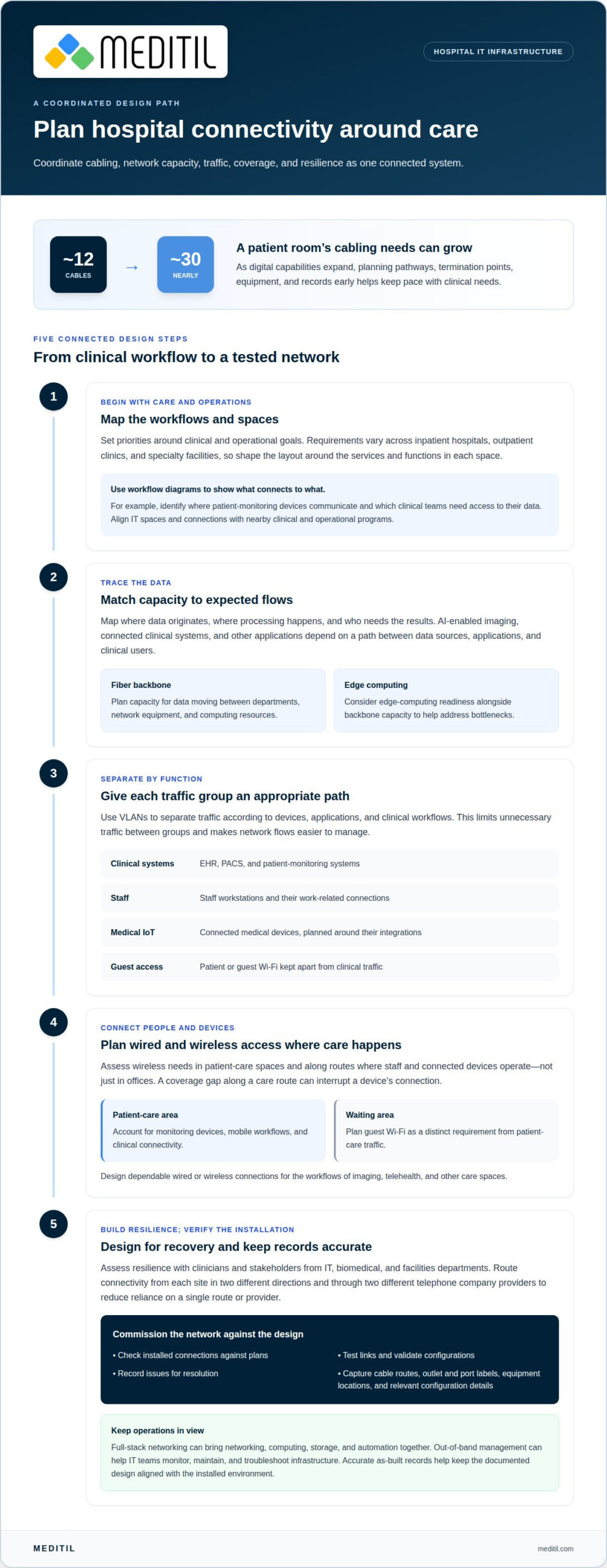
A hospital network can be constrained before its first device connects. Hospital IT infrastructure design should coordinate cabling and networking from the outset. A patient room’s cabling needs may grow from about a dozen cables to nearly thirty as digital capabilities expand. Planning both together helps align connectivity with clinical workflows, equipment, and future capacity.
Cabling and networking are interdependent parts of reliable hospital infrastructure. Decisions about one affect how the other supports care delivery. This article explains how traffic segmentation, network capacity, wireless coverage, and resilience fit into the design.
Early planning matters. Clinical and operational goals shape infrastructure decisions, while anticipating technology changes helps teams plan for future needs. Professional planning and network services can help a healthcare facility turn those requirements into a coordinated design.
Key Takeaways
- Plan cabling and networking as connected systems, and use commissioning and accurate as-built records to support ongoing operations.
- Separate clinical, staff, guest, and medical IoT traffic according to workflows and integration needs.
- Align fiber capacity, wireless coverage, and edge-compute readiness with expected data flows to help limit bottlenecks.
- Set infrastructure priorities early around clinical and operational goals; MEDITIL’s Infrastructure & Network Services can support healthcare facilities with that work.
Do you handle cabling and networking in healthcare?
Yes. Healthcare cabling and networking need coordinated design because each connection serves a clinical or operational purpose. A patient room’s cabling needs may grow from about a dozen cables to nearly thirty as digital capabilities increase. That growth affects pathways, termination points, network equipment, and documentation. Planning these elements together connects patient-care spaces, staff work areas, and technology rooms without treating cabling as an afterthought.
Network commissioning turns the design into a tested, documented system. It includes checking installed connections against plans, testing links, validating network configurations, and recording issues for resolution. As-built documentation captures what was actually installed, including cable routes, outlet and port labels, equipment locations, and relevant configuration details. A clearly labeled connection, for example, helps staff trace a patient-room outlet to its network destination when troubleshooting. Accurate records also support later changes and maintenance.
Resilience is another essential design consideration. Healthcare facilities should assess it with clinicians and stakeholders from IT, biomedical, and facilities departments. Network connectivity from each site should be routed in two different directions and through two different telephone company providers. Separate paths help reduce reliance on a single route or provider. Resilience engineering can help healthcare organizations prepare for and recover from disruptions such as demand surges, cyberattacks, and network failures.
Segmentation of clinical, staff, guest, and medical IoT traffic
Hospital network design varies by facility size and care setting because clinical workflows, connected devices, and operational priorities differ. Inpatient hospitals, outpatient clinics, and specialty facilities need network layouts shaped around the services provided in each space.
Core components include structured cabling, network equipment, wired and wireless access, and traffic segmentation. Workflow diagrams show how these components connect clinical systems, staff workstations, guest Wi-Fi, and medical IoT devices. For example, a diagram can identify where patient-monitoring devices communicate and which clinical teams need access to their data.
Clinical network architecture uses VLANs to separate traffic by function. EHR, PACS, and patient-monitoring systems can be isolated from staff workstations, medical IoT devices, and patient or guest Wi-Fi. This limits unnecessary traffic between device groups and makes network flows easier to manage. VLAN plans should reflect the devices, applications, and connections used in each clinical workflow, rather than placing every function on one network.
EHRs, imaging, telehealth, and medical devices need integrated connectivity designed around care delivery. Imaging systems, for example, need a path for clinical image access, while telehealth spaces need dependable wired or wireless connections suited to their workflows. Segmentation gives these systems appropriate network paths without mixing guest access with clinical traffic.
Good wired and wireless planning starts with clinical workflow and space planning. IT spaces should align with clinical and operational programs, so network equipment and connections support the functions nearby. A patient-care area with monitoring devices has different connectivity needs from a waiting area offering guest Wi-Fi. Workflow diagrams also reveal where devices move between spaces and where wireless coverage is important. Healthcare network planning can bring these requirements into one coordinated design.
AI data flows, fiber backbone capacity, and wireless coverage
AI-enabled care places new demands on the connections that carry clinical data. Planning should align fiber capacity, wireless coverage, and edge computing with how the facility delivers patient care.
An AI application analyzing imaging data, for example, depends on a path from the data source to the application and back to clinical users. Bottlenecks can arise when data flows exceed available network capacity or travel farther than necessary. Mapping where data originates, where processing happens, and who needs the results helps identify infrastructure requirements before deployment.
Fiber Backbone Capacity
Fiber backbone capacity is the ability of a facility’s central fiber network to carry data between departments, network equipment, and computing resources. Facilities planning for AI-enabled care should consider this capacity alongside edge-computing readiness. Imaging applications and connected clinical systems can create substantial data flows; insufficient backbone capacity can constrain them and contribute to bottlenecks. Capacity planning should account for the applications and data paths expected across the facility.
Wireless Coverage
Wireless coverage means having a usable network connection throughout the spaces where staff and connected devices operate. It matters because clinical workflows can involve moving between patient-care areas, and mobile devices need connectivity wherever those tasks occur. Assess wireless needs in the spaces where care takes place, not just in offices. For example, a coverage gap along a care route can interrupt a device’s connection as staff move between rooms.
Edge computing places applications closer to medical data sources, which can reduce latency and security risks. A design can locate processing near the source, then use the fiber backbone to carry data to other facility systems that need it. The location of data, applications, and users is therefore an important part of network planning.
Map each AI use case from data capture through processing to clinical use. This helps determine where wireless access is needed, where fiber carries traffic, and whether edge computing can reduce unnecessary distance. Aligning these elements supports data flow while helping limit avoidable delays and network bottlenecks.
Early planning for healthcare technology infrastructure
Start with the facility’s clinical and operational purpose, then align technology planning with those goals. Early hospital IT infrastructure design helps teams prepare for changing services and technologies.
Data Center, Cloud, and Hybrid Options
Healthcare data center, cloud, and hybrid options describe where infrastructure and services operate: within a facility, in cloud environments, or across both. The choice affects how an organization supports clinical and operational requirements. A technology master plan should connect the selected approach to health system goals, operational criticality, redundancy needs, and realistic technology lifecycles. These factors help teams assess infrastructure needs without assuming one model fits every facility.
Hospital IT Costs and Budget Factors
Hospital IT infrastructure costs are project expenses shaped by scope, facility needs, and planned systems. Costs depend on the case and are provided after a quote request. Key budget factors include operational criticality, redundancy requirements, technology lifecycles, and infrastructure needs tied to the facility’s clinical purpose. Considering these factors early helps teams account for trade-offs and establish project priorities.
A hospital IT infrastructure design should reflect clinical leadership’s vision for the next 10 years and align with health system goals. Facilities, IT, design, and clinical teams should coordinate early to identify trade-offs and required redundancies. According to the Facility Guidelines Institute’s 2022 guidelines, technology spaces should be adequate for the service requirements of their equipment, rather than follow fixed dimensions.
Before construction, project teams can test workflows and validate design assumptions through simulation, mock-ups, or pilot areas. A mock-up, for example, can reveal whether a proposed technology space can support the equipment and services planned for it. Sizing infrastructure around operational criticality, redundancy, and realistic lifecycles gives teams a clear basis for planning as technologies change.
For support aligning infrastructure planning with clinical and operational goals, discuss healthcare infrastructure planning.
MEDITIL: Infrastructure & Network Services
MEDITIL supports healthcare organizations planning, improving, or managing cabling and network infrastructure. Its Infrastructure & Network Services address connectivity and infrastructure needs, while ongoing Managed IT Services support continuing operations.
Turn to MEDITIL when network design, cybersecurity, or user support needs to work within a coordinated healthcare IT environment. Cybersecurity & Compliance and End-User Support & Help Desk can address related operational needs alongside infrastructure planning.
Contact MEDITIL to discuss your healthcare infrastructure requirements.
Carry infrastructure planning into ongoing operations
Connect design decisions to clear ownership: who maintains the network, manages changes, and addresses operational risks as services evolve. That accountability keeps hospital IT infrastructure design useful beyond construction and commissioning, particularly as clinical priorities shift. A clear handoff also brings technical decisions into routine service management.
MEDITIL supports healthcare organizations with Infrastructure & Network Services, ongoing Managed IT Services, and Cybersecurity & Compliance. These services can align infrastructure operations, ongoing support, and security considerations in a healthcare IT environment. The right starting point depends on whether the immediate need is a network project, operational support, or a coordinated approach across these areas.
Bring your facility’s priorities and infrastructure challenges into the conversation to identify a practical next step. Contact MEDITIL about hospital IT to discuss your needs and move forward with a clearer plan.
Frequently Asked Questions
Do you install network infrastructure in active hospitals?
Yes. MEDITIL provides Infrastructure & Network Services, including network design and implementation. In an operating hospital, installation planning should account for clinical schedules, access restrictions, affected departments, and how teams will communicate changes. For example, a network cutover affecting a treatment area needs coordination with the people who rely on its systems. The project plan should define work boundaries and escalation contacts.
What is HIPAA-aware network segmentation?
HIPAA-aware network segmentation organizes network access to support an organization’s privacy and security responsibilities. It separates systems and users by role and operational need, rather than treating every connection alike. For example, a billing workstation, a clinical application, and a guest device can have distinct access paths. The segmentation plan should align with data flows and the organization’s security controls.
Which network platforms do you install for healthcare?
Choose network platforms according to the facility’s connectivity, integration, and support requirements. MEDITIL provides network design and implementation for healthcare environments, including LAN, WAN, and Wi-Fi design. The appropriate components depend on how clinical systems connect, where staff need access, and how the organization manages its infrastructure. Platform decisions should also account for interoperability and the expertise available to maintain the environment.
What network architecture and bandwidth do hospitals need for clinical systems?
Hospitals need architecture and capacity plans matched to their clinical applications, connected users, and data flows. Bandwidth requirements vary with the systems in use and how they exchange information; imaging workflows, for example, move different data than routine staff communications. Design should assess expected concurrent demand, application dependencies, and traffic paths, then evaluate capacity where systems connect or share network resources.
What cybersecurity requirements and best practices apply to U.S. hospital IT infrastructure?
U.S. hospitals should align infrastructure security with their compliance responsibilities and clinical operations. Practical safeguards include restricting access by role, maintaining supported systems, monitoring for unusual activity, and planning recovery processes. For example, a hospital can define which teams manage network changes and how incidents are escalated. MEDITIL’s Cybersecurity & Compliance services support healthcare organizations as they address security and compliance needs.
What HIPAA, HITECH, and other regulations affect hospital IT infrastructure design?
HIPAA, HITECH, and other applicable requirements should inform infrastructure decisions, but obligations depend on an organization’s role, data, and operations. Design teams can work with compliance and legal stakeholders to map those obligations to access controls, data handling, auditability, and recovery planning. This connects technical decisions to the organization’s compliance program without assuming every facility has identical requirements.