
A HIPAA-compliant phone system depends on how it handles protected health information, not simply on a “secure” label. HIPAA compliant VoIP for healthcare should include appropriate safeguards for calls and related communications, as well as a Business Associate Agreement when the provider routinely accesses electronic protected health information. The healthcare organization must also consider how the system is configured and used.
A phone system should support clear, reliable communication without exposing patient information. This article explains when a Business Associate Agreement is needed, which security measures to consider, and how voicemail, messaging, and internet fax fit into the picture. It also explores how VoIP can support healthcare teams across locations while keeping privacy and security in view.
Key Takeaways
- Determine whether your VoIP provider routinely accesses electronic protected health information to understand when a Business Associate Agreement is needed.
- Assess safeguards such as access controls, encryption, audit logs, and contingency planning as part of the system’s overall security.
- Consider how calls, voicemail, messaging, and internet fax may handle patient information across your team’s communication workflows.
- Connect phone-system decisions with broader healthcare IT, infrastructure, and cybersecurity needs for a more coordinated approach.
Do I need a business associate agreement with my VoIP provider?
A Business Associate Agreement may be needed when a VoIP provider routinely accesses electronic protected health information. The key consideration is the provider’s role in handling patient information, not simply the phone system’s connection to the internet.
Business Associate Agreement Basics
A Business Associate Agreement is a written agreement that sets out a business associate’s responsibilities for protecting protected health information. It matters because a covered healthcare organization needs clear terms for how an associate handles information while supporting patient care. HIPAA business associate requirements are cited at 45 CFR 164.308(b) and 45 CFR 164.502(e). The agreement helps define the parties’ responsibilities rather than treating a technology relationship as outside privacy and security obligations.
VoIP Providers as Business Associates
A VoIP provider may be a business associate if its service routinely gives it access to electronic protected health information. For example, support staff might access call records or voicemail while maintaining the phone system. In that case, the agreement should address protection of the information and the provider’s HIPAA responsibilities. Using internet-based technology alone does not establish the provider’s role; routine access to electronic protected health information is the relevant consideration.
Consider how the system works in practice. A clinic might use voicemail for appointment messages, while technical support may access system records during troubleshooting. Map these information flows and identify which vendor functions involve protected health information. This helps the covered organization determine whether a Business Associate Agreement is needed and which activities it should address.
Keep the agreement and related compliance records organized for review. In most cases, HIPAA documentation requests must be fulfilled within 30 days, according to the U.S. Department of Health and Human Services, Office for Civil Rights. HIPAA sanctions documentation and records must be stored for at least 6 years, according to the U.S. Department of Health and Human Services, Office for Civil Rights.
Timely corrective action matters, too. HIPAA’s willful-neglect penalty tier applies when violations are not corrected within 30 days, according to the U.S. Department of Health and Human Services. An agreement does not replace the organization’s responsibility to manage its own safeguards and records.
What should you expect from a HIPAA compliant VoIP provider?
Choosing HIPAA compliant VoIP for healthcare means evaluating the provider’s safeguards, service responsibilities, and fit with your workflows.
Security Rule and Electronic Health Information
The HIPAA Security Rule protects electronic protected health information maintained or transmitted electronically. It applies to VoIP communications handling this information, so healthcare providers should assess both transmission and storage. The rule is codified at 45 CFR Parts 160 and 164, Subpart C. Consider providers whose services include safeguards suited to your information flows and responsibilities, rather than relying on a general security claim.
Privacy, Security, and Breach Notifications
The Privacy Rule, Security Rule, and Breach Notification Rule address different aspects of protecting patient information. Privacy governs permitted use and disclosure, while security safeguards electronic information against unauthorized access. The Breach Notification Rule helps assess impermissible use or disclosure. For breaches affecting fewer than 500 individuals, the U.S. Department of Health and Human Services, Office for Civil Rights describes an annual breach report. A noncompliant service can expose an organization to enforcement, corrective requirements, and penalties.
Safeguards and Risk Management
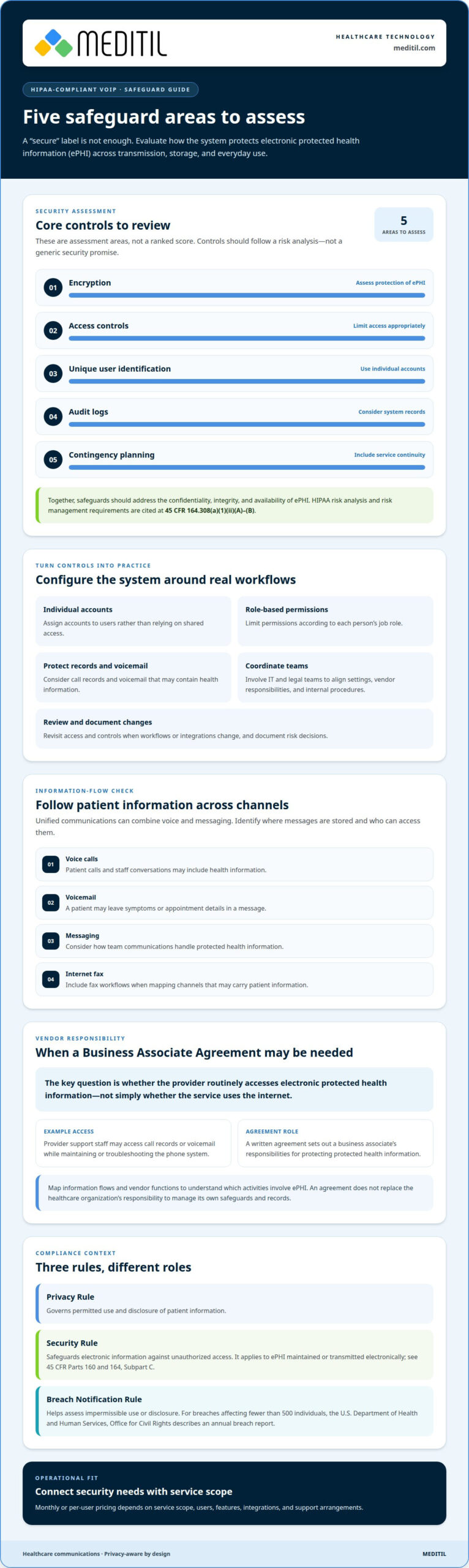
Security controls should follow a risk analysis, not a generic promise. HIPAA risk analysis and risk management requirements are cited at 45 CFR 164.308(a)(1)(ii)(A)-(B). Assess encryption, access controls, unique user identification, audit logs, and contingency planning. The provider’s safeguards should address confidentiality, integrity, and availability. Monthly or per-user pricing depends on service scope, users, features, integrations, and support arrangements. For teams implementing HIPAA compliant VoIP for healthcare, these factors help connect security requirements with operational needs.
Phone System Compliance and Configuration
Configuration puts safeguards into practice across everyday healthcare workflows. Assign individual accounts, limit permissions by job role, and protect call records and voicemail that contain health information. Involve IT and legal teams to align settings, vendor responsibilities, and internal procedures. Review access and controls when workflows or integrations change, and document risk decisions. Providers that routinely access electronic protected health information may act as business associates, so the relationship and agreement should reflect their role. Using a service without appropriate safeguards can expose patient information and create compliance risks.
VoIP communication channels covered by HIPAA
VoIP converts audio into a digital signal sent over the internet, while traditional phones use circuit-switched service through the Public Switched Telephone Network. Unified communications platforms can combine voice and messaging, so healthcare teams should consider every channel that handles protected health information.
Voice Communications for Patients and Teams
VoIP communications include patient calls, staff conversations, and voicemail that may contain health information. A patient might leave symptoms in a voicemail, for example, or a care team might discuss an appointment during a call. Covered entities should identify where these messages are stored and who can access them. Remote and on-site team members can use VoIP tools to collaborate, but access controls and secure handling remain essential.
Text, Fax, and Unified Communications
SMS, internet fax, and voicemail can carry protected information just as spoken calls can. A text with an appointment detail, a fax containing a medical record, or a voicemail with patient information creates a channel that needs protection. Unified communications can simplify team workflows by combining channels in one system, but can also concentrate access and records. Map how information moves between each tool, user, and destination.
Patient Communication Channels
Patient communication channels include calls, messages, voicemail, and internet fax when they contain protected health information. A reminder that identifies a patient or a fax containing a medical record needs appropriate safeguards during transmission and storage. Define which channels staff may use for each type of communication, then align access permissions with job responsibilities. This helps teams avoid putting sensitive details in a channel without suitable protection.
Safeguards and Traditional Phone Comparisons
Traditional phones carry voice through the Public Switched Telephone Network, while VoIP sends audio over the internet. Neither label alone determines whether communications are appropriately protected. Safeguards for VoIP calls, call logs, voicemail, SMS, and internet fax should address encryption, access, and information sharing. Unique user identities and audit logs can help track system activity. Review the full workflow, including storage and vendor access, rather than assessing voice calls alone.
Benefits of HIPAA-compliant VoIP
HIPAA compliant VoIP for healthcare can bring calls and team coordination into an internet-based communications workflow. Healthcare professionals working on-site or remotely can use VoIP tools to coordinate handoffs, discuss scheduling, and connect staff across locations. A shared communication approach can suit varied clinical workflows, provided the selected channels and configurations support the organization’s privacy and operational needs.
A thoughtfully configured phone system makes security part of routine communication. When calls or messages involve protected health information, safeguards should match how staff use the system and where information is stored. A risk-based approach helps covered entities identify relevant workflows, set appropriate access, and review how communications are handled. For example, staff permissions can reflect job responsibilities, while audit logs help document system activity for internal review.
VoIP can streamline coordination when teams use several communication channels. Staff might call to discuss a complex issue, then send a brief message about a follow-up task. Bringing these workflows together can reduce the need to switch between separate tools. In high-volume settings like patient outreach or scheduling departments, specialized platforms such as DialGame.AI illustrate how call center operating systems focus on dialing productivity and agent engagement. Clear internal procedures still matter: healthcare professionals need to know which channel suits each exchange and how much patient information to include. A connected system works best when convenience and privacy are planned together.
HIPAA compliant VoIP for healthcare can also offer an alternative to traditional phone lines, which VoIP systems typically cost less than. Cost alone, however, does not determine whether a system fits. Consider communications workflows, security needs, and how the phone system integrates with the wider healthcare environment. To align communications safeguards with broader security priorities, explore Cybersecurity & Compliance support.
MEDITIL: Healthcare Application Support
MEDITIL provides Healthcare Application Support for healthcare teams managing communication technology alongside clinical applications. If VoIP planning raises questions about security, infrastructure, or how systems fit together, MEDITIL can help with those broader IT needs.
Managed IT Services, Infrastructure & Network Services, and Cybersecurity & Compliance can support organizations reviewing their technology environment and security priorities. These services are a natural next step when phone-system decisions need to align with ongoing IT operations, network infrastructure, or compliance work. The focus is on the wider healthcare IT environment, rather than treating a phone platform alone as a complete compliance solution.
Contact MEDITIL to discuss your healthcare application support and related IT needs.
Build your next communications decision on a clear plan
Connect phone-system decisions with the broader needs of your healthcare environment. A HIPAA compliant VoIP approach for healthcare should fit how your organization manages technology, supports staff, and protects patient information. Treat the system as part of an evolving infrastructure, and review its configuration and operational needs as workflows change.
MEDITIL supports this work through Managed IT Services, Infrastructure & Network Services, and Cybersecurity & Compliance. These services address ongoing IT operations, network considerations, and security priorities around healthcare communications. The right starting point depends on your team’s challenge, whether it is aligning systems, strengthening safeguards, or planning ongoing support.
Use the next conversation to define the operational goal and the IT context around it. Contact MEDITIL to discuss your needs, and take a considered step toward communications that fit your organization’s priorities.
Frequently Asked Questions
What is a HIPAA compliant phone system?
It is a phone system configured and operated to protect patient information handled through its communications. Compliance depends on the safeguards around the system, including user access, data handling, and how the organization applies its policies. For example, a clinic should consider whether staff can access patient-related call information only as needed for their roles. A “compliant” label alone does not explain these operational controls.
How do I ensure HIPAA compliant communications?
Set communication procedures that limit patient information to what each exchange needs, and apply identity checks before disclosing it. HIPAA’s minimum necessary standard is cited at §164.502(b) and §164.512(d), and identity verification requirements at 45 CFR 164.514(h). For example, staff can verify a caller’s identity before discussing a patient’s information and avoid including unnecessary clinical details in a message.
VoIP and HIPAA: where do they intersect?
They intersect when voice communications involve protected health information maintained or transmitted electronically. HIPAA’s Security Rule applies to electronic protected health information, so the relevant question is how the healthcare organization and its vendors handle that information. An appointment call may be routine, but a message containing a patient’s care details calls for appropriate protection throughout the communication workflow.
What is VoIP?
VoIP, or Voice over Internet Protocol, converts audio into a digital signal and transmits it over the internet. It enables voice calls through an internet connection rather than traditional circuit-switched telephone service. For healthcare teams, this means calls use digital communication infrastructure. Whether a particular call involves protected health information depends on what participants communicate, not simply on the technology carrying the audio.
What makes a VoIP system HIPAA compliant for healthcare providers?
Appropriate safeguards, organizational policies, and secure configuration work together to protect electronic health information. Providers can assign unique user identities, restrict permissions by job responsibility, and maintain records that help trace system access. They should also account for continuity planning, including backup and recovery arrangements. These controls need to fit actual workflows, such as staff access to patient-related call records.
Do HIPAA rules require a business associate agreement with a VoIP provider?
A Business Associate Agreement is generally needed when a VoIP provider’s work involves routine access to electronic protected health information. A provider may meet that condition through service functions that expose patient information, rather than merely supplying internet-based calling. HIPAA business associate requirements are cited at 45 CFR 164.308(b) and 45 CFR 164.502(e). The organization’s assessment should focus on the provider’s actual role and access.