
A HIPAA audit preparation checklist for 2026 should help your organization show how it protects health information, assesses and addresses security risks, and monitors access to systems. A complete review also covers business associate responsibilities, asset inventories, audit logs, and the evidence that safeguards are operating.
Audit readiness is not just a folder of policies assembled when a review is announced. It depends on whether documentation reflects the systems, vendors, and day-to-day practices that handle protected health information. This guide explains what to include and how the pieces connect, from risk analysis and inventory records to activity reviews and ongoing monitoring.
Use these practical checklist items to review business associate agreements, keep risk and asset records current, and organize logs and monitoring processes. A clear, usable structure helps your team identify gaps and prepare evidence, giving you a consistent view of your security program before an audit.
Key Takeaways
- Review business associate agreements and clarify how subcontractors protect health information and report breaches.
- Use risk analysis and a current asset inventory to identify where electronic protected health information is stored, accessed, and exposed.
- Organize audit evidence across the Privacy, Security, and Breach Notification Rules so key policies and processes are easier to demonstrate.
- Make audit logs, system activity reviews, and ongoing monitoring part of a repeatable security process, not a one-time audit task.
Why are business associates required to comply with the Privacy Rule?
Business associates may create, receive, maintain, or transmit protected health information for covered entities. Their access means privacy safeguards must extend beyond the healthcare organization’s own workforce. The Privacy Rule applicability standard was amended through the Final Omnibus Rule in 2013 to apply its standards, requirements, and implementation specifications to business associates where provided.
A Business Associate Agreement (BAA) documents the relationship and sets expectations for handling protected health information. Include these checks in vendor oversight:
- Keep an executed BAA for each business associate. The agreement records applicable privacy and security conditions for the work.
- Review and update agreements annually. This step helps account for changed services, systems, or data access.
- Extend applicable restrictions to subcontractors. Business associates must ensure subcontractors handling protected health information agree to the same applicable restrictions and conditions.
Set a clear breach-reporting process in each agreement. According to the U.S. Department of Health and Human Services, Office for Civil Rights, business associates must notify covered entities of breaches as specified in their agreements or within 60 days of discovery. Record the discovery date, notification steps, and relevant communications so the response can be followed during an audit.
Retain BAA records and related compliance documentation in an organized, accessible system. HIPAA documentation retention runs from the document’s creation date or its last-effective date, whichever is later. The U.S. Department of Health and Human Services, Office for Civil Rights, states that HIPAA security management documentation must be stored for at least 6 years. Keep version history so reviewers can distinguish current agreements from superseded records.
Vendor oversight should connect contract terms with actual safeguards. Document which systems a business associate can access, what protected health information it handles, and how access is managed. Record evidence of administrative, physical, and technical safeguards, including applicable encryption practices. If a vendor’s role changes, update the BAA and related records to reflect new services or information flows. This creates a traceable link between the agreement, vendor activity, and your compliance records.
Security Rule risk analysis and asset inventories
A HIPAA compliance audit or risk assessment has no single standard price in the United States. The cost depends on the organization’s systems, vendors, data flows, and assessment scope; service pricing is provided after a quote request and depends on those project factors.
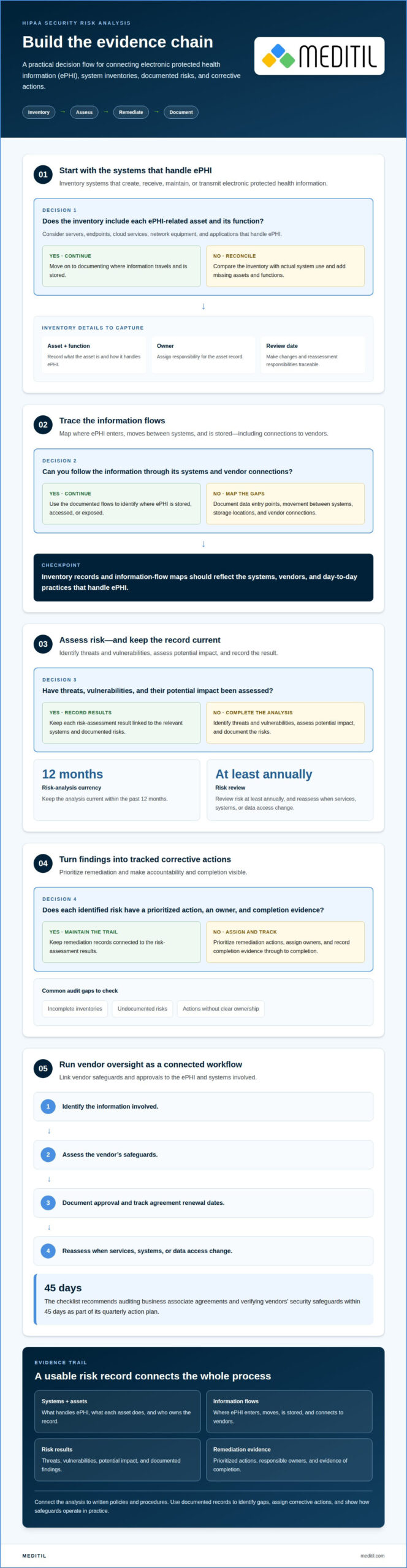
To conduct and document a HIPAA security risk analysis, first inventory systems that create, receive, maintain, or transmit electronic protected health information. Then identify threats and vulnerabilities, assess their potential impact, and record prioritized remediation actions, owners, and completion evidence. Keep the analysis current within the past 12 months and connect it to written policies and procedures.
- Record each asset and its function. Include servers, endpoints, cloud services, network equipment, and applications handling electronic protected health information.
- Map information flows. Document where data enters, moves between systems, and is stored, including vendor connections.
- Assign an owner and review date. This makes asset changes and reassessment responsibilities traceable.
Common audit gaps include incomplete inventories, undocumented risks, and remediation actions without clear ownership. Reconcile the inventory with actual system use, record each risk-assessment result, and track corrective actions through completion. A gap analysis can compare existing safeguards with documented risks and show where policies, procedures, or technical controls need updating.
Vendor approval should follow a repeatable workflow: identify the information involved, assess the vendor’s safeguards, document approval, and track agreement renewal dates. The checklist recommends auditing business associate agreements and verifying vendors’ security safeguards within 45 days as part of its quarterly action plan. Schedule reassessment when services, systems, or data access change, and review risk at least annually.
For organizations that need help coordinating the analysis, inventory, and corrective-action process, Cybersecurity & Compliance support can help align those activities with ongoing IT operations.
There is no fixed cost; pricing is determined by the organization’s systems, vendors, data flows, and assessment scope after a quote request.
What is a HIPAA Audit Checklist?
A HIPAA audit preparation checklist 2026 organizes evidence that an organization follows the Privacy, Security, and Breach Notification Rules. It connects written policies with safeguards, system access, workforce practices, incident handling, and supporting records. Use the checklist to identify gaps, assign corrective actions, and prepare clear evidence for an audit review.
Healthcare organizations—from large hospital networks to specialized clinical practices like thechirocentre.com—should maintain risk-analysis records, remediation plans, security policies, and procedures for reviewing system activity. The proposed Security Rule update is not final and is not a present legal requirement. Covered entities and business associates can prepare for an OCR audit by organizing documentation, assigning responsible staff, and demonstrating how safeguards operate in practice.
Test readiness with a documented exercise. Sample workforce training records, review access permissions, confirm backup integrity, and walk through incident-response steps. Record findings, action owners, and the evidence that will demonstrate completion. These checks help connect written controls to actual operations.
Breach assessment determines whether an impermissible use or disclosure requires notification under the Breach Notification Rule. The U.S. Department of Health and Human Services, Office for Civil Rights, states that covered entities must notify affected individuals without unreasonable delay and no later than 60 days after discovery. For a breach affecting 500 or more individuals, the U.S. Department of Health and Human Services, Office for Civil Rights, requires notification to the HHS Secretary without unreasonable delay and no later than 60 days after discovery. For breaches affecting fewer than 500 people, the U.S. Department of Health and Human Services, Office for Civil Rights, states that reporting to HHS is due within 60 days of the end of the year. The U.S. Department of Health and Human Services, Office for Civil Rights, also requires media notification for breaches affecting 500 or more individuals in a jurisdiction.
Use a HIPAA audit preparation checklist 2026 to connect incident timelines, assessments, decisions, notifications, and response actions in traceable records. Map each requirement to its evidence, responsible role, review date, and follow-up action. This structure helps covered entities and business associates explain their safeguards and response processes during an audit, whether managing a broad healthcare system or a specialized clinical practice like Ankle & Foot Centers, PC.
Audit logs, system audits, and continuous monitoring
Audit logs show who accessed systems, what actions occurred, and when activity took place. HIPAA requires covered entities to review information system activity, including audit logs, under 45 CFR § 164.308(a)(1)(ii)(D). Define a review process that records the reviewer, review date, exceptions found, and follow-up actions. This documentation helps connect technical controls with accountable oversight.
Use a consistent review sequence so unusual activity receives attention:
- Review PHI access logs quarterly. Look for unexpected access, unusual patterns, and activity that conflicts with assigned roles.
- Record findings and actions. Document the issue, responsible owner, resolution, and evidence supporting closure.
- Include vendor activity. Review vendor agreements and policy adherence quarterly, then retain the records with related oversight documentation.
Connect system alerts to a defined incident-response workflow. For example, an alert about unusual patient-record access should prompt review, documentation, escalation, and an assessment of whether breach-notification procedures apply. Test the workflow with a documented scenario, noting who receives the alert and how the response is recorded. A business associate agreement should also set clear expectations for vendor reporting and coordination.
MEDITIL helps healthcare organizations connect audit preparation with the IT systems and security practices that support daily operations. When asset records, access controls, monitoring, or remediation need coordinated attention, its Managed IT Services and Cybersecurity & Compliance offerings support ongoing IT management and compliance work.
For 2026 audit readiness, prioritize privileged access management, multifactor authentication, vulnerability management, backup integrity, system recovery testing, and incident response coordination. Integrated systems can make monitoring more consistent across connected applications. Coordinate systems integration and monitoring to improve visibility across those workflows.
MEDITIL
Infrastructure & Network Services can help address the systems and connections included in your risk analysis, while End-User Support & Help Desk can support consistent user-access practices. This support is useful when audit preparation reveals operational gaps or when maintaining security documentation and controls requires sustained coordination.
Infrastructure & Network Services can help address the systems and connections included in an organization’s risk analysis, while End-User Support & Help Desk can support consistent user access practices. This support is useful when audit preparation reveals operational gaps or when maintaining security documentation and controls requires sustained coordination.
Contact MEDITIL to discuss support for your healthcare IT and compliance needs.
Turn audit preparation into an ongoing practice
A HIPAA audit preparation checklist for 2026 is most useful when it becomes part of routine operational planning. Treat each identified improvement as a managed work item: assign ownership, define what completion evidence looks like, and integrate follow-up into existing governance processes. This creates continuity between audit readiness and the decisions that shape healthcare technology over time.
MEDITIL can help healthcare organizations coordinate IT operations and compliance priorities as they plan those next steps. If you’re ready to discuss how to make audit preparation more actionable for your organization, contact MEDITIL about HIPAA audits.
A clear plan gives your team a practical way to move from identified needs to sustained work. Build on that foundation at a pace that fits your organization, and keep security and compliance considerations connected to day-to-day operations.
Frequently Asked Questions
How can healthcare organizations track BAA compliance effectively?
There is no single evidence packet for every business associate relationship. Organize executed agreements and amendments alongside vendor service descriptions, relevant safeguard evidence, subcontractor records, and incident communications. Keep an index showing where each record is stored and which relationship it supports. For example, a cloud vendor file should connect its agreement to the systems and information involved, making review more traceable.
What documentation is required for BAA audits?
PHI is health information that identifies an individual or could reasonably be linked to one in a healthcare context. Examples include a patient’s name paired with a diagnosis, appointment details tied to an identifiable person, or billing information linked to care. For audit preparation, examine information in documents, messages, databases, and reports, not just records labeled “patient file.” Context and identifiability matter.
What is considered PHI under HIPAA?
Build an evidence index that maps each reviewed practice to its supporting record. Include current policies, risk-analysis documentation, asset records, access-control evidence, activity-review records, incident procedures, and remediation tracking. Add dates, document owners, and version details so reviewers can distinguish active materials from outdated copies. A sample access review or completed corrective-action ticket can show how written procedures work in practice.
What documents and evidence should be included in a HIPAA audit preparation checklist?
Prepare evidence addressing privacy practices, protection of electronic health information, and breach response. For the Privacy Rule, organize workforce procedures for handling information and individual requests. For the Security Rule, connect safeguards to systems and assigned responsibilities. For breach notification, preserve incident assessments and response records. Evidence should show how policies are implemented, not simply that policy documents exist.
What are the HIPAA Privacy, Security, and Breach Notification Rule audit requirements?
Prepare evidence that addresses privacy practices, protection of electronic health information, and breach response. For the Privacy Rule, organize workforce procedures for handling information and individual requests. For the Security Rule, connect safeguards to systems and assigned responsibilities. For breach notification, preserve incident assessments and response records. The evidence should show how policies are implemented, not simply that policy documents exist.
What are the current HIPAA audit protocols and likely focus areas for 2026?
The OCR audit protocol covers 169 control measures across three categories. The current round of OCR audits focuses on selected Security Rule provisions considered most relevant to ransomware and hacking. Prepare by linking each applicable control to evidence, an accountable owner, and any corrective action. Give particular attention to access management, system activity review, recovery readiness, and incident coordination, while keeping the audit record organized.