
A medical device can be both a clinical tool and a network endpoint. Endpoint security for healthcare organizations protects connected computers, mobile devices, workstations, and medical equipment from unauthorized access and cyber threats. It combines device visibility, access controls, monitoring, and safeguards tailored to how each endpoint is used, including network protections for devices that cannot run security software directly.
Healthcare security must support patient care, not disrupt it. The challenge is applying consistent controls across varied environments while accounting for sensitive health information, device limitations, and compliance responsibilities. This article explains how centralized endpoint management helps organizations monitor and secure devices, why medical-device cybersecurity may require network-level protections, and how endpoint practices support HIPAA-related safeguards. It also covers how inventory, patching, access management, and incident response fit together, and how healthcare IT support can coordinate these efforts.
Key Takeaways
- Build an endpoint inventory that includes medical equipment, workstations, mobile devices, and other connected assets, then prioritize devices by their role and access to sensitive data.
- Centralized management can help apply consistent device policies, coordinate updates, and secure endpoints across different locations.
- For medical devices that can’t run endpoint security agents, network segmentation and monitoring can provide additional protection.
- Connect endpoint controls to HIPAA safeguards through access management, audit practices, and incident response planning, with healthcare IT support to coordinate the work.
What Is “Endpoint Security” and What Does It Mean for Medical Device Cybersecurity?
Endpoint security brings together inventory, access controls, monitoring, and threat response for computers, mobile devices, and connected clinical equipment. Unified management helps healthcare teams apply consistent protections while accounting for differences between electronic health record systems and medical devices.
Unified Management and Device Coverage
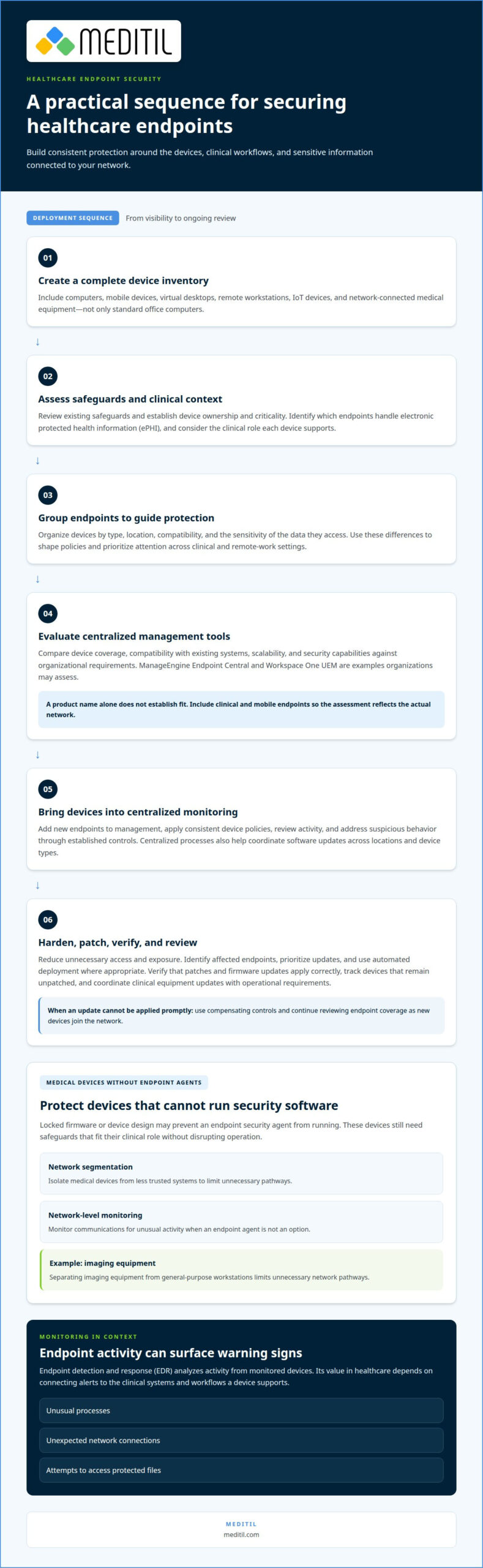
Unified endpoint management centrally controls and secures devices connected to a healthcare organization’s network. Its inventory may include computers, mobile devices, virtual desktops, remote workstations, IoT devices, and network-connected medical equipment. A unified approach helps teams apply consistent security policies instead of relying on separate tools for each device type. It also clarifies device ownership and criticality, including which endpoints handle electronic protected health information.
Protecting Records and Connected Devices
Endpoint security protects devices and access pathways used to view or handle electronic health records and medical-device data. Controls can, for example, limit sensitive patient records to authorized personnel and restrict which devices connect to clinical systems. Outdated medical-device software can leave known vulnerabilities unaddressed, while default passwords can provide attackers with an avoidable entry point. Tracking software status and replacing default credentials helps reduce these risks and support compliance.
Devices Without Endpoint Agents
Some connected medical devices cannot run endpoint agents because their firmware is locked or their design does not support additional software. They still need protection: network segmentation can isolate them from less trusted systems, while network-level monitoring can help detect unusual communications. For example, separating imaging equipment from general-purpose workstations limits unnecessary pathways. Security controls should reflect each device’s clinical role without disrupting its operation.
Healthcare Threats and Security Costs
Common threats include ransomware, phishing, stolen credentials, and unauthorized network access; attackers may use a compromised endpoint to reach records or connected devices. Endpoint security costs depend on device types and quantities, existing infrastructure, monitoring scope, and implementation and support needs. Providers set pricing according to the specific case and provide it after a quote request. Assessing those factors clarifies the resources needed to protect both clinical systems and patient information.
Centralized endpoint management
Centralized management coordinates endpoint configuration, monitoring, and security policies. It can cover clinical workstations, mobile devices, and remote-work endpoints.
Centralized Device Management
Unified endpoint management lets healthcare teams monitor, configure, and secure endpoints through centralized tools. This helps apply consistent practices across devices used in clinics and remote settings. Teams can promptly add new devices to management, review their activity, and address suspicious behavior through established controls. Centralized processes also make it easier to coordinate software updates instead of relying on separate device-by-device routines.
Endpoint Management Platforms
ManageEngine Endpoint Central and Workspace One UEM are examples of endpoint management platforms healthcare organizations may assess. A product name alone does not show whether a platform fits a particular environment. Compare device coverage, compatibility with existing systems, scalability, and security capabilities against organizational requirements. Include clinical and mobile endpoints so the assessment reflects the actual network, not just standard office computers.
Hardening and Patch Management
Hardening reduces unnecessary access and exposure, while patch management addresses known software vulnerabilities. A healthcare patching process should identify affected endpoints, prioritize updates, and use automated deployment where appropriate. Teams should verify that patches and firmware updates apply correctly, then track devices that remain unpatched. For clinical equipment, coordinate updates with operational requirements and use compensating controls when a patch cannot be applied promptly.
Choosing and Deploying a Solution
Deploying endpoint security across clinical and remote-work devices starts with an inventory and an assessment of existing safeguards. Group endpoints by device type, location, compatibility, and sensitivity of the data they access. Then evaluate management tools for scalability, existing-system compatibility, and security capabilities. Add devices to centralized monitoring, apply consistent policies, and continuously review coverage as new endpoints join the network. These practices make deployment more consistent across work settings.
When teams need support coordinating ongoing endpoint management, healthcare IT services can help align device, network, and security practices.
What is endpoint security in a healthcare setting?
Endpoint detection and response (EDR) monitors device activity for signs of compromise and helps teams investigate threats. In healthcare, its value depends on connecting alerts to clinical context, including the systems and workflows each device supports.
Endpoint Detection and Response
EDR collects and analyzes activity from monitored endpoints to identify behavior that may indicate a threat. Signals can include unusual processes, unexpected network connections, or attempts to access protected files. For example, a workstation that suddenly begins encrypting files can prompt an investigation of its processes, user activity, and network connections. This context helps teams distinguish suspicious behavior from legitimate clinical activity before responding.
Effective detection depends on which endpoints are monitored and whether alerts reach staff who can assess them. A signal involving a device connected to an electronic health record system may need different handling from one involving an administrative workstation. Connecting the alert to the affected device and its role helps responders understand potential exposure and plan a proportionate response.
AI-Assisted Threat Detection
AI-assisted detection analyzes network traffic and device behavior to flag patterns that may be difficult to spot through isolated alerts. An AI-powered EDR platform can help surface unusual activity, such as a device communicating with systems it rarely contacts. It supports threat detection and response by prioritizing signals for investigation, rather than replacing the judgment needed to assess clinical impact.
For example, a sudden change in a workstation’s connections may warrant review alongside its user activity and recent software updates. Together, these details can help distinguish a compromised endpoint from a legitimate workflow change. Teams should interpret alerts in context, especially when an investigation involves devices that support patient-care applications.
Automated Response and EDR Platforms
EDR platforms bring endpoint signals and investigation tools into a shared interface, helping security teams coordinate threat response. Depending on the organization’s configuration, automation can support defined steps, such as escalating an alert or starting a further investigation. For example, a suspicious encryption event can be routed for review with details about the associated device and activity.
Response procedures should account for clinical continuity as well as containment. A compromised administrative workstation may need different treatment from equipment supporting an active care workflow. Clear escalation paths help teams determine who assesses an alert, who authorizes action, and how findings are recorded. Linking detection to decision-making and response makes EDR more useful than alerts without an established process.
Healthcare endpoint security and compliance
Endpoint safeguards support compliance when they protect sensitive information and provide evidence of security practices. The key for healthcare teams is to connect device controls with documented risk management.
Healthcare Endpoint Compliance
Healthcare endpoint compliance means aligning device protections with safeguards for electronic protected health information (ePHI). The HIPAA Security Rule includes risk analysis, access controls, audit controls, integrity protections, transmission security, and device and media controls. Map relevant endpoint measures to these safeguards, then retain records showing how controls operate and where risks need attention. This links cybersecurity activity to compliance evidence without treating a tool as proof of compliance.
For example, connect access restrictions to authorized users, and monitoring to reviewable activity records. Assess workstations, mobile devices, and medical equipment according to their data access and role in care. In 2023, hacking or IT incidents caused 80% of the 739 data breaches reported in the cited healthcare statistic. That figure underscores why endpoint weaknesses belong in risk assessments, alongside the potential effect of a breach on sensitive information and connected operations.
HHS Goals for Endpoint Protection
HHS healthcare cybersecurity performance goals can help organizations organize endpoint protection around practical risk-reduction work. Use this approach to identify connected endpoints, assess vulnerabilities, and document how the organization addresses them. For instance, record which devices receive patches, which need compensating controls, and how access to sensitive systems is restricted. This makes endpoint measures visible within broader cybersecurity planning.
Translate priorities into operational evidence: retain patch records, review access and monitoring, and document incident-response procedures. A ransomware scenario can test whether teams can identify affected endpoints, assess clinical impact, and coordinate containment. Relate those actions to the organization’s risk assessment and compliance records, rather than relying on a traditional antivirus deployment alone. Healthcare cybersecurity and compliance support can help connect endpoint controls with documented risk-management practices.
MEDITIL: Healthcare Application Support
MEDITIL provides healthcare application support, managed IT services, cybersecurity and compliance, infrastructure and network services, and end-user support. These services can help when endpoint controls need to work alongside clinical applications, network access, and day-to-day staff support. Coordinating these areas connects security practices with the systems healthcare teams rely on.
Turn to MEDITIL when your organization needs ongoing healthcare IT management or support aligning endpoint security with broader infrastructure and compliance needs. The right scope depends on your environment, devices, and operational priorities. Contact MEDITIL to discuss your healthcare IT needs and the support that fits your organization.
Make endpoint security part of ongoing care operations
Treat endpoint protection as an ongoing operational responsibility, not a one-time technology decision. Assign clear ownership for reviewing device risks, coordinating security work, and considering how changes may affect clinical workflows. This provides a practical basis for improving endpoint security for healthcare organizations as systems and care needs evolve.
Bring clinical, IT, and compliance perspectives into decisions about security priorities. A shared view helps distinguish urgent risks from changes that need careful coordination with patient-care teams. MEDITIL supports healthcare organizations with managed IT services, infrastructure and network services, and cybersecurity and compliance.
If you’re ready to discuss how these needs fit your environment, contact MEDITIL about endpoint security. A focused conversation can help clarify a sensible next step for your organization and its care operations.
Frequently Asked Questions
How does endpoint security support HIPAA compliance?
Endpoint security supports HIPAA compliance by helping organizations implement and document protections for electronic protected health information. For example, access records can show who used a system, while encryption helps protect stored or transmitted data. A practical approach maps each control to relevant HIPAA Security Rule safeguards and keeps evidence of how the control operates. Security tools alone do not establish compliance.
What Are the Benefits?
Endpoint security gives healthcare teams better visibility into devices that access clinical systems and patient information. This visibility can help identify suspicious activity, manage vulnerabilities, and coordinate a response when a device is compromised. For example, reviewing device alerts alongside user and network activity can help teams assess whether an event affects patient data or clinical operations, then prioritize the investigation.
What about medical devices that cannot run an agent?
A medical device that cannot run an endpoint agent can still be protected with network-level controls. Place it on a segmented network, restrict which systems can communicate with it, and monitor its connections for unusual activity. For example, a device that only needs to communicate with a specific clinical system should not have unnecessary access to unrelated endpoints.
Which endpoint platform is best for a hospital?
No single platform is best for every hospital. The right fit depends on device coverage, compatibility, scalability, and security capabilities. Compare options such as ManageEngine Endpoint Central and Workspace One UEM against the hospital’s existing systems and clinical workflows. Assess how each supports centralized management of relevant endpoints, and consider how the organization will monitor and maintain the chosen setup.
What is endpoint security for healthcare organizations?
Endpoint security for healthcare organizations is the set of measures that protects devices connected to healthcare networks or used to access sensitive information. It can cover clinical workstations, mobile devices, remote endpoints, and connected equipment. The approach combines device visibility and access controls with monitoring and response processes, tailoring protections to each device’s capabilities and role in care delivery.
What endpoint security controls should hospitals and clinics implement?
Hospitals and clinics should combine controls that address device access, data protection, vulnerabilities, and incident response. Examples include multifactor authentication, least-privilege access, encryption, patch management, endpoint monitoring, and network segmentation for devices that cannot run agents. Assign ownership for reviewing alerts and privileged accounts, and test backups regularly to identify gaps before an incident occurs.