
The hardest part of healthcare data warehousing is making information from different systems reliable and useful. A healthcare data warehouse is an enterprise data warehouse designed for healthcare business intelligence and analytics, bringing together information from sources such as electronic health records, laboratory repositories, and radiology databases. Data warehousing in healthcare best practices connect sound integration and governance with security built into the architecture.
A healthcare data warehouse does more than store data. Inconsistent formats, unclear access rules, and changing analytical needs can undermine confidence in the results. This guide explains how a healthcare data warehouse works, how its architecture moves and organizes information, and how governance, access controls, encryption, backups, and auditing support security. It also covers implementation challenges such as data quality, integration, and scale, so you can plan effectively and understand how each decision affects the whole system.
Key Takeaways
- Set clear data ownership, access permissions, and usage expectations before combining information from healthcare systems.
- Align the warehouse architecture and data transformation approach with the organization’s reporting needs and data growth.
- Build security into daily operations through access controls, encryption, monitoring, backups, and audit trails.
- Address data quality and integration challenges as part of implementation planning; ongoing IT support can help maintain the underlying infrastructure and security controls.
What is data warehousing in healthcare?
A healthcare data warehouse is an enterprise data warehouse optimized for healthcare business intelligence and analytics. It combines information from electronic health records, laboratory databases, radiology systems, insurance claims, and wearables. Teams can, for example, review a lab result alongside medical history and imaging reports instead of treating each record as an isolated source.
Govern data, metadata, consent, retention, and patient identity with written policies, named owners, access rules, and documented lifecycle decisions. Record consent status and retention category as metadata, then link records through an Enterprise Master Patient Index (EMPI). An EMPI assigns each individual a specific identifier, helping providers access a shared patient medical profile.
Start by defining responsibilities. Clinical leaders determine how clinical terms should be interpreted, while data stewards maintain definitions and resolve quality issues. Technical teams manage extraction and transformations; designated data owners decide which uses are appropriate. For example, a reporting team should know who approves a new use of claims data and who maintains its definitions.
A data catalog makes these decisions actionable by documenting each dataset’s source, format, owner, and meaning. Include consent status, retention category, and transformation details in metadata so users understand the context before interpreting a record. Data lineage adds traceability: teams can follow a reported figure through its transformations to the source transaction that contributed to it.
Governance also needs practical quality controls. Define checks for completeness, valid formats, duplicates, and consistency across systems. If a patient’s date of birth differs between an electronic health record and a claims record, establish a process for resolving the discrepancy before using the combined data in analysis. Master Data Management helps organizations maintain core information about entities such as patients and providers. These controls support more reliable insights and outcomes by clarifying who manages data, who can access it, and how it may be used.
Healthcare data warehouse architecture
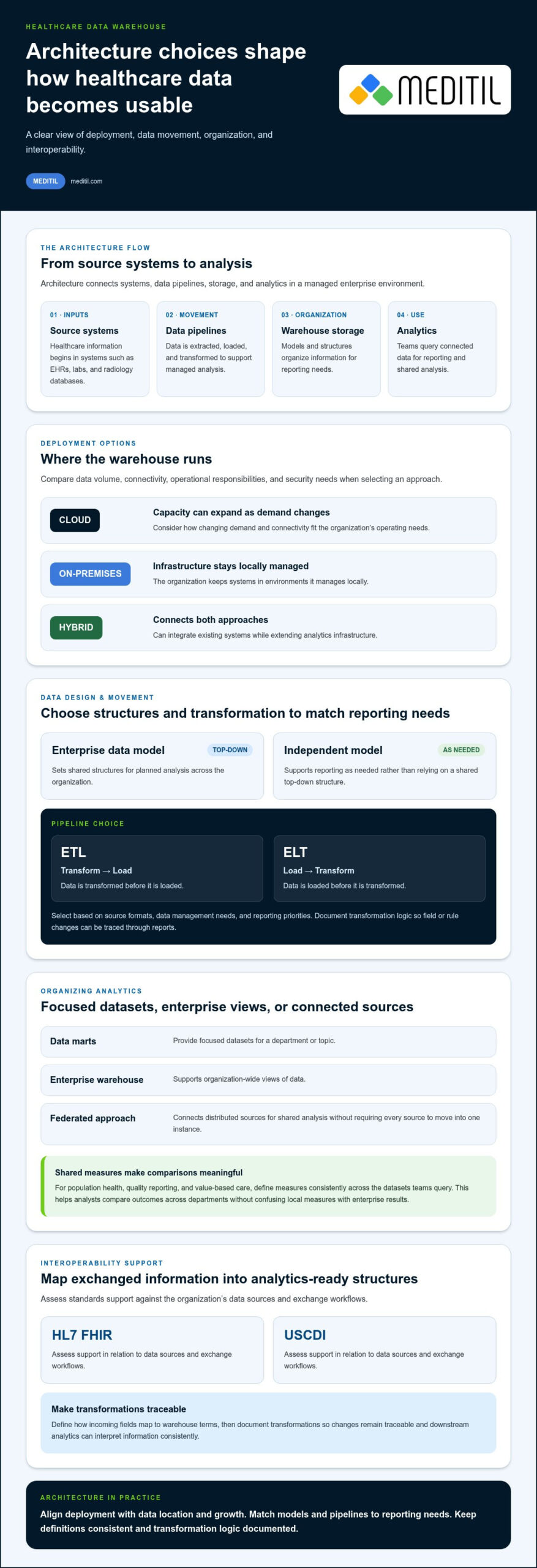
Architecture connects source systems, data pipelines, storage, and analytics in a managed enterprise environment. Several data warehousing in healthcare best practices begin with matching the design to data location, reporting needs, and growth.
Deployment Architecture Options
Cloud, on-premises, and hybrid architectures determine where warehouse components run and how they connect. Cloud deployment can expand capacity as demand changes; on-premises infrastructure keeps systems in locally managed environments. A hybrid design connects both approaches, helping organizations integrate existing systems while extending analytics infrastructure. Compare data volume, connectivity, operational responsibilities, and security needs. These choices shape how data warehousing in healthcare best practices work in daily operations.
Data Models and Pipeline Management
A data model defines how warehouse information is organized for analysis, while ETL and ELT describe how data moves and transforms. An enterprise data model takes a top-down approach, setting shared structures for planned analysis. An independent model supports reporting as needed. ETL transforms data before loading; ELT loads it before transformation. Choose based on source formats, data management needs, and reporting priorities. Document transformation logic so changes to fields or rules can be traced through reports.
Data Marts and Federated Architectures
Data marts provide focused datasets for a department or topic, while an enterprise warehouse supports organization-wide views. A federated approach connects distributed sources for shared analysis without requiring every source to move into one instance. For analytics, population health, quality reporting, and value-based care, define measures consistently across the datasets teams query. Analysts, for example, need shared definitions to compare outcomes across departments without confusing local measures with enterprise results.
Standards and Interoperability Support
Interoperability support maps exchanged information into consistent structures that downstream analytics can interpret. Organizations should assess HL7 FHIR and USCDI support against their data sources and exchange workflows. Define how incoming fields map to warehouse terms, and document transformations so changes remain traceable. These standards-related choices are part of data warehousing in healthcare best practices because they influence whether connected systems can contribute usable data. For implementation planning, systems integration and interoperability can help align data exchange with warehouse needs.
Data security, monitoring, backups, and auditing
Security controls should protect patient information throughout the warehouse, from ingestion through analytics. Include HIPAA, HITECH, and FDA requirements in compliance planning for healthcare data environments.
Security and Regulatory Compliance
Compliance-focused security combines governance, access controls, and documented handling of sensitive patient information. HIPAA and HITECH are relevant to protecting patient data in a warehouse, while FDA requirements may also apply to healthcare data environments. Map controls to the data and workflows they protect. A clinical repository used for analytics, for example, needs defined permissions and monitoring, not just secure storage. Metadata can record how information is classified and handled, helping teams apply governance consistently across integrated datasets.
Encryption and Secure Data Access
Encryption protects information by making it unreadable without authorized access, while access controls limit who can view or use warehouse data. Apply these protections to stored data and data moving between systems, then assign permissions according to each user’s role and work requirements. An analyst preparing population-level models, for example, may need aggregated clinical information rather than identifiable patient records. Restrict access to authorized users and use secure data access protocols to reduce unnecessary exposure. Review permissions regularly as staff change roles or leave, so outdated access does not persist.
Monitoring, Backups, and Auditing
Monitoring and audit trails help organizations detect inappropriate access and understand activity in the data repository. Configure auditing to capture who accessed information, when access occurred, and what data they viewed. Review records for activity that conflicts with a user’s role or expected analytics workflow. Regular backups protect warehouse data from accidental deletion, modification, or problems with the primary copy. Pair backups with a disaster recovery plan describing how systems and data will be restored after disruption. Together, monitoring, backups, and audits give security teams evidence to investigate access concerns and maintain the availability and integrity of clinical information.
Healthcare data warehouse implementation challenges
Implementation challenges often surface where data quality, integration, compliance, and scale meet. Data integration appeared as a work or improvement focus in 33% of reviewed clinical data warehouse articles. That points to a practical risk: connecting systems is not enough if teams cannot reconcile their fields, meanings, and update patterns.
Source systems may use inconsistent formats, duplicate patient records, or different definitions for the same measure. An Enterprise Master Patient Index can support identity resolution, while linked ETL or ELT processes transform records before analysis. Without these controls, a reporting platform may produce conflicting results and weaken decisions about clinical operations or organizational performance.
Implementation typically takes 3 to 12 months. Planning includes defining goals, selecting a solution and technology stack, creating a business case and roadmap, designing architecture, integrating data, then testing and stabilizing the platform. Goal definition is estimated at 3-20 days; solution conceptualization and technology-stack selection at 2-15 days. Business-case and roadmap creation also takes 2-15 days, while architecture design takes at least 15 days. Development and stabilization take at least 2 months.
Costs depend on the warehouse’s data volume, source complexity, architecture, integration work, security controls, cloud hosting, staffing, and ongoing maintenance. The price depends on the case and is provided after a quote request; the same factors shape the estimate. Scope these components separately so implementation decisions reflect both the initial platform and its operating needs.
To reduce delivery risk, tie each milestone to a testable outcome. Validate source mappings before loading, reconcile sample reports against source records, and test access controls before broader use. These checks can reveal data-quality or compliance gaps before they affect production reporting. Plan for growth by reviewing whether the architecture can accommodate additional sources and analytics workloads.
For support aligning healthcare systems and infrastructure during implementation, coordinate healthcare IT implementation planning.
MEDITIL: Managed IT Services (Ongoing)
MEDITIL helps healthcare organizations manage the IT environment that supports data warehouse operations. Its HIPAA-compliant Managed Services (Ongoing) provide oversight of the broader technology environment, while HIPAA-compliant Infrastructure & Network Services support the systems and connectivity that keep information moving.
For teams strengthening protections around sensitive healthcare information, MEDITIL’s HIPAA-compliant Cybersecurity & Compliance services support security and compliance needs. End-User Support & Help Desk helps staff resolve technology issues that can interrupt access to essential systems. These services are relevant when operational demands, infrastructure complexity, or security requirements stretch internal IT capacity.
Contact MEDITIL to discuss your healthcare IT needs.
Move from design to a supported operating model
The next decision is how the warehouse will support ongoing organizational priorities. Choose a reporting or care improvement objective, assign an accountable owner, and define how teams will use the resulting insights. This gives technical and clinical stakeholders a shared reference point as requirements evolve.
Applying data warehousing in healthcare best practices means treating the warehouse as an operational capability, not a one-time technology project. MEDITIL’s HIPAA-compliant Managed Services (Ongoing), Infrastructure & Network Services, and Cybersecurity & Compliance support the IT environment around that work. Consider these services when internal teams need help maintaining infrastructure or strengthening security operations.
A clear next step is to discuss how your organization’s IT priorities connect to its data goals. Contact MEDITIL about healthcare data warehousing to start that conversation. With defined ownership and the right operational support, your organization can move forward with greater clarity and purpose.
Frequently Asked Questions
What are best practices for designing a healthcare data warehouse architecture?
Align the architecture with the decisions teams need to make, then define workload, storage, and access requirements. Several data warehousing in healthcare best practices start by identifying users and reporting needs before selecting components. A quality reporting workload, for example, may need consistent measure definitions, while population health analysis may require broader datasets. Document refresh expectations and anticipated growth to guide design choices.
How should healthcare organizations integrate EHR, claims, lab, imaging, and other data sources?
Create a source inventory that captures system ownership, available fields, update patterns, and patient identifiers. Map equivalent concepts before joining records, such as distinguishing a billed procedure from a clinical procedure. Preserve source timestamps and transformation history so analysts can investigate discrepancies. If claims arrive later than clinical records, retain the timing differences so utilization reports reflect the correct period.
How can healthcare data warehouses ensure data quality, validation, and reliable clinical definitions?
Maintain a data dictionary defining measures, allowed values, and calculation logic. Data warehousing in healthcare best practices include validating definitions against representative records before reports reach decision-makers. For example, distinguish “unknown” from “not collected” rather than treating both as empty. Version updated definitions and identify which reports use each version, helping analysts explain changes in trends without mistaking revised logic for changed care patterns.
What HIPAA, HITECH, and state privacy requirements apply to healthcare data warehouses in the United States?
HIPAA and HITECH are relevant considerations when protecting sensitive patient information, and FDA requirements may apply to some healthcare data environments. State privacy requirements depend on the jurisdictions connected to an organization’s patients and data operations. Assess the organization’s role, data uses, disclosures, and agreements, then document how these factors shape governance and access decisions. This creates a practical basis for compliance planning without assuming one set of controls fits every organization.
What security controls should protect healthcare data warehouses, including encryption, access controls, auditing, and backups?
Use layered protections and separate administrative permissions from routine analytics access. Protect encryption keys independently from the data they secure, and monitor unusual exports or access patterns. Audit records should identify the user, time, and information involved. Test restoration from backups, not just backup creation, so teams can assess whether protected data and supporting systems can be recovered after disruption.
How do cloud-based and on-premises healthcare data warehouses compare in cost, scalability, and compliance?
Cloud environments can expand capacity without purchasing equivalent local hardware, while spending depends on usage and configuration. On-premises deployments require planning for infrastructure acquisition, upkeep, and internal operations. Hybrid designs combine approaches but add integration and management work. No deployment choice establishes compliance by itself; configuration, access governance, agreements, and operating controls all affect how patient data is protected.