
Physicians are more likely to support new technology when it addresses a shared clinical problem, fits existing workflows, and gives them a meaningful role in decisions. The practical answer to how to get physician buy-in for new technology is to involve physicians early, define measurable outcomes, and give them a formal voice through a technology advisory council. Visible leadership support helps turn that input into action.
Clinicians may reasonably question a new system if they expect more administrative work or less time with patients. A clear case for change, grounded in physician priorities and practical workflow needs, makes the purpose easier to assess and implementation more collaborative.
This article explains how to align technology with organizational and clinical priorities, set outcomes teams can track, and secure leadership support. It also shows how advisory councils can involve physicians before decisions are final, so their feedback informs planning, testing, and adoption.
Key Takeaways
- Connect each technology proposal to shared clinical and organizational priorities, and involve frontline users before decisions are finalized.
- Set measurable clinical and operational outcomes so physicians can assess whether a tool improves care and fits their workflows.
- Build trust with transparent updates, accessible leadership, and a visible feedback loop that shows how physician input shapes decisions.
- Give physicians a formal role in technology advisory councils, with clear responsibilities and opportunities to influence planning and implementation.
1. Aligning technology with organizational and stakeholder objectives
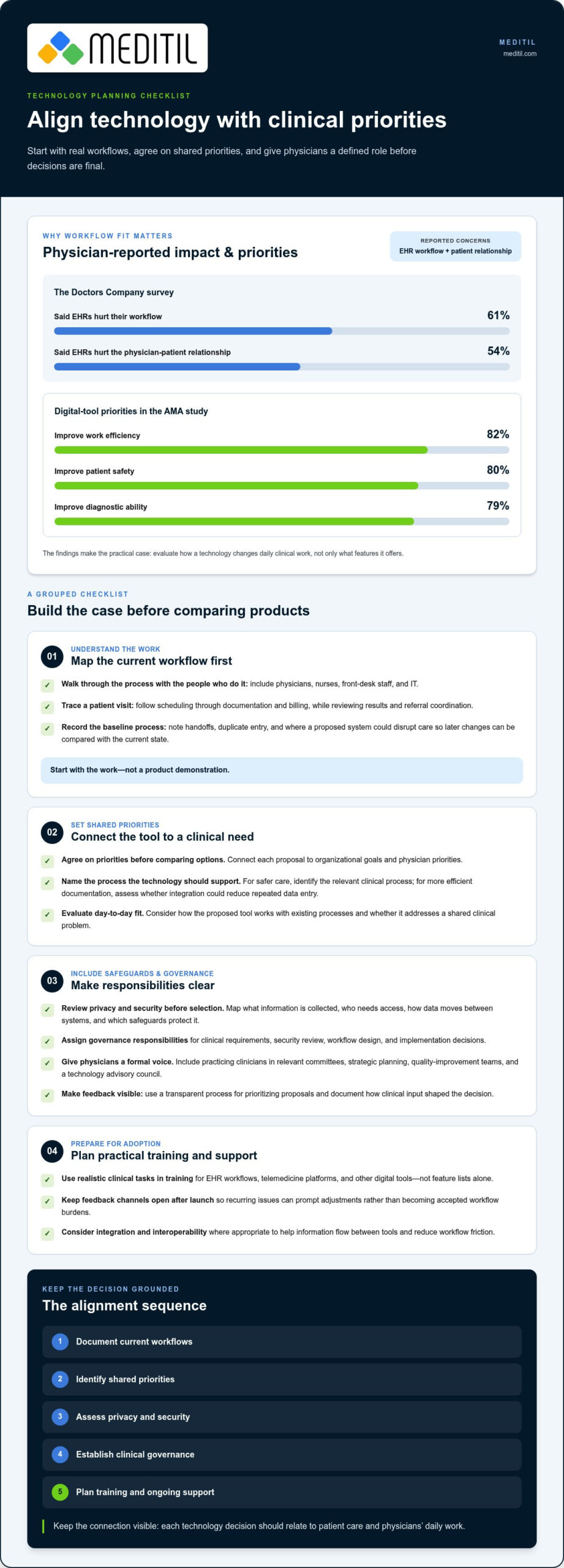
Start with a workflow assessment, not a product demonstration. Map how clinicians document visits, review results, coordinate referrals, and complete administrative tasks. Include physicians, nurses, front-desk staff, and IT in process walkthroughs. For example, trace a patient visit from scheduling through documentation and billing. This can reveal handoffs, duplicate entry, and points where a proposed system might disrupt care. Record the current process before setting goals, so the organization can compare it with actual changes after implementation.
Physician concerns often center on added administrative work, disrupted workflows, and less time with patients. In The Doctors Company’s October 2018 survey, 61% of physicians said EHRs hurt their workflow, while 54% said EHRs hurt the physician-patient relationship. Those findings show why a technology case must explain how it affects daily practice, not only describe features. The American Medical Association’s 2016 study found physicians were drawn to digital tools that could improve work efficiency (82 percent), patient safety (80 percent), and diagnostic ability (79 percent). Use these priorities to frame decisions around practical clinical value.
In the United States, adoption decisions should account for applicable privacy and security obligations when technology handles sensitive patient data. Before selecting a system, map the information it collects, who needs access, how data moves between systems, and which safeguards protect it. Review security alongside workflow and integration. This gives decision-makers a clear basis for assessing risk without leaving security until the final technical check.
Give physicians a defined role in organizational decisions. Establish governance that assigns responsibility for clinical requirements, security review, workflow design, and implementation decisions. Include practicing clinicians in medical committees, strategic planning, and quality-improvement teams. A technology advisory council can gather feedback before purchasing decisions are made. Set a transparent process for prioritizing proposals, then document how clinical feedback shaped the decision. This makes physician engagement part of governance, not an informal request for approval.
Connect each proposed tool to organizational goals and physician priorities. If the goal is safer care, identify the clinical process the technology should support. If the goal is more efficient documentation, assess whether integration can reduce repeated data entry. Interoperable systems can help information flow between tools and reduce workflow friction. Agree on shared priorities before comparing options, then evaluate each proposal against the clinic’s day-to-day needs and existing processes.
Training and ongoing support should reflect the technology physicians will use. Provide practical instruction for EHR workflows, telemedicine platforms, or other digital tools, using realistic clinical tasks rather than feature lists. EMR/EHR Implementation & Training can prepare teams for configuration and adoption; Healthcare Application Support and End-User Support & Help Desk can address application and user issues. Keep feedback channels open after launch, so recurring problems prompt adjustments instead of becoming accepted workflow burdens.
To align technology with organizational objectives, follow a clear sequence: document current workflows, identify shared priorities, assess privacy and security, establish clinical governance, and plan training and support. Physicians should see how each decision relates to patient care and their daily work. That connection gives the organization a practical foundation for evaluating technology and building informed participation.
2. Defining measurable clinical and operational outcomes
Define success before selecting technology. Choose outcomes that connect a clinical need to observable work, such as reducing duplicate documentation or making patient information easier to access. For each outcome, record the current process, identify the intended change, and assign someone to review results. The organization can then assess whether the technology supports care delivery instead of simply counting installations or logins.
Observe clinicians in their work environment before designing or configuring a tool. Follow how a physician reviews a chart, enters an order, and coordinates follow-up. Ask where repeated steps occur and which information needs to be visible at the point of care. Direct observation helps teams identify practical requirements and design an intuitive workflow around real clinical tasks, rather than assumptions made in a conference room.
How can technology fit clinical workflows without increasing physician workload? Integrate it with existing systems where appropriate, reduce duplicate entry, and test the complete workflow with clinicians before wider implementation. For example, systems that exchange information can help clinicians avoid switching between disconnected tools. Systems integration and interoperability can support that coordination across healthcare applications.
Evaluate clinical value against the work physicians actually perform. Electronic health records store patient data, support e-prescribing, and help coordinate care. Telemedicine platforms support remote consultations, while practice management systems handle scheduling, billing, and patient communication. Each tool should solve a defined problem and fit the clinic’s day-to-day processes. A feature that adds clicks without improving the clinical task is unlikely to show clear value.
Physicians should help shape technology strategy, including evaluation, workflow design, and implementation planning. Their input helps users take ownership of how the practice uses technology. Invite physicians to test proposed configurations, explain where workflows break down, and recommend adjustments. Treat their feedback as design input, not a final approval step. This can uncover usability barriers while teams still have time to address them.
Hospitals should measure adoption and outcomes using several signals, not a single activity count. Track participation in implementation projects and training, gather feedback through surveys or check-ins, and review relevant performance and quality indicators. Compare these measures with the baseline established before implementation. If physicians report extra work while usage rises, examine workflow fit and address the source of friction.
Use a structured review after launch. Compare intended outcomes with observed changes, review clinician feedback, and identify adjustments for the next improvement cycle. Separate adoption measures, such as participation and reported usability, from clinical or operational results. This helps leaders understand whether a tool is being used and whether it supports the intended work. Document decisions and share findings with participating physicians, so the next technology decision can draw on practical evidence.
3. Why is physician engagement so critical?
Physicians see how technology decisions affect patient care, documentation, and coordination. Gathering their feedback before implementation can uncover concerns that planning documents miss. A physician might flag an alert that interrupts medication review or a referral process that requires duplicate entry. Addressing issues early ties technology decisions to clinical work and helps teams identify adoption barriers before launch.
Engagement takes more than asking for opinions once. Establish a recurring feedback process with clear ways to participate, such as surveys, check-in calls, and advisory team invitations. Ask clinicians what works, where friction occurs, and which changes would help them care for patients. Include physicians with different roles and workflows, so responses reflect varied clinical settings rather than one department’s experience.
Some clinicians may hesitate to raise concerns in a group meeting. Anonymous surveys and suggestion boxes offer other ways to share candid feedback. Leaders can also schedule individual check-ins for physicians who prefer direct discussion. For example, after launching a documentation tool, ask whether it supports the visit workflow and where extra steps appear. Specific questions make responses easier to interpret and act on.
Close the feedback loop by reporting what leaders heard and what they changed. If physicians identify a confusing referral handoff, explain whether the process will be revised, tested, or retained, and why. Share updates through multiple channels, such as staff meetings and written project updates. If a suggestion cannot be adopted, explain the decision and its reasoning. A visible response shows that feedback informs decisions instead of disappearing into a report.
Accessible leaders make it easier for physicians to speak openly. Invite concerns during regular meetings, respond without dismissing operational details, and follow up on unresolved issues. A clinical informatics specialist can help translate physician feedback into technical requirements. For example, a request to reduce duplicate charting can become a workflow requirement for the implementation team to evaluate.
Physician engagement also has measurable organizational relevance. A Gallup survey found that engaged physicians at one hospital had 26 percent higher productivity than disengaged physicians. Gallup also estimated that one engaged physician adds an average of $460,000 in patient revenue per year. These findings concern specific survey results, not a guaranteed outcome for every organization. They reinforce why leaders should monitor engagement alongside clinical and operational measures.
Use a practical feedback cycle: invite input, record recurring themes, assign an owner, communicate the response, and revisit the issue after changes. Track meeting or project participation, survey responses, and feedback-session themes. Pair those signals with relevant quality and performance indicators. This helps leaders assess whether communication is reaching clinicians and whether their concerns are shaping technology decisions.
4. Leadership support and board backing
Physician participation needs visible executive support to move from discussion to implementation. The chief medical officer can sponsor a technology initiative, while the chief information officer coordinates technical decisions. Together, they can explain the clinical objective, decision process, and each team’s responsibilities. When leaders attend project meetings and address operational barriers, physicians can see that adoption is an organizational priority, not an isolated IT request.
Board support connects physician-led improvement plans to organizational authority and resources. When clinicians identify a workflow problem, leaders can present the proposed change, expected outcomes, implementation needs, and risks for board consideration. For example, a physician-led plan to improve referral coordination can show how teams currently exchange information and where handoffs fail. Board review gives the initiative a defined path for approval, oversight, and follow-through.
Physician champions make leadership support credible in clinical settings. Select respected clinicians who understand the affected specialty and can explain how a proposed system changes daily work. Their role is not to promote every decision. They should surface concerns, help colleagues understand the project’s goals, and report practical barriers to project leaders. A primary care champion, for example, may identify different workflow needs than a radiology champion.
Give physician leaders formal responsibilities, not honorary titles. Include them in technology committees, strategic planning, and implementation teams. Define their authority over clinical requirements, workflow review, and escalation of unresolved concerns. This gives teams clear accountability and physician leaders a route to raise critical issues before they affect patient care or disrupt routine operations.
Use evidence to brief executives and the board. Physician surveys can reveal recurring concerns, while workflow observations and project updates can show where implementation needs adjustment. Present findings alongside specific decisions required from leadership. If clinicians report that a new tool disrupts documentation, leaders can authorize a focused workflow review and assign owners to resolve the issue. Follow-up reporting shows whether the response was completed.
Leaders should involve more than physicians in supporting technology changes. Nurses, administrative staff, and IT professionals can identify dependencies that affect clinical adoption. For instance, a scheduling change may require revised front-desk processes and technical configuration. A shared leadership group can coordinate responsibilities, communicate decisions, and monitor progress. This keeps physicians from carrying the burden of resolving organizational issues alone.
To build lasting support, appoint an executive sponsor, assign physician champions, and establish board oversight for major initiatives. Give each role clear decision rights and a regular way to report progress. Leaders can then align clinical priorities with operational planning, address barriers, and recognize physicians who contribute to implementation. This visible structure makes physician leadership part of technology governance, not a temporary endorsement.
5. Physician participation in technology advisory councils
A technology advisory council gives physicians a formal way to influence decisions before purchasing choices are finalized. Its purpose is practical: translate clinical needs into requirements, identify workflow risks, and provide structured feedback to decision-makers. For example, physicians can explain how a proposed documentation tool affects a patient visit, while IT representatives assess integration and support needs.
Write a charter before inviting members. Define the council’s scope, how recommendations reach executives, and which decisions remain with organizational leadership. Specify that the council reviews clinical fit, workflow impact, interoperability, security, and implementation readiness. Clear boundaries help members understand their influence and prevent feedback from becoming an informal endorsement after key decisions have already been made.
Recruit physicians from different specialties, practice settings, and levels of technology experience. Include clinicians with distinct workflows, such as primary care visits, imaging, or referrals. Add representatives from nursing, administration, and IT when their processes intersect with the proposed tool. A diverse group can uncover conflicts a single specialty might miss, such as a scheduling change that shifts work to front-desk staff.
Use rolling appointments to maintain continuity while bringing fresh perspectives into the council. Stagger transitions so experienced members can brief incoming physicians on previous recommendations and unresolved issues. Set expectations for attendance, preparation, and feedback between meetings. This allows the council to maintain consistent oversight without relying on one physician champion to represent every practice or specialty.
Give each meeting a decision-focused agenda. Review the clinical problem, examine the proposed workflow, capture questions, and record recommendations with an assigned owner. Before a purchasing decision, members might assess whether a tool supports existing systems or creates extra steps. Document dissent as well as agreement. A concise report should state what the council recommended, why, and how leaders responded.
Keep participation meaningful after selection. Ask council members to review pilot feedback, identify workflow adjustments, and report recurring concerns from colleagues. For example, physicians testing a new referral process can flag missing information or unclear handoffs before wider implementation. Share resulting changes with the council so members can see how their input shaped the rollout and what remains under review.
A council works best when recommendations have a visible path into organizational decisions. Establish a regular reporting channel to executive leadership and communicate responses back to participating clinicians. To structure technology planning around clinical workflows and operational needs, discuss healthcare IT planning with a technology partner.
MEDITIL: Managed IT Services (Ongoing)
MEDITIL supports healthcare organizations that need ongoing IT operations to sustain technology adoption after planning and implementation. Physician feedback can reveal issues requiring coordinated attention, from application problems to network infrastructure and security needs. Managed Services (Ongoing) helps organizations manage these needs, while End-User Support & Help Desk gives staff a channel for technology assistance.
Turn to MEDITIL when your organization needs help managing healthcare IT operations, maintaining infrastructure, or addressing cybersecurity and compliance as technology changes. MEDITIL’s HIPAA-compliant services can help keep the operational work behind adoption aligned with clinical priorities and physician feedback.
To discuss HIPAA-compliant IT support for your healthcare organization, contact MEDITIL.
Make Physician Input Part of the Next Decision
The next technology decision can build on the working relationships established during this process. Keep physicians involved after implementation by making clinical feedback part of future planning, not a step reserved for one project. This ongoing practice gives leaders a clearer view of changing needs and helps physicians see how their input shapes the organization’s direction.
For healthcare organizations seeking to align IT operations with clinical priorities, MEDITIL offers Managed Services (Ongoing), Infrastructure & Network Services, and Cybersecurity & Compliance. These HIPAA-compliant services support the technical foundation behind technology initiatives while organizational leaders and physicians guide clinical priorities. A thoughtful approach to how to get physician buy-in for new technology starts with shared ownership and continues through every decision that affects care.
Contact MEDITIL to discuss physician buy-in and identify a practical next step for your organization. With clear priorities and sustained collaboration, your team can move forward with confidence.
Frequently Asked Questions
So, how do you get Physicians to love your tech?
Make the technology useful in the clinical moments that matter most. A practical way to get physician buy-in for new technology is to involve clinicians in a realistic demonstration using a familiar patient-care scenario. Ask them to identify steps that save effort, create friction, or obscure important information. Then address those findings before wider adoption. Trust grows when the tool performs reliably in everyday practice and leaders respond to physician feedback.
Why is physician engagement so critical?
Physician engagement helps organizations understand how technology affects clinical judgment, care coordination, and patient interactions. A tool that appears efficient to administrators may create a bottleneck during a busy clinic session. Physicians can identify that mismatch early and explain its clinical impact. Their participation also gives leaders a clearer basis for deciding whether to adjust workflows, provide additional support, or reconsider the proposed approach.
What are the best practices for gaining physician buy-in for new healthcare technology?
Start by defining the problem, then involve physicians in reviewing workflow requirements and testing the proposed solution. Explain what the technology will change, what it will not change, and how concerns will be addressed. For example, a clinic introducing digital intake can invite physicians to review how patient responses appear during visits. Follow with role-based guidance and a clear way to report issues after launch.
How should physicians be involved in selecting and evaluating new clinical technology?
Involve physicians before vendor evaluation, while requirements are still being shaped. Ask representatives from affected specialties to assess clinical scenarios, usability, information access, and compatibility with current processes. During demonstrations, have them complete common tasks rather than judge features in isolation. Record their feedback against agreed criteria, then share how it informed the selection decision. This makes clinical input specific and reviewable.
How can healthcare organizations demonstrate clinical value and ROI to physicians?
Connect the proposed technology to a clinical use case and explain how success will be assessed. For example, a referral tool might be evaluated on whether clinicians can access relevant information without separate workarounds. Pair workflow and care-quality measures with the resources needed to support the change. Explain who benefits, who carries the operational effort, and how leaders will review results after implementation.
What evidence and data do physicians need before adopting new technology?
Physicians need evidence relevant to their practice: usability in realistic scenarios, workflow effects, system integration, and safeguards for sensitive patient information. Provide a concise evidence pack with the proposed use case, test findings, known limitations, and a comparison with the current process. Include feedback from clinicians who evaluated the tool. Clear documentation helps physicians distinguish demonstrated capabilities from assumptions or planned improvements.
How can new technology be piloted with physicians before a full rollout?
Choose a limited clinical setting where the team can test representative tasks, not just demonstrate a product. Define what participants will evaluate, such as documentation steps, handoffs, or access to needed information. Capture issues during the pilot, assign owners to resolve them, and retest changes with clinicians. Use the findings to refine training and rollout plans before expanding to other practices.
How can physician champions and clinical leaders promote technology adoption?
Physician champions can translate project decisions into practical guidance for colleagues. Give them implementation updates, a direct route to raise unresolved concerns, and time to demonstrate workflows in context. A respected clinician might show peers how a revised process handles a common case, then report questions to project leaders. Champions should communicate both benefits and outstanding issues, giving colleagues a credible account rather than a sales pitch.