
What if analytics could support better decisions without adding work to clinical workflows? Healthcare BI consulting services help connect clinical, operational, and financial information that may be spread across separate systems. Bringing data together is only useful, though, when teams can trust the results and apply them to a specific decision.
When reports arrive late, conflict with one another, or take extensive interpretation, it is difficult to act with confidence. Healthcare BI consulting starts by identifying the decisions teams need to make, then aligning data, integration, and reporting with the workflows behind them. Privacy and security need to remain central throughout.
This article explains what healthcare BI consulting covers, how to set practical priorities, and what to look for in a secure, reliable analytics approach. MEDITIL provides healthcare-focused Business Intelligence & Analytics, data management, and systems integration as part of its HIPAA-compliant services. With 100% focus on healthcare IT environments, MEDITIL is Smart. Secure. Scalable. Healthcare IT, Simplified.
Key Takeaways
- Healthcare BI consulting services connect analytics to specific clinical, operational, and financial decisions, rather than simply producing more reports.
- A reliable BI foundation starts with clear business questions and accounts for data sources, definitions, ownership, quality, and access controls.
- Prioritize reporting around decisions such as operational visibility, revenue-cycle performance, and service-line or utilization needs.
- Define the meaning, business owner, and intended use of every proposed measure, then refine reporting based on how teams use it.
- MEDITIL provides Business Intelligence & Analytics as part of its HIPAA-compliant healthcare IT services, with 100% focus on healthcare IT environments. Smart. Secure. Scalable. Healthcare IT, Simplified.
What Healthcare BI Consulting Services Do for Clinical and Business Decisions
Healthcare BI consulting helps an organization turn information from clinical, operational, and financial systems into evidence that supports decisions. The work begins with the decision, not the dashboard: What does a care team, department manager, or executive need to understand, and which information can answer that question?
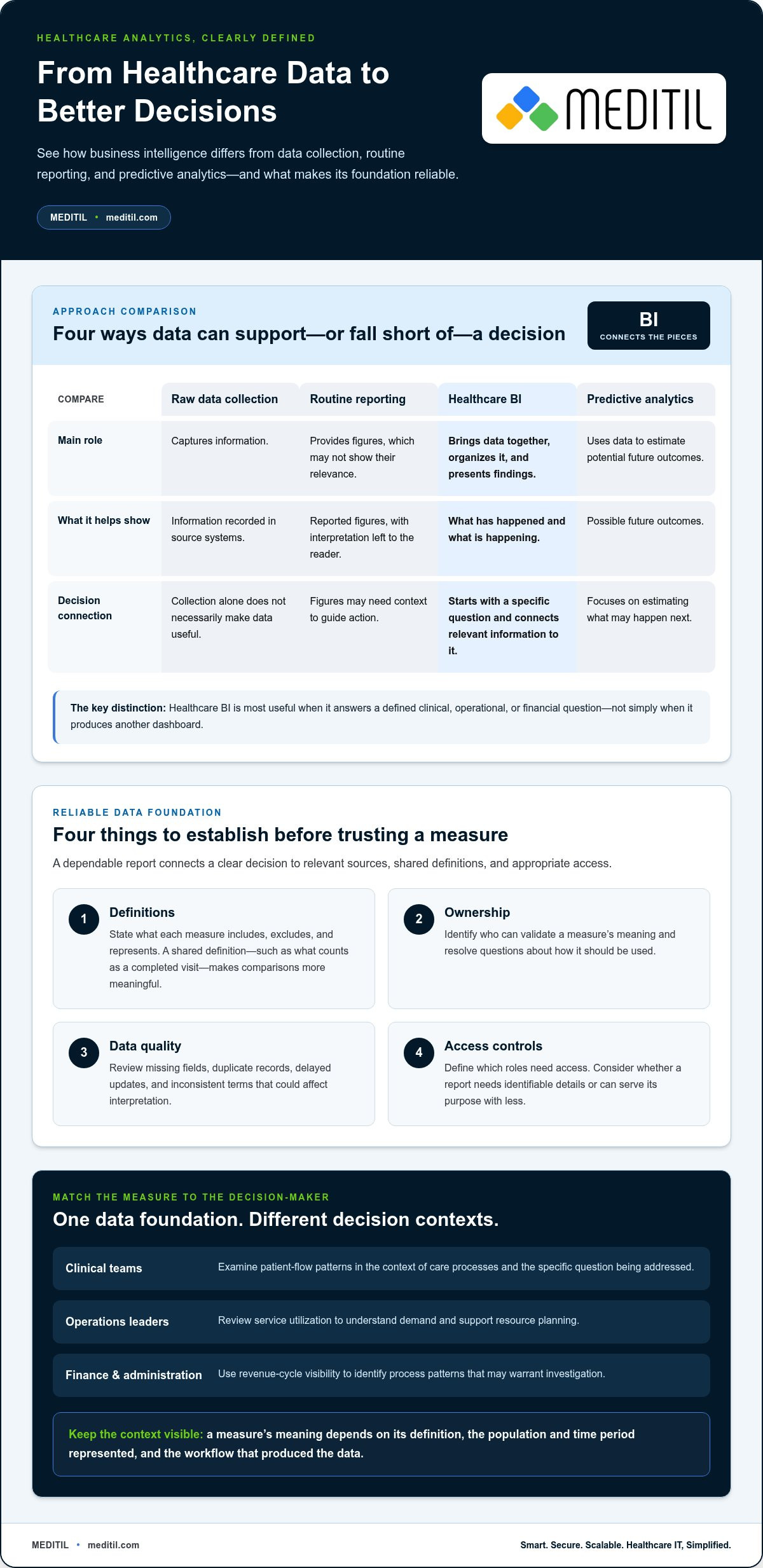
Business intelligence (BI) brings data together, organizes it, and presents findings through measures, reports, and visual analysis. Raw data collection captures information but does not necessarily make it useful. Routine reporting may provide figures without showing their relevance. Predictive analytics goes further by using data to estimate potential future outcomes. BI helps teams understand what has happened and what is happening. What is Business Intelligence? offers a broader overview of its methods and technologies.
How healthcare BI differs from general business intelligence
Healthcare BI needs to reflect how care is delivered, how administrative work moves, and how sensitive patient information is handled. For example, a patient-flow measure needs context about the workflow and the point at which the measure is captured. Service-utilization data can help leaders understand demand, while revenue-cycle reporting can highlight administrative processes for closer review.
The same metric can mean different things across departments or facilities. Interpretation depends on consistent definitions, the population and time period represented, and the workflow that produced the data.
What a healthcare BI consultant helps an organization accomplish
A consultant helps teams assess their needs, review relevant data sources, and determine whether available information can answer priority questions. The work can include analytics planning and guidance on systems integration, so reporting reflects how information is created and used across healthcare workflows.
Healthcare BI consulting connects trusted healthcare data to the decisions clinical, operational, and financial teams need to make.
Different decision-makers need different measures and context. For example:
- Clinical teams: Examine patient-flow patterns in the context of care processes and the specific question being addressed.
- Operations leaders: Review service utilization to understand demand and support resource planning.
- Finance and administrative teams: Use revenue-cycle visibility to identify process patterns that may warrant investigation.
Dashboards can make information easier to review, but they cannot resolve inconsistent metric definitions or poor-quality source data on their own. If departments calculate the same measure differently, a polished chart may make disagreement look precise without making it meaningful. Effective healthcare BI consulting services address data interpretation and reliability as well as presentation. Decision-makers should be able to understand what a measure includes, where it comes from, and how it can inform action.
How Healthcare BI Consulting Builds a Reliable Data Foundation
Reliable analytics require more than selecting measures or arranging charts. A sound foundation connects a defined decision to relevant sources, consistent data definitions, and reporting designed for its users. In healthcare, the work also needs to account for sensitive patient information and the realities of existing clinical and administrative systems.
Assessing healthcare data sources and readiness
An engagement can begin by mapping the systems that hold information relevant to a priority question. Depending on the decision, sources may include EHR or EMR records, billing systems, operational platforms, and specialty applications. The goal is not to bring every available data point into one report. It is to identify what is needed to answer the question and what can wait.
Reviewing source data can reveal gaps that affect interpretation, such as duplicate records, missing fields, delayed updates, or departments using the same term differently. For example, teams need a shared definition of a completed visit before they can meaningfully compare results from separate systems.
Planning should establish:
- Definitions: What each measure includes, excludes, and represents.
- Ownership: Who can validate the measure’s meaning and resolve questions about its use.
- Quality expectations: Which missing, duplicated, or delayed values need attention.
- Access controls: Which roles need access to the information for their work.
Connecting data while protecting patient information
Integration is a coordinated healthcare IT task. It should not assume that every system stores or exchanges information in the same way. Source review should clarify how data is captured, how often it is updated, and what work is needed to align formats and definitions. Reporting should preserve relevant context rather than hide differences between systems.
Access, information handling, and reporting design should account for the sensitivity of health information. Teams can define appropriate access for intended users and consider whether a report needs identifiable details or can serve its purpose with less. Make these decisions during analytics planning, alongside the question being answered, rather than waiting until a dashboard is ready.
Systems integration and interoperability can support a more connected analytics foundation. MEDITIL provides systems integration and HIPAA-compliant healthcare IT services. Its experience includes a 400GB patient data migration with zero compliance issues. That example concerns data migration, not a BI-specific result. MEDITIL brings 100% focus on healthcare IT environments, with a Smart. Secure. Scalable. approach: Healthcare IT, Simplified.
For organizations planning how systems exchange information, healthcare interoperability solutions are closely connected to building reliable analytics. MEDITIL’s healthcare IT consulting can support planning that aligns data integration with real workflows through HIPAA-compliant services.
Which Healthcare BI Use Cases Should an Organization Prioritize?
Start with a decision that matters to a specific team, not a target number of dashboards. A hospital may need a view across departments, while a clinic may focus on appointment activity and a billing provider may need visibility into work moving through the revenue cycle. Healthcare BI consulting services can help teams connect these questions to relevant data and useful reporting.
Use this comparison to frame initial discussions. The measures are examples. Before choosing dashboards or visualizations, stakeholders should agree on definitions, scope, and intended use.
Clinical and operational questions BI can help clarify
Patient queues, appointment activity, and service utilization support different kinds of operational review. A hospital may compare workflow stages across departments; a clinic may examine scheduling patterns; a radiology group may review imaging activity using relevant PACS/RIS or DICOM data. The purpose is to support visibility and analysis, not to promise a particular clinical outcome.
Interpretation depends on the local workflow. For example, teams should agree on which events mark the start and end of a queue measure and what counts as an appointment. Otherwise, apparent differences may reflect calculation choices rather than operational patterns.
Financial and administrative questions for healthcare leaders
Billing teams may examine how work progresses through defined stages, while finance leaders may look for trends across departments or service lines. These are potential analysis priorities, not guaranteed findings. Consistent definitions help leaders compare like with like and understand what a reported trend represents before deciding whether it needs further review.
When billing workflows are part of the analytics discussion, medical billing automation solutions provide related context. Start by choosing a decision owner, documenting the question, and agreeing on the measure’s meaning and reporting context. MEDITIL’s healthcare-focused Business Intelligence & Analytics can support that planning alongside HIPAA-compliant healthcare IT services. Explore MEDITIL’s healthcare BI consulting as part of an approach centered on Smart. Secure. Scalable. Healthcare IT, Simplified.
How to Plan a Healthcare BI Consulting Engagement Step by Step
A well-scoped engagement keeps analytics work tied to decisions and the workflows behind them. Before development begins, align on the question, who will use the answer, and what safeguards the data requires. This creates a practical basis for defining scope without assuming every organization has the same systems, priorities, or implementation needs.
Set the decision, stakeholders, and success measures
Start with a specific operational, clinical, or financial question rather than a general request for a dashboard. Identify the leaders, analysts, and workflow owners who can explain how the decision is made and how reporting will be interpreted. Before development, agree on each proposed measure’s meaning, business owner, intended use, and review cadence. These foundations help prevent a report from being technically complete but unclear in practice.
Validate, implement, and improve the analytics workflow
Use an ordered planning sequence to move from the decision to reporting that can be reviewed and refined:
- Define the decision. State the question the analytics work should help answer and the action or review it is meant to inform.
- Identify stakeholders and ownership. Include decision-makers, analysts, and staff who understand the relevant clinical or administrative workflow. Assign an owner to each proposed measure.
- Review sources and definitions. Map the information needed, assess its consistency, and agree on what each measure includes. Note data gaps that could affect interpretation.
- Plan integration and governance. Coordinate technical integration with access requirements, information handling, and the workflow in which reporting will be used. Keep sensitive health information in view throughout planning and implementation.
- Validate the reporting. Test whether the information reflects agreed definitions and answers the original question. Review the results with stakeholders who understand the underlying process.
- Orient users and refine. Explain how to interpret the reporting, establish a feedback path, and revisit definitions or presentation when users identify a practical issue.
Validation should test more than whether a report displays data. Teams can compare results with source information, check that filters reflect the agreed scope, and confirm that users interpret measures consistently. If a report appears to show a change, stakeholders should be able to trace the measure’s definition and context before drawing conclusions.
Implementation scope and timing depend on organizational requirements, source systems, integration needs, governance, and workflow considerations. Defining these dependencies early helps teams set a realistic scope without relying on generic timelines or assumptions about technical complexity.
For ongoing operational support around healthcare technology, managed IT services for healthcare provide related context. To plan healthcare BI consulting services around defined decisions and workflows, explore MEDITIL’s HIPAA-compliant healthcare BI consulting.
How MEDITIL Supports Healthcare BI Consulting Services
Healthcare analytics depends on more than a reporting interface. It also relies on how data is managed, how systems exchange information, and whether analysis fits the clinical, operational, and administrative workflows that produce the data. MEDITIL provides Business Intelligence & Analytics as part of its broader healthcare IT consulting portfolio, connecting analytics planning with relevant technology and integration needs.
MEDITIL has 100% focus on healthcare IT environments and provides HIPAA-compliant services. This healthcare focus informs BI planning around patient information, existing systems, and the practical needs of people who rely on reporting. MEDITIL provides services and consulting, not standalone BI software.
Connect analytics planning with healthcare IT capabilities
Data management, systems integration, interoperability, cloud services, and analytics can be considered together when an organization plans how information should support decisions. For example, a reporting need may depend on aligning data from separate applications before teams can interpret it consistently. Considering these dependencies as part of the engagement keeps analytics connected to the systems and workflows where information originates.
MEDITIL supports cloud environments including Azure, AWS, and Google Cloud, alongside private and hybrid cloud capabilities. The right planning approach depends on an organization’s requirements and existing environment. Integration and cloud considerations can be assessed in context, rather than treating a dashboard as a standalone solution to data challenges.
MEDITIL’s experience also includes a 400GB patient data migration with zero compliance issues. This is a data migration proof point, not a BI outcome. It reflects relevant experience handling healthcare data within a broader IT context. MEDITIL’s HIPAA-compliant services bring together healthcare IT capabilities with a positioning grounded in Smart. Secure. Scalable. and Healthcare IT, Simplified.
Start a conversation about healthcare BI consulting
A useful first discussion can begin with an outline of the decisions your organization wants to support, the systems that hold relevant information, and the reporting gaps that make those decisions harder. Include who uses the information and how it fits into existing workflows. This provides a practical starting point for setting analytics priorities alongside integration, data management, and other healthcare IT requirements.
Healthcare BI consulting services should be shaped around organizational needs, not a standard package of dashboards. MEDITIL combines Business Intelligence & Analytics with healthcare IT consulting and related capabilities through HIPAA-compliant services designed for healthcare environments.
Discuss your healthcare BI consulting needs with MEDITIL.
Turn Analytics Priorities Into a Practical Next Step
Clear decisions do not require every available data point or a sweeping analytics initiative. Start with a priority that matters, a shared understanding of what information can support it, and a plan that fits the people and workflows involved. Then shape the next phase around the organization’s actual needs.
That is the purpose of healthcare BI consulting services: connecting analytics planning to decisions teams are prepared to use while accounting for healthcare’s operational and information needs. MEDITIL brings healthcare-focused expertise to that work, guided by Smart. Secure. Scalable. and Healthcare IT, Simplified.
Consider the decision your team most needs to make with greater clarity. Which information would help, who needs to interpret it, and what gap currently stands in the way? A focused conversation can turn those questions into a practical direction for analytics planning.
Discuss your healthcare BI consulting needs with MEDITIL and take a considered next step toward decision-ready analytics.
Frequently Asked Questions
What are healthcare BI consulting services?
Healthcare BI consulting services help healthcare organizations plan how data can inform specific decisions. A project might assess what information is available for a leadership review, clarify how a measure should be interpreted, or identify integration needs before reporting begins. The scope can include strategy and technical guidance, not just dashboard design. A useful engagement connects the organization’s question, data sources, and intended users so reporting has a clear purpose.
How is healthcare business intelligence different from healthcare analytics?
Healthcare business intelligence generally organizes and presents information to support understanding of operational and organizational activity. Healthcare analytics is a broader term that can include BI as well as statistical analysis and predictive methods. For example, a BI report might show appointment activity over time, while predictive analysis could estimate future demand based on available data. The terms can overlap, so teams should define the specific capability and decision they mean.
What data sources can healthcare BI bring together?
Depending on the question and technical environment, healthcare BI may use information from EHR or EMR systems, billing platforms, scheduling tools, operational applications, and specialty systems such as radiology environments. Not every source needs to be included in every project. A clinic reviewing appointment patterns may need scheduling and visit information, while a revenue-cycle question may require billing workflow data. Source selection should reflect the decision, data readiness, and appropriate access.
Can healthcare BI consulting support a small clinic as well as a hospital?
Yes. The approach can be tailored to an organization’s size, systems, and priorities. A small clinic might focus on a defined question about appointment activity or billing workflow, while a hospital may need to examine information across multiple departments. Neither needs to begin with an enterprise-wide analytics program. A focused scope can help teams identify a useful starting point while accounting for available staff, systems, and reporting needs.
How do healthcare organizations protect patient information in BI projects?
Protection starts with planning how information will be accessed, handled, and presented. Teams can identify which users need particular data, limit reporting details to what the intended decision requires, and involve security and compliance stakeholders in project planning. They should also consider how information moves between source systems and analytics environments. MEDITIL provides HIPAA-compliant healthcare IT services, with project safeguards designed around the organization’s environment and responsibilities.
How much do healthcare BI consulting services cost?
There is no single standard fee for healthcare BI consulting services. Scope depends on factors such as the number and condition of data sources, integration requirements, reporting objectives, governance needs, and user orientation. A focused assessment differs from work involving several systems and workflows. Organizations can clarify potential scope by documenting the decisions they want to support, relevant systems, and known data challenges, then using those details to frame project planning.
How long does a healthcare BI consulting engagement take?
Engagement duration depends on the organization’s requirements and the work involved. Reviewing one priority question with accessible data differs from coordinating multiple source systems, resolving inconsistent definitions, and preparing reporting for several user groups. Decisions about access, integration, validation, and workflow fit can also shape the schedule. Define the initial scope with stakeholders and assess technical dependencies before setting timing, rather than relying on a generic project estimate.