
If your risk analysis identifies a security gap, can you trace it to an accountable owner, supporting evidence, and a follow-up action? A HIPAA security rule checklist 2026 should do more than list controls. It should help your organization determine which safeguards apply to its systems and workflows, then turn findings into trackable work.
Reviewing policies, vendor records, and IT documentation can be challenging when they are spread across teams. This practical checklist helps you assess administrative, physical, and technical safeguards, document gaps, and prioritize next steps based on risk and operational needs. As of October 2026, OMB targets July 2027 for final action on a Security Rule update. Keep current requirements separate from proposed changes.
The guide explains what to review and how to record owners, evidence, and follow-up actions for identified gaps. It also provides a structure for ongoing healthcare IT and security planning. Managed IT support and strategic leadership can help coordinate remediation and maintain oversight.
Key Takeaways
- Use the HIPAA security rule checklist 2026 to organize a review around safeguards relevant to your systems, workflows, and documented risk analysis.
- Assess administrative, physical, and technical safeguards separately, then connect identified gaps to the risks they address.
- Track each gap with supporting evidence, an accountable owner, a priority, and a due date so remediation can be followed through.
- Review vendor relationships and business associate documentation within your organization’s scope. Distinguish written policies from evidence that processes operate.
- Use a repeatable review cycle and coordinated healthcare IT leadership to keep security priorities aligned with operational needs.
HIPAA Security Rule Checklist 2026: Define Your Scope Before Reviewing Controls
Start with the information and workflows your organization needs to protect, not a generic list of technologies. The HIPAA Security Rule establishes standards for protecting electronic protected health information (ePHI) that covered entities and business associates create, receive, maintain, or transmit. Its focus is the confidentiality, integrity, and availability of that information. In practical terms, the HIPAA security rule checklist 2026 is a structured review of the safeguards protecting ePHI across your organization’s actual operating environment.
Covered entities and business associates have Security Rule responsibilities where applicable. The systems and relationships in scope depend on the organization’s role and how ePHI moves through its work. Treat this checklist as a readiness and planning tool, not legal advice, a certification, or a guarantee of compliance. It helps teams decide what to review and organize evidence and follow-up.
Identify ePHI systems, users, and business relationships
Build an inventory by tracing how ePHI is created, received, maintained, and transmitted. Include EHRs, email, endpoints, cloud services, backups, and connected workflows such as billing or remote care when they handle ePHI. Map locations, workforce roles, and access paths, including remote access and connections between systems. A workflow map can reveal information flows that a software-only inventory may miss.
For each system or workflow, record an accountable owner and the information it stores, sends, or receives. Note relevant business associate relationships and the systems or processes they support. This gives you a practical starting point for reviewing safeguards and helps prevent gaps in the inventory, including information handled outside the primary clinical platform—such as departmental radiology software solutions from smaart.net.
Set the 2026 regulatory baseline carefully
Use the currently effective Security Rule as the baseline for assessing applicable requirements. Track proposed amendments separately, and don’t describe proposed measures as binding requirements unless they have taken effect. As of October 2026, the update is delayed, with the Office of Management and Budget targeting July 2027 for final action. Check current HHS materials before relying on a change’s status.
This distinction keeps the review grounded while allowing leaders to track emerging expectations without confusing them with current obligations. For broader context on aligning safeguards with healthcare operations, connect the checklist to a healthcare cybersecurity services strategic guide and your organization’s security planning.
Before reviewing individual controls, confirm that the scope captures the information environment, not just centrally managed applications. Ask teams which systems exchange ePHI, where users access them, and which business relationships support those workflows. Record known inventory gaps, such as unclear ownership or undocumented data flows, rather than treating an incomplete map as proof that no exposure exists. A clear scope gives the safeguard review a defined, traceable foundation.
Review Administrative, Physical, and Technical Safeguards Against Current Risks
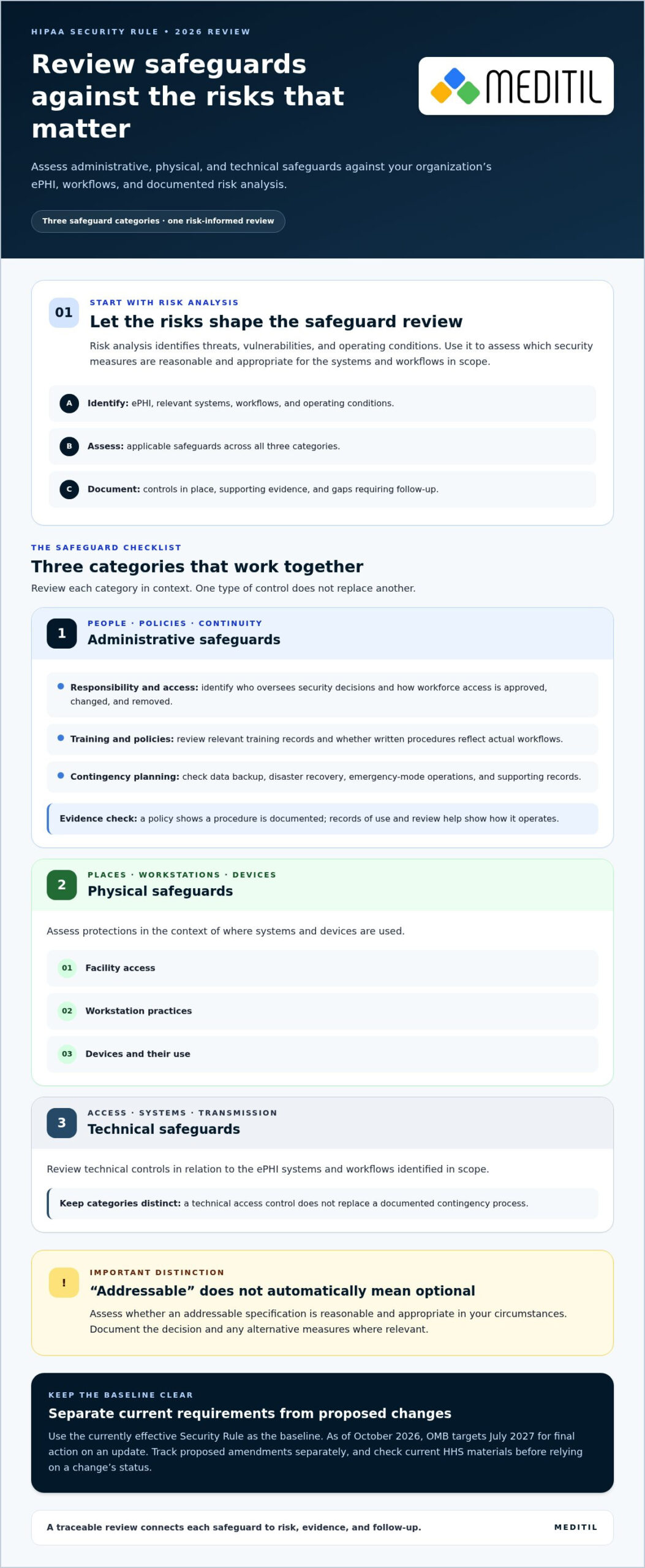
Once the organization’s scope is defined, review safeguards through the Security Rule’s three categories: administrative, physical, and technical. They work together, but they are not interchangeable. A workforce access procedure won’t secure an unattended device, and a technical access control won’t replace a documented contingency process. Use each category to organize the review, then connect every finding to the risks, systems, and workflows identified in your organization’s risk analysis.
Risk analysis informs which security measures are reasonable and appropriate by identifying the threats, vulnerabilities, and operating conditions those measures must address. For each applicable standard and implementation specification, record the control in place, the evidence that supports it, and any gap requiring follow-up. An “addressable” specification isn’t automatically optional. Assess whether it’s reasonable and appropriate in your circumstances, and document the decision and any alternative measures where relevant.
Administrative safeguards: responsibility, training, and contingency
Review assigned security responsibility, workforce access procedures, training, and current policies. Check whether contingency planning covers data backup, disaster recovery, and emergency-mode operations, and whether staff understand their roles. For each risk-management action or periodic evaluation, record an owner, review date, and evidence of completion. A policy document shows that a procedure is documented. Records showing that it is followed and reviewed give a clearer picture of how it operates.
- Responsibility and access: Identify who oversees security decisions and how workforce access is approved, changed, and removed.
- Training and policies: Review relevant training records and whether written procedures reflect actual workflows.
- Contingency and follow-up: Check plans, supporting records, assigned actions, and scheduled reviews.
Physical and technical safeguards: access, systems, and transmission
Assess physical protections in the context of where systems and devices are used. Consider facility access, workstation practices, device controls, and media handling where relevant. For technical safeguards, review unique user access, authentication, audit controls, integrity protections, and transmission security. Test these processes against real access paths and information flows, not just configuration documents.
- Physical: Review how access to relevant facilities, workstations, devices, and media is controlled.
- Technical: Examine how users are identified, access is limited, activity is recorded, and ePHI is protected from improper alteration or transmission.
Document why selected measures fit identified risks, and note where evidence is incomplete. The Official HHS HIPAA Security Rule Guidance is a reference for checking current rule materials and proposed changes. A proposed update is not an effective requirement simply because it appears in a proposal. Verify its status before treating a measure as mandatory. A HIPAA security rule checklist 2026 should distinguish current obligations from planning considerations.
MEDITIL’s healthcare cybersecurity and compliance support helps organizations coordinate technical controls with risk and operational priorities.
Turn the HIPAA Checklist Into Evidence, Ownership, and Prioritized Remediation
A checklist becomes useful when each finding leads to a decision and a trackable action. For every safeguard reviewed, capture the risk or gap, evidence considered, accountable owner, priority, and due date. This creates a clear path from assessment to remediation and helps leaders identify which issues need attention first. Completing the checklist alone does not prove ongoing compliance. Safeguards and supporting evidence need continued review as systems and workflows change.
Build an evidence register that supports review
Connect evidence to the specific control or process it supports. A policy may show that a procedure is documented, but it doesn’t establish that staff follow it or that the process is reviewed. Pair written policies with relevant operational records, such as completed access reviews or training records. The CDC Overview of HIPAA Security Rule provides context for the rule’s focus on protecting ePHI.
Depending on the safeguard, an evidence register may include risk-analysis records, policies, training records, access reviews, incident documentation, system configurations, or logs. Avoid collecting technical artifacts without a clear connection to the control. Record the evidence date, responsible owner, storage location, and review cadence so another reviewer can locate it and assess whether it remains current.
Prioritize findings and track corrective action
Use documented risk to guide priorities, considering ePHI exposure, potential operational impact, and dependencies between tasks. An access issue creating immediate exposure may require prompt risk-reduction steps, while a larger infrastructure improvement may need planning, resources, and interim measures. Keep the rationale visible so priority decisions are understandable and can be revisited when conditions change.
Use a consistent register to move findings into action:
| Safeguard | Risk or gap | Evidence | Owner | Priority | Due date |
|---|---|---|---|---|---|
| Access review | Review process not documented | Access review record | Assigned system owner | Based on risk | Set by organization |
| Contingency planning | Recovery procedure needs validation | Plan and validation record | Assigned IT lead | Based on impact | Set by organization |
For addressable implementation specifications, record the assessment, rationale, and any alternative measures selected where appropriate. Don’t leave the decision implicit. Assign each corrective action a responsible owner, milestones, dependencies, and the evidence needed to demonstrate completion. Once the action is complete, validate that the change addresses the identified gap instead of closing the item based only on a status update.
A concise status view helps distinguish open risk from verified resolution:
| Status | What to record |
|---|---|
| Identified | Finding, risk rationale, and proposed next step |
| In progress | Owner, milestones, dependencies, and target date |
| Mitigated | Validation evidence and remaining risk, if any |
| Accepted | Decision rationale, approver, and review date |
This evidence-and-action structure makes the HIPAA security rule checklist 2026 a working management tool, not a one-time record. It also gives technical and organizational leaders a shared view of what remains open and what has been verified.
Use This 2026 HIPAA Security Rule Checklist to Test Operational Readiness
A readiness review should test whether safeguards work in practice, not just whether policies exist. Use the cycle below to connect your organization’s scope to documented findings, follow-up, and ongoing review. Adapt the sequence to your systems and operating environment.
- Scope: Confirm which systems, workflows, users, locations, and business relationships handle ePHI.
- Assess: Review applicable safeguards against documented risks and observe how relevant processes operate.
- Document: Record findings, evidence, control decisions, and any remaining uncertainty.
- Prioritize: Consider ePHI exposure, operational impact, dependencies, and the organization’s risk assessment.
- Assign: Name an accountable owner and set milestones and a target date for each action.
- Validate: Review evidence that the action was completed and addresses the identified gap.
- Revisit: Update the review as systems, workflows, vendors, or risks change.
Include vendor relationships in scope wherever they support workflows involving ePHI. Review relevant business associate agreements and supporting security documentation alongside the services and information flows they cover. Note who owns each relationship, which systems or processes are involved, and when the documentation was last reviewed. This connects vendor records to actual operations instead of treating agreements as isolated files.
Validate controls through records and practical exercises
Sample records to test whether procedures are followed. For example, compare a workforce access change or termination with the related account records, and review evidence of periodic access reviews. Tabletop exercises can walk relevant staff through incident-response and contingency procedures, surfacing unclear roles, missing information, or coordination needs without assuming a particular outcome.
Document exercise observations, assigned corrective actions, and follow-up dates. Check that training materials, written policies, and technical records reflect current workflows. If a procedure describes an approval or escalation step, confirm that the corresponding record shows how the step is handled in practice.
Maintain the checklist as systems and risks change
Set a review cadence suited to your organization, and define event-based triggers for reassessment. New systems, workflow changes, incidents, and material shifts in risk can make earlier assumptions or evidence stale. After a significant change, update the system inventory, risk records, control owners, and supporting documentation so the review reflects the current environment.
Connect security priorities to the broader healthcare IT roadmap. Infrastructure work, application changes, and operational dependencies can affect the order or timing of remediation. A HIPAA security rule checklist 2026 is most useful when its findings inform ongoing planning rather than sitting apart from it. MEDITIL’s healthcare-focused cybersecurity and managed IT support helps organizations coordinate security work with IT priorities. See healthcare cybersecurity support as part of planning how assessment findings and remediation align with operational needs.
Coordinate HIPAA Security Rule Work With Healthcare IT Leadership
Security findings often cross team boundaries. A remediation item may require an infrastructure change, input from cybersecurity staff, updated procedures, and a decision about operational timing. Without someone coordinating those dependencies, work can stall or evidence can fall out of step with the change. The HIPAA security rule checklist 2026 is more useful when actions connect to named owners, decision-makers, and the organization’s IT plans.
Internal leaders remain responsible for organizational decisions, while the right support model can help coordinate technical work and follow-through. Healthcare-focused managed IT and cybersecurity support can contribute to infrastructure management, risk-focused security planning, and ongoing oversight. This support can help teams organize implementation and documentation, but it doesn’t certify an organization or guarantee compliance.
Coordinate technical work, documentation, and decision-making
Managed IT support can help coordinate infrastructure tasks with the operational records needed to track them. For example, a system or access-process change may involve technical implementation, communication with affected teams, and documentation of the work. Cybersecurity and compliance support can connect identified risks to security priorities, while internal leaders retain visibility into decisions, ownership, and unresolved issues.
A managed IT services for healthcare strategic guide provides additional context for aligning support with healthcare operations and IT planning.
Choose a sustainable operating model for security work
Organizations can retain day-to-day ownership with internal teams, add capacity through an augmented IT team, or use managed operational support for ongoing coordination. The appropriate model depends on existing roles, internal capacity, and the work requiring attention. In each case, define decision authority and responsibility for tracking actions so security work stays connected to organizational oversight.
Fractional CIO guidance can help connect technical remediation to operational priorities, infrastructure plans, and leadership decisions. For example, leaders can assess how the timing of a security improvement interacts with planned system changes, available internal resources, or dependencies across departments. This perspective supports prioritization without treating the checklist as a substitute for risk-based decisions or organizational accountability.
Use these questions to shape the operating model:
- Ownership: Who approves priorities and remains accountable for decisions?
- Capacity: Which tasks can internal teams manage, and where is added technical or coordination support useful?
- Continuity: How will owners, evidence, and open actions stay visible as systems or responsibilities change?
MEDITIL brings healthcare-focused managed IT, cybersecurity support, consulting, and fractional CIO leadership together around healthcare organizations’ operational needs. Learn about MEDITIL’s healthcare IT and security support as you consider an approach aligned with your organization’s plans.
Turn Your Next Review Into a Clear Plan
Choose a practical next step: bring one open security decision into your next healthcare IT planning discussion. Use the HIPAA security rule checklist 2026 to clarify what needs attention, who should participate, and what information leaders need to make a sound decision. A focused discussion can move a finding from a tracker into a considered action.
Keep the plan connected to the realities of care delivery. Account for operational dependencies, assign follow-up, and revisit decisions as the organization changes. Progress doesn’t require solving every issue at once. It requires a deliberate approach that keeps important work visible and moving forward.
MEDITIL helps healthcare organizations coordinate IT and security priorities through support aligned with their needs. Discuss your healthcare IT and security priorities with MEDITIL to take the next step with a clear, manageable plan.
Frequently Asked Questions
What is included in a HIPAA Security Rule checklist?
A HIPAA Security Rule checklist typically covers risk analysis, risk management, assigned security responsibility, workforce access, training, contingency planning, physical protections, and technical controls. It should also identify which systems and workflows contain ePHI and which records support each review. For example, an organization might track whether a policy is current and separately record evidence that staff follow the process. Tailor the checklist to your systems and risks.
Does the HIPAA Security Rule require a risk analysis?
Yes. The Security Rule requires covered entities and business associates to conduct an accurate and thorough assessment of risks and vulnerabilities to ePHI. A practical analysis considers where the information is used, what could threaten its confidentiality, integrity, or availability, and which safeguards address those risks. For example, adding a cloud-based workflow may change data flows and access paths, prompting an updated assessment of potential vulnerabilities.
Are addressable HIPAA Security Rule specifications optional?
No. “Addressable” doesn’t mean an implementation specification can be skipped without review. The organization must assess whether the specification is reasonable and appropriate in its circumstances. If it is, implement it; if not, document why and consider an equivalent alternative measure where appropriate. Keep the reasoning with the relevant risk and control records. This creates a clear record of the decision instead of an unexplained blank in the checklist.
Who must follow the HIPAA Security Rule?
Covered entities and business associates must follow the Security Rule where its requirements apply to them. Covered entities include health plans, healthcare clearinghouses, and healthcare providers—ranging from large health systems to specialized clinical practices like Premium Sports & Orthopedic Center—that conduct covered electronic transactions. A business associate generally performs functions or services for a covered entity involving protected health information. A vendor’s role depends on its actual work and relationship, so assess the services and information involved rather than assuming every technology supplier has the same status.
How often should an organization update its HIPAA Security Rule checklist?
The Rule doesn’t set one universal interval for refreshing a checklist. Establish a review cadence suited to your environment, then reassess sooner when an event could change risk. Examples include adopting a system that handles ePHI, changing how staff access applications, or responding to an incident. A dated review record can show what changed, which controls were reconsidered, and whether earlier findings or assigned actions need revision.
Does completing a HIPAA Security Rule checklist prove compliance?
No. A completed checklist records a review, but it doesn’t by itself establish that safeguards are suitable, operating effectively, or maintained over time. For example, a checked box beside an access policy doesn’t demonstrate that permissions are reviewed or adjusted when roles change. Treat the checklist as one component of a broader compliance program, supported by current evidence, follow-up on findings, and ongoing evaluation as operations evolve.
Will the HIPAA Security Rule change in 2026?
As of October 2026, the final update to the Security Rule has been delayed; the Office of Management and Budget targets July 2027 for final action. Proposed amendments should not be treated as effective requirements. Use the currently effective rule as your compliance baseline, and monitor official HHS updates for changes in status. Organizations can track proposed measures separately in their planning so future developments aren’t confused with current obligations.