
Automating patient eligibility verification can reduce repeat work, but an unclear payer response still needs review before it becomes a billing mistake. Teams need current coverage information and a reliable way to handle missing, conflicting, or time-sensitive responses before those details move downstream.
When staff repeat payer checks and enter the same information in multiple systems, automation can help. Reliable results depend on more than sending an electronic inquiry. The workflow needs to connect with registration, the EHR, and billing, with clear staff oversight when a response requires attention.
This guide explains how to plan timely checks, route exceptions for review, and connect eligibility data with billing operations. The aim is a repeatable process that reduces avoidable manual steps while giving staff a defined role in resolving uncertainty.
Key Takeaways
- Eligibility verification checks coverage and benefits for a service, but it does not guarantee payment.
- Automating patient eligibility verification works best as a connected workflow, from patient data capture through response review and billing handoff.
- Use a supervised hybrid process to route incomplete records, conflicting responses, and changing coverage for staff review.
- Test the workflow with representative scenarios and monitor data quality, system connections, and exceptions over time.
- Healthcare IT integration and support can help align eligibility workflows with EHR, billing, infrastructure, and cybersecurity needs.
What Automating Patient Eligibility Verification Actually Does
Eligibility verification checks the coverage and benefit information a payer returns for a patient and a planned service. It helps staff understand what the response indicates at that time, but it does not guarantee payment.
Automating patient eligibility verification means using connected systems and repeatable steps to request, receive, and route this information with less manual entry. Staff still need to match the response to the patient and planned service, interpret the details, and follow up when information is incomplete or unclear.
Which information can an eligibility check return?
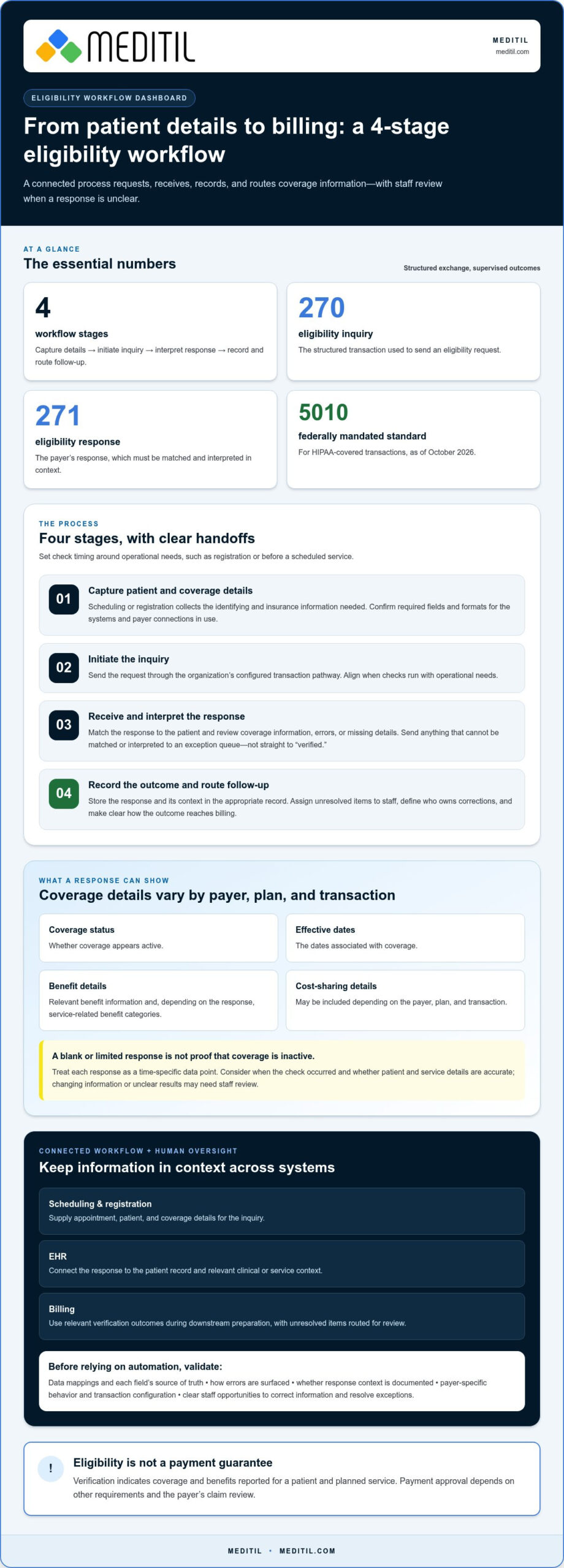
A response may show whether coverage appears active, the coverage’s effective dates, and relevant benefit details. Depending on the payer, plan, and transaction, it may also include service-related information such as applicable benefit categories or patient cost-sharing details. Available fields vary, so a blank or limited response should not automatically be treated as proof that coverage is inactive.
Coverage information can change as records are updated or a patient’s circumstances change. Treat each response as a time-specific data point, not permanent confirmation. Staff should consider when the check occurred, whether patient and service details were accurate, and whether the response needs further review.
Eligibility verification indicates reported coverage and benefits. Payment approval depends on other requirements and the payer’s claim review.
Why automate verification in healthcare workflows?
Repeated portal lookups and manual re-entry take staff time away from other registration and billing tasks. They can also leave information in one system but not another, making it harder for teams to work from a consistent record. Automation can standardize when checks are initiated and where responses are recorded, while directing exceptions to staff instead of treating every result as complete.
For example, a patient may have an appointment scheduled and insurance details already entered during registration. A connected workflow can use those details to initiate a check, return the response to the appropriate record, and flag missing or conflicting information for review before billing moves forward. Staff can then correct the record or follow up, rather than repeating the lookup without a clear handoff.
Eligibility is an early step in Revenue Cycle Management (RCM), the broader process connecting patient registration, services, and billing. Automating this step supports downstream work only when responses are handled in context and flow into the systems teams use.
How an Automated Patient Eligibility Verification Workflow Works
A dependable workflow moves information from scheduling to a payer connection, then returns a usable result to staff and relevant systems. The handoffs depend on the organization’s EHR, billing environment, payer connections, and operational policies. Validate those details before relying on the automation.
From patient details to a payer response
For HIPAA-covered transactions, the 270 is the eligibility inquiry and the 271 is the response. Version 5010 remains the federally mandated standard as of October 2026. These transactions provide a structured way to exchange eligibility information, but they do not ensure that every payer connection returns the same fields or level of detail. The CAQH Index data offers industry context on electronic administrative transactions. Local implementation still requires payer-specific validation.
- Step 1: Capture patient and coverage details. Scheduling or registration collects the identifying and insurance information needed for a request. Confirm the required fields and formats for the systems and payer connections in use.
- Step 2: Initiate the inquiry. The workflow sends the eligibility request through the organization’s configured transaction pathway. Set when checks run, such as during registration or before a scheduled service, according to operational needs.
- Step 3: Receive and interpret the response. Match the response to the patient and review it for useful coverage information, errors, or missing details. Route any response that cannot be matched or interpreted to an exception queue instead of treating it as verified.
- Step 4: Record the outcome and route follow-up. Store the response and its context in the appropriate record, then direct unresolved items to staff. Define who owns corrections and how the outcome reaches billing.
Where EHR and billing integrations fit
Scheduling may supply appointment details, while registration maintains patient and coverage information. An EHR can provide clinical and service context, and billing workflows can use relevant verification outcomes during downstream preparation. Interfaces should transfer agreed-upon data without creating duplicate records or obscuring review decisions. Staff need clear opportunities to correct information and resolve exceptions.
Before deployment, validate data mappings, the source of truth for each field, how errors are surfaced, and whether responses are documented with enough context for later review. Test payer-specific behavior and the organization’s transaction configuration as well. The workflow described here assumes the connections support the planned exchange, so technical teams must confirm that in the actual environment. For a broader view of connected billing processes, see the medical billing automation solutions guide.
Integration planning can align eligibility checks with existing EHR and billing workflows. Explore healthcare systems integration support as part of that planning.
Manual vs. Automated Eligibility Verification: Benefits, Limits, and Oversight
Manual and automated checks each have a role. Staff can investigate unusual cases directly, but repeated lookups and re-entry can slow the process. Automation can retrieve and route information consistently, but it cannot resolve every ambiguous response or guarantee that coverage applies to a planned service. A supervised hybrid workflow combines repeatable automation with clear human review.
| Approach | What it supports | Limit to manage |
|---|---|---|
| Manual checks | Staff can investigate payer responses and use judgment in complex cases. | Repeated lookups and duplicate data entry may delay handoffs or create inconsistent records. |
| Automated checks | Systems can retrieve responses and route routine results through defined workflow steps. | Missing data, connection issues, or changing coverage can leave gaps or produce results that need interpretation. |
| Supervised hybrid workflow | Automation handles repeatable retrieval and routing; staff review exceptions and document follow-up. | It requires defined review criteria, an assigned queue, and clear responsibility for unresolved cases. |
What automation can streamline, and what it cannot decide
Good candidates for automation include assembling verification requests from existing records, sending them through configured connections, recording responses, and flagging missing or conflicting information. These steps can reduce repetitive handling when source data and system mappings are reliable.
A response is not a final decision about whether a specific service will be covered or a claim paid. It may be incomplete, difficult to interpret, or inconsistent with information already on file. Staff may need to confirm patient and service details, review plan information, and decide on the next step. Automating patient eligibility verification should support that judgment, not replace it.
When a human review should remain in the workflow
Route missing, inactive, conflicting, or ambiguous responses to a named staff queue. Define who reviews each exception and how it returns to registration or billing once addressed. Record the response source, check timing, and follow-up actions so another team member can see what was checked and what remains unresolved.
An automated check needs an owner for exceptions. A system can flag uncertainty, but staff must determine and document the next step.
Coverage information can change, so teams should define when their workflow requires a new check. A previously returned response may not reflect a later change. Consistent review and documentation help staff use the result as operational information, not as an assurance of payment.
How to Implement Eligibility Automation with Reliable Data and Controls
Successful implementation starts with the existing workflow, not the automation configuration. Map how information moves from scheduling and registration through verification and billing. Then identify where staff repeat tasks, correct records, or resolve unclear responses. This gives the team a practical basis for deciding what to automate and where human review must remain.
Prepare systems, data, and staff before launch
- Assign workflow ownership. Identify who maintains the process, who reviews exceptions, and who updates procedures when payer connections or internal workflows change.
- Review data quality and dependencies. Check patient identity fields, coverage details, payer mappings, and the systems that exchange information. Confirm the authoritative source for each field and how mismatches will be handled.
- Document handoffs. Define when checks are initiated, where results are recorded, and how unresolved cases reach registration or billing staff. Map these steps before automating a transfer.
- Train the people involved. Staff should know how to interpret responses, escalate unclear results, correct source information, and document follow-up according to organizational procedures.
These are general implementation practices, not a substitute for organization-specific technical or regulatory requirements. Validate transaction configuration, payer connection behavior, interface mappings, and internal policies in the organization’s own environment.
Test, protect, and monitor the workflow
Before broader use, test representative scenarios across the entire handoff, not just whether a request can be sent. Include complete and incomplete records, mismatched patient or payer details, inactive coverage, delayed or unsuccessful responses, and results that require staff interpretation. Confirm that each case is either recorded correctly or routed to the appropriate review process.
For ongoing oversight, track operational measures that show where the workflow needs attention. Useful measures may include unresolved exceptions, repeat checks, unsuccessful payer responses, and staff rework caused by missing or mismatched data. Review patterns over time and use them to refine data-entry guidance, routing rules, and interface behavior. Set targets based on the organization’s baseline and operational needs rather than assuming a universal benchmark.
Access permissions, auditability, and security safeguards should reflect the systems and information involved. Review privacy and regulatory obligations with qualified organizational stakeholders. An automated workflow alone does not establish compliance. For additional planning context, read the healthcare cybersecurity services guide.
MEDITIL supports workflow design, system integration, and operational controls through its healthcare IT services. Explore MEDITIL’s healthcare IT consulting.
Build a Sustainable Eligibility Automation Strategy with Healthcare IT Support
Eligibility automation depends on more than a successful payer inquiry. The surrounding infrastructure must support dependable data exchange, applications must handle responses consistently, and staff need a clear process for reviewing exceptions. Integration planning and ongoing operational support help keep these elements connected as workflows and system requirements evolve.
Connect eligibility automation to the wider revenue cycle
Eligibility checks sit at the intersection of patient access and billing. Scheduling and registration collect the information that supports a check. Downstream teams may rely on the documented result as they prepare billing work and handle follow-up. If information is isolated in one application or transferred without clear ownership, staff may face duplicate entry or uncertainty about which record to use.
Integration decisions should reflect the systems already in place and the teams responsible for each handoff. Define which system supplies patient and coverage details, where the response is recorded, and how unresolved items reach the appropriate staff. These decisions connect eligibility automation with broader billing processes. The healthcare interoperability guide explains the importance of connected health information, while the managed IT services for healthcare guide outlines the ongoing support healthcare technology environments require.
MEDITIL’s healthcare IT consulting and systems integration work supports planning for connected workflows. Infrastructure, application support, interoperability, billing automation integration, and cybersecurity all contribute to a process staff can use and oversee. The goal is to fit the workflow to existing operations, not to automate in isolation.
Plan the next step around your current workflow
Before changing systems, create a practical baseline. Document:
- The scheduling, registration, EHR, and billing systems involved.
- How eligibility information moves between them and who owns each handoff.
- Where staff encounter duplicate entry, delayed responses, or unclear results.
- Which exceptions arise and how often they require repeat checks or follow-up.
This inventory gives operational and technical teams a shared view of the process. It also helps identify where integration, access controls, application support, or staff procedures need attention. MEDITIL can support integration planning and ongoing operational needs as organizations refine connected workflows.
Use your current workflow map to define the next improvement and the people responsible for it. Discuss your healthcare IT workflow with MEDITIL.
Make Eligibility Automation a Connected, Reliable Workflow
Automating patient eligibility verification works best when accurate data, connected systems, and clear staff oversight support one repeatable process. Automated checks can reduce repetitive handling, but responses still need context, and unclear or conflicting results need a defined review path.
Start by mapping how eligibility information moves through scheduling, registration, the EHR, and billing. Identify data-quality issues, system handoffs, exception ownership, and measures such as repeat checks or staff rework. These steps help teams make practical improvements while preserving the human judgment payer responses can require.
Reliable workflows also depend on the technology around the check. MEDITIL provides healthcare-focused IT consulting, integration, and interoperability support, alongside managed IT and cybersecurity capabilities for healthcare operations. This broader perspective can help align eligibility processes with existing systems and revenue-cycle needs.
Ready to plan a connected approach for your organization? Discuss your healthcare IT workflow with MEDITIL. With a clear view of your current process and a thoughtful integration plan, your team can move toward more dependable verification workflows.
Frequently Asked Questions
What is automated patient eligibility verification?
Automated patient eligibility verification uses connected systems to submit insurance coverage inquiries, receive payer responses, and route or record results with fewer repetitive manual steps. A workflow may start with patient and coverage details collected during registration, then pass results to staff or billing processes. Automation can make checks more consistent, but staff still need to interpret incomplete or conflicting responses and follow up when information needs review.
How does automated insurance eligibility verification work?
An automated workflow uses patient and insurance details to send an eligibility inquiry to a payer through a configured connection. For standard electronic transactions, the 270 is the inquiry and the 271 is the response. The workflow receives the result, associates it with the appropriate record, and routes unclear or unsuccessful responses for review. Available information and response handling can vary by payer connection, so validate the workflow in the systems being used.
Can eligibility verification be integrated with an EHR or billing system?
Yes. Eligibility workflows can connect with scheduling, registration, EHR, and billing systems so information moves between steps with less manual entry. Integration planning should establish which system supplies each data field, where payer responses are recorded, and how exceptions reach staff. The specific handoffs depend on the organization’s systems and processes. Healthcare IT consulting and systems integration can help align those connections with operational needs.
Does an eligibility response guarantee that a claim will be paid?
No. An eligibility response reports information returned for a particular inquiry. It does not guarantee coverage for a planned service or payment of a claim. Payment depends on the claim and the payer’s review of applicable coverage and other requirements. Treat the response as useful, time-specific information. Staff should verify that the patient, coverage, and service details are appropriate and address uncertainty before relying on the result.
When should staff manually review an automated eligibility response?
Staff should review responses that are missing, unsuccessful, inactive, conflicting, or ambiguous, as well as results that do not match the patient or planned service details. Assign these cases to a defined review queue with clear responsibility for follow-up. Record the response source, when the check occurred, and any corrective steps. A documented exception process helps prevent uncertain results from moving downstream as if they were resolved.
What information is needed to verify patient eligibility?
A verification request generally relies on patient identifying details, insurance or payer information, and context for the planned service. Depending on the payer connection and transaction, this may include the patient’s name, date of birth, member identifier, and relevant service details. Accurate, current source data is essential. Validate the fields the workflow uses and define how staff correct incomplete or mismatched records.
How can a healthcare organization protect patient data during eligibility automation?
Protect patient information by limiting system access according to staff roles, maintaining appropriate auditability, and applying security safeguards suited to the organization’s environment. Review how data moves between registration, the EHR, payer connections, and billing, including who can access records and how exceptions are documented. Qualified organizational stakeholders should assess applicable privacy, security, and regulatory obligations. Automation by itself does not establish compliance, so controls and procedures need ongoing oversight.