
A HIPAA badge on a telehealth platform doesn’t prove that the way your organization uses it protects patient information. For teams ensuring telehealth platform HIPAA compliance, the essential question is whether the platform, its configuration, and day-to-day workflows work together to safeguard protected health information (PHI).
Before relying on a vendor’s compliance claims, gather evidence about how the service handles patient information. Video visits, messages, uploaded files, and recordings can each create privacy and security risks. Responsibility for addressing them may span clinical, privacy, security, and IT teams. A signed Business Associate Agreement is an important starting point, but it doesn’t replace a review of the platform or the safeguards your organization must manage.
This practical guide explains how to assess a telehealth platform, configure appropriate safeguards, and establish repeatable operational controls. You’ll learn what to document, how to clarify responsibilities with vendors and internal teams, and how to review workflows over time. The goal is a dependable operating model, not a compliance claim that goes unchecked.
Key Takeaways
- Map every place patient information may flow, from video and chat to recordings, analytics, support access, and connected systems.
- Use a repeatable vendor review to examine evidence, assign responsibilities, test controls, and document approval decisions.
- Assess safeguards such as unique accounts, role-based access, multifactor authentication, session controls, and timely access removal.
- Make ensuring telehealth platform HIPAA compliance an ongoing team process, with clear owners, review schedules, training, and escalation paths.
- Coordinate infrastructure, cybersecurity, cloud, integration, and clinical workflows to support a secure and workable telehealth environment.
What ensuring telehealth platform HIPAA compliance actually requires
Ensuring telehealth platform HIPAA compliance means protecting electronic protected health information (ePHI) throughout virtual care and the systems that support it. That includes more than the video session: patient messages, uploaded files, scheduling details, recordings, integrations, and vendor support access may all affect how information is handled.
Compliant use depends on the platform’s capabilities and an organization’s verified configuration, policies, workforce practices, and ongoing safeguards. It is not established by a label or vendor claim. HIPAA obligations depend on the organization’s role and the information it creates, receives, maintains, or transmits. The Health Insurance Portability and Accountability Act of 1996 (HIPAA) establishes a broader framework; for telehealth operations, the Privacy, Security, and Breach Notification Rules are central.
Which HIPAA rules matter to telehealth?
The Privacy Rule governs permitted uses and disclosures of protected health information (PHI), including information shared during care. The Security Rule requires covered entities and business associates to use administrative, physical, and technical safeguards to protect ePHI. Organizations assess risks and implement reasonable and appropriate protections for their circumstances. A feature list alone doesn’t establish that those protections are working.
The Breach Notification Rule sets requirements for responding to breaches of unsecured PHI. If an incident occurs, follow your response procedures, assess the event, and determine applicable notification duties and timelines using current guidance from the U.S. Department of Health and Human Services (HHS) Office for Civil Rights (OCR). Reporting requirements can depend on the circumstances, so don’t treat every security incident as automatically subject to the same notification process.
Who is responsible: the provider, platform, or business associate?
A covered entity generally includes a healthcare provider that conducts certain standard electronic transactions, as well as health plans and healthcare clearinghouses. A business associate is a person or organization that performs certain services for a covered entity involving PHI. A telehealth platform vendor that handles PHI on the organization’s behalf may therefore be a business associate.
Before PHI is shared with a vendor acting as a business associate, the parties generally need a written Business Associate Agreement (BAA). It documents permitted uses and disclosures, safeguards, and responsibilities if an incident occurs. But a BAA isn’t proof that either party has put effective controls into practice. The healthcare organization still needs to govern its users, settings, workflows, and oversight; the vendor remains responsible for the obligations that apply to its role. A vendor’s compliance claim cannot establish the organization’s compliance.
How to assess a telehealth vendor before adopting its platform
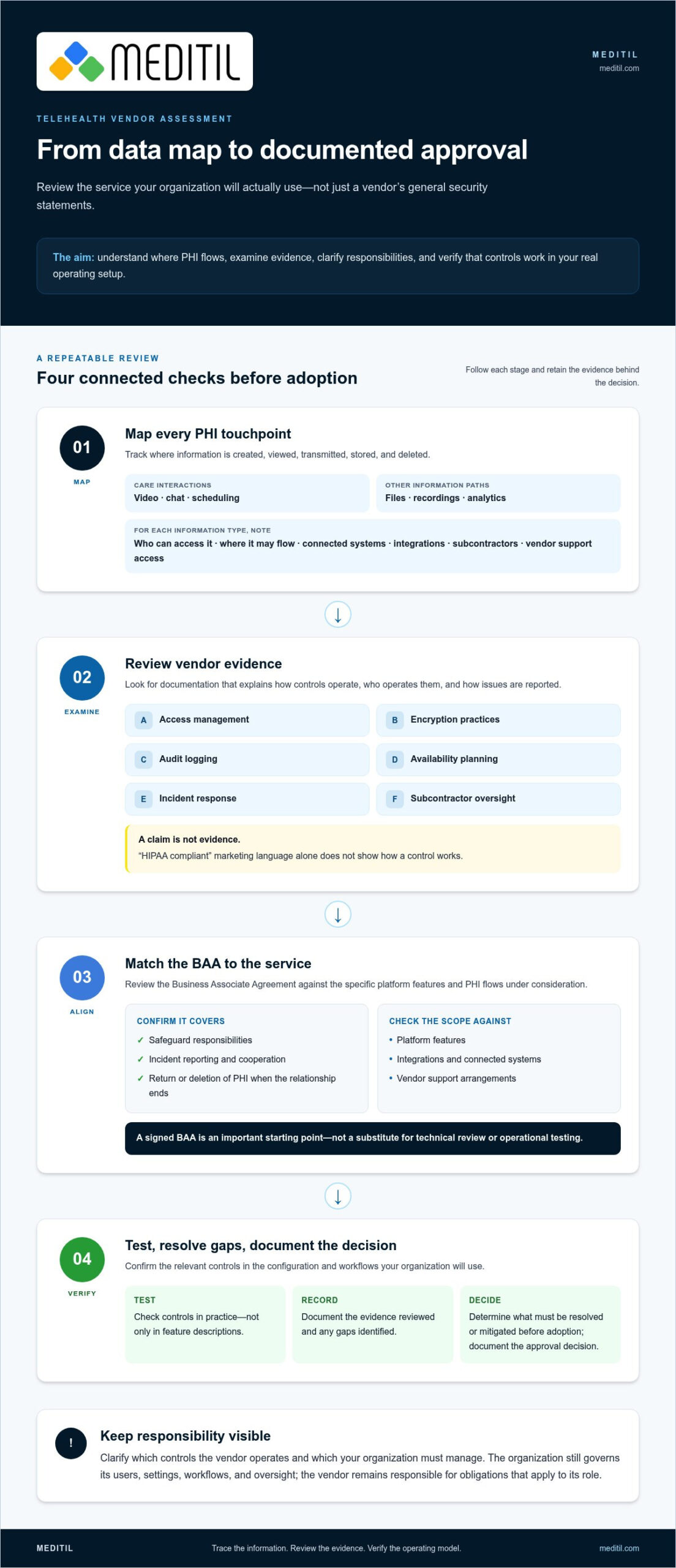
Assess the service your organization will actually use, not just the vendor’s general security statements. Trace how patient information moves through the platform and clarify which controls belong to the vendor and which your organization must operate. The U.S. Department of Health and Human Services (HHS) outlines legal considerations for telehealth HIPAA compliance; use its guidance alongside your organization’s risk analysis and operational requirements.
What information and vendor evidence should the review cover?
Start by mapping where protected health information is created, viewed, transmitted, stored, and deleted. Include video, chat, scheduling, files, recordings, analytics, vendor support access, and connected systems. For each information type, note who can access it, where it may flow, and whether subcontractors or integrations are involved. This makes it easier to spot data paths that a general platform overview may not explain.
Next, assess documentation about the vendor’s security controls and service operations. Look for evidence about access management, encryption practices, audit logging, availability planning, incident response, and subcontractor oversight. A marketing statement such as “HIPAA compliant” is not the same as documentation showing how a control works, who operates it, or how issues are reported. Record evidence gaps and decide what must be resolved or mitigated before adoption.
How should a business associate agreement fit into the decision?
Review the Business Associate Agreement (BAA) against the specific service and information flows under consideration. It should identify the parties’ responsibilities for safeguards, incident reporting, cooperation, and the return or deletion of PHI when the relationship ends. Confirm that the agreement’s scope aligns with the platform’s features, integrations, and support arrangements. A signed BAA matters, but it doesn’t replace technical review or operational testing.
Use a consistent approval sequence:
- Map data. Document information types, system touchpoints, access paths, storage, and deletion.
- Review vendor evidence. Assess security documentation, incident procedures, availability planning, subcontractors, and integrations.
- Document responsibilities. Compare the BAA with actual data flows and assign ownership for each safeguard and response task.
- Test controls. In a controlled review, verify that expected access, logging, support, and information-handling procedures work as documented.
- Approve use. Record the decision, unresolved risks, required mitigations, responsible owners, and conditions for future review.
This process turns vendor due diligence into a repeatable decision record, rather than a one-time review of assurances. For planning that connects platform decisions with healthcare operations, MEDITIL’s healthcare cybersecurity planning can bring security, infrastructure, and integration considerations into a coordinated approach.
Which platform safeguards protect telehealth sessions and patient data?
Safeguards should address the full visit lifecycle, from joining a session to documenting care and managing any information retained afterward. The HIPAA Security Rule calls for administrative, physical, and technical safeguards for electronic protected health information (ePHI). The controls an organization implements depend on its risk analysis and circumstances, so no single configuration is right for every practice. HHS provides official HIPAA Rules for telehealth guidance to inform that review.
| Safeguard | Telehealth risk addressed | Implementation evidence | Responsible owner |
|---|---|---|---|
| Unique accounts and role-based access | Shared credentials or access to more information than a role needs | Named accounts, approved role permissions, and access review records | Organization administrator, with vendor support as needed |
| Multifactor authentication and session controls | Account compromise or an unattended, active session | Configured authentication, timeout settings, and documented session procedures | IT or security lead, coordinated with platform administrator |
| Encryption and secure messaging | Exposure while information is transmitted or communicated | Technical documentation for transmission protections and approved messaging workflows | Vendor for platform controls; organization for configuration and use |
| Audit logs and access removal | Unnoticed access or former workforce members retaining permissions | Reviewable logs, a defined review process, and documented removal procedures | Organization identity or IT administrator |
| Recording and retention controls | Unnecessary copies of visit content or unclear access and deletion | Recording settings, applicable consent workflow, retention schedule, and deletion evidence | Clinical and privacy leads, with IT support |
How should access, sessions, and communications be controlled?
Match permissions to clinical and operational responsibilities, and use unique accounts so activity can be associated with an individual. Apply multifactor authentication where appropriate to the organization’s risk assessment. Check how patients and clinicians are identified, how waiting rooms and participant access work, and whether sessions end or lock after inactivity. Use approved secure messaging channels for care-related information. Treat recording as a deliberate decision: define its purpose, applicable consent process, permitted access, retention period, and deletion workflow.
How do integrations, devices, and cloud services affect risk?
A telehealth visit may connect with scheduling, billing, electronic health record, or remote-monitoring systems. Trace what information each connection sends and receives, and clarify who monitors failures or changes. Review endpoint protections, device access, patching practices, and remote support procedures. For cloud services, distinguish the vendor’s infrastructure responsibilities from the organization’s account, configuration, and user-management duties. Validate those boundaries against current contracts and technical evidence. Reviewing the wider system is central to ensuring telehealth platform HIPAA compliance.
How to operationalize telehealth HIPAA safeguards across the care team
Safeguards work when people know who owns them, what evidence shows they’re functioning, and where to escalate problems. Build an operational checklist that connects technical settings to clinical workflows. Set review intervals according to risk and organizational policy, then update the checklist when platforms, integrations, or care processes change. A checklist supports oversight, but it doesn’t establish compliance on its own.
| Control area | Owner | Evidence to retain | Review and escalation |
|---|---|---|---|
| Workforce access and training | IT administrator and workforce lead | Access approvals, removal records, training completion | Review access on a defined cadence and after role changes; escalate exceptions to privacy or security leads |
| Visit privacy and identity procedures | Clinical operations | Staff procedures and training records | Reinforce during onboarding and workflow updates; escalate suspected disclosure or identity concerns |
| Secure documentation and communications | Clinical and application leads | Approved workflows for notes, messages, files, and recordings | Review when tools or policies change; route issues to privacy and IT contacts |
| Incident and downtime response | Privacy, security, and technology leads | Exercise results, incident records, corrective actions | Test periodically and after material changes; follow documented escalation paths |
What should staff do before, during, and after a virtual visit?
Before: Use the organization’s approved platform, confirm authorized access, and prepare a private environment where others can’t overhear or view patient information. Follow the established identity-check procedure. During: Limit discussion to appropriate participants and avoid unnecessary disclosures. If an unintended person joins or privacy is interrupted, follow the clinical escalation procedure. After: Document care in the designated system and handle messages, files, and any recordings according to organizational policy.
How can an organization test and improve its controls?
Periodically review access and verify that reassigned or departed users no longer retain inappropriate permissions. Exercise incident and downtime procedures with clinical, privacy, security, and technology stakeholders. Test how teams identify an issue, preserve relevant information, escalate it, and communicate with affected patients when required by applicable procedures. Record findings, exceptions, owners, corrective actions, and review outcomes. Revisit unresolved risks until actions are completed or formally addressed.
Consistent oversight makes ensuring telehealth platform HIPAA compliance part of routine operations rather than a one-time setup task. MEDITIL’s healthcare IT planning and managed services help organizations coordinate technology operations, security, and clinical workflows.
How MEDITIL can support a secure, workable telehealth environment
Telehealth security depends on how technology, clinical workflows, and operational ownership fit together. MEDITIL works with healthcare organizations on telehealth implementation, cybersecurity, infrastructure, cloud services, and systems integration. This healthcare IT perspective connects platform configuration with the networks, devices, applications, and support processes that virtual care relies on.
Where can healthcare IT expertise add practical value?
A coordinated review can identify dependencies that may be missed when each system is considered separately. For example, a telehealth workflow may involve endpoint access, cloud-hosted services, identity controls, and information exchange with scheduling or clinical applications. Planning across these areas helps clarify configuration needs, integration boundaries, support responsibilities, and the effects of technology decisions on staff workflows.
MEDITIL’s consulting and fractional CIO capabilities help teams prioritize work and clarify ownership across clinical and IT operations. This can include sequencing implementation activities, coordinating stakeholders, and establishing ongoing monitoring and improvement. The aim is a secure, workable environment that supports care delivery, not a promise of certification or guaranteed compliance.
What are the next steps for a telehealth compliance program?
Use the assessment work in this guide to create a practical starting plan. Keep the actions specific and assign a responsible owner to each:
- Map information flows: Record where patient information is created, accessed, shared, stored, and removed.
- Review agreements: Align vendor responsibilities and incident coordination with the services and data flows in use.
- Assess controls: Compare platform settings, integrations, devices, and support procedures against identified risks.
- Assign ownership: Establish who manages access, training, configuration, incident escalation, and documentation.
- Schedule testing: Set a review cadence for access, workflows, incident response, and corrective actions.
These steps make ensuring telehealth platform HIPAA compliance an ongoing operational program. Document decisions and exceptions, track corrective actions, and revisit the plan when technology or workflows change. Connect telehealth work with the organization’s broader healthcare cybersecurity and compliance priorities.
MEDITIL helps coordinate healthcare IT planning across telehealth implementation, managed IT, cybersecurity, cloud, and integration. Discuss your telehealth security and IT planning needs with MEDITIL to establish practical priorities and a coordinated path for implementation and continuous improvement.
Build telehealth safeguards into everyday operations
Telehealth security depends on more than a platform’s assurances. A sound program connects vendor due diligence, appropriate safeguards, clear ownership, and regular testing. Mapping information flows and documenting responsibilities gives clinical, privacy, security, and IT teams a practical foundation for ensuring telehealth platform HIPAA compliance.
Those controls also need to work within the organization’s wider technology environment. MEDITIL brings healthcare-focused cybersecurity and compliance expertise together with telehealth and remote monitoring implementation, managed infrastructure, cloud services, and systems integration. Coordinated planning can help align platform configuration, clinical workflows, vendor roles, and ongoing support without treating compliance as a one-time setup or guaranteed outcome.
Ready to strengthen your telehealth security and IT planning? Discuss your telehealth needs with MEDITIL and take the next step toward a more coordinated, resilient environment for virtual care.
Frequently Asked Questions
Is a telehealth platform HIPAA compliant by itself?
No. A platform label or vendor assurance doesn’t make an organization compliant on its own. HIPAA responsibilities depend on the organization’s role, the information handled, and how the technology is configured and used. A practical approach to ensuring telehealth platform HIPAA compliance includes reviewing vendor safeguards and agreements, then addressing workforce access, policies, risk analysis, incident response, and connected systems. Check current HHS guidance for requirements that apply to your organization.
Does a telehealth vendor need to sign a business associate agreement?
A Business Associate Agreement (BAA) is generally relevant when a vendor creates, receives, maintains, or transmits protected health information on behalf of a covered entity or another business associate. The specific relationship and services matter. Review the agreement alongside the actual information flows, including the parties’ security responsibilities and incident reporting procedures. A signed BAA is important, but it doesn’t replace your organization’s own safeguard evaluation or obligations.
What should a HIPAA telehealth risk assessment include?
A telehealth risk assessment should map where electronic protected health information is created, received, maintained, or transmitted across visits and connected workflows. Consider platform access, devices, networks, integrations, storage, vendor support access, and other service providers. Document relevant threats and vulnerabilities, existing safeguards, and corrective actions. The assessment should reflect your organization’s actual environment, not a generic checklist, and be revisited when technology, workflows, or risks change.
Can telehealth visits be recorded under HIPAA?
HIPAA doesn’t make recording a telehealth visit automatically necessary. Whether recording is appropriate depends on the care context, organizational policy, applicable law, and patient communication practices. If recording is enabled, define its purpose and assess who can access the file, where it’s stored, how long it’s retained, and how it’s deleted. Document the workflow, and seek qualified privacy or legal guidance on consent and state-specific requirements.
How can a healthcare organization secure telehealth video and messaging?
Use individual accounts, role-appropriate permissions, strong authentication, secure session settings, and controlled access to messages and files. Review encryption, audit logging, recording options, retention, device security, and vendor support access. Train staff on approved workflows, then test access removal and incident procedures. The appropriate controls depend on your organization’s risk analysis and environment. Document why controls were selected and review them as systems and workflows change.
What happens if protected health information is exposed during a telehealth visit?
Follow your incident response process promptly. Contain the issue, preserve relevant evidence, notify designated privacy and security leads, and assess what information was involved. Determine with qualified guidance whether the event meets applicable breach definitions and reporting obligations. Document decisions and corrective actions. Reporting duties and timelines can depend on the facts and applicable rules, so verify current HHS requirements rather than relying on a generic timeline.
How often should telehealth platform security be reviewed?
Review security when selecting a platform and when material changes affect data flows, users, integrations, vendors, or clinical workflows. Establish recurring access reviews, risk reassessments, configuration checks, and incident or downtime exercises based on documented risk and organizational policy. Revisit vendor agreements and security evidence periodically, too. HIPAA doesn’t set one universal schedule for every control, so document a reasoned cadence and verify applicable guidance for your organization.