
What if the main clinical technology problem isn’t a system failure, but a gap between technology and the work clinicians need to do? Clinical IT services can address more than software issues. Disconnected applications, unclear support ownership, and manual workarounds can interrupt care workflows and take staff time away from other responsibilities.
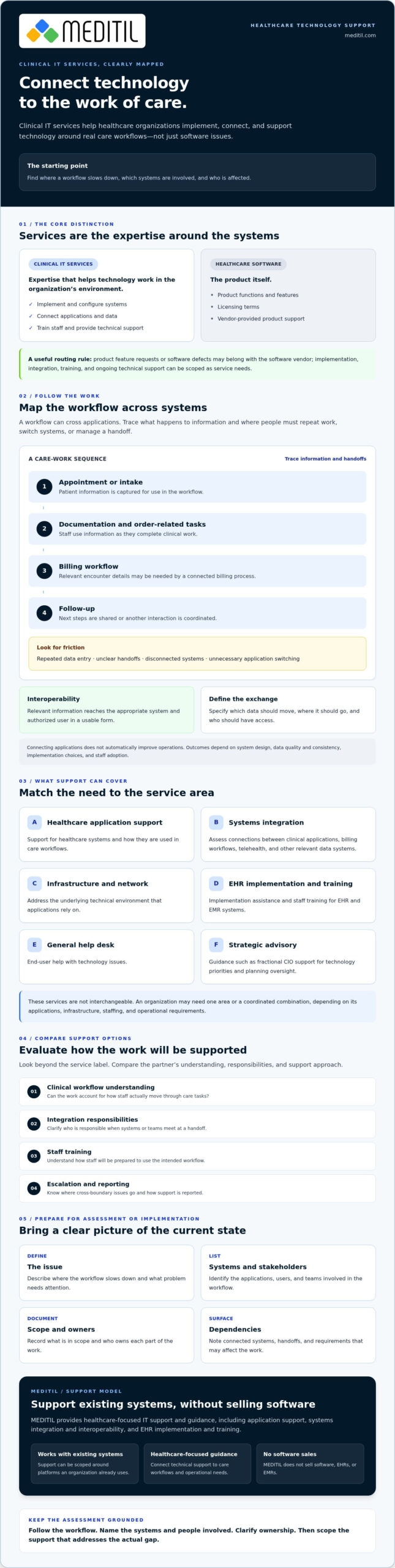
It’s not always clear what kind of help an organization needs. A problem might call for healthcare application support, systems integration, infrastructure services, EHR implementation and training, or strategic guidance. The right starting point is to identify where a workflow slows down, which systems are involved, and who is affected.
This article explains what clinical IT services can cover, how to assess your organization’s needs, and how to align technology with care workflows. It also outlines what to look for in a partner and what to prepare before an assessment or implementation. MEDITIL provides healthcare-focused IT support and guidance, including EHR implementation and training, without selling EHR software.
Key Takeaways
- Clinical IT services support the systems and connections behind care delivery; they’re distinct from the clinical software itself.
- Trace a workflow from intake through documentation and follow-up to find repeated data entry, unclear handoffs, and disconnected systems.
- Compare support options by their understanding of clinical workflows, integration responsibilities, staff training, escalation, and reporting.
- Prepare for an assessment by defining the issue, listing systems and stakeholders, and documenting scope, owners, and dependencies.
- MEDITIL can support existing systems through application support, EHR implementation and training, integration, and interoperability without selling software or EHRs.
What Do Clinical IT Services Include in Healthcare?
Clinical IT services are technical and advisory support that helps healthcare organizations implement, connect, and maintain technology used in care delivery. They’re distinct from clinical software products: the service is the expertise around the systems, not the software license itself. This work draws on Health informatics, which brings healthcare and information technology together to support the management and use of medical information.
The goal is to make technology work in ways that support staff workflows and dependable operations. An application may function as designed but still create friction if it doesn’t exchange information with other systems or fit the steps staff follow. Clinical IT services can help assess and address those gaps. The appropriate scope depends on the organization’s applications, infrastructure, staffing, and operational requirements.
Which systems and workflows can clinical IT services support?
Support may include EHR and EMR implementation, configuration assistance, and staff training, along with connections between clinical applications, billing workflows, telehealth, and other relevant data systems. To define the work, map the workflow and list the applications, users, and handoffs involved. The specific scope should reflect the organization’s existing environment and needs.
For example, a team might assess whether information entered during a clinical workflow can be made available to a connected billing process, so staff don’t have to enter the same details twice. Support planning can also clarify where to report an issue that crosses application and infrastructure boundaries. These are potential outcomes, not automatic results. System design, implementation choices, and staff adoption all affect what changes in practice.
Related services aren’t interchangeable. Clinical application support focuses on healthcare systems and how they’re used. Infrastructure and network services address the underlying technical environment. A general help desk supports end users with technology issues, while strategic advisory work, such as fractional CIO guidance, helps leaders set technology priorities and oversee planning. An organization may need one area or a coordinated combination.
How are clinical IT services different from healthcare software?
Clinical IT services provide the expertise to implement, connect, train staff on, and support healthcare technology within an organization’s operating environment. Healthcare software is the product, including its functions, licensing terms, and vendor-provided features. A service partner may work with platforms the organization already uses rather than recommend replacing them.
This distinction helps leaders direct a problem to the right party. If staff need a product feature or have a software defect, the software vendor may be the right contact. If the challenge involves implementation, integration, training, or ongoing technical support, those service needs should be scoped separately. MEDITIL provides healthcare application support, systems integration and interoperability, and EHR implementation and training. It supports existing systems and does not sell software, EHRs, or EMRs.
How Clinical IT Services Connect Applications, Data, and Care Workflows
A clinical workflow often crosses several systems. An appointment or intake process may capture patient information for staff to use during documentation and order-related tasks. Billing workflows may rely on relevant encounter details, while follow-up may involve sharing next steps or coordinating another interaction. If information doesn’t move appropriately between systems, staff may have to repeat work or switch between applications to finish a task.
Clinical IT services can help assess these connections and plan integration around the way work is performed. The aim is to reduce unnecessary manual handoffs, not to assume that connecting applications will automatically improve operations. Outcomes depend on system design, data quality and consistency, and whether staff can use the workflow as intended.
What does interoperability mean in day-to-day clinical operations?
Interoperability means relevant information can reach the appropriate system and authorized user in a usable form. For example, information captured during intake might be available to a staff member in a separate application used later in the workflow. The organization needs to define which data should be exchanged, where it should go, and who should have access, based on its systems and operating requirements.
Having multiple applications isn’t the same as having interoperability. If staff repeatedly re-enter information or reconcile conflicting records, systems may exchange information only in limited ways, or not at all. Interface design, data quality, permissions, and clear ownership of each workflow all affect whether an exchange is useful. The U.S. government’s health information technology standards resources provide context for the broader standards and policies that shape health IT exchange.
Organizations assessing these connections can also review MEDITIL’s healthcare interoperability challenge resource.
Where can clinical technology create friction for staff?
Friction often appears where people, systems, and responsibilities meet. Staff may enter the same information in more than one place, encounter inconsistent access, or be unsure whether an application issue belongs with internal IT, a vendor, or another support team. Training gaps can also make a workable process difficult to follow consistently.
Start by observing the process as staff perform it. Ask where they pause, repeat steps, switch applications, or seek help. Compare that feedback with the systems involved, then document who owns each handoff and escalation path. This can help distinguish a technology limitation from a workflow or training issue before changes are proposed.
Integration is most useful when it fits the workflow, delivers relevant information to the right users, and remains practical for staff to use. If your organization needs help evaluating those connections, consider MEDITIL’s healthcare IT integration support.
How to Evaluate Clinical IT Services Without Confusing Them With Software Sales
Start by identifying the work you need done, not by comparing provider labels. A software vendor, internal IT team, general managed service provider (MSP), or healthcare-focused services partner may each contribute, but their responsibilities can differ. The right arrangement depends on your systems, internal capacity, and operational needs. Use the comparison below to guide questions, then confirm the actual scope with each provider.
| Provider model | Clinical workflow understanding | Integration responsibility | Training | Escalation and reporting |
|---|---|---|---|---|
| Software vendor | Typically centered on its product | Clarify what the vendor supports versus what requires coordination | May cover product use; confirm scope | Usually follows the vendor’s support process |
| Internal IT team | Depends on healthcare experience and role | May coordinate systems in-house, depending on capacity | May arrange or provide it | Uses internal processes and reporting |
| General MSP | May focus on broader IT operations | Confirm clinical application and interface responsibilities | Confirm whether workflow-specific training is included | Review escalation routes and service reporting |
| Healthcare-focused services partner | Can bring healthcare application and workflow context | May coordinate application and integration work, as scoped | May support implementation and staff training | Agree on ownership, escalation, and progress measures |
What questions should leaders ask a clinical IT services provider?
Ask how the provider will assess current workflows, systems, integrations, and staff needs before recommending work. Request a written scope that names owners for implementation tasks, issue escalation, documentation, and coordination with software vendors. Clarify assumptions and dependencies, including who provides system access and who approves changes. Ask how training and change communication will be handled, and how the team will review progress after launch. These questions turn a broad proposal into work with defined responsibilities.
How can you distinguish clinical IT expertise from generic IT support?
Look for a clear understanding of healthcare applications and the operational context in which staff use them. Ask how application, network, security, and integration responsibilities will be coordinated, and who will manage handoffs when an issue crosses those areas. A provider should explain its boundaries rather than imply it controls every vendor or system. For broader operational considerations, see this managed IT services for healthcare guide.
Don’t treat any provider model as universally best. Match responsibilities to your actual gaps, then agree on how work, dependencies, escalation, and progress will be documented and reviewed.
How to Prepare for Clinical IT Assessment and Implementation
A useful assessment starts with the work staff need to complete, not a preferred technology or a predetermined project plan. Before engaging a partner for clinical IT services, assemble a clear picture of the workflow, systems, people, and constraints involved. This preparation helps define realistic scope and identify dependencies that could affect implementation.
- Define the workflow issue. Describe where the process breaks down, who is affected, and what staff currently do to complete the task. Separate what you have observed from assumptions about the cause.
- Inventory systems and connections. List the applications involved, known integration points, relevant data flows, and current support arrangements. Note which details still need confirmation from internal teams or vendors.
- Identify stakeholders and dependencies. Include clinical and administrative staff, IT owners, decision-makers, and relevant software vendors. Identify required access approvals, data considerations, and staff availability for discovery, testing, and training.
- Agree on scope and readiness. Document deliverables, task owners, assumptions, dependencies, escalation paths, and how progress will be reviewed. Plan controlled testing before operational changes, along with training and communications for affected staff.
What should a clinical IT discovery process document?
Record the current workflow, systems, integration points, reported pain points, and accountable owners. Mark which requirements are confirmed and which need validation from staff or vendors. Prioritize needs by operational importance and feasibility, rather than by how new or technically appealing a proposed solution may be. This gives stakeholders a shared reference for assessing options and tracking decisions.
Don’t treat project timelines as fixed before the details are known. Timing depends on verified scope, system conditions, vendor coordination, approvals, and organizational readiness. If a dependency remains unresolved, document it and clarify how it affects the plan rather than relying on an untested assumption.
How can teams support adoption while limiting disruption?
Give clinical and administrative stakeholders a chance to review proposed workflow changes before implementation. Their feedback can reveal role-specific needs and practical concerns that may not be apparent from system documentation alone. Schedule testing in a controlled manner, provide training suited to each affected role, and establish a clear route for reporting and escalating issues.
After changes are introduced, review what is working, what needs adjustment, and whether staff need additional support. When leaders need help setting priorities or providing strategic oversight, fractional CIO services for healthcare may be relevant. To discuss assessment, implementation, or training support, contact MEDITIL about your IT project.
How MEDITIL Can Support Clinical IT Services Across Your Organization
Clinical technology needs can involve more than one application. MEDITIL provides healthcare-focused support across clinical applications, EHR implementation and training, systems integration, and interoperability. Work can be scoped to an organization’s existing systems and workflows, with responsibilities and deliverables agreed before it begins.
MEDITIL supports existing systems. It doesn’t sell EHRs, EMRs, or standalone software. This distinction can help leaders determine whether they need a software product or services such as implementation, integration, staff training, or ongoing technical and strategic support.
Which MEDITIL services may fit a clinical technology need?
The right service depends on the gap your organization is trying to address. Consider how these capabilities may align with your priorities:
- Implementation and training: EHR implementation and training can support organizations introducing or configuring an EHR and preparing staff to use it.
- Connected systems: Systems integration and interoperability can address needs involving information exchange between applications. Confirm the specific connections and responsibilities during scoping.
- Ongoing operational support: Managed IT services or an augmented IT team may fit organizations seeking ongoing support or additional IT capacity.
- Strategic oversight: Fractional CIO support can help leaders assess technology priorities and direction. It provides strategic guidance, not clinical or legal decision-making.
- Defined project work: Project-based IT consulting may fit a specific, time-bounded need, subject to an agreed scope.
These options aren’t interchangeable, and an organization may need one or a combination. The appropriate approach depends on its systems, internal capacity, workflow priorities, and operational requirements. Confirm which activities are included, how existing teams and vendors will be involved, and how progress will be reviewed.
What should leaders bring to an initial conversation?
A short, practical summary helps establish what needs assessment. Describe the workflow challenge, the users affected, and the operational improvement you’re seeking. Then list relevant applications, known integrations, current support arrangements, and unresolved questions. You don’t need to have every answer. Noting what still needs validation helps define useful next steps.
Bring stakeholders’ perspectives where possible. A clinical or administrative view of the workflow, paired with IT’s understanding of the current environment, can help clarify scope and dependencies.
Ready to discuss your organization’s priorities? Discuss clinical IT needs with MEDITIL to explore which support options may fit. Review and agree on any proposed scope, implementation approach, and measures of progress for your environment. No provider can promise a particular compliance status or operational outcome solely by delivering IT services.
Align Technology Support With the Work of Care
Clinical technology is most useful when applications, data, and support processes fit the workflows staff rely on. The right clinical IT services begin with understanding the operational need, clarifying who owns each task, and defining a practical scope before implementation or integration begins.
As you assess options, distinguish software products from the services needed to implement, connect, and support them. Consider whether your organization needs application assistance, staff training, integration, ongoing IT capacity, or strategic oversight. The appropriate mix depends on your systems, team, and priorities.
MEDITIL provides healthcare-focused managed IT, application, integration, and consulting services. Its capabilities include EHR implementation and training without selling the software, with support options that may include managed services, augmented IT teams, or fractional CIO guidance.
To explore what may fit your organization, discuss your clinical IT priorities with MEDITIL. A conversation about your workflows and technology environment can help clarify practical next steps.
Frequently Asked Questions
What are clinical IT services?
Clinical IT services help healthcare organizations implement, connect, support, and manage technology used in care delivery. They can include healthcare application support, EHR implementation and training, systems integration, interoperability, and related infrastructure or consulting. The focus is not just on technical functions, but on how systems support staff workflows. Scope varies with an organization’s applications, internal capacity, and operational requirements.
How are clinical IT services different from managed IT services?
Clinical IT services focus on technology used in clinical workflows, such as healthcare applications, EHR implementation, and connections between systems. Managed IT services generally provide ongoing operational IT support, which may include infrastructure, networks, cloud services, or end-user help desk support. The services can overlap, but they aren’t identical. A healthcare organization should clarify which clinical applications, technical environment, and support responsibilities are included in its specific scope.
Can clinical IT services support an existing EHR?
Yes. A services partner may support an organization’s existing EHR through implementation assistance, training, application support, or integration work, depending on the agreed scope. For example, a team may help prepare staff for a workflow change or assess how the EHR connects with another application. Confirm which tasks the partner handles, what requires coordination with the EHR vendor, and what access or staff participation is needed.
How do clinical IT services improve interoperability?
Clinical IT services can help assess how information should move between applications and plan or support the connections needed for a workflow. For instance, teams may review whether relevant information can pass between clinical and billing systems rather than being entered repeatedly. Results depend on the systems involved, interface design, data quality, permissions, and staff adoption. Confirm compatibility and responsibilities for each connection instead of assuming every platform will work together.
Do clinical IT services help with HIPAA requirements?
Healthcare IT providers may support technology-related security and compliance work, such as helping assess systems and align technical practices with an organization’s requirements. However, engaging a provider doesn’t by itself establish or guarantee HIPAA compliance. Responsibilities depend on the organization, its vendors, and the agreed service scope. Ask what specific activities are included, how findings are documented, and which compliance decisions remain with your organization and its qualified advisors.
How should a healthcare organization choose a clinical IT services provider?
Choose based on the needs you’ve documented, not a provider label alone. Ask how the provider assesses workflows, applications, integrations, and staff requirements before proposing work. Clarify ownership for implementation, vendor coordination, escalation, training, and reporting. Request written scope, assumptions, dependencies, and ways to review progress. A provider should explain where its responsibilities end and how it will coordinate with your internal IT team and software vendors.
Does MEDITIL sell EHR or clinical software?
No. MEDITIL doesn’t sell EHRs, EMRs, or standalone software. It provides healthcare-focused IT services, including EHR implementation and training, healthcare application support, systems integration, and interoperability. MEDITIL can work with existing systems, with specific tasks and responsibilities agreed as part of the scope. Organizations seeking a software product should evaluate software vendors separately from partners that provide implementation, training, integration, or ongoing IT support.