
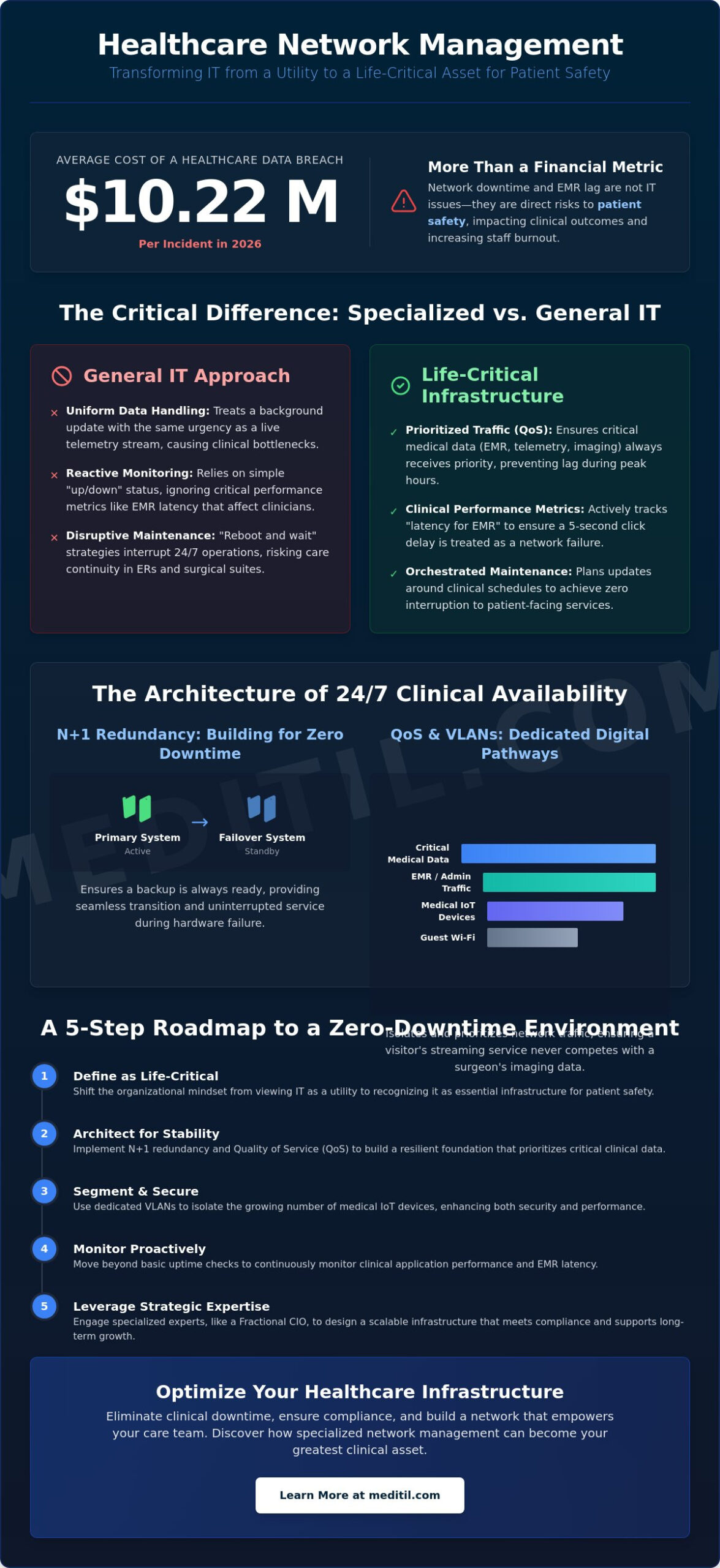
In 2026, the average cost of a healthcare data breach has reached a staggering $10.22 million per incident. This figure isn’t just a financial metric; it represents a critical vulnerability in the foundation of modern medicine. When clinical downtime occurs or EMR systems lag during peak hours, the primary concern isn’t the technology itself, but the risk to patient safety. Effective network management is no longer a back-office function. It’s a vital clinical safety protocol that requires precision, stability, and a strategic hand at the wheel.
You likely recognize that maintaining a secure, high-performance environment is increasingly difficult as medical IoT devices proliferate and regulatory scrutiny tightens. It’s a complex challenge to balance seamless interoperability with the rigid requirements of HIPAA and the new CMS network adequacy standards. This guide provides a clear roadmap to transform your infrastructure from a basic utility into a life-critical asset. You’ll learn how to achieve a zero-downtime environment and establish predictable IT costs. We’ll examine how to leverage the latest ITIL 5 frameworks and strategic infrastructure services to ensure your clinical team can focus on care without technical friction.
Key Takeaways
- Define the transition from viewing IT as a utility to treating it as life-critical infrastructure necessary for patient safety.
- Learn how N+1 redundancy and Quality of Service (QoS) configurations ensure that critical medical data traffic always receives priority.
- Recognize the risks of general IT support and why specialized healthcare compliance expertise is required to meet modern regulatory standards.
- Implement a proactive five-step roadmap for network management to eliminate clinical downtime and stabilize high-volume medical IoT environments.
- Understand the strategic role of a Fractional CIO in designing a scalable infrastructure that supports seamless interoperability and long-term growth.
What is Healthcare Network Management? Defining Life-Critical Infrastructure
In a standard corporate setting, a network failure is a loss of productivity. In a high-volume medical facility, it’s a disruption to patient care. Network management within the healthcare sector requires a fundamental shift in perspective. We no longer view connectivity as a “best-effort” utility. Instead, it’s a life-critical infrastructure where every millisecond of latency can impact a clinical outcome. When systems lag, the gap between a clinician and their data widens, creating risks that extend far beyond simple technical frustration.
Standard IT providers often treat data as uniform. They prioritize bandwidth for general applications without understanding the specific hierarchy of medical traffic. This approach fails when clinical workflows are involved because it treats a routine background update with the same urgency as a live telemetry stream. We focus on the “Clinical Hub,” the point where networking meets patient care. This is the digital foundation that allows a nurse to pull up a patient record instantly or a surgeon to view high-resolution imaging without delay. It’s the invisible hand that ensures the right data reaches the right provider at the right time.
The Core Components of Medical Network Administration
Effective administration begins with precise provisioning. This involves creating dedicated VLANs to isolate medical IoT devices from general administrative traffic and guest Wi-Fi. By segmenting these paths, you ensure that life-critical devices aren’t competing for bandwidth with a visitor’s streaming service. This level of customization is essential for both security and performance in a high-volume environment.
Monitoring must also evolve. Relying on simple “up/down” status checks is insufficient for modern healthcare. We move beyond basic connectivity to track “latency for EMR” metrics. If a physician experiences a five-second delay every time they click a button in the EHR, that’s a failure of the network, even if the system is technically “up.” Finally, maintenance requires a disciplined approach. Updates and patches must be orchestrated to avoid interrupting 24/7 surgical or emergency operations. There’s no room for a “reboot and wait” strategy in a facility that never sleeps.
Why Stability is a Patient Safety Metric
Stability isn’t just about uptime; it’s about the quality and reliability of the connection. There’s a direct link between network latency and physician burnout. When EHR systems lag, documentation takes longer, extending shifts and increasing the risk of human error. A stable network allows clinicians to stay focused on the patient rather than fighting with the interface.
Packet loss presents an even greater danger. In real-time patient monitoring or telehealth consultations, even minor data loss can cause video stuttering or delayed alerts. This makes it impossible for clinicians to make informed, split-second decisions. In high-volume environments, packet loss can lead to fragmented data in real-time telemetry, which may cause false alarms or missed cardiac events. Healthcare network management is the proactive administration of digital pathways to ensure uninterrupted clinical delivery.
The Architecture of Stability: Ensuring 24/7 Clinical Availability
High-volume healthcare environments demand an architecture that transcends standard commercial reliability. When a network serves as the backbone for surgical suites, emergency departments, and continuous patient monitoring, “uptime” is a matter of clinical safety. Building this level of resilience requires a shift from reactive troubleshooting to a disciplined network management strategy focused on architectural redundancy and data prioritization. A stable network isn’t built on a single high-capacity line; it’s constructed through layers of intentional failovers and segmented pathways that protect the integrity of every clinical interaction.
Beyond the digital network, the physical integrity of a medical facility is also vital; for instance, facilities in Florida often rely on specialized slab leak detection and repair Port St. Lucie to ensure that utility failures do not compromise the clinical environment.
The rise of the Internet of Medical Things (IoMT) has introduced a massive volume of data into the clinical environment. Every smart pump, wearable monitor, and imaging device adds a layer of complexity to the existing infrastructure. Without a segmented architecture, this influx of traffic can create bottlenecks that delay Electronic Medical Record (EMR) updates or disrupt telehealth streams. The Cybersecurity and Infrastructure Security Agency (CISA) classifies healthcare as life-critical infrastructure, which highlights the necessity of treating these digital pathways with the same rigor as physical medical equipment. For organizations looking to audit their current resiliency levels, specialized Infrastructure & Network Services can provide the necessary technical oversight to ensure every segment is optimized for performance.
Achieving N+1 Redundancy in Clinical Environments
N+1 redundancy is the minimum standard for a stable healthcare environment. In this model, “N” represents the number of components required to run the facility, while “+1” ensures an independent backup is always ready to take the load. This isn’t limited to power supplies. It must extend to critical switches, routers, and firewalls. If a primary core switch fails during a peak shift, the standby unit must take over instantaneously without dropping active clinical sessions.
Dual-homed Internet Service Providers (ISPs) are equally non-negotiable. A modern practice cannot rely on a single fiber connection, regardless of the provider’s reputation. True redundancy involves two separate physical paths into the building, ideally from two different carriers. Proactive network management also includes regular failover testing. A backup system is only a theory until it has been verified under load to ensure it performs as expected during a real-world outage.
Traffic Prioritization and Quality of Service (QoS)
Not all data packets carry the same weight in a medical setting. A staff member downloading a large administrative report shouldn’t impact the clarity of a remote neurology consultation. Quality of Service (QoS) allows administrators to define strict hierarchies for data traffic. By tagging EMR and telehealth packets as high-priority, the network ensures these services receive the necessary bandwidth even during periods of extreme congestion. QoS acts as a digital triage system that prioritizes life-critical data packets over lower-priority administrative requests. This granular control ensures that VoIP communications and high-definition video streams remain fluid, preventing the lag that often leads to clinical frustration and delayed care.
Why General Managed IT Fails the Healthcare Sector
Many healthcare administrators receive regular reports from their IT providers stating that the network is “fine.” In a standard office environment, “fine” means the internet is accessible and email is functioning. However, in a high-volume clinical setting, this basic level of connectivity is a liability. General Managed Service Providers (MSPs) often lack the industry-specific expertise to distinguish between a functional office network and a life-critical medical environment. When network management is treated as a generic utility, the unique demands of clinical uptime and data integrity are frequently overlooked.
The gap between general IT support and specialized healthcare engineering often results in significant technical debt. Generalists tend to focus on reactive “Help Desk” support, fixing individual hardware issues as they arise. In contrast, infrastructure engineering involves the proactive design and maintenance of the entire digital ecosystem. When Optimizing Healthcare Infrastructure, it’s essential to look beyond the surface of “up or down” status. A network can be technically online while still suffering from micro-outages or congestion that disrupts the flow of patient data. This lack of specialized oversight leaves practices vulnerable to both operational failures and regulatory penalties.
The HIPAA Compliance and Security Gap
General IT providers often assume that simple encryption and a standard firewall are sufficient for HIPAA compliance. This is a dangerous misconception. Network-level compliance requires a much more granular approach, including the implementation of detailed audit logs for every network access point. If your current provider cannot produce a report showing exactly which device accessed the network and when, you’re likely facing a compliance gap.
Furthermore, general MSPs frequently overlook the security vulnerabilities inherent in medical devices. Many legacy imaging machines or patient monitors run on older operating systems that are difficult to patch. A specialist understands how to isolate these devices within secure network segments to prevent them from becoming entry points for cyberattacks. Cybersecurity & Compliance in healthcare isn’t just about software; it’s about how the network itself is architected to protect sensitive patient information.
Clinical Friction: The Hidden Cost of Lag
Clinical friction is the term for the technical resistance that slows down medical staff. While a 3-second lag in EMR response times might seem negligible to a general IT technician, the cumulative impact is devastating. In a 50-provider practice, those three seconds occur hundreds of times per day across every exam room and nursing station. This translates into hours of lost clinical time, increased physician burnout, and a measurable decrease in patient throughput.
The psychological impact is equally significant. When a network is unstable, medical staff lose trust in their tools. This leads to workarounds that often bypass security protocols or result in incomplete documentation. MEDITIL operates as a strategic partner to eliminate this friction. By focusing on high-performance network management and specialized Infrastructure & Network Services, we ensure that the technology supports the speed of care rather than hindering it. Our goal is to provide a steady hand at the wheel, allowing your team to focus entirely on patient outcomes without the distraction of technical instability.
A Strategic Framework for Managing High-Volume Medical Networks
Stabilizing a high-volume clinical environment requires moving away from the reactive “break-fix” model that characterizes most general IT support. A disciplined network management framework treats the digital infrastructure as a clinical asset that requires regular calibration and strategic oversight. This shift ensures that technology serves as a silent partner in patient care rather than a source of persistent friction. By implementing a structured roadmap, healthcare leaders can eliminate the unpredictability of system lags and secure their operations against the increasing sophistication of cyber threats.
Step-by-Step Optimization Roadmap
A proactive strategy begins with a clear understanding of the current state and a defined path toward stability. We recommend a five-step approach to modernize and secure your clinical pathways.
- Step 1: Comprehensive Network Audit and Heat Mapping. You cannot manage what you haven’t mapped. This phase involves identifying every connected device and conducting wireless heat mapping to eliminate dead zones in patient care areas.
- Step 2: Hardware-Level Redundancy. As discussed in our architectural overview, this step focuses on eliminating single points of failure. We implement N+1 redundancy for core switches and routers to ensure continuous clinical availability.
- Step 3: Advanced EUE Monitoring. We deploy tools that track End-User Experience (EUE) metrics. Instead of just checking if a server is “up,” we measure exactly how long it takes for a clinician to open a chart or transmit an image.
- Step 4: Disciplined Patch and Firmware Management. Security vulnerabilities often exist in the gaps between updates. We establish a rigorous cycle for firmware and patch deployment that occurs during low-impact windows to maintain security without interrupting care.
- Step 5: Strategic Lifecycle Planning. The final step involves aligning your IT infrastructure with your long-term clinical goals. This includes regular reviews with a Fractional CIO to ensure your network can support future growth and emerging technologies like AI-driven diagnostics.
Integrating Interoperability and Automation
A stable network is the prerequisite for modern healthcare initiatives like HL7 and FHIR data exchange. These interoperability standards allow different systems to communicate seamlessly, but they rely on a consistent, high-performance pathway to function. If the network drops packets or suffers from high latency, the exchange of critical patient data becomes unreliable. Interoperability is only as strong as the network it travels on.
This reliability also extends to the financial health of the organization. Billing automation and integration services require real-time synchronization between clinical documentation and financial systems. When the network is unstable, these automated processes can fail, leading to delayed claims and increased administrative overhead. By prioritizing network management, you create a foundation where automation can thrive. To begin stabilizing your environment and reducing clinical friction, consider a professional assessment through our Infrastructure & Network Services to identify and resolve hidden bottlenecks.
Optimizing Healthcare Infrastructure with MEDITIL
Building a stable network requires more than just technical proficiency. It demands a deep understanding of the clinical environment where every decision impacts patient safety and operational continuity. MEDITIL operates as a strategic partner rather than a transactional service provider. We provide a steady hand at the wheel, ensuring your infrastructure is not just functional but optimized for high-volume clinical delivery. By integrating technical expertise with a mission-driven focus, we help healthcare organizations transition from reactive troubleshooting to proactive stability and long-term growth.
Strategic Advisory and Fractional CIO Leadership
One of the most significant challenges in healthcare IT is the lack of strategic alignment between technology budgets and clinical outcomes. Our Fractional CIO services bridge this gap. This role provides the executive-level guidance necessary to design a long-term network roadmap, ensuring that every infrastructure investment supports your specific medical workflows. A strategic advisor helps you move beyond the immediate needs of the day to consider the scalable requirements of your organization’s future.
Whether you are navigating a complex EMR implementation and training phase or preparing for the next generation of AI-driven diagnostics, having an advisor who understands the regulatory and operational landscape is essential. This leadership ensures that your IT strategy remains a driver of clinical excellence rather than a bottleneck. You can learn more about how we align technology with your mission through our Fractional CIO advisory services. This high-level oversight is the difference between a network that merely exists and one that actively advances your clinical objectives.
Managed Infrastructure: Your Foundation for Growth
For organizations with existing internal resources, an Augmented IT Team provides the specialized skills required to manage complex medical segments. This collaborative approach allows your local staff to focus on immediate user needs while our engineers handle high-level network management and cybersecurity-first infrastructure design. We provide continuous monitoring and specialized support for telehealth and remote monitoring programs, ensuring these services remain reliable even during peak patient volumes. It’s about creating a partnership where every detail is handled with precision.
To ensure your in-house staff is fully equipped to handle evolving cybersecurity threats and networking protocols, you can check out Insoft Services for world-class professional training and consultancy.
Our approach to network management prioritizes the integrity of the clinical hub. We maintain a disciplined focus on performance metrics that matter to providers, such as EMR latency and seamless device interoperability. This precision-focused management creates a secure environment where data flows without interruption and patient safety is never compromised by technical instability. By choosing a partner dedicated to the healthcare sector, you gain access to a team that understands the high-stakes nature of your work. Contact MEDITIL today to secure your clinical infrastructure.
Securing the Future of Your Clinical Infrastructure
Transforming your digital environment from a reactive utility into a stable, life-critical asset is a strategic necessity for modern medicine. We’ve explored how specialized network management serves as the foundation for patient safety, clinical uptime, and seamless interoperability. By prioritizing hardware-level redundancy and precise traffic prioritization, you ensure that your technology supports care delivery rather than hindering it. General IT solutions often overlook these nuances, leaving high-volume practices vulnerable to persistent lag and significant compliance gaps.
MEDITIL provides the specialized healthcare IT expertise required to navigate these high-stakes complexities. From developing tailored infrastructure roadmaps to providing Fractional CIO strategic advisory, we offer a steady hand at the wheel for your organization. Our goal is to align your technology with your clinical mission, allowing you to focus on patient outcomes with complete confidence. Schedule a Strategic Infrastructure Consultation with MEDITIL to begin optimizing your facility. It’s time to build a foundation that grows with your practice and protects your patients.
Frequently Asked Questions
What is the difference between general network management and healthcare network management?
General network management focuses on standard office connectivity and basic uptime for administrative tasks. Healthcare network management treats the digital environment as life-critical infrastructure. It requires specialized knowledge of medical IoT devices, clinical workflow prioritization, and the stringent security standards necessary to protect sensitive patient information in a high-volume setting.
How does network stability affect HIPAA compliance?
Stability is essential for the continuous operation of security protocols like real-time encryption and automated audit logging. If a network is unstable or experiences frequent micro-outages, security gaps can occur that leave data vulnerable to unauthorized access. A stable environment ensures that every access point remains monitored and compliant with federal data protection standards.
What is N+1 redundancy and why is it critical for medical practices?
N+1 redundancy involves having a backup for every critical component required for the network to function. This “backup for the backup” strategy is vital for medical practices because it eliminates single points of failure. If a core switch or router fails during a clinical shift, the redundant unit takes over instantly, preventing any disruption to patient care.
Can poor network management cause EMR/EHR lagging?
Yes, improper infrastructure configuration is a primary cause of EMR latency during peak clinical hours. Without dedicated bandwidth and segmented pathways, administrative traffic or guest Wi-Fi can congest the network. Professional network management identifies these bottlenecks and configures the system to ensure that EMR applications remain responsive for clinicians at the point of care.
How often should a healthcare network undergo a security audit?
Healthcare networks should undergo a comprehensive security audit at least once per year. However, high-volume facilities often benefit from more frequent quarterly assessments or continuous monitoring. Regular audits are necessary to verify that firmware is updated, security patches are applied, and the network remains resilient against the increasing sophistication of healthcare cyberattacks.
What are the benefits of a Fractional CIO for network strategy?
A Fractional CIO provides executive-level leadership to align your technology roadmap with clinical and operational goals. This role moves your organization away from reactive “break-fix” IT toward a proactive, strategic partnership. They ensure that your infrastructure investments are intentional, scalable, and designed to support long-term initiatives like telehealth expansion or billing automation.
How does network management support telehealth and remote patient monitoring?
Effective management provides the low-latency and high-bandwidth pathways required for real-time video and data transmission. It ensures that telehealth streams are prioritized over non-essential traffic, preventing the stuttering or dropped connections that can compromise a clinical assessment. This reliability is the foundation for maintaining patient trust in remote care delivery models.
What role does Quality of Service (QoS) play in a medical facility?
Quality of Service (QoS) acts as a digital triage system that prioritizes life-critical data packets over administrative requests. In a medical facility, QoS ensures that EMR updates, VoIP calls, and telemetry data receive the necessary bandwidth during periods of high congestion. This prevents routine background tasks from interfering with the immediate delivery of clinical information.